28 C
Awka
Sunday, April 5, 2026

Trumpet With Certain Sound

Home Blog Page 3

There’s a Short Distance from MAGA in America to Èmi l’ókàn in Nigeria

0
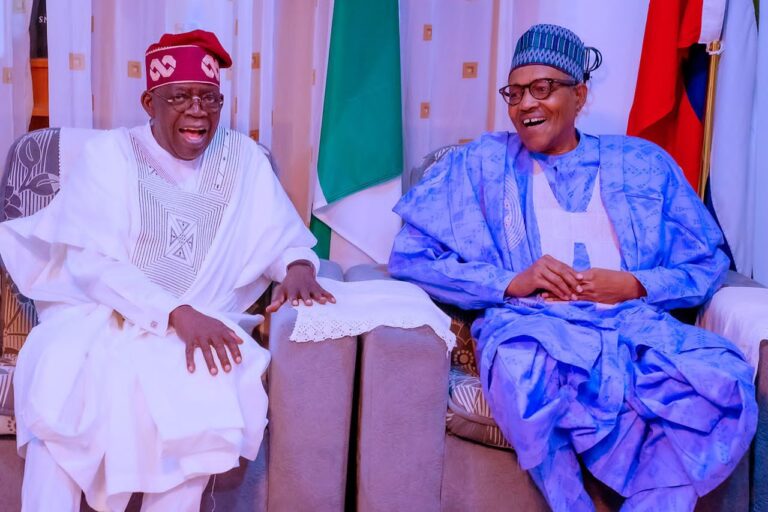
Birds of same feather: Presidents Trump and Tinubu

Donald Trump’s MAGA and Bola Tinubu’s Èmi l’ókàn are poignant political slogans. They are also clever political technologies that parlay elite ideology and class interest into populist myths that manufacture mass appeal and the willing consent of the dispossessed.

By Chudi Okoye

Economists often speak of ‘wage rigidity,’ by which they refer to the resistance of wage rates to changing market conditions. It is a term that calls to mind another kind of ‘wage’ inflexibility: the one found in Romans 6:23 where the Bible declares with finality that “the wages of sin is death,” and again in Revelation 21:8 where the Good Book says sinners will suffer that death in “the lake of fire and brimstone.” Both suggest a kind of unyielding, almost fateful, resistance to change or new reality.

It is all rather redolent of the rigidity of political behavior in both Western and non-Western societies: one ideological and increasingly nativist; the other ethnocentric – or ‘primordial’, as Western ethnographers are fond of saying, implying a backward fixation on bloodlines. But is there, in sooth (to use a semi-biblical term) much difference between the ideological tribalism and nativism that now animate Western politics, and the tribalist ideology that persists in African politics?

If there’s a distinction between ideological tribalism and tribal ideology, it is ordinal rather than categorical – a difference of degree, not of kind.

To demonstrate, let us compare the political proclivities of President Bola Tinubu in Nigeria and President Donald Trump’s dispositions in the United States. Before anyone dismisses African politics as ‘tribal’ and posits contemporary U.S. politics as somehow more evolved, they might pause to ask: Is Trump’s rallying campaign cry and now governing ideology, Make America Great Again, really so different from Tinubu’s howl on the hustings, Èmi l’ókàn (meaning “It is my [our] turn”)? Is there truly a gulf between Trump’s nostalgic nativism, evoking notions of “real Americans” and “traditional values”’ and Tinubu’s idea of ethno-regional entitlement?

In my view, there isn’t a great distance between Trump’s White House and Tinubu’s Aso Rock Villa, despite the 9,200km remove. Both MAGA and Èmi l’ókàn evince atavistic impulses: the first cloaked in the veneer of ideology; the second, a veneer for ideology and class dominance. MAGA and Èmi l’ókàn are more than campaign slogans; they are codes, signaling to their respective bases a revanchist promise of racial restoration or ethnic ascendance. Beneath their outward differences lies a shared logic: the mobilization of particularistic identities, whether nativist or ethnocentric, to consolidate and legitimize elite power.

Some sticklers may be startled or even scandalized by the audacity of juxtaposing MAGA and Èmi l’ókàn, or more broadly, parallelizing the tribalisms of ideology and ethnicity. But come along, let’s “compare and contrast” – as they say in popular parlance – to see if there’s all that much difference.

MAGA vs. Èmi l’ókàn
Donald Trump’s Make America Great Again and Bola Tinubu’s Èmi l’ókàn are masterclasses in political branding – succinct phrases that weaponize nostalgia and entitlement to forge unshakable loyalties. At first glance, they appear worlds apart: one a nativist call to restore a mythic past, the other an ethno-regional demand for power-sharing. Yet both slogans reveal how political elites manipulate identity to consolidate power, even as they obscure the economic and ideological realities beneath.

Trump’s MAGA mantra presents itself as an ideological project – a revolt against globalization, “elites,” “wokeness,” and progressive cultural shifts. Its rhetoric is steeped in policy jargon: “America First” trade deals, “draining the swamp” or “deconstruction of the administrative state,” and “securing the border.” These phrases function not only as policy signals but also as cultural dog whistles. MAGA’s true potency lies in its invocation of a lost racial and cultural order – a time when America was “great” because it was whiter, more Christian, and less contested.

Thus, the ideological veneer of MAGA masks a deeply atavistic agenda. Trump’s electoral coalition united free-market libertarians, evangelical conservatives, and White supremacists, not through shared economic principles but through shared grievance. MAGA’s real genius lies not in ideological coherence, but in its fierce emotional appeal. It fuses policy, grievance, and identity into a kind of political totem – a rallying cry for restoration rather than transformation. For many of its followers, it is not merely a policy platform; it is a spiritual return to an imagined America: hierarchical, homogenous, and unambiguous.

Yet, while longing for an unambiguous America, MAGA thrives on its own rhetorical ambiguity. Its genius, in fact, lies in this ambiguity. This is its unique strength: it is at once an ideology (libertarian, anti-establishment populism) and an identity (White Christian nationalism). This duality allows MAGA supporters to frame their allegiance as a matter of rational principle, even as the movement devolves into a cult of personality seeking atavistic regression.

In Nigeria, Tinubu’s Èmi l’ókàn operates differently but to similar ends. The phrase, rooted in Yoruba idiom, explicitly invokes ethnic and regional entitlement – a demand that power rotate to the South West after eight years of northern Muslim leadership under Muhammadu Buhari. I’m not sure if Tinubu is aware of this, but his slogan, trotted out in 2022, echoes the logic captured in It’s Our Turn to Eat, a 2009 book by British journalist Michela Wrong. That book explores the unspoken creed of Kenyan politics, grounded in ethnic patronage and power rotation among Kikuyu and Kalenjin kingpins. Wrong was right in her depiction of Kenya’s political coalitions, and her thesis may just as well apply to Tinubu’s agenda. Yet his ethno-centric rallying cry obscures a deeper reality: Nigeria’s political elites, regardless of ethnicity, share an abiding commitment to neoliberal economics and patronage politics.

Nigerian politics is an intricate blend of ideology and ethnocentrism. You might think, from the frequent cross-party defections of party stalwarts (Tinubu himself has belonged to five parties since 1999) that politics in the country is bereft of ideology. But that is not so. In Nigeria, ideology is a potent political force, made the more so by an elite ideological consensus that marginalizes radical political tendencies.

We saw such marginalization in the 1993 presidential election – Nigeria’s freest and fairest, later annulled by the military. Moshood Abiola, the Yoruba businessman who won that vote, ran under the Social Democratic Party (SDP), a platform billed as “a little to the left.” His coalition attracted labor unions, students, and radicals advocating wealth redistribution and other progressive ideas. His victory threatened not just the prevailing regional balance of power but potentially the entire architecture of elite consensus. The military’s annulment of the election, justified as preventing “chaos,” was in fact a defense of the status quo against ideological disruption – a correction to the center, so to say.

Ideology is indeed a motive force of Nigerian politics, though often obscured by ethnicity and other primordial differences exploited by ideologically converged elites, as they strive for supremacy in Nigeria’s politics of spoils.

Bola Tinubu’s Èmi l’ókàn continues this tradition. It reflects precisely that intersection of class, ideology, and ethnocentrism – not unlike MAGA. The slogan mobilizes Yoruba sentiment, reflected in Tinubu’s Yoruba-centric appointments, while his governing ideology echoes the same neoliberal policies favored by ascendant elites. Indeed, the re-centering of neoliberal orthodoxy was part of Tinubu’s immediate policy shifts when he took the reins from an exhausted and discombobulated Buhari in May 2023, seen in his instantaneous deregulation of the Naira and removal of fuel subsidies.

Èmi l’ókàn is a mirror image of MAGA. Both mobilize identity to deflect from policy: Trump’s nativist theatrics distract from his corporate tax cuts; Tinubu’s ethnic posturing sidesteps questions about the pernicious effects of his neoliberal policies.

Both also marginalize radical alternatives: “woke” progressives in America; radicals in Nigeria. For MAGA, “real Americans” must reclaim their country; for Èmi l’ókàn, power is a tribal trophy.

The difference lies in packaging. MAGA wraps atavism in ideological garb; Èmi l’ókàn drapes elite ideology in ethnic symbolism. Both, however, serve the same end: personal aggrandizement and elite consolidation of power. Though MAGA’s cult-like aura often casts Trump in a messianic light, different in this way from an Èmi l’ókàn anchored in transactional politics, both slogans ultimately function alike: they mobilize identity to legitimize power, deflect scrutiny, and entrench elite dominance. In the end, the slogans may differ in slant and semantics, but the ploys and purposes of power remain the same.

Identity and Ideology
At the heart of both MAGA and Èmi l’ókàn lodges a simple truth: in modern politics, identity often eclipses ideology. When power is pivotal and up for grabs, symbols matter more than substance, affect (what we call “body language” in Nigeria) trumps argument, and the politics of belonging outpaces the politics of belief.

But this is no accident. Political elites have long understood that identity can be just as pliable as ideology – if not more combustible. Whereas ideology requires articulation, coherence, and risk of contradiction, identity is visceral, unreflective, and deeply tribal. MAGA and Èmi l’ókàn both exploit this dynamic, offering their followers not a rational vision of the future, but a mythic meaning of self: a twinning of grief and belief, a promise that power is a birthright, that grievance is sacred, and that politics is a battlefield of “us” versus “them.”

And yet, even as these slogans stir deep consciousness of identity, they do so in service of ideology – just not the kind worn on banners or debated in sterile manifestos. The real ideology is hidden in plain sight: an elite consensus that codifies inequality, favoring capital over labor, deregulation over redistribution, and stability over social justice. The brilliance of slogans like MAGA and Èmi l’ókàn is that they allow elites to pursue their narrow class and ideological interests under the cover of a broader cultural warfare.

This is not to say that ideology is irrelevant. Far from it! In our populist age, ideology does not disappear; it simply dons the mask of identity. Economic orthodoxy is repackaged as cultural reclamation. Austerity is recast as sacrifice for the tribe – witness Trump and Tinubu’s call for mass endurance and sacrifice, while both and their families grubbily monetize their presidencies.

MAGA and Èmi l’ókàn are not just political slogans – they are political technologies. They fuse instinct and interest, tribe and class, myth and method. They “manufacture consent” (to borrow a term from Noam Chomsky, the doyen of my college days), not through persuasion, but through resonance. Their power lies not so much in their truth, but in their ability to feel true.

The interplay between ideology and identity is hardly unique to the United States or Nigeria. Across the world, political elites have mastered the art of fusing abstract principles with the visceral pull of belonging – sometimes wielding ideology to mask exclusionary impulses; other times deploying identity to obscure the true beneficiaries of power.

This dynamic can be seen in Viktor Orbán’s “Hungary for Hungarians,” which exploits nativist rhetoric, using the language of sovereignty to mask the consolidation of power and the enrichment of loyal elites. In India, Narendra Modi’s BJP blends Hindu nationalism with neoliberal economics, channeling identity politics to distract from widening inequality. I have already mentioned the case of Kenya.

Across these contexts, the interplay of ideology and identity is less about genuine belief than about the maintenance of elite power. Whether ideology masks identity, or the latter camouflages class interests, the effect is the same: the marginalization of progressive alternatives and the entrenchment of a narrow, self-serving consensus.

In the end, the distance between the White House and Aso Rock Villa – between MAGA and Èmi l’ókàn – is not measured in miles or constitutions, but in the sameness of their ambitions. The slogans may change, the cosmetic banners may differ, but the choreography and disguises of power remain remarkably the same.
The Roots of Democracy Are Watered by Storms of Tyranny

0
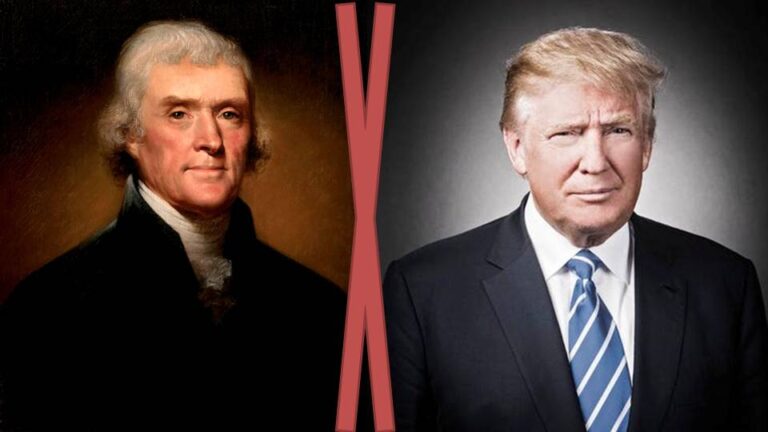
Poles Apart - Presidents Thomas Jefferson and Donald Trump

Donald Trump’s second presidency has fractured American democracy in just its first 100 days. Decay is not inevitable, as history shows; but democratic renewal will require bold and decisive action.

By Chudi Okoye

If Thomas Jefferson – America’s third president and fierce champion of democracy who authored the 1776 Declaration of Independence – meant to strike fear into the fantasies of would-be autocrats in the newly formed country, he likely achieved it with a warning he issued on November 13, 1787. In a letter to William Stephens Smith, son-in-law of fellow founding father John Adams, Jefferson wrote what would become a canonical statement in defense of democracy:

“The tree of liberty must be refreshed from time to time with the blood of patriots and tyrants.”

Jefferson, whose vision helped forge the American experiment in self-government, made similar remarks in other writings, emphasizing the importance of democratic vigilance and the role of citizens in safeguarding their liberties. But his statement to Smith, made in the wake of Shays’s Rebellion, an armed revolt by farmers in western Massachusetts in 1786-87 against state tax policies and farm foreclosures, stands out in its audacity and revolutionary diction.

It is a remarkable statement, up there with Jefferson’s earlier assertion – which became part of America’s founding creed – that “all men are created equal.” The statement was likely inspired by the sentiments of the Constitutional Convention that had concluded two months earlier, culminating in the U.S. Constitution ratified in 1789.

In the more than two centuries that American democracy has endured, it has maintained a vigilant watch against tyrannical rule, though not at all times or for all peoples within its borders. There certainly have been deviations from the democratic ideal.

We are witnessing such a moment currently, with the creeping autocratization of American government under President Donald J. Trump. I have written plenty about this subject elsewhere (see here, here, and here, for instance).

The fire ignited by America’s angered slide into autocracy under Trump could burn down the country’s storied institutions and scorch budding democracies elsewhere. But if American democracy emerges from the current storm strengthened, it could once again become a beacon beckoning the world, showing there’s life after autocratic interregnum.

While the current autocratic trend may induce despair, not just in the U.S. but around the world, there is another fact of history that inspires hope. Human history reveals an arc bending toward liberty and self-government – indeed a dialectical logic of democratic erosion eventuating in democratic renewal. Though not always apparent, you might say that the roots of democracy are watered by the fearsome storms of tyranny. Nations are sometimes buffeted by tempests of tyrannical rule, but these can occasionally produce rains that seep into the very roots of liberty and nourish them toward democratic revival.

This is not in any way to counsel complacency, assuming some ineluctable law of democratic recovery. Most certainly not! After all, as the Economist’s Democracy Index shows, only about 6.6% of the world’s population lives in a full democracy. Of the rest, 38.4% resides in flawed democracies, 15.7% in hybrid regimes, and roughly 39.2% endures authoritarian rule. As Jean-Jacques Rousseau noted in the opening lines of The Social Contract (1762): “Man is born free, but everywhere he is in chains.”

Not all storms come with a downpour. There’s occasionally what meteorologists call a “dry thunderstorm,” which flashes with fury and fire but brings no rain. Similarly, tyranny can sometimes lead not to democratic renewal but to prolonged or even permanent democratic reversal.

The question is: what is the trajectory of America’s current storm under President Trump? History offers no guarantees – only warnings, and the rare precedent of democracies that weathered their own storms.

Erosion and Renewal
History shows that the march to freedom, far from being linear, is often a cycle of hope and disappointment, progress and regression. Across centuries and continents, democracies have proven both fragile and resilient, often tested by tempests of tyranny that threaten to uproot their foundations. Yet, time and again, these storms have also provided the conditions for renewal – though never automatically, or ever without struggle. This paradoxical dynamic reveals that the erosion of democracy can, at times, be the very catalyst for its eventual resurgence.

The story of democratic erosion and revival can be traced to ancient Athens, the cradle of democracy. In the aftermath of the devastating Peloponnesian War (431–404 BCE), Athens fell prey to internal strife and the rise of the Thirty Tyrants, an oligarchic regime that suspended the city’s democratic institutions from 404 to 403 BCE. For eight months, Athenians endured repression and purges. But the city’s democratic spirit was not extinguished. Through collective resistance and a yearning for self-rule, democracy was restored in 403 BCE. The trauma of tyranny led to reforms – such as the introduction of legal safeguards against demagoguery – that strengthened Athenian democracy for generations. Athens, after all, was a city-state that had learned the high cost of democracy’s fragility, a lesson that would reverberate through future generations.

The Roman Republic offers a cautionary tale, however. Beset by civil wars and the ambitions of powerful individuals, the Republic’s institutions buckled under the weight of crisis. Julius Caesar’s dictatorship (49–44 BCE), followed by Augustus’s rise as emperor (27 BCE–14 CE), marked the end of Rome’s republican experiment. Unlike Athens, Rome’s democracy did not recover; instead, it gave way to centuries of imperial rule. Yet, the memory of Roman republicanism would inspire later generations in their own struggles for liberty, demonstrating that the lessons of democratic collapse can persist long after the fall of a republic.

England’s political history is another vivid illustration. The absolutist tendencies of Charles I led to the English Civil Wars (1642–1651) and the temporary abolition of the monarchy. Oliver Cromwell’s Protectorate (1653–1659), though republican in name, soon devolved into autocracy. But the pendulum swung back. The Restoration of the monarchy in 1660, followed by the Glorious Revolution of 1688–1689, established the principle of parliamentary supremacy and enshrined rights that would become the bedrock of modern constitutional democracy. England’s saga serves as a reminder that democratic recovery can follow even the most turbulent of times.

America, too, has weathered its own storms. The end of the Civil War in 1865 brought the promise of Reconstruction (1865–1877), with new rights for formerly enslaved people. But this brief flowering of democracy was cut short by the rise of Jim Crow laws in the South, which enforced racial segregation and disenfranchisement from the late 19th century until the 1960s. It was only through the determined struggle of the Civil Rights Movement (1954–1968) that democracy was renewed, culminating in landmark legislation that restored and expanded the franchise. In this case, the renewal of American democracy came not by the victory of one faction, but by the collective will of marginalized citizens fighting for their rights. The struggle for justice, though painful and prolonged, revitalized the democratic ideal.

Across the Atlantic, France’s democratic journey was repeatedly interrupted by autocracy, as I indicated in my previous essays (here and here). The collapse of the Second Republic and the rise of Napoleon III’s Second Empire (1852–1870) marked a period of democratic eclipse. Yet, following his defeat in the Franco-Prussian War (1870–1871), the Third Republic was established between 1871 and 1875, laying the ground-work for modern French democracy. France’s experience underscores the point that even after a complete rupture, democracy can be rebuilt on new foundations, often with even stronger safeguards than before.

Germany’s 20th-century experience is perhaps the starkest example. The Weimar Republic, born in 1918, succumbed to economic crisis and extremist politics, paving the way for Hitler’s dictatorship through the Enabling Act of 1933. The Nazi era brought unbelievable horrors and the near-total destruction of democratic institutions. But West Germany rebuilt itself after World War II, emerging as the Federal Republic of Germany in 1949, its constitution based on principles that included strong safeguards against authoritarianism – a powerful testament to democracy’s capacity for rebirth after its darkest hour. This renewal, however, did not happen in a vacuum. The legacy of the Weimar Republic haunted the architects of its successor, prompting them to embed stronger constitutional safeguards and adopt a more cautious approach to democratic governance.

Even in later decades, this pattern persisted. In 1973, Chile’s democratically elected government was over-thrown in a military coup, ushering in a dictatorship that lasted until 1990. Brazil endured military autocracy from 1964 to 1985 before returning to democracy. In Eastern Europe, Hungary has experienced democratic backsliding since 2010, while Poland, after eight years of populist rule, saw a democratic rebound following the 2023 parliamentary election.

Across the African continent, similar cycles can be observed. Nigeria offers a particularly complex case. As I argued in a recent essay, since independence in 1960 the country has limped from “khaki to kakistocracy” – from military rule to a flawed civilian orthodoxy – though there remains a deep yearning for the democratic ideal.

The lesson is clear: the survival of democracy is never guaranteed. Each generation must confront its own storms – some bringing renewal, others leaving only destruction. The roots of democracy, as history shows, are watered not just by the gentle rains of progress, but sometimes by the fierce storms of tyranny. Whether these storms nourish new growth or leave lasting scars depends on the courage, vigilance, and wisdom of those who weather them.

America’s Current Challenge
IThe United States under President Trump’s second presidency presents an interesting test case for these historical tensions. We’ve already seen a staggering number of challenges to American democracy in just the first 100 days of the administration (marked on April 29). The signs of erosion are no longer subtle; nor, it seems, are they intended to be. The administration’s actions are causing concern about the weakening of institutional checks and the fraying of democratic norms that once seemed unassailable. In what follows, I’ll quickly retrace the trends in Trump’s autocratic mission (he notably declared mid-campaign in 2023 that he would be a dictator if re-elected, though seemingly only “on day one”), and then examine the tentative shoots of democratic resistance that may yet lead to renewal.

The breadth of Trump’s brazen assaults on American democracy is nothing short of breathtaking. Having grown up under military rule in my native country, Nigeria, I see echoes of that clime in Trump’s America. A U.S.-based Egyptian-American writer for The Guardian, Mona Eltahawy, made a similar point recently, comparing the U.S. to her authoritarian native country. These are fascinating, but unflattering, comparisons.

President Trump’s authoritarian playbook, honed during his first term and now executed with vigor in his second, has targeted nearly every pillar of American democracy. The electoral process is one of them. From the outset, in all three elections which he contested, Trump sought to delegitimize the process except where favored by the outcome: not committing to conceding if he lost in 2016; refusing to concede in 2020 when he actually lost; instigating the January 6, 2021 insurrection to prevent election certification, following efforts to foul the electoral process; boycotting Joe Biden’s inauguration, in continued disdain for the transfer of power; and once again in 2024, threatening to reject the election results, except if he won. Not the least troubling, Trump vulgarizes the political culture, denigrating opponents with unbecoming insults, branding critics “enemies of the people,” threatening to prosecute political opponents, and weaponizing federal agencies to pursue personal vendettas. He’s even mulling a third term, in this way mauling the provision and spirit of the constitution.

During the 2024 presidential campaign, Trump denied any knowledge of the Heritage Foundation’s Project 2025 initiative, designed to reshape the U.S. federal government and consolidate executive power in favor of right-wing policies. Yet, back in office, he has largely followed the blueprint. Media analyses showed that about two-thirds of his first flush of executive orders mirrored the Project 2025 playbook. So far, just 100 days in, Trump has issued an estimated 140 executive orders, far more than any predecessor. Though most of the orders are of dubious legality, they have enabled him to bypass Congress and basically rule by diktat – not unlike military decrees in authoritarian jurisdictions.

With his self-acquired powers, Trump has unleashed himself across vast areas of policy, taking a blizzard of executive actions without the slightest legislative check. He has wrested control of spending from Congress, unilaterally defunding programs and entire agencies. He’s taken control of hitherto independent agencies, demanding direct reporting to the White House and putting stooges in charge. He initiated massive – often cruel but cack-handed – layoff of federal employees, his Gestapo-like Department of Government Efficiency forcing access to sensitive government databases to identify programs for elimination. His alien deportations are not limited, as promised on the hustings, to illegal immigrants. He has also targeted legal immigrants (even naturalized citizens), deporting hundreds to a Gulag-like prison in El Salvador without due process, on pretext they’re gang members. Border controls are more severe, and surveillance has been intensified. He’s attempting to revoke birthright citizenship, contravening the Constitution. College students who protest Israel’s genocidal war on Gaza are arrested, visas for participating foreign students revoked. He is aggressively eliminating diversity programs, apparently trying to make America White again. Bypassing Congress, he has imposed high tariffs on U.S. trading partners, triggering massive stock-market sell-offs and threatening a possible stagflation. Above all, like third-world tyrants, he has engaged in brazen self-dealing and corruption, using all manner of schemes to monetize his office and enrich his family.

As Trump consolidates power, deploying it with shock and awe, he has sought to muzzle constraining or competing institutions. Congress is neutered; corporate entities are shaken down; leading universities are defunded; media outlets threatened or sued; leading law firms are compromised; and the judiciary is hobbled, with dissenting judges vilified or threatened, a few already arrested.

You wouldn’t believe the overreach, if it weren’t happening. Trump’s America certainly isn’t Ronald Reagan’s “shining city upon a hill.”

Yet, despite its fury and fearsome determination, Trump’s power grab hasn’t gone unchallenged. The dialectic of autocratic ambition rousing democratic resistance is unmistakable. The judiciary has blocked over 100 presidential actions, defending constitutional limits. States and cities have mounted legal and legislative resistance; some federal agencies are pushing back; civil society has rallied through lawsuits, protests, and grassroots organizing. Universities and law firms are suing to preserve their independence. The media, bruised but unbowed, continues to expose abuses, often aided by whistleblowers. Civil society is roused, and resistance is rising.

Though battered by the Trumpian storm, America’s tree of liberty endures, its rugged roots resilient even as autocratic winds lash its branches. Jefferson saw those roots refreshed by the blood of patriots and tyrants; today, they are nourished by the vigilance and courage of citizens. Whether this tempest will terminate remains uncertain. Yet as history shows, the fiercest storms can drive roots deeper, making the prospect of post-Trump renewal – a boon for America and the world – a distinct possibility.

Neutered by North, Wasted by West, Nigeria Crawls from Khaki to Kakistocracy

0
Products of the the Duopoly - Tinubu, Buhari

The North-South West duopoly that has governed Nigeria for six decades must be politically defeated for the country to forge ahead.

By Chudi Okoye

There may be wondrous beauty and harmony in the heavens when the Sun, Earth, and Moon align in a near-perfect straight line, in what astronomers call a ‘syzygy’, that is, a yoked union of celestial bodies. Yet such alignments often trigger eclipses and tidal upheavals, disrupting earthly equilibrium.

As in the heavens, so in the fractured firmament that is Nigeria. The country remains trapped in the syzygy of its 1914 colonial amalgamation, a yoked union of disparate civilizations in Britain’s northern and southern protectorates. Like celestial bodies locked in a destabilizing orbit, Nigeria’s regions tug at one another in a zero-sum struggle, their gravitational tensions straining the country’s fragile force field. This is a syzygy without synergy; a country crippled by contradictions and hobbled by a pervasive ‘con’ tradition. Just as celestial syzygy causes eclipse and tidal perturbations, so too does this imposed union warp reality, obstruct progress, and stir tides of political turmoil in Nigeria.

If the so-called ‘Pottery Barn rule’ (“you break it, you own it”) means that imperial Britain bears historical blame for the colonial contraption, it follows that the dominant elites in post-independence Nigeria—overwhelmingly from the North and South West regions—must answer for its present malaise. Following Britain’s exit and an initial period of civilian self-rule, Nigeria has been kicked from khaki to kakistocracy: from a failed ‘authoritarian bargain’ under military rule (economic security for limited political rights) to abuse and sustained misrule by a rudderless and utterly incompetent civilian bloc.

Yet, our political discourse too often blames a nebulous ‘military’ or ‘civilian’ governing class (‘the leadership,’ as Chinua Achebe once described them); sometimes the ‘masses’ and even, still, Britain, are inculpated. Such scapegoating is surprising and unwarranted. Elite complicity and opportunism certainly cut across regions; and neither mass apathy nor colonial legacy should be discounted. However, it is specifically elites from the northern and south-western regions that have held sway and are chiefly to blame. The North has neutered the nation; the South West has laid it to waste. For 59 of Nigeria’s 64 years of independence, elites from these regions have dominated the federal government, designing its institutions, shaping the architecture of power, and monopolizing resource flows. These regional power blocs are therefore primarily responsible for the resulting dysfunction, not their imperiled compatriots or imperial ghosts.

This point must be pressed with force and forthrightness, especially as the 2027 presidential election looms. Nigeria’s marginalized groups must begin to brand the North and South West as co-architects of a failing republic, and thus demand a genuine power shift.

An Incompetent Duopoly
The push for power shift by marginalized groups in Nigeria, or rather their yearning for power-sharing, is not new or radical. It has echoed through much of Nigeria’s tortured history, and was crystallized in several constitutional proposals, both colonial and postcolonial. For instance, recommendations for a rotational presidency and related provisions were made in the 1994/95 Constitutional Conference convened by the late General Sani Abacha, the 2005 National Political Reform Conference summoned by President Olusegun Obasanjo, and the 2014 National Conference initiated by President Goodluck Jonathan. Though driven by varying political contexts and motives, these conferences converged on the same imperative: that apex power must rotate across Nigeria’s geopolitical zones to promote inclusion, reduce ethno-regional tensions, and reinforce national cohesion. Yet successive regimes—military and civilian alike—have refused to constitutionalize this principle, leaving it to the vagaries of elite bargains and party traditions.

This persistent agitation, it must be said, is driven less by high-minded ideals of justice than by a visceral craving for sectional access to political goods. Nigeria is a perverted laboratory for Kwame Nkrumah’s well-meaning dictum, itself an adaptation of Jesus’ innocent charge in Matthew 6:33: “Seek ye first the political kingdom, and all else shall be added unto you.” In our culture of distributive politics, the presidency is the grand vault of prebendal patronage and influence. Unsurprisingly, critique of the North and South West’s hegemony often hinges not on competence, but on exclusion.

Yet a more damning argument exists: these ruling blocs have not only monopolized power, they have squandered it. They have presided over the utter ruination of Nigeria, their reign marked by corruption, incompetence, and abject state failure. The demand for a power shift should therefore rest, not merely on the logic of inclusion, compelling though that may be, but also on the empirical record of the duopoly’s abysmal governance.

Let’s peep a little into the arithmetic of the duopoly’s power and underperformance.

Arithmetic of a Failed State
The truth is easy to track. A glance beyond the gloss of Nigerian democracy reveals the dross beneath. A picture of predation emerges, brimming with the brazen details of a duopoly that has turned governance into graft, an extractive industry.

For much of Nigeria’s postcolonial history, following a fleeting period of diffused power under the First Republic’s parliamentary system, two regions—the North and South West—have locked in power with what looks like precision engineering. The North had some heft from the proto-independence period, having been privileged by departing British administrators who trusted the northern oligarchy more than the southern radicals and their rowdy entourage. Even so, other regions also had sway in that era: the East as the North’s central government partner, and the West a feared and formidable opposition. But with the outbreak of the Nigerian Civil War (1967–70), everything changed. The military emerged as a political force. The West went from opposition to governing partner. The East was defenestrated. A duopolistic ruling formation began to take shape, tentative at first but eventually entrenched. It has since become the hegemonic force in Nigeria, controlling the institutions of state, the security apparatus, the treasury, and the commanding heights of the economy.

Let’s pick through some of the startling statistics of hegemony. The North and South West have produced 14 of Nigeria’s 16 heads of government (HoG) since independence, including the First Republic’s prime minister, successive civilian presidents, and a string of military honchos. Together, they account for a staggering 92% of all HoG tenures. The same duopoly has occupied the army chief of staff post for an identical 92% of the nation’s postcolonial history. It has also held overwhelming sway at other coercive helms, securing 74% of DSS/SSS leadership tenures since 1976, 77% of police inspector general tenures since 1964, and a full 100% headship of the Economic and Financial Crimes Commission since its creation in 2003. To this must be added what has become a fixed tradition across administrations: all key ministerial portfolios are held by the duopoly, with exceptions rare and typically symbolic. The All Progressives Congress (APC) years have ushered in even more brazen levels of tribal nepotism. In all, this is a gripping portrait of dominance, with the levers of executive power and the state’s coercive instruments firmly under duopolistic control.

It doesn’t quite end there. Even in the Central Bank, where meritocratic ideals might suggest more regional diffusion, the duopoly has claimed 55% of all governorship years. But what may appear to be technocratic accommodation of other regions belies a deeper truth: candidates from outside the duopoly may occupy the apex seat, but they invariably serve hegemonic interests. And should they ever forget their place, there is a steep price to pay.

Consider the cautionary case of Godwin Emefiele, where hubris collided with the heuristics of hegemonic power, with tragic consequences. The high-flying banker, a former Zenith Bank CEO once lauded for his technocratic acumen, ascended to the CBN’s top post under a southern president (Jonathan) and was retained by a northern one (Buhari). In his near-decade at the helm, Emefiele became a pliant steward of hegemony, printing money to fund its appetites, implementing controversial currency policies at the presidency’s behest, and was famously photographed bowing before Isa Funtua, a northern powerbroker in Buhari’s cabal. A loyal steward par excellence. Yet when he sprouted wings and dared to seek the presidency, the same system he served so slavishly turned on him with a vengeance: he was suspended, arrested, publicly humiliated, his properties seized, and his reputation left in ruins. He became a cautionary relic of overreach, proof that loyalty is rewarded only as long as it does not threaten the architecture of exclusion.


The structuring of power and obedience under duopolistic rule is deliberate. It is not coincidence; rather choreography. The North and South West do not merely govern; they guard the gates, police dissent, and control the vaults. In Nigeria, hegemony is not just a matter of who sits at the top; it is the architecture of exclusion, engineered and enforced across every commanding height of the state.

Political power, to be legitimate, must be used for public good, especially in a poor country like Nigeria where state power is critical for development. Major theorists of the state, with notable exceptions like Machiavelli, have long agreed on this foundational idea: Jeremy Bentham and J.S. Mill invoked the utilitarian principle of “the greatest happiness of the greatest number”; Thomas Hobbes argued that the state exists to prevent life from being “solitary, poor, nasty, brutish, and short”; and Max Weber justified the state’s monopoly on legitimate force by its duty to maintain order and protect citizens.

By any of these basic standards, Nigeria’s duopoly has failed spectacularly, especially when compared to its governing peers in Asia and elsewhere. Its sixty years of rule has left a trail of staggering poverty, economic collapse, systemic corruption, mass insecurity, and a grotesque privatization of public wealth.

The statistics of failure are astounding. I’ll cite only a few, familiar figures. In just the 10 years between 2014 and 2024 with APC as the ruling party, Nigeria’s economy shrank from $568.5 billion in real terms to an estimated $199.7 billion, a percentage decline of 64.9% and CAGR of -9.93%. This means the economy contracted by nearly 10% per year on average over that period, an extraordinary decade-long deterioration. In the same period, GDP per capita plummeted from $3,222 to an estimated $877. Over two-thirds of Nigerians, about 133 million, now live in extreme hardship or multidimensional poverty. Insecurity is rampant, with kidnapping emerging as a rapid growth industry. A recent report by the government’s own Bureau of Statistics estimated that Nigerians paid ₦2.23 trillion in ransom demands between May 2023 and April 2024, which was President Tinubu’s first year in office. This figure only reflects reported payouts! Many areas of the North, for instance, have become ungovernable, due to the violence of kidnappers, bandits and other non-state actors. Under the ruling duopoly, Nigeria has experienced a decline in human development, with an HDI of 0.539, ranking 163rd globally. Simultaneously, the country has ascended to sixth place in the 2025 Global Terrorism Index, with 565 terrorism-related deaths in 2024, reflecting a deteriorating security landscape. Little wonder foreign investment has dried up, with hundreds of international companies fleeing the country.

This record points not just to incompetence and policy failure; it is stark evidence of a state that has abdicated its foundational duties. The duopoly has not merely failed Nigeria; it has inverted the very logic of the state. It is way past time for change—beginning with a genuine power shift, possibly in the 2027 national election cycle.  

Toward a Power Shift
In the aftermath of Nigeria’s 2023 election, many blamed Bola Tinubu’s victory on electoral fraud. Some maintain that view even today, despite court rulings upholding the outcome. I’ve written extensively (see here, here, here, and here, for instance) arguing that while irregularities existed, the opposition’s strategic failings were more decisive. To unseat the APC—a symbol of the entrenched North-South West duopoly—opposition forces must rethink their playbook.

Defeating an incumbent party is rare in Nigeria, but APC did it in 2015 through years of careful preparation. As 2027 approaches, it’s unclear to me if opposition parties have the cohesion or strategic clarity needed for such feat. Power does not yield to moral appeals; it must be contested, coerced, or catalyzed. Nigeria’s marginalized regions—South East, South South, Middle Belt—must shift from lamentation to calculation.

The call for a power shift is not merely a demand for symbolic justice; it is a bid for structural correction. The current distribution of power does not reflect Nigeria’s demographic, intellectual, or economic diversity. The South East, with its entrepreneurial dynamism, remains politically marginalized. The South South, despite being the economic lifeblood of the nation through oil revenues, is institutionally sidelined. The Middle Belt, often the theatre of ethnic and religious conflict, wields little agency.

To force a shift, these regions must first forge a cross-cutting compact—a strategic alignment based on shared interests. Such an alliance could draw inspiration from global examples: the civil rights coalition in 1960s America, the anti-apartheid movement in South Africa, or the grassroots revolutions in Eastern Europe. Power structures crack when marginalized blocs unite with a common vision, sustained pressure, and a refusal to remain complicit in their own subjugation.

Tactics must be diversified to achieve the goal, which isn’t merely regime change but systemic renewal. It is to create a polity where legitimacy flows from competence, equity, and inclusion. Without such a recalibration, the 2027 election risks becoming another rerun in Nigeria’s tragic ritual, with the same old kakistocracy reemerging while the nation limps forward, hobbled by its unresolved contradictions.

Nigeria stands at a moment of syzygy as 2027 looms: a rare alignment of crisis and opportunity. Whether this convergence yields a new dawn or yet another eclipse depends on the courage and vision of those determined to break the cycle.

A ‘Tariffic’ Payback for Some Africans’ Perverse Admiration of Donald Trump

0
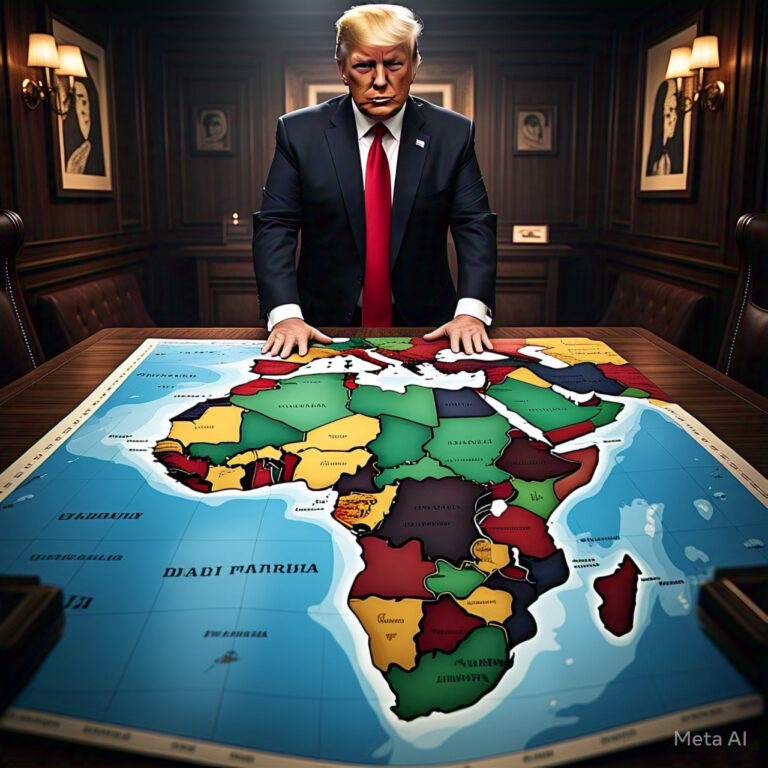
Donald Trump and prostrate Africa

Admiration for Donald Trump runs deep in parts of Africa, despite his racist record. But will this survive the turmoil of the U.S. president’s current tariff wars? A 90-day moratorium, forced by global fury, offers little reprieve for vulnerable African economies already burdened by his broader policy shifts.

By Chudi Okoye

So strong, it seems, is his grip on their minds that even now—whacked yet again by his whimsical actions, this time his global tariff offensive launched on April 2nd—some Africans remain unshaken in their perverse admiration of Donald Trump, the current U.S. president. The term ‘Trump Derangement Syndrome (TDS)’ has been pushed into public usage, often glibly tossed out to pejoratize what’s perceived as irrational liberal contempt for Trump’s persona and his norm-bending behaviors. But we have yet to properly acknowledge what may be dubbed ‘Trump Admiration Disorder (TAD),’ a phenomenon that seems equally irrational in its exuberance, manifesting even in the far-flung flanks of Africa.

Though neither condition has made the hallowed list of officially recognized mental disorders, both can be visceral, TAD arguably a tad more so.

Such is the force of the TAD phenomenon, such the fad, that Trump’s political movement is often likened to a personality cult—distinct yet comparable to the fervor that followed some of his towering predecessors, among them Andrew Jackson, Abraham Lincoln, Franklin D. Roosevelt, John F. Kennedy, and Ronald Reagan. These historical figures possessed immense charisma and an ability to inspire deep loyalty, each cultivating their base in unique ways—through crisis leadership, ideological appeal, or simply personal magnetism. We’ll yet see if Trump can achieve their stature and similar historical durability. But his movement stands out in modern American politics, not only for its intensity but also its diversity: an inchoate coalition of working-class voters, White evangelicals, nativist ideologues, and the gilded ranks of media and financial elites—all animated by grievance or greed and the sheer force of Trump’s personality.

Trump’s support base displays distinct signs of a personality cult, surpassing that of any other contemporary politician. It is evident in their utterances and their actions, in the various departments of their deportment. Even his most powerful admirers speak in tones that verge on devotional. Elon Musk, the world’s richest man and leader of an efficientizing government agency, in February—a few days to Valentine—dropped a Twitter post saying “I love @realDonaldTrump as much as a straight man can love another man.” He was widely mocked for this, many embarrassed on his behalf. But he didn’t seem to care. Republican lawmakers similarly fall over themselves to demonstrate loyalty to Trump, their ‘Dear Leader,’ issuing rote praise and retreating into silence when he crosses lines they once deemed inviolable. This is to say nothing of the huddled masses, the swooning rank and file in Trump’s base, many of whom already idolized him prior to his attempted assassination before the November election.

Trump has not merely attracted this cult-like following; he has gleefully and artfully cultivated it. Moving at a rapid pace, he’s imposing his personal brand on the U.S. government, much as he does in private business, projecting strength and cultic power whilst demanding absolute fealty. This has allowed him to commandeer the Republican Party, sidelining or subserviating its traditional leaders and placing its apparatus firmly under his control. He also aggressively monetizes his political celebrity, launching a steady stream of branded products—from cryptocurrency to a vast collection of MAGA merchandise that includes a $550 ‘45-47’ Bling Clutch and other pricey bibelot. He even peddles a ‘God Bless the USA’ Bible, printed for pittance in much-maligned China and sold to devotees with wrappings of piety at the celestial price of $59.99, plus shipping and fees. According to one media outlet, Trump’s online store hawks some 1,725 items, a collection that could set a giddy supporter back about $36,000 in one ‘patriotic’ shopping spree. The proceeds, of course, flow directly into the Trump family coffers. With him, ‘political fortune’ has shifted from Machiavelli’s notion of erratic fate (Fortuna) to pure profiteering, unconstrained by virtue.

Milking the MAGA Merchandise

Yet, though he reigns supreme in today’s Republican Party, Trump’s electoral performance hasn’t been that impressive. Across the three presidential elections he has thus far contested, Trump never cracked 50% of the popular vote. In 2016, he won the presidency by securing 304 electoral votes against Hillary Clinton’s 227, but she outpaced him in the popular vote, garnering 48.2% to his 46.1%. In 2020, he lost to Joe Biden, who won decisively with 306 electoral votes and 51.3% of the popular vote, while Trump managed 46.8%. Even in 2024, when Trump defeated Kamala Harris with his clutch of 306 electoral votes, he still fell short of majority in the popular vote, winning 49.8%. Trump’s approval ratings have tracked these election results: middling at best, and currently underwater.

This pattern suggests that Trump faces a hard ceiling in terms of national support. His record compares unfavorably with some earlier Republican candidates: Richard Nixon achieved a landslide victory in 1972 with 60.7% of the popular vote and 520 electoral votes; Ronald Reagan secured 50.7% and 489 electoral votes in 1980 before improving to an overwhelming 58.8% and 525 electoral votes in 1984; and George H.W. Bush won comfortably in 1988 with 53.4% of the popular vote and 426 electoral votes. Trump’s rigid ceiling complicates his apparent third-term agenda, which anyway is decidedly unconstitutional.

African Favorability
Ironically, though he lacks the overwhelming support once enjoyed by his more august predecessors in the United States, Trump is widely admired in parts of Africa. He remains polarizing on the continent, no doubt, but repeated surveys show him consistently outperforming his domestic numbers, even amid a spiral of controversies. For instance, in spring 2019, when Trump’s U.S. approval rating hovered around 39%, Pew Research found that 65% of Kenyans and 58% of Nigerians expressed confidence in his global leadership. By contrast, traditional U.S. allies registered much lower ratings: 13% in Germany, 20% in France, and 32% in the UK. Five years later, in 2024—during Biden’s tenure and on the eve of Trump’s comeback election—the pattern persisted: 63% in Nigeria and 59% in Kenya, versus 15% in Germany, 16% in France, and 30% in the UK (global median: 28%). Meanwhile, throughout his presidency, Biden enjoyed stratospheric levels of favorability among America’s major allies, much like President Barack Obama before him. These patterns highlight a pronounced global distaste for Trump, especially in the West, offset only by the surprising levels of admiration he continues to enjoy in parts of Africa.

Trump’s enduring favorability in Africa is surreal against his lifelong record of racial animus—a catalog of slurs, conspiracies, and policies targeting Black communities that began in his youth. In 1973, a 27-year-old Trump and his property company were sued by the U.S. Department of Justice for systemic discrimination against African American renters, exposing biases that would persist for decades. He later spearheaded the racist ‘birther’ conspiracy against Barack Obama, evidently seeking to delegitimize the nation’s first Black president, by questioning his American birth. In 1989, he demanded the execution of five Black and Latino teenagers falsely accused of raping a white jogger in New York’s Central Park. The ‘Central Park Five’ were exonerated in 2002, with their convictions vacated, following a confession from the actual assailant, and DNA evidence confirming his confession; yet, as late as 2014, Trump still insisted on their culpability, calling their $41 million settlement “a disgrace.” He reignited the smear as recently as 2024, during his presidential campaign, prompting a new defamation lawsuit against him.

As president, he infamously branded African nations, along with Haiti and El Salvador, as “shithole countries.” He told four Democratic congresswomen of color—one naturalized and three U.S.-born citizens—to “go back” to their supposed countries of origin, a remark condemned as racist for its nativist undertones. He described Black neighborhoods as war zones, disparaged Somali refugees, and pursued immigration bans targeting majority-Black nations. He amplified White nationalist stereotypes on social media, and pursued policies that often paralleled his incendiary talk. All this proved that his youthful bigotry had hardened over the years into institutionalized racism.

Against this sordid backdrop, Trump’s enduring popularity in Africa seems jarringly counterintuitive. What explains it?

One could charitably, and quite legitimately, blame Trump’s African fanbase on basic ignorance. Despite the confident presumption of many in Africa, there’s clear evidence of the Dunning-Kruger effect, with not a few overestimating their knowledge of Trump and U.S. politics. That explanation, however, only goes so far, especially when you spot flickers of Trumpist fervor among the African cognoscenti. So, then, what gives? Well, religion, for a start. It mediates much African thinking, often short-circuiting political judgment. Trump’s hard-edged cultural conservatism—his open disdain for liberal permissiveness, especially on LGBTQ+ issues—resonates in societies where progressivism is seen not as evolution but decadence. His name is intoned almost liturgically in some Pentecostal circles, thanks in part to his zealous support for Israel. For instance, for many Nigerian Christians chafing under Muslim political dominance, Israel’s pummeling of the Islamic Middle East is divine retribution, and Trump—more than some of his restrained predecessors—is admired for being its ardent enabler. Layer onto this the enduring cult of the strongman—a staple of African political life—and the appeal of Trump’s brash persona begins to make cultural sense. His vulgarity becomes virility; his sharp elbows, forged in the rough and tumble of the real estate business, a proof of manliness. In a continent where shifting economies are quietly empowering women, his exaggerated masculinity probably offers threatened men a fantasy of restored dominance. What reads as political admiration may thus be psychic compensation.

This is my quick take on the issue. Others, I’m sure, have their own views. But whatever the explanation, it may soon collide with the brute fact of Trump’s new tariff offensive, a potential headache for Africa.

From MAGA to MASA
It might be easy—for Africans not familiar with the dynamics of global trade, and even experts in advanced countries less informed about Africa—to overlook the continent as they calibrate the consequences of Trump’s escalating tariff wars. As the battle intensifies between the U.S., China, and the EU, there has been only the faintest focus on far-off Africa.

The reason is not hard to fathom. The continent barely registers in U.S. global trade. In 2024, America imported $39.5 billion worth of goods from Africa—just 2% of its $2 trillion import bill. Its exports to the continent totaled $32.1 billion, less than 5% of Africa’s own $699 billion in global imports. The disparity is just as stark in capital markets. In the first four days following Trump’s tariff announcement, the S&P 500 (which tracks the 500 largest U.S. companies) lost $5.83 trillion in market value, a figure over four times the combined market capitalization of Africa’s 29 stock exchanges.

With negligible trade volumes and fragile financial footprints, it is easy to see why Africa might be forgotten. Yet this must not be. An ancient Swahili proverb warns that “when elephants fight, the grass suffers.” As the global juggernauts escalate their ‘tariffying’ trillion-dollar brawl, the consequences for Africa could be catastrophic. The world’s most vulnerable economies will be whipsawed by the seesaw, if there’s no withdrawal in Washington or retreat by the rest.

But will the sparring powers pull back from the brink? There are mixed signals. On April 9th, after a week of worldwide turmoil attending the tariff surge, news broke that Washington may indeed have climbed down—if only partially. President Trump had earlier insisted, amid the weeklong churn, that there’d be no change of course until countries yielded to a fairer trade deal for America. Now, however, without any overt sign of the global concession he craved, Trump announced a 90-day moratorium on his tariff hikes, replacing the individuated assessments he had earlier imposed with a uniform 10% “reciprocal tariff” on all nations.

This temporary reprieve, however, excluded China, which was slapped with a further hike, bringing its current levy to an astonishing 145%. Trump accused China of showing a “lack of respect to the World’s Markets” by raising its own tariff on U.S. imports to 84%, in retaliation to the earlier U.S. mark-up. This tit-for-tat escalation between the world’s two largest economies raises the stakes dramatically, and it remains unclear where it will end. As of this writing, China had yet to respond to the latest U.S. move, though the E.U. opted to suspend its threatened retaliation after Trump’s partial backtrack. Perhaps China expects the U.S. president to relent at some point, if offered an off-ramp, especially given that Trump’s China-produced merchandise, including his branded Bible, could be caught in the crossfire.

While the China-excluded moratorium may suggest a tactical retreat, it is also a stark reminder of the dizzying volatility of U.S. trade policy under Donald Trump, a frenetic rhythm of rancor and reversals that leaves allies, adversaries, and vulnerable economies alike in a state of perpetual uncertainty. Trump’s spokespeople spun the policy shift as a win, claiming tariff pressure had forced negotiations. But the president himself let slip that the move was triggered by mounting market jitters, visible in tumbling indexes and massive losses, including a sharp sell-off in U.S. government bonds and the dollar, traditionally safe havens for investors.

Trump had teased the reversal on social media hours before the announcement, prompting speculation of market manipulation, especially as the markets rebounded spectacularly in its wake. The maneuver added yet another twist to the aura of policy volatility, heightened further by reports that many of Trump’s own advisers had been blindsided by the decision.

Nowhere is this volatility more concerning than in Africa. The continent, already whipsawed by Trump’s sweeping tariff measures, finds itself increasingly at the mercy of America’s changing moods. Lesotho, a landlocked country reliant on textile exports to the U.S., faced a punitive 50% tariff—an existential threat to its fragile $2 billion economy. For its 12,000 garment workers, many supporting extended families on $0.50/hour, this tariff would have been devastating. Even with the temporary reprieve, uncertainty remains. Not only will the new uniform rate hurt the country, there’s no clarity what comes after the moratorium. Trump could revert to the higher rate later, or cancel the reprieve altogether. This may be less a retreat than strategic reload!

Other African nations face similar risks. Nigeria, once Africa’s largest economy, had been hit with a 14% tariff on its exports to the U.S., but now faces the universal baseline tariff of 10%—a rate that still threatens its already fragile fiscal outlook. While crude oil (accounting for 80% of Nigeria’s exports to the U.S.) is exempt from the new tariffs, non-oil exports worth N324 billion ($209 million) now face steep challenges. This includes agricultural products like cocoa, nuts, and fertilizers, which are critical to Nigeria’s diversification efforts. South Africa, meanwhile, had been slapped with a 30% tariff, possibly tied to its ICC suit against Israel over Gaza or tensions with Trump adviser Elon Musk over anti-apartheid land reforms. The base rate could still erode a significant chunk of its auto industry revenue, particularly in vulnerable regions like the Eastern Cape, where employment in the auto sector provides a vital lifeline. Madagascar’s vanilla exports, Ivory Coast’s cocoa production, Kenyan tea growers, and Ethiopian coffee farmers all risk becoming collateral damage in Trump’s tariff wars.

Notwithstanding the new moratorium, which induced a momentary sigh of relief, African economies with U.S. linkage are still at risk, given Washington’s weaponization of uncertainty under Trump. With the U.S. Congress having apparently abandoned its role in setting trade policy, it is now up to Trump, a man with mixed motivations who seems to relish chaos and disorder. With little leverage of their own—as opposed to the major powers who can occasionally call Trump’s bluff—Africa is completely vulnerable to policy vacillations in Washington.

This is not just an economic story; it is a political reckoning. Trump’s trade offensive threatens to unravel decades of cautious optimism anchored in frameworks like AGOA (African Growth and Opportunity Act), which has granted duty-free access to U.S. markets since 2000. With AGOA set to expire this year, and no evident path to renewal under Trump’s America First ethos, African economies now face exclusion from global value chains alongside eroding trust in a partner once seen as a beacon of opportunity.

The irony here is pungent. Many African leaders, and not a few citizens, had viewed Trump with a kind of idiosyncratic admiration. His defiance of so-called global elites, his populist swagger, even his transactional worldview resonated in parts of Africa still navigating the complexities of postcolonial sovereignty. But this admiration now confronts a brutal test, as the consequences of Trump’s policies play out not in the abstract arena of global geopolitics, but in the day-to-day struggles of textile workers, cocoa farmers, and small business owners. Africa’s admiration of Trump may have been emotional, even symbolic, but the tariffs and his other policy swerves are painfully real.

With Trump and Africa, it is a story of MAGA versus MASA: to Make (his) America Great Again, it seems the U.S. president is prepared to Make Africa Suffer Again.

The Eighteenth Brumaire of Donald Trump (Pt. 2)

0
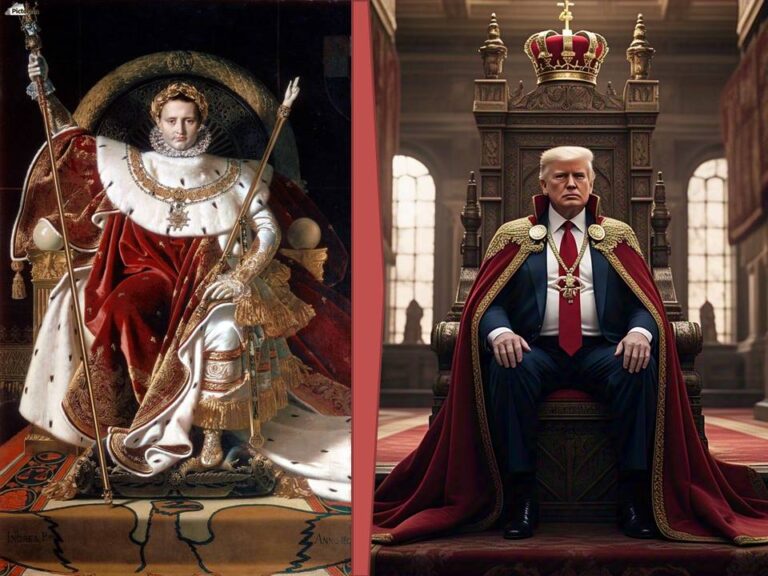
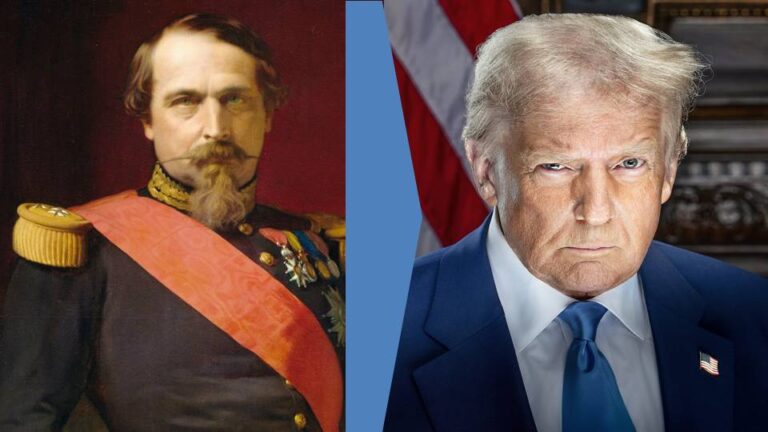
The Bonapartist Emperor and the Proto-Bonapartist President

This two-part essay explores the potential course of President Donald Trump’s second term. Based on Trump’s antecedents and moves he has made two months into his current tenure, the essay anticipates an increasingly illiberal, Bonapartist shift that may lead to tenure elongation or even self-perpetuation, if unchecked. Part 1 of the essay explored the history of Bonapartism, to contextualize Trump’s authoritarian impulses. This concluding part examines the Bonapartist echoes in Trumpism and its potential to accelerate global democratic recession.

By Chudi Okoye

A poignant moment came at the close of the U.S. Constitutional Convention in Philadelphia on 17 September 1787, one that has endured. As the delegates departed, Elizabeth Willing Powel, a prominent member of the Philadelphia upper class and an influential salonnière who hosted the likes of George Washington, reportedly approached Benjamin Franklin, a Founding Father and conference luminary, wondering about the outcome. She is said to have asked him: “Well, Doctor, what have we got? A republic or a monarchy?” Franklin’s reply was pointed and prescient: “A republic, if you can keep it.” It was a weighty response, especially from a revered elder statesman in his twilight years. Franklin—a writer, scientist, inventor, diplomat, printer, publisher, and political philosopher—was 81 at the time and would die less than three years later, his warning reverberating down the ages.

While the exact phrasing of that exchange has long been debated, the moment itself is well-documented in contemporaneous and subsequent accounts. It has become a canonical anecdote in America’s national narrative, a reminder that the republic’s survival depends on the vigilance of its people.

The anecdote is often used as a warning about the fragility of democracy, a system of government that imposes on the domineering impulses of men. The story encapsulates the tension between the ideals of democracy and the vulnerabilities that allow for the erosion of those ideals. We saw this in the first part of this essay in which I traced the roots of Bonapartism and its historical parallels, to contextualize Donald Trump’s increasing pursuit of personalized power and attempts to dominate U.S. governing institutions. I argued that his illiberal shift echoes the patterns of 19th-century French coups by Napoleon Bonaparte and Louis-Napoléon Bonaparte, both of whom overthrew republican governments to establish autocratic empires. That first installment recalled Karl Marx’s The Eighteenth Brumaire of Louis Napoleon, a major work dissecting the societal forces and social conditions that enabled the authoritarian ascendancy of Louis-Napoléon Bonaparte. I also broadened the historical scope in that earlier segment, tracing Bonapartist tendencies from ancient Rome to 20th and 21st-century examples like Weimar Germany, Argentina, the Philippines, Hungary, Brazil, and Russia, demonstrating a recurring pattern of democratic decay where leaders used institutional mechanisms to subvert democracy itself.

In the concluding part of this essay, I will examine the Bonapartist echoes in President Donald Trump’s policy moves and personal actions, as his second term unfolds, posing the ominous question of what America’s authoritarian drift portends for global democratic governance.

Bonapartist Echoes in Trumpism
History may not repeat itself precisely, but it certainly echoes. On 9 November 2016, exactly 217 years after Napoleon Bonaparte’s coup of 1799, the world awoke to Donald Trump’s first election as U.S. president. The Bonapartist parallel runs even deeper, in the political movement surrounding Trump—grandly dubbed ‘Trumpism’—which mirrors the later ascent of Napoleon’s nephew, Louis-Napoléon, in 19th-century France. It is a comparison many ignore, favoring more sensational references to Hitler. Trump and Bonaparte, though born apart and facing different historical contexts, display an eerie resemblance in their personae and political tactics: each a mercurial and demagogic figure decrying the extant conditions of their time—even exaggerating the severity, promising national restoration, leveraging populist rhetoric, exploiting institutional weaknesses, and embodying a new form of authoritarianism within a nominally democratic framework.

Louis-Napoléon Bonaparte emerged stronger after the 1848 revolution in France, his path to power paved in part by his earlier failures. He had tried to seize power through coup attempts at Strasbourg (1836) and Boulogne (1840), but both were badly botched: the first ending when a drunken general in his ragtag band defected mid-plot, the second collapsing as his borrowed imperial eagle flew away and he was shot in the arm before being arrested. These farcical misadventures, which made him a laughingstock among Parisian elites (much like Trump would later be mocked in U.S. liberal media), taught him a crucial lesson: military adventurism without mass support was doomed.

Bonaparte’s earlier coup attempts had failed, leading to exile and imprisonment, but they also refined his tactics and burnished his myth, especially among the common people. Behind bars, he abandoned military adventurism for political tactics, honing his populist persona through writings like The Extinction of Pauperism, in which he cast himself as both heir to Napoleonic glory and champion of the working class. By the time revolution broke out in 1848, he had transformed humiliation into legend: the imprisoned prince became a symbol of persecuted virtue, the last man standing who embodied national glory, social reform, and decisive action. The once-ridiculed conspirator now posed as a martyr for national renewal. Bonaparte’s reinvention was so complete that rural peasants defiantly hung portraits of ‘Napoleon the Small’ (Napoleon le Petit, an epithet his opponent, Victor Hugo, had coined to mock him) beside images of Christ, turning caricature into veneration. Not unlike the cult of personality surrounding Trump, especially following what seemed like his attempted assassination in the lead-up to the November 2024 election, about which I offered my thoughts here. Capitalizing on popular discontent, Bonaparte railed against corrupt elites, particularly those in the Directory, the governing body of the First French Republic, and cast himself as the savior of a fractured republic. His appeal to those nostalgic for Napoleonic grandeur finds an echo in Trump, who has conjured an idealized past with his repurposed slogan, ‘Make America Great Again’. 

Like Bonaparte, Trump had been plotting his rise long before his electoral breakthrough. For decades, he flirted with presidential runs, honing a public persona that weaponized conspiracy theories (most notoriously his birther lie targeting Barack Obama) and framed opponents as existential threats to America. His 2016 campaign was no political debut but the culmination of a years-long project to channel resentment and grievance into power. And like Bonaparte, he ascended through democratic means, mobilizing populist anger to secure victory, only to subvert the very institutions that legitimated his rule.

Bonaparte’s path to power was marked by a strategic manipulation of legal and institutional processes. As president of the Second Republic, he systematically undermined parliamentary authority, consolidating power through a December 1851 self-coup, dissolving the Assembly, arresting opponents, and imposing martial law. He then legitimized his actions through a January 1852 plebiscite (a tactic borrowed from his uncle Napoleon I) which approved a new constitution granting him dictatorial powers. By December 1852, another plebiscite ratified his transition to Emperor Napoleon III.

For his part, though soundly defeated in the November 2020 election (Joe Biden won 51.3% of the popular vote and 306 Electoral College votes to Trump’s 232), Trump refused to concede, falsely questioned the results, and sought to overturn the certification of the election. He pressured state officials to ‘find’ votes for him, mounted numerous legal challenges—filing over 60 failed lawsuits—while stoking anger among his supporters with baseless claims of fraud. His rhetoric contributed to the 6 January 2021 insurrection, when a mob stormed the U.S. Capitol to disrupt the electoral count. Having failed in his efforts to subvert the election, Trump refused to attend Biden’s inauguration, becoming the first outgoing president in over 150 years to do so. His actions reflected a deep disregard for constitutional norms and a willingness to undermine democracy in the pursuit of personal power.

Even after leaving office, Trump relentlessly undermined his successor’s legitimacy while tightening his grip on the Republican Party, transforming it into a personal vehicle for his political resurrection. This mirrored Louis-Napoléon’s strategy after his failed coup attempts in 1836 and 1840, when he spent years carefully cultivating a populist base and loyal following before winning the 1848 presidential election. Both leaders mastered the art of coalition-building among contradictory factions: Bonaparte drew strength from sections of the military whilst presenting himself as a restorer of order to urban conservatives terrified of socialist revolution, and to disaffected rural peasants yearning for stability; Trump, in turn, united white Christian nationalists, alienated blue-collar workers, pro-deregulation plutocrats, and far-right ideologues, many embedded in the media landscape. Both thrived on cultural grievances, presenting themselves as bulwarks against encroaching radicalism: Bonaparte against the ‘red menace’ of Parisian socialists, Trump against the specter of ‘woke progressivism.’ Crucially, both understood the power of using the media to amplify their grievances, whether through Bonaparte’s subsidized newspapers or Trump’s dominance of conservative cable news and social media.

Ideological Roots and Contagion
While Bonaparte and Trump employed similar tactics to achieve power, they differ in their approach to ideology and governance. Bonaparte was a product of a dynastic tradition, intellectually and ideologically rooted with a coherent vision for government, whereas Trump operates more on impulse and political instinct, relying on a loosely bound coalition of grievances rather than a structured ideological framework. Compared to Bonaparte, Trump seems more like a philistine. Marx stated in his preface to the second edition of The Eighteenth Brumaire that he intended to show how circumstances allowed “a grotesque mediocrity” like Bonaparte “to play a hero’s part” in France. That description of Bonaparte is debatable, but it is far less so in the case of Trump. This point is crucial in assessing Trump’s potential contagion, particularly in fledgling democracies where the absence of ideological coherence makes his brand of populism easier to imitate and deploy.

Bonaparte’s political philosophy was not shallow or contrived; rather, it was the product of deep reflection and systematic articulation. Classically educated (like his uncle, Napoleon, who engaged intellectuals like Laplace and Goethe), trained as an officer in the Swiss Army, and well-versed in Napoleonic military doctrine, he authored works such as Napoleonic Ideas, Political Reveries, and Political and Military Considerations on Switzerland—each advancing his vision for governance. His ideal? A state “strong without despotism, free without anarchy, and independent without conquest.” His earlier cited work, The Extinction of Pauperism, laid out an economic vision that sought to provide stability and ownership to the working class, reflecting his attempts to reconcile popular sovereignty with social order. His History of Julius Caesar was as much a historical study as it was a political project—an implicit defense of his own leadership, drawing a parallel between himself and a figure who had risen to power through a blend of military prowess, popular support, and institutional restructuring. Even in exile, he remained engaged with intellectual debates, publishing scientific articles on electromagnetism in British journals. His breadth of study made him not only a political actor but also a theorist of governance, military strategy, and social transformation. His appeal was broad—uniting leftist workers, rural peasants, and conservative landowners under a structured political program.

Trump, by contrast, lacks a comparable ideological foundation. His ascent is less about a coherent vision for governance and more about instinct, grievance, and nostalgia for a past order. Unlike Bonaparte, who built his movement on the principles of universal suffrage and national interest, Trumpism is animated by cultural resentment, an aversion to globalization, and a rejection of established norms. Trump’s political appeal is not derived from a structured set of policies or an intellectual tradition but from an ability to channel discontent into political momentum. His movement thrives on contradictions—he decries globalization while embracing corporate tax cuts, appeals to working-class anxieties while courting billionaires, and claims to defend democracy while undermining its institutions. These inconsistencies do not weaken his appeal; rather, they allow disparate factions to project their own beliefs onto him, creating an amorphous but potent coalition.

Yet, despite its ideological incoherence, Trumpism is reshaping American politics. It has transformed the Republican Party into a vehicle not for traditional conservatism but for a broader illiberal movement, defined by what it opposes rather than what it supports. While Trump himself lacks a firm ideological bearing and is dismissed by some as a buffoonish megalomaniac motivated more by monetizing his office than molding an authoritarian state, his ideologically driven allies are busy laying the groundwork for a radical reconfiguration of American governance. For instance, as I showed in a previous essay, the Supreme Court, in its 2024 ruling on presidential immunity, embraced a maximalist vision of executive authority, echoing the Bonapartist impulse toward a strongman unbound by traditional democratic constraints. Again, as I depicted in another essay, the Heritage Foundation, an influential conservative think tank, has enshrined this vision in its Project 2025, a sweeping manifesto that calls for dismantling the administrative state and centralizing power in the hands of the presidency. This project, with its unitary executive theory, seeks to strip the civil service of its independence, turning federal agencies into instruments of partisan loyalty, much like Bonaparte’s consolidation of power in 19th-century France.

Among Trump’s acolytes, figures like J.D. Vance, his vice president, provide the ideological scaffolding that Trump himself lacks. As I demonstrated in a previous piece, Vance has flirted with national conservatism, a movement hostile to liberal democracy and enamored with reactionary, even monarchical, governance. He has cited Carl Schmitt, the Nazi-affiliated theorist of executive supremacy, and finds intellectual kinship with Michael Anton, a disciple of Leo Strauss, whose elitist critique of liberalism has influenced many on the radical right. On a trip to Germany in February, Vance accused Europe of suppressing “free speech,” for monitoring the activities and rhetoric of far-right parties like Alternative for Germany (AfD). Meanwhile, Trump’s influential adviser and major financier, the tech-right billionaire Elon Musk, who heads his Department of Government Efficiency, has been accused on several occasions of making Nazi or fascist Roman salutes. Even more alarming is Trump deputy Stephen Miller’s claim in February that the president was “elected by the entire nation” and thus alone embodies “the whole will of democracy.” This grossly distorts Rousseau’s concept of ‘general will’ (volonté générale) which emphasizes collective deliberation, not unchecked power. More crucially, the Constitution vests that will in Congress, not a president installed by the Electoral College without a popular vote majority.

These ideological currents suggest that while Trump may operate on instinct, he is far from intellectually adrift. Rather, he is surrounded by ideologues with an agenda, one that seeks to dismantle the guardrails that have historically constrained executive overreach.

The gradual erosion of democratic norms in Trump’s America—through bureaucratic restructuring, excessive use of Executive Orders (akin to military decrees), thus usurping Congress, assault on the judiciary, media and academia, the mainstreaming of illiberal ideology—mirrors Bonaparte’s subversion of the French Republic. What began as an unconventional political insurgency has metastasized into a systematic effort to remake American governance in a way that could endure beyond Trump’s personal reign. Whether America resists its own Eighteenth Brumaire remains an open question. The outlook is foggy, redolent of ‘Brumaire,’ the second month of autumn in France’s revolutionary calendar, which means ‘the foggy month.’ The lessons of history suggest that authoritarian transitions, whether built on a coherent ideology or populist grievance, often leave lasting scars on the democratic fabric they seek to upend. France itself struggled with its legacy of Bonapartism for nearly a century, cycling through multiple republics, empires, and authoritarian regimes. Even after Louis-Napoléon Bonaparte was deposed in 1870 and the Third Republic established, democratic consolidation remained extremely fragile, illustrating the profound difficulty of shaking off the imprint of strongman rule.

In the end, the greatest threat of Trumpism is not merely its impact on American democracy, but its viral adaptability, a likely blueprint for aspiring autocrats in fragile states. Unlike Louis-Napoléon Bonaparte’s structured, theory-based dictatorship, Trumpism thrives on resentment, opportunism, and emotional appeal, offering a playbook for illiberal populism that can take root in fledgling democracies without America’s constitutional guardrails. The United States, fortified by its founding memories—including Benjamin Franklin’s prescient warning, “A republic, if you can keep it”—may yet resist this proto-Bonapartist drift. But if even the world’s oldest constitutional democracy can be shaken by demagogic subversion, what hope for nations without its entrenched institutions or deep democratic traditions? As America wavers, so too does the global democratic order, emboldening authoritarians and accelerating the erosion of liberal democracy worldwide.

The Eighteenth Brumaire of Donald Trump (Pt. 1)

0
Emperor Napoleon III and President Donald Trump

Two months into his second term, President Donald Trump has unleashed a frenetic wave of policies, rapidly remaking America in his image. This essay argues that he seeks a fundamental, illiberal shift towards personalized power, echoing Bonapartist transitions in world history. If unchecked, this could lead to tenure elongation or even self-perpetuation, with dire implications for fledgling democracies that emulate the U.S. model. Presented in two parts, the essay examines: 1) the historical and theoretical roots of Bonapartism, to contextualize Trump’s authoritarian project; and 2) the Bonapartist echoes in Trumpism and the potential for global democratic erosion.

By Chudi Okoye

Karl Marx was only partly right when, borrowing from his friend Friedrich Engels to critique Hegel in The Eighteenth Brumaire of Louis Napoleon (1852), he claimed that history repeats itself, first as “tragedy,” then as “farce.” The United States of America, today under the presidency of Donald J. Trump, is witnessing something akin to a Bonapartist re-enactment, an Eighteenth Brumaire of our time, but there is little that’s farcical about it. If anything, history is here repeating itself with force.

Donald Trump was once perceived as an improbable presidential candidate, and even after winning his first term, he was in some corners considered a comical aberration in the annals of the U.S. presidency. Yet now, at the onset of his second term (secured by a plurality of the popular vote and a decisive Electoral College victory), he appears intent on an illiberal remaking of America, with a clear desire to impose an imperial presidency on the country. In this, he mirrors the path paved in 19th-century France by the famous Napoleon Bonaparte and his nephew, Louis-Napoléon Bonaparte, both of whom dismantled republican governments and erected autocratic empires. Like these historical precedents, Trump’s authoritarian project is propelled not merely by personal ambition but by deeper societal forces: a self-seeking elite class seemingly willing to sacrifice democracy to preserve its privileges; disaffected sections of the electorate seeking a ‘strongman’ to salve their primordial anxieties; and institutions that, far from resisting his overreach, rather rationalize and even enable it. These forces—reactionary nationalism, economic dislocation, institutional decay, and elite complicity—make the Trumpian trajectory anything but farcical.

I described some of these social forces in a recent essay, arguing that “internal stresses are multiplying and manifesting in the United States,” along with external geopolitical pressures, similar to “what caused the collapse of ancient Rome and Pax Romana.” These, arguably, may be aiding the authoritarian impulse in Trump’s America.

To understand how this transformation is unfolding, we must revisit Marx’s analysis of Bonapartism. I had invoked this concept in an earlier essay, written in July 2024 before the November election that ushered in Trump’s second term, wherein I dissected the U.S. Supreme Court’s ruling on presidential immunity. I argued in the piece that the ruling reflected the ardent yearning of the American right “for an unbounded president able to take ‘bold and unhesitating action,’” as Chief Justice John Roberts, writing for the majority, had put it. As I framed the argument:

It is a yearning for ‘Caesarism’ or ‘Bonapartism’, a leap from Locke to Hobbes. It is an argument for a singular, concentrated authority able to impose order on a cacophonous, conflict-bound, post-constitutional society. The American right, probably upset by the ideological war which it imagines it is losing to the liberals and progressives, wants an imperial presidency, a Deus ex Machina, to slow down progress and return America to a primordial social order, or as Trump’s campaign slogan says: to “Make America Great Again.”

Marx’s analysis in The Eighteenth Brumaire of Louis Napoleon shows clearly how democratic institutions, in times of crisis, can be manipulated to manufacture an autocracy. Hence, my further effort here to leverage that work as a way to understand the Trumpian phenomenon in America. But Trumpism does not merely mirror 19th-century France; it resonates with other historical and contemporary instances of authoritarian transition, from the collapse of the ancient Roman Republic to 20th-century Weimar Germany, to present-day Hungary, Russia, and Brazil. More ominously, as I signposted in concluding my July essay, its potential success could impact fledgling democracies modeled on the American archetype, particularly those where a history of military rule and weak institutions makes the country especially vulnerable to authoritarian contagion.

In this essay, I examine the Bonapartist trend in Trump’s America, probing what it portends for the future of democratic governance around the world.

Bonapartism and Its Parallels
The specter of Bonapartism has haunted human history as a recurring pattern of democratic decay, where governing institutions meant to serve the people as sovereign citizens are instead captured and repurposed to consolidate power in the hands of an authoritarian leader. Marx’s celebrated work, The Eighteenth Brumaire of Louis Napoleon, was an attempt to understand how such a transformation could happen in 19th-century France.

The term Eighteenth Brumaire itself refers to the coup d’état of 9 November 1799, when Napoleon Bonaparte seized power, dismantling the unstable Directory (the governing committee of the First French Republic) and establishing in its place another body known as the Consulate. That coup date equated to 18 Brumaire, in Year VIII under the short-lived French Republican calendar, originally devised to mark a radical break from monarchy but now ironically used as a reference point for its return. Napoleon’s bloodless coup effectively ended the French Revolution that had started in 1789 and would soon lead to his coronation as Emperor of the French, bringing revolutionary France full circle. Over half a century later, Napoleon’s nephew, Louis-Napoléon Bonaparte, followed a similar path. Elected president of the French Republic in 1848 under a constitution that barred reelection, and having failed in his attempt to remove this restriction, Louis-Napoléon faced the prospect of leaving office. To retain power, he orchestrated a self-coup on 2 December 1851, dissolving the National Assembly, arresting opponents, and using plebiscitary legitimacy to proclaim himself Emperor Napoleon III the following year. The coup was launched symbolically on the anniversary of his revered uncle Napoleon Bonaparte’s coronation (on 2 December 1804) and the latter’s famous victory in the Battle of Austerlitz (2 December 1805), as if to justify the usurpation and his acquisition of dictatorial powers. With the coup, France transitioned from democratic to imperial rule.

It was this event that Marx dissected in The Eighteenth Brumaire of Louis Napoleon, using it to illustrate how history can repeat itself—though not as a perfect mirror image, but as a distortion shaped by shifting social forces. But the relevance of Marx’s analysis extends far beyond his era. From ancient Rome to 20th-century Europe and today’s global political landscape, history reveals a familiar cycle: democratic republics born in crisis, navigating their internal contradictions, only to succumb to a figure who claims to rescue them from their own instability. In this, Trump’s America is not an anomaly—it is the latest iteration of an old story.

Bonapartism, as Marx framed it, emerges when the traditional ruling class is unable to maintain control through the usual mechanisms of governance, while the working masses lack the organization or coherence to assert their own power. In such a moment of crisis, an ambitious leader can present himself as a unifying force, transcending the divisions of class and ideology, speaking directly to the ‘people’ while simultaneously reinforcing elite interests. Louis-Napoléon Bonaparte, like his more famous uncle before him, exploited these conditions to dismantle the French Republic, positioning himself as the indispensable leader who alone could restore order.

But the origins of this phenomenon stretch further back in history. The fall of the Roman Republic offers one of the earliest and most instructive parallels. In the first century BCE, Rome was wracked by internal strife, populist demagogues, and institutional paralysis. The Republic’s governing structures, designed for a smaller, more homogeneous polity, proved incapable of managing the vast empire Rome had become. The resulting instability gave rise to ambitious generals who wielded their armies as political tools. Among them, Julius Caesar emerged as a charismatic leader, championing the common people against a corrupt senatorial elite. However, his ascent to power culminated in his appointment as dictator perpetuo (dictator for life), a move that alarmed the Senate. Fearing the end of the Republic, a faction of senators assassinated him in 44 BCE. Yet, rather than restoring republican rule, Caesar’s death only hastened its demise. Within decades, his grand-nephew Augustus consolidated power, dismantling the Republic entirely while maintaining the façade of restoring stability. The lesson was clear: once institutions lose their ability to mediate power effectively, a strongman can step in—not by overtly destroying democracy, but by subverting it from within.

Fast forward to 20th-century Europe, and the same dynamics played out with chilling regularity. The collapse of Weimar Germany in the 1930s followed a trajectory eerily reminiscent of Rome and 19th-century France. Weimar, plagued by economic turmoil and political fragmentation, became fertile ground for a leader who promised to transcend division and restore national greatness. Adolf Hitler, much like Louis-Napoléon, did not seize power through outright revolution; he was legally appointed, using the very institutions of democracy to undermine it. Step by step, through emergency decrees, suppression of dissent, and the gradual erosion of checks and balances, he transformed a fragile republic into a totalitarian state.

Beyond Europe, Bonapartist tendencies have surfaced in other regions, adapting to local conditions. In Argentina, Juan Perón rose to power in the 1940s by appealing directly to the working masses while consolidating authority through military backing and state-controlled media. His brand of populist authoritarianism—Peronism—proved enduring, shaping Argentine politics long after his rule. Similarly, Ferdinand Marcos in the Philippines used democratic elections to gain power but later declared martial law in 1972, dismantling institutional checks and ruling with an iron grip under the pretense of national stability. Like Napoleon III, both leaders invoked popular mandates to justify the erosion of democratic norms, demonstrating the adaptability of Bonapartist rule across different political and cultural landscapes.

These historical patterns of autocratization are not confined to the distant past. In the 21st century, leaders from Hungary’s Viktor Orbán to Brazil’s Jair Bolsonaro and Russia’s Vladimir Putin have followed variations of the Bonapartist model. Each rose to power within a democratic framework, each claimed to be a tribune of the people against corrupt elites, and each gradually hollowed out democratic institutions to entrench personal rule. Orbán, for instance, systematically reshaped Hungary’s judiciary and media landscape to ensure his party’s perpetual dominance, all while maintaining the façade of electoral legitimacy. Putin, with a fearsome military and security background, has consolidated his grip through constitutional manipulations and the suppression of opposition, ensuring that Russia’s democracy remains a democracy in name only.

In this broader historical landscape, the trajectory of Trump’s America takes on an ominous significance. Though with a mixed record of defending democratic ideals abroad and itself often rated as a ‘flawed democracy,’ the United States has nonetheless been a beacon of this form, pioneering key institutional innovations for liberal constitutional governance. If, despite this legacy, America is now lurching toward autocracy, what does that portend for the future of democratic governance?

I will turn to this question in Part 2 of the essay.

Have the NASA Voyager Probes Got Close to or Flown Past Heaven?

0
Voyager
Voyager

(I originally wrote and circulated this piece on social media in August 2023. It has been refreshed in light of recent NASA mission updates.)

By Chudi Okoye

I have been scratching my head lately with emerging reports that the American space agency, NASA, is shutting down more instruments on its celebrated Voyager 1 and Voyager 2 spacecraft, to conserve power and extend communication as long as possible. The two hardy probes have pushed deeper into space than any other man-made object. They have been traveling in space now for nearly 48 years (since their launch in August and September 1977), and have gone well past Neptune (the farthest of the major planets in the Solar System). They are now positioned respectively at the interstellar distance of 15.6 billion miles and 13 billion miles from Earth.

The two spacecraft have lasted far longer in their mission than the original five years projected by NASA. But it is now thought that they may lose power by 2026 or possibly 2030, after which time Earth-based stations will likely lose all contact with them. The spacecraft will thereafter simply continue drifting deeper into space, without beaming any signals that could reach Earth.

As indicated in the media reports, NASA estimates that in about 300 years, Voyager 1 will enter the vast, icy Oort Cloud beyond Neptune, taking an astonishing 30,000 years to pass through it before continuing on its cosmic journey.

NASA also estimates that it will take Voyager 2 some 296,000 years to pass by Sirius, the brightest star in our night sky located about 8.6 light-years (~50.6 trillion miles) from Earth.

Think about this: even after 296,000 years, the spacecraft would still be floating within our galaxy. How vast our Milky Way! How vaster still the Universe!

With these imponderable distances, I began to wonder exactly how far away heaven might be; how distant the much-revered realm of the gods.

There are some passages in the Bible which give the impression that heaven is simply the sky above us. In Genesis 1:6-8, for instance, we are told that on Day 2 God created the heavens (“firmament”, “vault”, “canopy”, “air”, “expanse”, “space” or “dome”, depending on translation) to separate the waters above and below it. But then, parts of the Bible also specifically say that heaven is the dwelling place of God (see, as just two instances, Deuteronomy 26:15 and 2 Chronicles 6:21). These varying descriptions raise an intriguing question: if heaven exists as a physical realm beyond Earth, could it lie somewhere in the observable universe? They also inspire the question: if God created heaven on Day 2, where then was God dwelling before that, since He is said to have always existed? Did He move from some other realm to take His abode in heaven after He created it? In fact, in some passages, the Bible gives the impression that God is not even in heaven but is somewhere “on high” overseeing the affairs in heaven and on Earth (see, for instance, 1 Kings 8:27 and 2 Chronicles 6:18).

I don’t want to dwell today on the theological question of God’s habitation, though Mark 16:19 and 1 Peter 3:22 (as well as other passages) are unequivocal that Jesus is in heaven where he is sitting at the right hand of God. My concern for now is more about the physics (or, more specifically, the astronomy) of heaven. If it is somewhere in space, as the Bible sometimes suggests, have either of the Voyager probes passed it? Will they reach it sometime in their cosmic journey, perhaps long after they have stopped beaming signals back to Earth?

Yet another question. There are several persons said in the Bible to have been taken up bodily to heaven; people who were assumed up to heaven without actually dying. There is, for instance, an assumption by some believers, based on Genesis 5:24 and Hebrews 11:5, that the antediluvian figure Enoch, father of Methuselah, was taken up to heaven. The Bible isn’t exactly clear on the ultimate fate of Enoch. It simply says that Enoch “walked faithfully with God; then he was no more, because God took him away.” This has been interpreted in some Jewish and Christian traditions as Enoch entering heaven alive. But, while there may be some ambiguity about Enoch, there is much greater clarity in the case of Elijah, who is said at 2 Kings 2:11 to have been taken up to heaven by a chariot and horses of fire. Jesus too is said at Luke 24:51 (and elsewhere) to have bodily ascended to heaven, but I will focus on the example of Elijah for my present discourse.

Elijah, born around 900 BC, lived through the reigns of Kings Ahab and Ahaziah. He is thought to have ‘departed’ (carried up to heaven) around 849 BC, that is, about 2,874 years ago.

My question is: if NASA’s Voyager 2 spacecraft—traveling at approximately 35,000 miles per hour – will require 296,000 years merely to reach a star, Sirius, within our galaxy, does it mean that Elijah’s chariot has not even got anywhere close to heaven—that is, if heaven is somewhere beyond the Milky Way? And if his journey required something faster than light speed to be plausible, how does that reconcile with modern physics, which holds that massive objects cannot travel at such speeds? Was his chariot exempt from known laws of physics, or does his journey suggest a different model of space and time altogether?

Let’s stretch this a bit, shall we? The diameter of the observable universe is about 93 billion light-years, and the distance from Earth to the edge of the observable universe is 46.5 billion light-years. Now, we know that the speed of light is approximately 186,000 miles (~300,000 km) per second, which translates to 5.88 trillion miles (9.46 trillion km) per year. If we put these two figures together—the distance from Earth to the edge of the observable universe and the distance light travels in a year—we get (I hope my math is correct) a little over 270 billion trillion miles (270 sextillion or 270^21 miles). The actual figure, to render its full expression, is 270,480,000,000,000,000,000,000 miles.

What this means is that even if, perchance, Elijah’s chariot—an object with mass—has been theoretically traveling at the speed of light, and if heaven is located, say, at the edge of the observable universe, it would take the great prophet at least 46.5 billion years to reach it. And the guy only took off less than three thousand years ago! If Elijah and his chariot were like a photon without mass, they might have arrived instantaneously in heaven, wherever it is located, traveling at the speed of light. But Elijah is said to have been assumed up “bodily” to heaven. This means that Elijah had mass, and that he—along with all others said to have been taken up bodily to heaven—must still be cruising to their destination, since they cannot have been traveling at the speed of light!! God only knows when they will arrive, especially if they are traveling no faster than the Voyager spacecraft. If heaven is a physical place located far away in the cosmos, then these biblical figures may still be en route to it—or impossibly delayed by relativistic constraints, due to extreme time dilation at high speeds, such that they may never arrive!

If, on the other hand, heaven is not that far but is located much closer to us (as some have argued), why have we not detected it? Joseph Smith, founder of the Mormon Church, claimed in the 19th century that God revealed to him that heaven was near a celestial body called Kolob, possibly within our galaxy. Similarly, Dr. Mortimer, a 19th-century physician, theorized that heaven might exist as a hidden sphere within Earth’s atmospheric layers. If such claims had any merit, why have the Voyager probes, scanning the cosmos for nearly half a century, not relayed any signals indicating the presence of the divine realm?

When the two Voyager probes were launched, NASA placed a phonograph record in each (a 12-inch gold-plated copper disk) containing a selection of images and sounds from around the world. These were intended to communicate to any extraterrestrials who might encounter the capsules the story of our planet and the diversity of life on it. The great cosmologist Carl Sagan chaired the committee that selected the contents, which include 115 encoded images, natural sounds like thunder and birdsong, musical selections from different cultures and eras, and spoken greetings in 55 languages. Instructions for playing the record were also included.

So far, however, almost five decades on, NASA has not reported any extraterrestrial response.

If heaven is a physical place within the cosmos, could the Voyagers’ golden record, carrying the sounds and images of Earth, have reached its inhabitants—or even God Himself?

I have also sometimes wondered: If, instead of the ebullient greetings, the golden record had carried the anguished cries of humanity—the desperate prayers of ‘the wretched of the Earth’ (apologies to Frantz Fanon)—perhaps, just perhaps, the probes might have relayed some divine acknowledgment by now. That is, if the Voyager spacecraft have hovered close to heaven or encountered the heavenly hosts.

Trapped Between the Carpetbaggers and Imperial Conquistadors

0
Zelenskyy and Trump on 28 Feb, 2025

As Ukraine fights for survival in the face of Russian aggression, its leader, Volodymyr Zelenskyy, must navigate not just the perils of war but also the treacheries of geopolitics—where some allies seem as unreliable as adversaries are ruthless.

By Chudi Okoye

Poor Ukraine! A frazzled and beleaguered country trapped between two predatory forces—Russian neo-imperialists and Western profiteers.

Evidently, to Vladimir Putin—a former KGB operative, Russia’s dominant leader for the past 25 years, and a modern-day imperial conquistador—Ukraine is nothing but “a mere geographical expression.“ The phrase (rendered as une expression géographique in French, the lingua franca of 18th- and 19th-century diplomacy, and later translated as una espressione geografica in Italian) was famously used in 1847 by the German-Austrian statesman Klemens von Metternich (1773–1859) to describe the then-fragmented states of the Italian peninsula. That description seems apt for how Putin perceives his western neighbor: a land lacking true sovereignty, open to his imperial conquest. Presumably, this view of Ukraine is shared by Donald Trump, returning president of the United States, and his fellow carpetbaggers, who salivate over the vast mineral wealth of that Eastern European country.

Metternich, a staunch conservative and opponent of rising nationalism in Europe, did not use the phrase to dismiss Italy’s historical or cultural significance. Rather, he observed—accurately—that the Italian mini-states lacked political unity and were vulnerable to foreign dominance. He was not the first to employ the phrase; earlier in 1818, the French historian and diplomat Abbé de Pradt had referred to Italy as “a mere geographical denomination.” But Metternich repurposed it to justify Austria’s role in maintaining the post-Napoleonic order established at the Congress of Vienna (1815). Within two decades, however, Italy defied the label, achieving unification under the Kingdom of Italy (1861) and proving the phrase historically short-lived.

Presumably to Putin, Trump, and their imperialist co-travelers, Ukraine is not a real nation but an unsovereign land—there for the taking. But history has a habit of humbling those who dismiss the will of a people. As Italy once did, Ukraine may yet defy its would-be conquerors. That is certainly my hope!

Imperial Ambitions
As Putin’s latest war on Ukraine rages into its fourth year, a new reality is emerging that further strains an already overwhelmed nation. The United States, once a steadfast ally in Ukraine’s resistance against Russian adventurism, now once again led by Trump, is not only withholding support but also seemingly harbors imperial designs on its ostensible ally. It is a double whammy for the war-weary country, with betrayal by a supposed ally possibly the greater threat and no doubt a deeper cut.

This well-founded concern perhaps explains President Volodymyr Zelenskyy’s evident fretfulness during his White House visit on 28 February, presumably to sign a proposed deal to share Ukraine’s rare earth minerals with America, as condition for the latter’s continued support. It was sheer diplomatic rumpus, as Trump assailed his disobliging guest. The embattled Ukrainian leader faced virulent verbal attacks from the U.S. president and his voluble vice, James David Vance, for his ‘impudent’ refusal to sign the deal being pressed upon him—without further security guarantees from the superpower.

This nuance was likely lost on Trump’s Republican allies and right-wing media cheerleaders, who derided Zelenskyy’s supposed ‘impudence.’ Such critics believe Zelenskyy failed to show sufficient deference to Trump during the visit, even as he was being hideously harangued by his hosts. In their view, Zelenskyy should have meekly and gratefully signed the proposal being pushed on him—one that would effectively have handed over his country’s future to the shadowy private interests represented by Trump, with little in return. He was expected to sign away his nation’s resources without firm U.S. security guarantees, without any commitment to reclaim Ukrainian territories violently seized by Russia, and with no prospect of NATO membership: all, positions that would greatly favor Putin, if not directly dictated by him—as suspected by some who believe the Russian president wields a secret leverage over Donald Trump.

Pray, what was in such a deal for Ukraine? How could anyone imagine that Europe would continue to provide costly military and financial support while Trump and his profiteering posse plundered the country’s resources?

Signing such a deal would have shredded Zelenskyy’s reputation at home, likely earned him international ridicule, and undoubtedly finished him politically. Perhaps that was the intent!

After the debacle of Zelenskyy’s recent visit, some fuming flame-throwers felt he was “finished,” and said so openly. Not a few of them were gleeful at the prospect. But whether or not the Ukrainian leader faces a looming fall, he deserves credit, in my view, for rebuffing the Mafia-like shakedown by Trump, who held a rhetorical gun to his head, insisting he sign the minerals agreement or the U.S. would abandon his country to its fate. Zelenskyy did what any self-respecting leader should have done: push back against a bully and battle for his battered country.

Trump has whacked him for weeks on end, since returning to the presidency in January, clearly preparing America for a pivot away from the prevailing U.S. policy on Ukraine. In a scathing social media post, he mocked Zelenskyy as “a modestly successful comedian,” incredibly oblivious to his own far less illustrious TV career. He has wrongly branded Zelenskyy a “dictator” while defending an actual dictator, Putin. He has claimed the Ukrainian leader is not a legitimate president because his term was originally scheduled to end in May 2024, though he continues to govern under war-time necessity, as the ongoing Russian invasion has made a regularly scheduled election impossible. He has lied about Zelenskyy’s approval rating, falsely claiming it languishes at 4% when it actually stands at 57%, higher than Trump’s own. He has also misrepresented the measure of American support for Ukraine, claiming it exceeds $350 billion and outstrips Europe’s contributions—despite repeated corrections that the U.S. has actually spent around $119.7 billion, trailing Europe’s estimated $138.7 billion. In a striking act of projection, Trump even insinuates that Zelenskyy has siphoned off foreign aid for personal gain. Above all, Trump and his lieutenants have undermined Ukraine’s position even before any armistice with Russia, insisting that Ukraine must abandon its NATO aspirations and resign itself to conceding its eastern territories already seized by Russia.

Rather uncharitably, Trump even mocked the war-dazed Ukrainian leader for his less-than-dapper style, since Zelenskyy often appears in an approximation of combat gear rather than designer suits. Trump, however, seems to forget that his own favored adviser, Elon Musk—head of the so-called Department of Government Efficiency, which sounds like one of those notorious ministries in Nazi Germany or revolutionary Russia—stomps around the White House and cabinet meetings looking for all the world like an unkempt street hustler.

If Zelenskyy had accepted (or eventually accepts) Trump’s extortionist proposal without any U.S. security guarantees, he would be finished anyway, in my opinion. Ukraine deserves better. Under the Budapest Memorandum on Security Assurances, signed in December 1994, the United States, the United Kingdom, and Russia provided security assurances to Ukraine, Belarus, and Kazakhstan in exchange for their renunciation of nuclear weapons and accession to the Nuclear Non-Proliferation Treaty (NPT). Strictly speaking, these security assurances were not legally binding instruments akin to NATO’s Article 5; nor did they include any enforcement mechanism. However, they affirmed a commitment to the UN Charter and OSCE (Organization for Security and Co-operation in Europe) principles, prohibiting the major signatories from using or threatening military force or economic coercion against the smaller powers, “except in self-defense or otherwise in accordance with the Charter of the United Nations.” France and China later issued separate statements offering somewhat weaker assurances but still adhering to the same UN principles. As a result of these agreements, Ukraine, Belarus, and Kazakhstan relinquished their nuclear weapons between 1993 and 1996.

Yet, in clear violation of the Budapest Memorandum, Russia annexed the Ukrainian peninsula of Crimea in 2014. Not content, it followed up with the full-scale invasion of eastern Ukraine in February 2022. The smaller powers, whatever the compulsions they faced at the time, may have unwisely accepted these protocols, but they likely did so with the understanding that, whatever its precise legal status, the Budapest Memorandum was at minimum morally and politically binding. They would have expected that none of the signatories could violate it with impunity and that, if such a breach occurred, the other signatories would be obliged—if not strictly obligated—to respond.

In light of the Budapest Memorandum, it seems to me that the U.S. has a moral duty to back Ukraine against this Russian breach, as the other signatories, the U.K. and France, have been doing; or at the very least, not to complicate life for the embattled country. Trump’s predecessor, Joe Biden, provided staunch support for Ukraine, presumably with this undertaking in mind. But Trump is now seemingly undermining the agreement, demanding that Zelenskyy offer him and his shadowy associates rights to Ukraine’s natural resources as quid pro quo for previous U.S. assistance—bizarrely, without any firm U.S. security guarantees.

What manner of agreement would that be? So, while Putin retains the Ukrainian territories he has usurped and likely makes further incursions, Trump and his private-sector associates would plunder Ukraine’s precious minerals. What fate awaits poor Ukrainians under that scenario—pummeled by Putin on the one end and extorted by Trump and his gang of carpetbaggers on the other?

New World Disorder
Beyond a banal profit motive—the primary incentive of an unrestrained president looking to cash in on U.S. diplomacy, there may be strategic reasons why Trump appears to be retreating from unconditional support for Ukraine. Some have wondered if this betokens the birth of a new world order. That may be so. But I myself do not yet see that: only the contours, or even less glimmers of it. A ‘new world order’ may be on the horizon, heralding a definitive transition to a theorized multipolar world. For now, though, we may be witnessing more a decomposition of the post-WWII international order, one once so dominated by the United States of America—especially since the collapse of the Soviet Union—that it was a de facto unipolar world.

To comprehend the moment, recall some of what caused the collapse of ancient Rome and Pax Romana: political turmoil, internal power struggles, economic instability, military overextension, barbarian invasions, and, some scholars suggest, demographic decline. Some even point to the rise of Christianity as a factor, though that remains debated. As in ancient Rome, so in many ways contemporary America.

Without question, internal stresses are multiplying and manifesting in the United States, though the country remains very strong and, at present, probably peerless. Washington is often gripped by gridlock, caused by a clash of contending factions and ideological forces. Progressive ascendancy and the surge of liberal-internationalism, both arguably a mark of an increasingly enlightened society, have long confronted a conservative strain in American politics which is now, under Trump, resurgent. This conservative risorgimento is rooted in divergent and conflicting impulses: primordial nativism, Christian nationalism and traditional conservatism. Atop these tendencies in the Trump era perches—for now at least—a highly assertive plutocratic class represented by the likes of Elon Musk and others in the tech-right, foisting a form of tech autocracy on the country—one that, for now, appears appealing to the spoils-spurred ruling faction ostensibly headed by Trump. These internal fissures, marked by dueling factions and shifting allegiances, mean that we may be witnessing turmoil and something of a political decay in America.

Partly because of these internal dynamics and also due to the gradual rise of other powers, America can no longer impose its wishes at will on the world. Though the American hegemon seems wobbly in its current posture, other world powers are not yet highly assertive in the global arena. Not the weakened democracies of the West. Not the emergent powers of the East. And certainly not the disparate countries of the Global South, which remain lower in the pecking order. It seems premature, therefore, to speak definitively of a ‘multipolar world,’ even as mighty America appears to falter. For the moment, the global system is marked more by flux and instability, as America resets and other powers gradually consolidate.

The foregoing, then, is the reality facing Ukraine, and the reason Zelenskyy was visibly roiled as he was raked over the coals during his recent White House visit. Who can blame him? Only the most unsympathetic observer would have been unmoved. On the evening of his disastrous visit, I heard some Washington wag joking on TV that Zelenskyy might have fared better had he fawned over Trump and festooned him with flattery, as the U.S. president is notoriously fond of brown-nosers and apple-polishers. I get it: play on the president’s weakness. But that is a joke made in the comfort of a TV studio, far from the theater of war in Ukraine, by someone unburdened by his grim reality.

In my view, Volodymyr Zelenskyy acquitted himself very well in his recent Washington outing. He effectively telegraphed his frustration to the broader world, even if his intransigent hosts and their insufferable allies failed to notice. We’ll wait to see if his traumatized country reaps a deserved dividend from his distress.

A Toast to IBB at Book Launch

0
Rtd. Gen. Babangida with power elite at his book launch

A Toast to IBB at Book Launch

By Chudi Okoye
(Second draft: Feb 21, 2025)

What an event they made of it!
Grand, gilded, and glittering
A blistering reminder of their mighty gains
And glistering provenance of our biting pains.

Behold, the power elite at full register
The moguls, our masters, and their muscles
The timber, the calibre, and the macabre.
They came in their fleet to fête a figure
Who fouled our fate to feed their fortune.

He raised ₦18 billion there on the spot
A sizeable portion of our depleted pot
One man. At one glistening occasion
In a nation nearly an irredeemable rot.

One wonders, only with modest mischief:
Would Nigeria have been beset or had a reset
If an asteroid, or maybe a benevolent bomb
Had struck this hour at this ornate gathering
Zapping the movers and shakers, the rakers and takers,
The jostlers and jugglers, juggernauts of our realm
The crème-de-la-crème with their unending schemes
The blunderers and plunderers, the artful sunderers
Who’ve put our lives and nation wholly asunder?

We can but dream, if to suppress our scream.

The Risen and the Chosen

0
The Risen and the Chosen

By Chudi Okoye
(First draft: Jan 13, 2025)

The tone of the Tanakh tells it all
As do the texts of its varied scrolls
That many had in fact been created
But the Jews were the truly chosen.

The New Testament of Redemption
Suggesting a startling supersession
Insists many more are now called
Though very few will be chosen.

The ‘few’ aren’t merely the Jews
But all who believe that Christ
The ‘Messiah’ and ‘Son of God’
Is the reason and he is risen.

The ones previously chosen
By parochial and patriarchal logic
Who now appear to be frozen
In ancient and prideful delusion,
Still unwilling to accept ‘the Word’,
Are nonetheless tightly embraced
By the flock of the newly chosen
As if they hadn’t been displaced.

The flock of the confused chosen
Bestir and overwork themselves
Using the full might of their nations
The strident force of their passions
Even in the face of tribal atrocities
To serve a tribe now duly replaced
By a compelling new biblical order
Set out in the Testament of Grace.

Indeed, many may be called
But most thereof are thralled.