28 C
Awka
Tuesday, April 7, 2026

Trumpet With Certain Sound

Home Blog Page 2

Homeland Blues and Igbo Diaspora Role in Regional Recovery

0
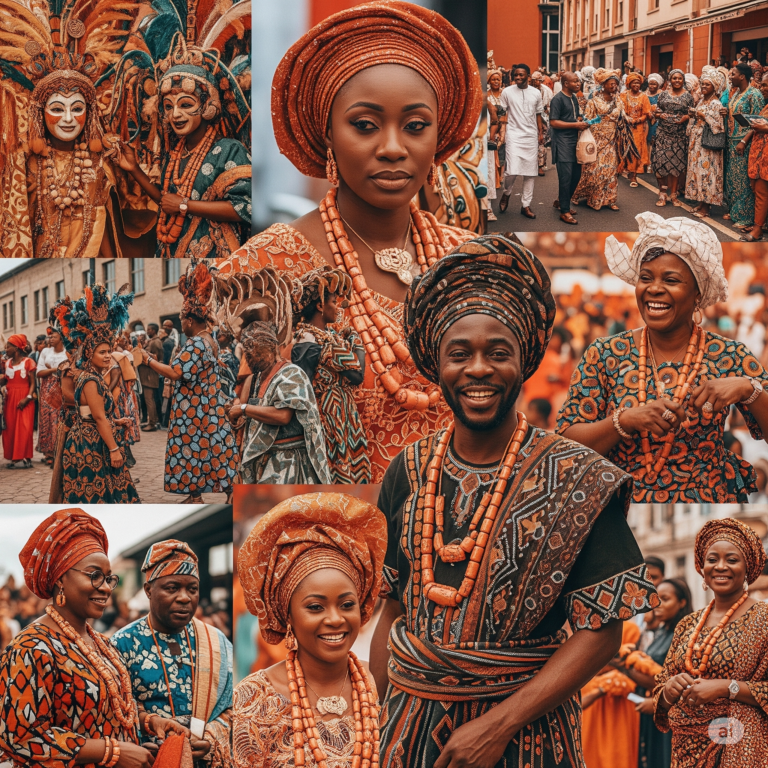
Igbo Diaspora
Igbo Diaspora

The Igbo diaspora’s homeland investment is lagging. A reset is needed to unlock its massive potential.

By Chudi Okoye

If there’s one thing that gives one pause in pondering the persistent claim of Igbo Jewish lineage or broader heritage – apart from the paucity of historical proof – it is the differing attitudes of Jews and Igbos to their respective homelands.

Consider this stark dissimilitude. When Israel launched “Operation Babylon” in 1981 to destroy Iraq’s Osirak nuclear reactor, its fighter jets avoided Ur – Abraham’s birthplace in southern Iraq, now, in Arabic, called Tell el-Muqayyar – as if some ancestral reverence restrained their path. Over the years Israel has launched other attacks on Iraq – an ancient power which, as Babylon, brutally oppressed the Jews. Yet it has never struck that sacred ground, once described by Pope Francis as “the place where faith was born.”

By contrast, Igbo separatists invoking Jewish kinship have shown little such restraint. Under IPOB and its armed wing ESN, they impose coercive sit-at-home orders that have crippled the very homeland they claim they’re trying to liberate. Since 2021, the campaign has triggered 332 violent incidents, claimed 776 lives, and cost ₦7.6 trillion in economic damage, according to SBM Intelligence. Modeled, perhaps, on a 1961 South African anti-apartheid protest, the IPOB version is not brief and voluntary, but indefinite, compulsory, and self-defeating. Israeli jets spared their symbolic origin; Igbo militants ravage their own.

But that’s only one distinction. Consider also the specter of homeland crisis which afflicts both Israel and Igboland, and the contrasting attitudes of Jewish and Igbo diasporas: one showing fortitude and patriotic risk acceptance; the other, for the most part, risk aversion and apparent withdrawal.

Jewish Diaspora
Throughout Israel’s tumultuous history – marked by wars, intifadas, rocket attacks, and retaliatory strikes – the Jewish diaspora has remained deeply engaged in Israel’s survival and development. From the Nakba (the mass displacement of Palestinians) and the 1948 Arab–Israeli War to the current Gaza and Iran flashpoints, diaspora commitment has remained steadfast, not just in sentiment but in strategy and substance.

Between 1948 and the early 2000s, diaspora Jews contributed an estimated $40–60 billion to Israel through direct aid, endowments, and philanthropic organizations, funding housing, education, and immigration absorption. U.S. Jewish philanthropy alone contributes over $2 billion annually, supporting hospitals, universities, and cultural programs.

A pillar of this commitment is Israel Bonds, which have raised over $50 billion since 1951 to support national development. After the October 7, 2023 Hamas attacks, diaspora Jews mobilized $1.4 billion in emergency aid and within months purchased $3.6 billion in Israel Bonds – reviving a tradition seen during previous crises: $250 million raised in 1948, and $700 million during the 1973 Yom Kippur War. Today, diaspora Jews inject around $3 billion annually into Israel’s economy, not merely as financial flows but as expressions of solidarity and enduring faith in the homeland.

Beyond economic commitment, the Jewish diaspora wields extraordinary influence in securing foreign government support, especially from the United States. According to the Council on Foreign Relations, the U.S. has provided over $310 billion (inflation-adjusted) in aid to Israel – more than to any other country. This reflects not only shared values and strategic alignment but also persistent, organized lobbying by powerful Jewish advocacy networks.

That support extends further. The U.S. has cast 50 of its 88 UN Security Council vetoes to shield Israel from critical resolutions. In moments of crisis, diaspora-aligned influence has been decisive. Most recently, against domestic opposition, it drew America into Israel’s confrontation with Iran, culminating in the June 21, 2025 U.S. strike on Iranian nuclear facilities. The New York Times estimated that the mission cost the U.S. hundreds of millions of dollars in munitions and logistics alone. Israeli lobby at times drives the world’s most powerful state to self-abnegating behavior.

The Jewish diaspora’s reach extends beyond diplomacy. It brokers defense contracts, technology transfers, and global partnerships that reinforce Israel’s resilience. The diaspora not only supports Israel, it reshapes the world around the homeland to secure its future.

Diaspora support also manifests demographically. Aliyah – Jewish return to the homeland – has brought over 3.4 million immigrants since 1948, helping build a Jewish population of 7 million in a nation of 9.5 million. This has ensured Jewish political dominance; but these immigrants also bring capital, connections, and competence, powering Israel’s rapid ascent. It is proof that, for some diasporas, homeland crisis is not cause to flee but to flex – a summons to destiny.

Igbo Diaspora
Igbo diasporans – abroad or dispersed within Nigeria – are widely recognized for their high achievement in business, academia, and the professions. In some countries, for instance the United States, they are cited as an example of successful immigrant communities, though in others they are considered overly aggressive and a touch overbearing. In general Igbo diasporans maintain strong emotional and cultural ties to their homeland. They are known to send significant remittances back home, often to support kith and kin, though there remains substantial headroom in terms of their direct investment in the South East economy. Many diasporans harvest Igbo identity but do not invest in the land.

This mixed record becomes even more confounding when one considers the magnitude of the diaspora’s potential. PricewaterhouseCoopers (PwC), leveraging data from World Bank, Central Bank of Nigeria, money transfer operators (MTOs), and commercial bank channels, estimates that Nigerians abroad remit $20–25 billion annually. The United States alone contributes around $6 billion – about a quarter of the total. According to the U.S. Census Bureau’s American Community Survey (2022), Nigerians in the U.S. number around 760, 000, and the Joshua Project estimates that Igbos comprise roughly 237,000 – or 31%. If that proportion holds true for remittances, Igbos in the U.S. speculatively send home about $1.86 billion annually. At today’s exchange rate, that amounts to nearly ₦2.88 trillion – equivalent to 82% of the combined 2025 state government budgets in the South East. This figure excludes remittances from Igbos in Europe, Canada, and other parts of the world, which could push the presumptive total significantly higher.

These are, of course, hypothetical extrapolations. It is highly unlikely that Igbo diasporans remit anything near the logic of these assumptions. We can also assume that a significant portion of their actual remittance finds a pipeline into places like Lagos, Abuja, or other attractive destinations. Worse, the trickle that does reach the region is often absorbed in subsistence consumption, ceremonial spending, or prestige projects rather than enterprise development. All these scenarios are troubling, revealing a serious misalignment between diasporic wealth and homeland development. What should be a source of renewal risks becoming a sinkhole of lost opportunity.

Part of the problem may be that the Igbo diaspora is far from monolithic. Some are deeply assimilated in host societies with little homeland consciousness. Others maintain a visible Igbo identity but show little practical interest in engaging the homeland. Some remit to support family or political causes but do not view the homeland as an investment frontier. A smaller cohort is indeed committed to economic engagement. But even among these, a large portion hedge their portfolios elsewhere in Nigeria. Some do so because they perceive, and do receive, better returns outside Igboland. Others are probably deterred by past experiences of fraud; or are concerned about proximity to social obligations that erode capital. Yet others, probably the majority, are repelled by stubborn insecurity in the homeland.

What’s striking is that many Igbos who avoid investing in the South East readily commit resources to regions that are just as volatile. They invest in the North, where sectarian violence simmers, or in the South West – especially Lagos – despite periodic property demolitions and complaints of ethnic discrimination. They absorb these external threats as costs of doing business, yet judge similar or lesser risks in the homeland as disqualifying. This apparent double standard reveals not just a risk calculus, but deeper concerns.

Part of these concerns is the region’s extensive infrastructure deficits. There is no seaport in the South East, no standard-gauge rail or competitive international airport, and there are few serviceable roads to power the regional economy. No major bank is headquartered in the South East. The region also suffers from erratic power supply, poor digital infrastructure, and the absence of designated industrial or logistics hubs. This logistical bottleneck undermines both real and perceived returns. Meanwhile, the Igbo political elites – who often preach the imperative of “aku luo uno” (wealth repatriation) – are largely opportunistic and extraverted. Many run businesses outside the region, station their families abroad or elsewhere in Nigeria, and retreat to Abuja or Lagos after their tenures, treating the South East as a temporary duty post rather than a permanent stake. The hypocrisy is corrosive – reinforcing the very disinvestment they decry.

Even the “aku luo uno” mantra itself may inadvertently encourage a ceremonial, rather than productive, conception of investment. Originally a cultural ethic for wealth repatriation, it is too often interpreted as building a showpiece mansion, hosting lavish events especially during traditional homecoming, or performing kin obligations – not founding enterprises or driving local economic transformation. Home becomes less a place to pursue high ambition and more a stage for self-celebration.

The situation is worsened by separatist agitation. When IPOB militants impose coercive sit-at-home orders, they create an atmosphere of insecurity, disrupt commerce and undermine productivity. These conditions heighten diasporan hesitance, making the South East even less competitive for capital.

But deeper explanations lie in the sociological roots of Igbo itinerancy. The region’s dense population and limited arable land historically fostered outward mobility – what’s been called “economic self-propulsion.” Without centralized kingdoms, the Igbo political structure emphasized personal initiative, enabling migration. Title systems rewarded individual achievement. Trade routes thrived. Over time, mobility became identity.

The Nigerian Civil War further cemented this pattern. After the devastation of 1967–70, Igbos were forced to rebuild through dispersal, having lost assets and status in the post-war order. That emergency turned into a long-term strategy. Diaspora became destination. Home, once the center, became optional.

Today, even after flourishing in business and the professions across Nigeria and abroad, many Igbos maintain this outward posture. It results in a twinned risk and value calculus that leads, in some cases, not just to a brief or strategic disengagement but to permanent withdrawal. Homeland investment shrinks, emotional attachment withers, and alienation deepens, potentially across generations.

Meanwhile, a quiet demographic shift is unfolding within Igboland itself which complicates the picture. As the educated indigenes of Igbo states like Anambra migrate out of the region in search of greener pastures, less-privileged Igbos from neighboring states, along with northern and Middle Belt migrants, are moving in, seeking opportunity, and putting down roots. Over time, these shifts could alter the region’s cultural and economic landscape, with potential political consequences.

Where the Jewish diaspora surges toward homeland crisis, often in defiance, many Igbos recoil from theirs, repelled by risk and precarity. The irony is profound: a people claiming kinship with Jews increasingly abandon their ancestral land. This raises a pressing question: do modern Igbos, for all their pride in identity, feel a strong attachment to their homeland?

The answer isn’t altogether reassuring. Igbo migrations across Nigeria even before amalgamation; the cosmopolitan leanings of leaders like Dr. Nnamdi Azikiwe; and the Igbos’ rapid postwar return to other regions – including the North where they had suffered pogroms – all indicate a cultural disposition toward dispersal rather than rootedness.

If this desertion persists, a cruel fate may unfold. With Fulani encroachments advancing in the South East, the old Zionist slogan, “a land without a people for a people without a land,” once used to justify Palestinian dispossession, could one day be turned against those who claim Jewish descent. Worse still, if nothing changes, some Igbo diasporans may indeed become a “lost tribe” – not unlike the ten tribes of ancient Israel, exiled by the Assyrians in the 8th century BC, whose descendants vanished into the mists of history.

Several groups – including one I’m actively involved with, the South East Business and Investment Summit (SEBIS) – are working to reverse this trend and reposition Igboland as a viable economic destination. Re-engaging the diaspora is central to that effort, through institutionalized investment vehicles like Igbo Bonds, dedicated diaspora engagement offices, and public-private partnerships to de-risk major projects. But success depends on understanding diaspora fragmentation and the reasons for disconnection.

To borrow a metaphor from my tech background, the Igbo diaspora needs to move beyond the classical computing model, where “bits” – the basic unit of data – are either 0 or 1, and adopt a quantum mindset. In quantum computing, “qubits” exist in superposition, simultaneously 0 and 1. Likewise, the diaspora must transcend the binary choice of “home” or “abroad” by thriving globally while investing deeply in the homeland, harnessing their worldwide presence to fuel regional development.

With proper strategies and persistent outreach, the mental clogs can be unblocked and the vast potential of the Igbo diaspora unlocked, for the long overdue task of homeland development.
Israel vs. Iran: Ancient Amity, Modern Enmity, and Looming Calamity (Pt. 2)

0
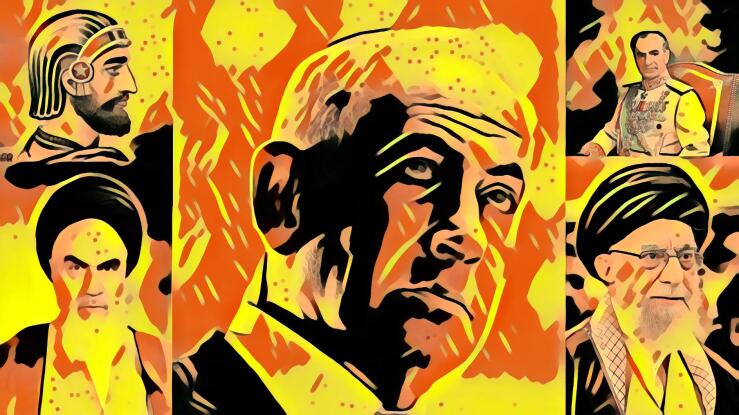
Israel and the Persians - Cyrus, Shah, Iran's Supreme Leaders and Netanyahu

In a tragic historical twist, Israel and Iran have gone from millennia of fraternity to a fratricidal war. Part 1 of this essay explored their current conflict; Part 2 traces the origins of the rupture.

By Chudi Okoye

He was a gentle and Gentile king, a conqueror and yet pragmatic ruler upon whom ancient Jews fastened their fervent hope. Though he didn’t worship their God YHWH, he was venerated in their Holy Scripture, lauded alike by their prophets and political leaders.

Over a century earlier the great prophet Isaiah ben Amoz, an astute political observer who watched as powerful Assyria crushed the northern kingdom of Israel in 722 BC, proclaimed the conqueror an instrument of God’s wrath against disobedient Israelites, his words thundering in Isaiah 10:5–6: “Ah, Assyria, the rod of my anger, the staff of my fury! Against a godless nation I send him…” At the time, the Assyrian empire was beginning a westward expansion (ancient Assyria overlapped the modern territories of northern Iraq, northwestern Iran, southeastern Turkey, and eastern Syria), threatening Israel which controlled strategic Mediterranean ports and was thus in constant tension with the Near Eastern powers seeking coastal access.

Disciples in Isaiah ben Amoz’s prophetic tradition, writing about two centuries later in the second part of the Book of Isaiah (chapters 40-55, known as Deutero-Isaiah), picked up on a different geopolitical dynamic. The setting was 539 BC, nearly five decades after 586 BC when the Judaeans were sacked by the Neo-Babylonian king, Nebuchadnezzar II, who destroyed the First Temple (built by Solomon) and carried them into exile. By now, Nebuchadnezzar had been dead for over 20 years and Nabonidus, his fourth successor and a weak ruler without royal lineage, was on the throne. A new regional power, Persia (modern Iran), had arisen. Led by a canny warrior king, Cyrus, it had toppled several empires – Media, Lydia – and had wobbly Babylonia firmly in its sights.

In 539 BC, Cyrus the Great marched into Babylon and deposed its reigning king who hardly put up a fight. He proceeded to free the varied peoples in Babylonian captivity, including the Judaeans. Writing either prophetically before this epochal event, or retrojecting politically after the fact (scholars still debate the timing), the authors of Deutero-Isaiah proclaimed Cyrus the “anointed one of God” or “Messiah,” the one chosen by God to liberate Judah from Babylonian bondage – the greatest tragedy in Jewish history, barring the Holocaust. It is worth quoting what the Jewish scribes said of this Iranian ancestor who worshipped a different deity:

“Thus says the Lord to His anointed, to Cyrus, whose right hand he has grasped to subdue nations before him: ‘I will go before you and level the mountains; I will break in pieces the doors of bronze and cut asunder the bars of iron. I will give you the treasures of darkness and the hoards in secret places, that you may know that it is I, the Lord, the God of Israel, who call you by your name. I summon you by name and bestow on you a title of honor, though you do not acknowledge me. I will gird you, though you have not known me, that men may know from the rising of the sun and from the west that I am the Lord, and there is no other.’” (Isaiah 45:1-6; cf. Psalms 107:16).

Cyrus the Great remains the only non-Jew to be honored as “Messiah” in the Hebrew Bible – a title the Jews withhold to this day from Jesus, the man from their midst widely acknowledged as such by Christians and even Muslims. The Iranian ancestor is celebrated by the Jews not only because he freed them from bondage and facilitated their return from exile. He also issued edicts which gave them religious freedom (see Ezra 1:1–4; 2 Chronicles 36:22–23, and also the Persian document, Cyrus Cylinder), and even bankrolled the rebuilding of their Temple (see Ezra 6:3–5; cf. Isaiah 44:28; 45:13,). He established a legacy of tolerance and patronage picked up by his successors, including Darius the Great who completed the construction of the Second Temple in 516 BC, and Artaxerxes I who empowered Ezra and Nehemiah to restore Jewish religious and civic life. Not only is Cyrus exalted in the Tanakh, the Hebrew Bible; he is also mentioned in the Talmud, the rabbinic interpretation of Jewish foundational text where he is praised as a righteous Gentile king who acted justly among the nations.

There’s not a non-Persian patron of the Jews in succeeding centuries who comes close to Cyrus the Great’s generosity or matches the legacy he left behind. Not Alexander the Great, who merely exempted Jews from taxation. Not his successors, the Ptolemies and Seleucids, who oscillated between tolerance and repression, often interfering in Jewish religious affairs (the Seleucid king, Antiochus IV Epiphanes, persecuted the Jews and desecrated the Temple, sparking the Maccabean revolt in 167 BC). Not even Rome’s Herod, the client king of Judea, whose grandiose Temple renovations could not conceal his role as imperial puppet. Only perhaps Emperor Constantine’s patronage of Christianity over eight centuries later, and America’s ardent support of Israel in modern times (often seemingly against its own interests), could approximate Cyrus’s enduring impact. Even so, Cyrus’s legacy of Jewish restoration reverberated far beyond his reign, setting in motion millennia of amity between Persians and Jews, making the current enmity between Iran and Israel – and the calamity it portends – all the more tragic and ironic.

A Benign Legacy
The era of Achaemenid restoration under Cyrus the Great, Darius I, and Artaxerxes I laid a durable foundation for Jewish life within the Persian realm. Far from being an isolated golden age, its legacy of religious freedom, political autonomy, and financial support inaugurated a post-exilic order and the Second Temple era, defining Jewish-Persian relations for over two millennia. Jewish communities in Persia (later Iran) often fared better than their diaspora counterparts, flourishing while others faced persecution.

After the Achaemenid Empire fell to Alexander the Great in 330 BC, Jewish communities survived the turmoil of Hellenistic rule and later thrived under successive Iranian dynasties. They enjoyed considerable autonomy under the indigenous Parthian dynasty (247 BC–224 AD), with a recognized communal authority. The Parthians were generally tolerant, and under their rule Jewish scholarship flourished, laying the foundations for the Babylonian Talmud.

Under the Sasanian Empire (224–651 AD), the last pre-Islamic indigenous dynasty, Jewish populations expanded across Persian cities like Hamadan, Isfahan, and Susa. Zoroastrianism was made state religion, causing tensions and occasional Jewish persecution. Yet Jewish religious and intellectual life thrived, with the Babylonian Talmud completed and canonized during this period: another Jewish milestone under Persian rule, after Babylonian liberation and the Second Temple. Persian Jewry so flourished – in contrast to Roman Byzantine where Christianity was rising – that in 614 AD when Persians briefly captured Byzantine Jerusalem, local Jews aided them, hoping for liberation.

The Arab conquest of Persia in the 7th century introduced Islam as the dominant religion, reshaping the socio-political order through what would become the longest governing tradition in Iranian history. Seen as “People of the Book” (community with revealed scripture), Jews were protected but designated second-class citizens under Islamic law. Still, they retained communal autonomy and persisted as part of Persian society through successive Islamic dynasties – Umayyads, Abbasids, Buyids, Safavids, Qajars – contributing in fields like medicine, commerce, and crafts. Persian Jews even thrived under Mongol rule (1256–1353), which otherwise devastated Islamic civilization and ended the Abbasid Golden Age. Later, Shi’a consolidation under the Safavids (1501–1736) introduced stricter religious controls and occasional forced conversions, foreshadowing the 1979 Islamic Revolution. Yet most disruptions were localized or temporary, and many forced converts quietly returned to Judaism. In cities like Isfahan, Shiraz, and Tehran, Persian-Jewish culture endured, shaped by resilience and adaptation.

Pahlavi and Discontent
Jewish life in Persia thrived across centuries under indigenous dynasties, and did as well, despite challenges, under Islamic rule. This stood in contrast to the expulsions and pogroms that plagued Jewish communities in Christian Europe. Through its many dynastic changes and shifting religious tides, Persia remained a safe Jewish home, despite occasional challenges, becoming even more propitious in the 20th century under the Pahlavi dynasty (1925–1979), during which Persia – long so designated internally – was officially renamed Iran.

Although the Pahlavis ruled as monarchs, they inherited a constitutional framework established during the 1905–1911 Constitutional Revolution, which introduced a parliament and the office of Prime Minister, thus curbing absolutist power. This system produced an uneasy balance between royal authority and popular sovereignty that would later be sorely tested.

The dynasty’s founder, Reza Shah, was a secular modernizer who repressed clerical influence and pursued aggressive nation-building. But in 1941, amid World War II and Allied fears of his Nazi sympathies, he was forced to abdicate in favor of his son, Mohammad Reza Shah. The younger Shah inherited a more volatile domestic environment, where nationalist sentiment – especially over Iran’s oil resources – was rapidly growing. That movement culminated in the rise of Prime Minister Mohammad Mossadegh, who in 1951 nationalized the British-controlled Anglo-Iranian Oil Company, triggering a geopolitical crisis.

In 1953, Mossadegh was overthrown in a coup orchestrated by British and American intelligence. During the unrest that followed, the Shah briefly fled the country, but was soon reinstated with expanded powers. While this secured Western oil interests, it also deepened nationalist resentment against foreign meddling that in turn emboldened authoritarian rule. Though the Shah promoted modernization and was allied with the West, beneath the surface, tensions simmered – between secular elites and religious traditionalists, between economic development and political repression.

Amid this turbulence, the Jewish community in Iran found room to flourish. The Pahlavis promoted education and integration, and under their rule Jews increasingly entered universities, expanded into the modern professions, and in some cases rose to positions of national influence. By mid-century, the Iranian Jewish population – over 80,000 strong – was among the largest in the Middle East outside Israel. Synagogues thrived, Hebrew education was tolerated, and Zionist sympathies, though quiet, weren’t suppressed. When Israel was established in 1948, Iran under the Shah maintained informal ties, and in 1960 became the second Muslim-majority country to offer Israel a de facto recognition.

This was, in many ways, the final flowering of a relationship more than two millennia old, rooted in Cyrus the Great’s sixth-century BC edict freeing the Jews from Babylonian exile and enabling their return to rebuild the Temple in Jerusalem. From that ancient restoration to the modern expansions under Pahlavi rule in the 20th century, Persian-Jewish coexistence had endured – tested, stretched, but never broken.

Yet under the surface, a very different force was gathering. The Shah’s unbridled embrace of Westernization, his clampdown on dissent, and the perceived erosion of Islamic values gradually fused into a potent ideological movement. Clerics, nationalists, and leftists – unlikely allies – began to coalesce around a growing opposition. By the late 1970s, that current would surge into a revolution, sweeping away the Pahlavi order, severing Iran’s deep ties to Israel, and inaugurating a new era of estrangement – religious, political, and profoundly symbolic. The long arc of Persian-Jewish amity was about to be broken, with fraternity turned fratricide.

Revolution and Rupture
The bond finally broke in February 1979, after a year-long revolutionary fervor that began in January 1978. The Islamic Revolution, fueled by popular discontent, economic strain, and outrage at Western domination, swept away the Shah and installed a theocratic regime under Ayatollah Khomeini. I was a schoolboy then, but I remember it clearly, with the Ayatollah’s posters everywhere in Nigeria, especially in the North. The revolution was popular with Islamic revivalists as well as anti-imperialist forces in the country. It unfolded in the final stretch of a ‘radical’ Murtala-Obasanjo military regime that had opposed apartheid South Africa, supported nationalist movements across Africa, and was preparing a return to civilian rule.

In a swift turn, Iran’s posture toward Israel hardened into open hostility. Diplomatic ties severed and the Jewish state was recast, with America, as the chief antagonist to the new Islamic republic. Though Jews were not formally expelled and a small community remains, over 70,000 fled, many fearing violence and property dispossession. A relationship consecrated by Cyrus’s ancient decree was undone by a revolution that cast Persians and Jews into mutual estrangement.

Now, nearly half a century later, that estrangement has curdled into kinetic confrontation, with Israel’s June 13 offensive against Iran, which I discussed in Part 1 of this essay. As Israel and Iran trade attacks and threats, their enmity deepens into something nearly unrecognizable from the ancient fraternity they once shared. In announcing the Israeli attack, Prime Minister Benjamin Netanyahu sought to reassure Iranians that Israel’s war is not with them but with their regime. “I believe that the day of your liberation is near,” he said, envisioning the revival of “great friendship between our two ancient peoples.”

It is a noble hope; yet a deeply improbable one. Even if Iran’s regime were to fall, the scars left by wars, assassinations, cyber-sabotage, and escalating brinkmanship will not heal quickly. Resentment will fester, fueled further by Israel’s hardline posture toward the Palestinians and its wider regional assertiveness. And if the U.S., under pressure from right-wing hawks, enters the fray, the entire region could tip into convulsive destabilization.

This is not the road to a renewed friendship. It is the coda to a historical amity inaugurated by Cyrus, now bent into bitter enmity, one that portends unimaginable calamity.

Israel vs. Iran: Ancient Amity, Modern Enmity, and Looming Calamity (Pt. 1)

0
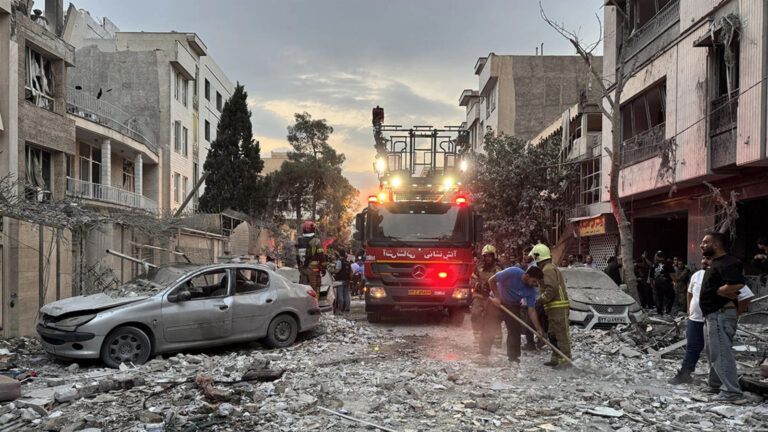
Devastation in Israel-Iran War

This two-part essay traces how Israel and Iran, once bound by a shared past, became bitter foes. Part One examines the current stand-off; and Part Two will unearth the deeper roots of their rupture.

By Chudi Okoye

If the 6th-century BC Achaemenid king Cyrus the Great were alive today, there’s no telling how he would view the ongoing hostilities between his Iranian (Persian) descendants and the Israeli progenies of an ancient people he once liberated from Babylonian captivity. Known to be just and benevolent – a peacemaker and tolerant ruler who supported local customs among the disparate peoples of his vast empire – it is unclear whether his noble sensibilities would be wounded by the crass calculations and decades-long furies that now define Iran-Israel relations, which exploded in the last couple of days with a terrifying Israeli attack on Iran.

It was an attack that once again demonstrated Israel’s power and absolute military superiority in the Middle East. An attack that made nonsense, yet again, of the risible propaganda that portrays Israel – a nation with immense diplomatic leverage and the world’s 15th strongest military – as a regional underdog: the solitary David pitched against a plethora of implacable Arab Goliaths. 

It was a measure of that superiority that even though the attack had been telegraphed for months, it still caught Iran off-guard, as it appeared initially dazed and overwhelmed. Iran may have been lulled by what now seems a dubious and possibly diversionary nuclear parley with the United States; but Israel’s long history of sabotaging Iran’s nuclear infrastructure and its stated objections to the talks should have signaled an imminent strike to derail it.

Hot War
In the pre-dawn hours of June 13, 2025, the Iranian skies lit up with fearsome fire and fury. In a meticulously coordinated operation, more than 200 Israeli fighter jets, supported by drone squadrons, electronic warfare platforms, and precision cyber strikes, unleashed an unprecedented aerial assault across Iranian territory. Over 100 targets were struck, ranging from nuclear research facilities and missile bases to command centers and military infrastructure.

The scale of the operation was staggering. As was its sophistication. Israeli F-35 stealth fighters reportedly penetrated Iranian airspace undetected, their electronic warfare suites jamming radar networks across a broad arc – from the northwestern city of Tabriz to Isfahan in the central region, home to critical nuclear infrastructure. Simultaneously, cyber weapons – likely evolved from the infamous Stuxnet virus that had previously disrupted Iran’s enrichment program – disabled key nodes in Iran’s integrated air defense system. The operation demonstrated Israel’s formidable reach and technical prowess, while exposing surprising vulnerabilities in Iran’s air defense posture.

The devastation was surgical and extensive, though questions remain whether Israel achieved its ultimate objective: a decisive degradation of Iran’s nuclear capabilities. On the first day and in follow-up strikes over the next several days, Israel reportedly destroyed parts of the famous Natanz nuclear facility and damaged Isfahan’s uranium conversion plant. Missile complexes near Tabriz and Kermanshah were hit, as were Islamic Revolutionary Guard Corps (IRGC) facilities near Tehran and in Piranshahr. Civilian infrastructure and military assets were also damaged or destroyed, underscoring the breadth of the assault.

The strikes hit multiple high-value targets, including the Arak heavy-water reactor complex, the classified Parchin military research center, and sections of the Fordow Fuel Enrichment Plant. Also targeted was the previously undisclosed Qom Nuclear Research Institute, where Iran had reportedly made breakthroughs in uranium metallurgy – a critical step toward weaponization. Its destruction carried deep symbolic weight: this was believed to be a site where Iranian scientists had been working to overcome the final technical barriers separating civilian nuclear activity from military capability.

Still, despite the scale and coordination of the attack, it remains unclear whether Israel breached Iran’s most deeply fortified nuclear redoubts. Analysts later confirmed that Iran’s most heavily protected subterranean installations – such as the deeply buried centrifuge halls at Fordow and Natanz – remained largely intact, shielded from destruction by their extreme depth and reinforced structure. While the strikes delivered a powerful demonstration of Israeli resolve and capability, they may not have eliminated Iran’s nuclear breakout potential.

By the end of the first day’s attacks, Iran reported at least 78 dead and 329 injured, including civilians (many women and children), with the death toll since rising to 224 and injuries at over 1,277. The strikes decimated Iran’s military leadership, some sources reporting that at least 20 senior commanders were killed. Among the dead were Armed Forces Chief of Staff Mohammad Bagheri, IRGC Aerospace Force chief Amir Hajizadeh, IRGC senior commander Gholam Ali Rashid, IRGC commander Hossein Salami, IRGC air defense unit commander Davoud Shaykhian, and IRGC drone unit commander Taher Pour. Israel claimed a strike on an underground bunker killed most of the IRGC Aerospace Force leadership after they had convened for a meeting. At least nine nuclear scientists were confirmed killed by Israel, some sources reporting up to 14, including physicists Fereydoon Abbasi and Mohammad Mehdi Tehranchi, successors to Mohsen Fakhrizadeh, the celebrated chief of Iran’s nuclear program who was assassinated in 2020. The attacks, described by observers as a systematic decapitation strike, also destroyed residential areas, with Iranian media confirming civilian deaths and injuries in multiple provinces. In a sign of internal fallout, Iran executed one of its nationals days later for allegedly passing intelligence to Israel.

Though it had to have expected the blitzkrieg, Iran’s response was forceful but ultimately constrained by Israel’s technological edge. In the hours and days that followed, Tehran launched at least 370 ballistic missiles and hundreds of drones in successive waves, targeting Israel’s military bases in the Negev and suspected intelligence facilities near Tel Aviv, as well as civilian areas. Israel’s layered defenses – Iron Dome, David’s Sling, Arrow systems, and the Terminal High Altitude Area Defense (THAAD) – intercepted a preponderance of incoming projectiles, but some missiles penetrated, striking 30 locations and causing significant casualties and infrastructure damage, including in central Tel Aviv and Bat Yam. As of June 16, at least 24 Israelis had been killed and 592 wounded, with 10 in critical condition. Iran claimed to have downed Israeli F-35 fighters and detained their pilots, but Israel has vigorously denied these claims and no independent verification has emerged. The exchange, while illustrating Iran’s capacity for retaliation, also underscored the stark power asymmetry at this early stage of the confrontation, especially following years of crippling sanctions. Iran’s proxy responses – symbolic salvos from Hezbollah in southern Lebanon and Houthi forces in Yemen – were easily intercepted.

Grim Implications
In short order, the message became clear: Israel’s “Operation Rising Lion” was not merely a preventive strike. It was a demonstration of dominance. Tel Aviv framed the attack as a preemptive move against an imminent Iranian nuclear breakout – citing intelligence that Tehran had amassed enough 60%–enriched uranium for three nuclear warheads within months – but the scale and precision of the strike signaled something far more assertive. This was not deterrence; it was dominion, the posture of a regional hegemon asserting its primacy.

The international response only confirmed Israel’s diplomatic insulation. While China and Russia issued routine condemnations, the United States offered tepid criticism and privately welcomed the degradation of Iran’s nuclear capabilities. European powers urged “restraint from all sides,” which, in effect, offered tacit approval of Israel’s actions. Even traditional backers of Iran, like Turkey and Qatar, limited themselves to rhetorical protest, unwilling to directly challenge Israel’s growing power.

Most telling, however, was muted reactions from Arab capitals. Saudi Arabia, the UAE, and Egypt – once reliable critics of Israeli military aggression – remained notably restrained. Their caution reflected a deeper geopolitical shift in the region, with many Sunni Arab states increasingly disposed toward accommodation with Israel. The 2020 Abraham Accords – brokered by the first Trump administration – appear to have crystallized this shift. These agreements, which normalized relations between Israel and the UAE, Bahrain, Morocco, and Sudan, did more than disrupt decades of Arab consensus linking normalization to Palestinian statehood. They established a tacit alliance architecture that isolated Iran, enhancing Israel’s ability to project power in the region.

The durability of this realignment became undeniable after October 2023, when the Abraham Accords’ signatories maintained diplomatic ties with Israel despite its devastating campaign in Gaza, which by some estimates has killed over 50,000 Palestinians. These agreements have afforded Israel not only diplomatic cover, but also intelligence-sharing partnerships, overflight rights, and economic integration – tools that have strengthened its strategic reach while shielding it from political fallout. Public anger has simmered in Arab streets, especially over what many view as Israel’s disproportionate and possibly genocidal campaign, using the pretext of seeking to destroy Hamas as cover for systemic ethnic cleansing. That Israel – a military power capable of flying fighter jets and precision munitions over 2,000 kilometers to strike hardened targets in Iran – has failed to dislodge Hamas militants barely 50 kilometers away in Gaza, has raised uncomfortable questions about its intent. Yet, despite the street rage, several Arab governments appear to prioritize Iran containment over Palestinian solidarity, thus insulating Israel from criticism over Gaza or Iran.

The current stand‑off with Iran represents only the latest escalation in Israel’s broader regional campaign. Since the Gaza war began, Israel has intensified its operations across multiple theaters. In April 2024, for example, it struck an Iranian consulate annex in Damascus killing 16 people, including seven IRGC officers and Brig. Gen. Mohammad Reza Zahedi, a senior Quds Force commander coordinating Iran’s activities in Syria and Lebanon. In July, Ismail Haniyeh, Hamas’s political leader, was assassinated in an Israeli strike on an IRGC guesthouse in Tehran. In Lebanon, Israel launched a massive air campaign in September, culminating in the assassination of Hezbollah Secretary-General Hassan Nasrallah and strikes that killed over 800 people and injured thousands, devastating Hezbollah’s leadership and infrastructure. In Yemen, Israeli air and naval forces have steadily degraded Iran-aligned Houthi infrastructure. And in the occupied West Bank, settlement expansion continues apace, accompanied by frequent strikes on Palestinian militants and infrastructure. These coordinated strikes are not the actions of a besieged state, but the prolonged strategy of a regional power reshaping the strategic map across its periphery.

The ongoing hot war with Iran shows no sign of abating. With stakes so high on both sides, neither appears willing to de-escalate. Iran’s Supreme Leader, Ayatollah Khamenei, has vowed “crushing retaliation” and ordered the acceleration of uranium enrichment to weapons-grade levels. Given that Iran’s underground and heavily fortified facilities at Fordow and Natanz likely sustained only partial damage, enrichment operations may well continue. Israel warns that any further nuclear advances would prompt “even more devastating” strikes. Yet its current arsenal may be insufficient to neutralize Iran’s deepest sites. To complete the job, Israel would likely require access to the U.S.’s Massive Ordnance Penetrators (MOPs), which can only be deployed by American B‑2 bombers. So far, Washington has resisted requests for these. That leaves Israel facing a difficult choice: escalate the campaign and risk dragging the United States into a broader regional war, or pause prematurely and acknowledge that its strategic objectives remain incomplete.

Iran faces equally grim options. Its economy is strangled, proxies degraded, and domestic legitimacy fraying. A restrained response may signal weakness; a bolder counterstrike risks devastating retaliation and possible U.S. intervention. Yet a nuclear retreat seems inconceivable for Iranian hardliners. The country has paid too high a price: assassinated officers, slain scientists, ruined facilities, civilian collateral, and decades of economic siege – much of it inflicted by Israel with Western complicity. Few nations have paid a heavier toll in pursuit of nuclear capability. Had Tehran pursued a pragmatic, low-profile program, it might have reached the threshold with far less carnage. But too much pain and humiliation has accrued, entwining the program with regime survival and national pride. Iran will want vindication and honor for its fallen by finally attaining nuclear status.

Moreover, Israel’s nuclear hypocrisy deepens Iran’s resolve. An undeclared nuclear state outside the Non-Proliferation Treaty, Israel leads the charge against Iran – a signatory professing peaceful use. History, too, shapes Tehran’s view: Gaddafi was overthrown after disarming; Ukraine was invaded post-denuclearization; only defiant North Korea has endured. Iran is watching, and learning.

For all its tactical brilliance, Israel’s strike against Iran may unleash further regional instability. Saudi Arabia and Turkey may now pursue nuclear hedges. And in pursuing its goal of regional dominance, Israel has caused too much pain and devastation for peace to reign. If Cyrus the Great were today observing the behavior of those he once liberated, he might ask how they came to this dark turn. I will explore that question in Part 2.

Beyond Utomi’s ‘Big Tent’: Nigeria Needs Institutionalized Opposition

0
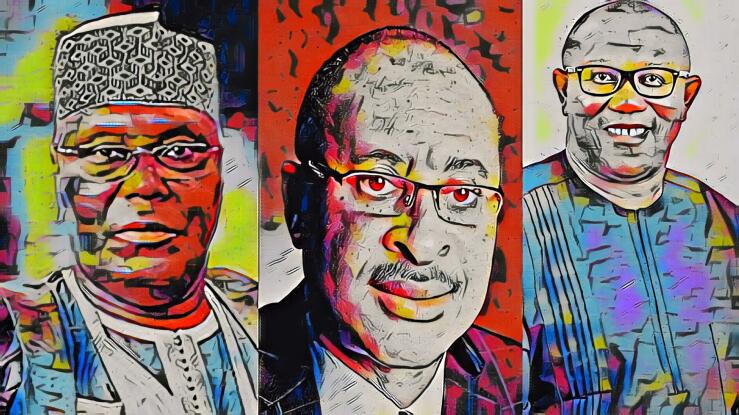
The Opposition - Atiku Abubakar, Pat Utomi and Peter Obi

Pat Utomi’s recently announced ‘Shadow Cabinet’ has stirred controversy, but it reveals the dire need for institutionalized opposition to shore up Nigerian democracy.

By Chudi Okoye

It is truly remarkable, and rather disturbing, when you think about it.

Nigeria’s ruling party, the All Progressives Congress (APC), barely eked out a victory in the 2023 presidential election, clinching a fiercely contested 36.7% plurality. Yet, just two years on, the party bestrides the polity like a colossus, stirring fears of creeping one-party rule. With its recent success in luring Akwa Ibom State governor Umo Eno from the People’s Democratic Party (PDP), APC now controls 23 of Nigeria’s 36 state governorships, along with a Senate majority and dominant plurality in the House of Representatives. The once-preeminent PDP is down to 10 states, while the Labour Party, New Nigeria People’s Party, and All Progressives Grand Alliance each clings to a solitary stronghold. Speculation swirls as well that APC aims to flip vulnerable PDP governors in Adamawa, Enugu, Plateau, and Rivers. Should those materialize, the party would control an incredible 27 governorships. By my estimate using StatIT’s latest State of the States data, this would represent about 74% of Nigeria’s population (up from 63%) and 84% of its GDP (up from 76%).

These are staggering statistics of dominance – undeniable signs of the country’s hegemonic drift. This calls for urgent democratic correction – which is taking shape, though only tentatively and not without controversy.

A few weeks ago in May, amid emerging talks of an opposition coalition ahead of the 2027 elections, news broke that Professor Pat Utomi of Lagos Business School had launched a policy entity and civic engagement forum he calls the Big Tent Coalition Shadow Cabinet. He says it is a “national conscience project” aimed at restoring meaningful dissent in Nigerian politics. Styled loosely after the Westminster model, the initiative seeks to convene technocrats, civil society actors, and opposition figures to assess government performance, offer policy alternatives, and advocate for structural reform. Utomi emphasizes that this is not a political party or electoral vehicle but a “coalition of conscience” – a civic watchdog responding to what he calls a “national emergency” marked by economic collapse, insecurity, and a growing loss of public trust. The group will hold weekly sessions to spotlight failures and propose reforms in key sectors, from education and the economy to constitutional restructuring and electoral law. For Utomi, this is a rallying point for Nigerians who refuse to remain silent in the face of national decline.

You might call this intervention a roar of the lesser opposition, given that Professor Utomi has been largely affiliated with fringe parties that have struggled for electoral traction. His past bids for power, including a 2007 presidential run on the African Democratic Congress ticket and a 2011 shot with the Social Democratic Mega Party, barely registered electorally. Even his later flirtations with APC and Labour yielded little political capital. To borrow Napoleon’s famous quip – later echoed by Stalin – “How many [army] divisions does the Pope have?” One might ask the same of Utomi’s Shadow Cabinet. Yet, considering his stature as a public intellectual, the seriousness of this initiative – and its moral impulse – is undeniable.

It would appear, at least going by this one project, that fringe opposition forces, perhaps frustrated by the feebleness of their frontline counterparts, are attempting to position themselves as the real vanguards of dissent. Perhaps they feel that leadership of the opposition, especially at this critical juncture ahead of the 2027 elections in Nigeria, is too important to be left to the major opposition parties.

If so, it evokes a famous statement by the French statesman and co-architect of the 1918 Treaty of Versailles, Georges Clemenceau: “War is too serious a matter to entrust to military men.” Charles de Gaulle, another famous French figure, offered a much closer riff on the aphorism: “Politics is too serious a matter to be left to the politicians.”

I cite these epigrams in part to applaud Pat Utomi’s project and underscore its importance, though its future remains uncertain. This is, doubtless, a laudable effort – inventive, with clear incentives – but it will demand intensive commitment. The initiative may prove useful in ventilating civic grievances and proposing policy alternatives, yet it lacks statutory authority, so its recommendations may be easily ignored. Moral suasion and ardent policy critique alone may not shift the calculus of a deeply entrenched regime.

Since announcing his initiative, Utomi has faced fierce pushback from government officials, especially over the term “Shadow Cabinet,” which critics argue implies a parallel government. The Department of State Services (DSS) filed a lawsuit against him at the Federal High Court in Abuja, claiming the initiative is an illegal attempt to usurp presidential powers and poses a threat to constitutional order and national security. The DSS requested a perpetual injunction barring Utomi and his associates from establishing or operating the shadow cabinet and sought an interlocutory injunction preventing rallies, media campaigns, and public mobilization until the case, scheduled for hearing on June 25, is resolved.

It’s unclear how the DSS case will be determined. Legal analysts have weighed in on both sides regarding the project’s legality: on the one hand citing the constitution’s freedom of speech guarantees, and on the other its silence on political opposition and the concept of a shadow cabinet. Whatever the case, given the uproar, one wonders whether Pat Utomi’s think-tank might be tanked before it starts the thinking!

Uncertain Role for Opposition
Whatever its fate – whether it flourishes, flounders or totally founders – Utomi’s forum throws into focus a deeper defect of Nigeria’s democratic architecture: the absence of an institutionalized opposition capable of checking executive overreach, offering policy alternatives, and sustaining a pluralistic ethos in governance.

The word “opposition” – or any cognate of it – does not appear in the 1999 Constitution, nor are rival parties given formal roles. While the National Assembly provides for Minority Leaders and Whips, these roles are creations of parliamentary standing orders, not law. They are informal, weakly defined, and largely symbolic within Nigeria’s executive-dominant presidential system.

This marks a stark departure from the First Republic, when a Westminster-style system prevailed under the 1960 Independence and 1963 Republican constitutions. Though not explicitly inscribed in the constitution, the Leader of the Opposition role – held at the federal level by Chief Obafemi Awolowo – was supported by convention, statutes, and legislative norms. Similar to the UK, India, and Canada where the opposition enjoys official recognition, with budgetary support and defined parliamentary privileges, the role in Nigeria during the First Republic carried real influence and visibility: it provided structured scrutiny of government actions, offered alternate policy visions, and stood as a symbolic counterbalance in the democratic process.

Today, in Nigeria’s presidential dispensation, opposition is more intuition than institution. Its influence is shaped largely by the vicissitudes of political culture and the vagaries of personality.  

One former legislator I spoke with about the influence of the minority bloc told me that its actual impact on policy is minimal, citing their size disadvantage. But I wonder if parliamentary size is dispositive. Consider that in the UK the official opposition, the Conservatives Party – currently with just 18.5% of the House of Commons seats (120 of 650) – wields far greater influence on policy and governance than Nigeria’s PDP (the largest opposition party) which currently holds about 33% of the combined National Assembly seats (155 of 469). The Nigerian opposition’s weakness is institutional, if also situational.

Opposition forces are further debilitated by opportunism, with constant party-switching or opposition figures grubbily lobbying the ruling party for personal gain, all of which erodes public trust. The opportunism arises in part from the lack of institutionalized opposition.

My legislator contact pointed to the impact of Nigeria’s political culture, with opposition often misread as disloyalty. He also told me that although the opposition’s role is not constitutionally recognized, it exists “in reality” due to the provisions for freedom of speech and association which are indirect constitutional protections for opposition activity. But this only underscores the institutional ambiguity of dissent in Nigeria’s democracy: opposition survives by inference, not by design.

Opposition weakness in Nigeria is not merely political; it is institutional. Today’s opposition lacks formal standing, defined duties, or sustained support. As a result, dissent is episodic, not systematic. There’s a dire need for institutional correction.

Institutionalizing the Opposition
Nigeria in 1979 adopted a presidential system of government, in part to mitigate the centrifugal pressures that doomed the First Republic. The parliamentary system, inherited at an early stage of national integration, exacerbated the country’s deep fissures. The pivot to presidentialism was based on the belief that a strong, unifying executive – elected by a national plurality but governed by separation of powers – might stabilize the polity and foster a greater sense of inclusion.

But reality has diverged significantly from theory. The Nigerian variant of presidentialism has concentrated power, weakened checks and balances, and marginalized dissent. The result: a shift from power separation to a fusion of powers not dissimilar to what obtained under the parliamentary system – though now without institutionalized opposition. The consequence is imperiled pluralism – dangerous in a multi-ethnic federation, especially with one-party drift and growing evidence of ethnic domination under the APC.

This is why re-institutionalizing the opposition role in Nigeria isn’t mere luxury. It is a democratic necessity. Crucially, such a move isn’t incompatible with presidentialism. Many countries with presidential or hybrid systems have formally recognized opposition roles. In Ghana’s presidential system, for example, the Minority Leader enjoys procedural standing, budgetary support, and real committee influence. In South Africa’s and France’s hybrid systems, opposition figures are granted defined rights, despite a strong executive.

Nigeria doesn’t need to return to Westminster parliamentarianism, though that could certainly be argued. What it needs is a hybrid: a presidential system that includes codified roles for opposition leaders. These should include guaranteed speaking time, policy oversight, shadow portfolios, and budgetary support – all grounded in law. This would not weaken the executive. It would strengthen democracy. It would ensure that all regions and parties – even those out of power – retain a stake in governance.

Democracy is not just elections or majoritarian rule. Nor is it secured by the dominance of a single party. It thrives on the balance between power and accountability, authority and critique. Today, Nigeria’s democratic balance is broken, hence its rating in the Economist’sDemocracy Index as a “hybrid” form. To restore it, we must formalize opposition as a central pillar of governance. This should be considered an urgent system correction as Nigeria marks its 7th Democracy Day and a postcolonial milestone, celebrating 25 years of uninterrupted civilian rule. Only when this is done can the country boast of being a truly responsive and representative democracy.

Reconciling the ‘Okonkwo’ vs. ‘Obierika’ Tension in Igbo Political Strategy

0
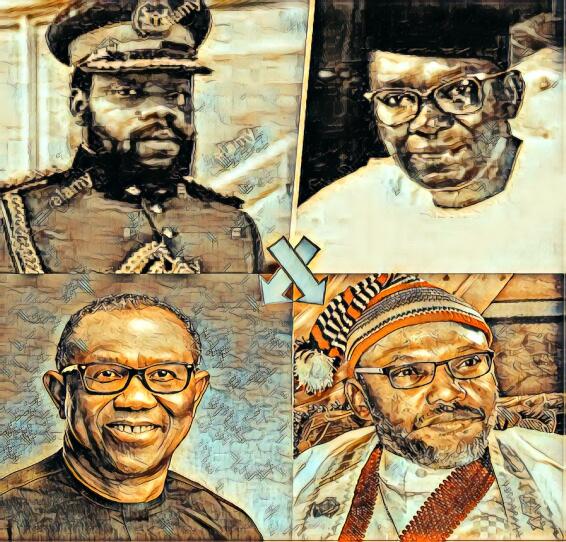
Ojukwu, Azikiwe, Obi and Kanu

In Things Fall Apart, Chinua Achebe depicted Okonkwo and Obierika as contrasting Igbo responses to colonial intrusion. Their symbolic tension persists in Igbo attitudes toward Nigeria today, and must be reconciled for effective political strategy.

By Chudi Okoye

They would not stand for any ‘nonsense’ like cautiousness, temperance, or strategic prudence; nor in their call to arms, tolerate any squeamish talk about avoiding self-harm. In their righteous rage, it seemed an outrage to make such inane suggestions. How dare one urge restraint and acknowledge constraints in the valiant struggle to wrest freedom from an overwhelming and asymmetrical force?

Such was my ‘temerity’ – recently having the effrontery to share my cautionary commentary on a particularly fervent Igbo forum. It elicited furious, and sadly predictable, reactions. In an instant, my sober and sobering piece was pulled, and when re-posted it invited a feverish but failed effort to force it off the forum.

Yet, to be fair, not all reactions were visceral. Cooler heads in that dreaded den seemed to understand and appreciate where I was headed in my latest essay series.

A few days ago, with Biafra Day looming and news trickling out about a potential opposition coalition ahead of Nigeria’s 2027 elections, I began to contemplate an essay on these developments. Initially conceived as a single piece, the effort has evolved into a trilogy.

The first installment welcomed the early opposition stirrings and emphasized the imperative of unity in the face of a flexed ruling party. But it also employed a game-theoretic motif to warn of likely pitfalls in the opposition’s efforts.

The second, published on Biafra Day, honored the occasion but cautioned that what I called “exitism” could undermine Igbo quest for national power, especially in this narrow window for returning to mainstream politics amid emerging coalition talks.

In this third installment, I dig deeper into the pathologies of Igbo politics, leveraging the dialectical tension between the Okonkwo and Obierika characters in Achebe’s Things Fall Apart to describe the contrasting – and often conflicting – tendencies in Igbo culture and their impacts on political behavior. The ‘Okonkwo’ impulse favors confrontation; the ‘Obierika’ sensibility urges restraint.

I attempt a reconciliation of these dispositions – urging a tempered Okonkwo radicalism to animate Igbo political praxis, while cultivating and edifying it with Obierika’s wisdom and prudence – for a more coherent and strategic outcome.

‘Okonkwo’ vs. ‘Obierika’
Most readers will recall the Okonkwo and Obierika characters. Near opposites in temperament, thought, and action, they embody distinct ways of navigating the world. Through them, Achebe reveals a deeper tension in Igbo character: between impetuous valor and reflective prudence, between rigid mindset and pragmatic wisdom. These figures, to an extent, also evoke Carl Jung’s archetypes: Okonkwo as the ‘Hero’ – courageous but impulsive, whose shadow is insecurity and fear of weakness; Obierika as the ‘Sage,’ embodying wisdom, reflection, and adaptability. There are even echoes of these Achebe characters in other literary traditions. You could find the tragic hero Okonkwo in Sophocles’ hubristic Oedipus, and the measured and pragmatic Obierika in Shakespeare’s stoic Horatio. Yet in Igbo society, these archetypes are not merely literary; they manifest in political behavior and responses to existential tumult. Today, these contrasting impulses are mirrored in the strategic impasse of Igbo politics.

Okonkwo is the tragic hero par excellence: bold, martial, impatient with weakness, and uncompromising in his defense of tradition. Haunted by his father Unoka’s perceived failures, he equates strength with moral virtue, and action – especially violent action – with manly dignity. Okonkwo’s obsession with erasing his father’s legacy blinds him to the costs of his choices. He rises swiftly in the social ranks of his clan, Umuofia, by cultivating this reputation for fearlessness and decisiveness. But his rash and impulsive nature proves his undoing. When colonial rule arrives, Okonkwo cannot abide its subversion of Igbo autonomy. He yearns for instant, fiery resistance. And when that is not forthcoming, his people appearing paralyzed and uncertain, he takes his own life in a final, symbolic act of protest. It is an act, ironically, that violates Igbo custom and renders him an abomination even in death.

Okonkwo’s brave but unbending and belligerent spirit has echoed in key figures of Igbo political history. It manifested in Emeka Odumegwu Ojukwu, the bold, charismatic, and military-trained leader who – appalled by the pogroms against Igbos in the First Republic and disillusioned by the unraveling of the Nigerian state – led the Eastern Region into secession and the civil war that followed. His Igbo foil at the time was Nnamdi Azikiwe, a nationalist titan cast more in Obierika’s mold, who initially counseled against secession and, as war broke out, worked diplomatically from abroad to help end it. While Zik the politician sought survival through negotiation, Ojukwu the soldier pursued justice through rupture – their approaches shaped by conviction, character and contrasting careers. The Nigerian state’s military response precipitated a brutal civil war, in which millions of Igbos perished, their homeland devastated, and a traumatized generation scattered. In this tragic arc, the Okonkwo archetype acted – and history still bears the scars.

This tragic cycle did not end with Biafra’s defeat. In the contemporary period, the Okonkwo archetype re-emerged in the person of Nnamdi Kanu and his separatist IPOB movement. Like Okonkwo, Kanu speaks in binary terms – freedom or death, secession or slavery. His rhetoric thrills the disaffected, and his charisma sustains a mythos of impending rupture. Yet, like Okonkwo, his defiance has precipitated no strategic gain. Incarcerated by the state, abandoned by most of the political class, and with splinter IPOB elements now engaged in violent criminality under the guise of liberation, Kanu’s crusade has left Igboland utterly disfigured – economically, politically, and otherwise.

Meanwhile a different tradition, in Obierika’s spirit, has over time proved more effective in transforming the Igbo political landscape. Colonial-era nationalists like Azikiwe secured regional self-government through the 1954 Lyttleton Constitution barely 40 years after amalgamation, followed by independence six years later; while the Okonkwo archetype has pursued Igbo independence from Nigeria for 58 years (since 1967), to no avail. Today, notable Igbo leaders in the Obierika mold, including governors and legislators, are making a difference. They reflect a sober turn in strategy: more technocratic than theatrical; focused on reform and reconstruction, rather than ‘slacktivism’. Their chosen path – negotiation, persuasion – contrasts sharply with the fiery ultimatums of exitism. In different registers, they exemplify pragmatic radicalism: advancing the Igbo cause through coalition-building and institutional engagement rather than isolation. The dividends are visible: improving infrastructure, growing social investment, and a re-energized civic spirit. Their gradual success stands as a quiet rebuke to the futility of performative agitation.

It is this Obierika mindset that I believe must permeate Igbo politics at this critical point, quickened by a tempered Okonkwo spirit. It is what I imply with my concept of pragmatic radicalism – restructuring rather than romanticizing secession, an echo of Obierika’s ethic of sober engagement. Like Achebe’s sage, this approach recognizes that wisdom often lies in navigating complexity, not conquering it. Jung reminds us that societies, like individuals, flourish when the Hero’s drive is balanced by the Sage’s discernment. The integration of these archetypes is the hallmark of maturity – personal and political. This approach is not passive. It recognizes the structural injustices baked into the Nigerian project and seeks their radical undoing. But it does so through coalition-building, institutional contestation, and regional restructuring. It pursues the possible, not an illusory perfect. It seeks to reshape the Nigerian compact rather than shatter it. And unlike the symbolic politics of exitism, which provokes without leverage, pragmatic radicalism marshals tools of real negotiation – demographics, alliances, elite consensus, and electoral strategy – to reposition the Igbo, not as exiles-in-waiting but as co-architects of a re-imagined federation.

The tension between Okonkwo and Obierika is not just a literary device; it is a lens into the pathologies of Igbo politics. Achebe, who understood the pulse of Igbo society like few others, warned that the crisis of modernity would test not only our strength but our wisdom. In this, he shares ground with Sophocles and Shakespeare, whose tragedies dissect the fatal allure of hubris and the redemptive power of prudence. Jung would add that the fate of a people depends on whether its heroes can learn from its sages, and whether the collective can harmonize the urge to act with the wisdom to reflect. In the current political moment, where emotional reflex often masquerades as courage, it is worth asking: which path yields more than momentary catharsis? Which one offers a bridge to real transformation?

The Okonkwo archetype may stir the soul, but it is the Obierika disposition, tempered yet resolute, that is more likely to salvage what must change. The challenge, then, is to transcend this binary and forge a synthesis of both traditions.

‘Obierikonkwo’
The argument advanced by the exitist camp is that the Igbo are so profoundly oppressed within Nigeria that nothing short of secession and sovereignty will suffice. But this thesis collapses when held up to the light of real-world conditions.

To begin with, who authorized this sweeping mandate for secession? Have the exitists consulted the Igbo power elite – the businessmen, professionals, politicians, clergy, and traditional authorities who are deeply invested in the Nigerian project? Have they taken the pulse of the general Igbo population, most of whom live and thrive outside Igboland? Millions of Igbos have made homes in Lagos, Abuja, Kano, and virtually every corner of the country, often building immovable assets, forging deep relationships, and establishing local economic networks that bind them more tightly to their adopted environments than to ancestral soil. Are these people – many of whom have ignored repeated “Akụ̀lụ̀ ụ̀nọ̀” (homeland investment) appeals – now expected to abandon it all and retreat to a hastily imagined sovereign homeland, spurred by a fervent digital vanguard?

More pointedly, how do the exitists intend to enforce this vision of sovereignty? What legal mechanism are they proposing to enforce it? If exitism was ever intended as a form of radical negotiation with the Nigerian state, the gambit has not succeeded; it is treated rather as insurrection, hence the prolonged prosecution and incarceration of Kanu. However badly ruled, Nigeria, like any modern state, will not sit idly by while its territorial integrity is challenged. The Nigerian Civil War of 1967–70 was a brutal lesson in this reality – a war the Igbo paid for in blood, in starvation, in generational marginalization. That war was led by charismatic, educated men – Ojukwu, Azikiwe, Nwafo Orizu, Eni Njoku, Louis Mbanefo, Pius Okigbo and others – whose international standing far exceeded anything the current crop of exitist figures can claim. Yet, despite their clout and a favorable post-independence era, they failed to secure meaningful support or global recognition.

Today, with less clout and an unfavorable geopolitical climate, what realistic path exists for exitists to achieve Biafran statehood? If the long-suffering Palestinians, along with others like the Kashmiris, the Kurds, and the Sahrawis have not achieved full statehood at the United Nations, how likely will Igbo secession receive global endorsement?

In truth, the exitist impulse is unmoored from practical politics. It is a theater of performance – a cathartic ritual more than a strategy. It produces spectacle, not statecraft. It dissipates Igbo energy into the ether of social media sloganeering, raising false hopes among the disaffected and uneducated, while diverting attention from winnable battles. It is full of sound and fury, but it signifies nothing – except perhaps that its fury, seen in the attempt to censor me on an online forum for merely urging restraint, may well portend an authoritarian ethos that would define an exitist-led Biafra. Its audacity, however, is proof of the void left by some among the Igbo political leadership.

That void must be filled, and filled with conviction. The Igbo political class must stop cowering before this chorus of futility. They must reclaim the narrative. They must speak boldly and clearly to their people – not just to dismiss the exitist fantasy, but to redirect its passion toward a restructuring agenda that is difficult but attainable. The lack of statehood does not always imply a lack of self-determination or agency. There are other pathways to assert identity, preserve culture, and exercise political leverage. The Igbo political class must show, with results and not just rhetoric, that “winning in Nigeria” is not only possible but preferable to “escaping” into implausible sovereignty. The dream of Biafra has become a displaced dream – one rooted in historic grievance, but exploited today by opportunists who offer no workable blueprint.

What is required now is a synthesis, not a standoff: an Obierikonkwo – a fusion of Okonkwo’s passionate insistence on dignity with Obierika’s strategic patience and clarity. The Igbo cannot afford to be trapped in extreme poles: not in tragic absolutism, nor in cautious inertia. Instead, they must forge a middle path – fortified by memory, but oriented toward the future. This is not a call to forget the wounds of history or the depth of current frustrations, but to channel them into a politics with the power to transform rather than merely protest.

The future lies not in romantic retreat, but in rational advance. Not in the brittle purity of secession, but in the messy, stubborn, and ultimately transformative politics of restructuring. That is the task of leadership. That is the challenge of this moment. And that, more than anything, is how to honor both the wound and the wisdom in the Igbo political soul.

Biafra Day Meditation: Igbo Exitism or Restructuring for Regional Autonomy?

0
Fused identities: Biafra-Nigerian flags

Biafra Day passions should infuse the Igbo political playbook, but purged of secessionist praxis. Strategic pragmatism is required as the 2027 presidential poll approaches.

By Chudi Okoye

If the smart researchers and data analysts at SBM Intelligence got it right – and I can’t think why not – the coerced weekly sit-at-home ‘protest’ in the South-East of Nigeria, started by the Independent People of Biafra (IPOB) in 2021, enforced by its armed wing Eastern Security Network (ESN), and now seemingly hijacked by stochastic local gangs, has, in its four-year duration, caused 332 violent incidents and 776 fratricidal fatalities. It has also cost the region about ₦7.6 trillion in economic damage. SBM converts the economic cost to $4.6 billion using today’s depreciated exchange rate, but the figure would be significantly higher if calculated using historical exchange rates prior to the naira’s steep devaluation.

The economic loss, annualized, exceeds the GDP of some small African countries, and is equivalent to the combined budgets of all South-East state governments in 2024. Rather steep!

This is to say nothing of the disruption of governance and the humanitarian toll (young children missing school, job losses and impact on families, etc). Or the social fracture it fosters, with a generational divide emerging between the secessionist agenda sold to Igbo youths and the purposive restructuring agenda of the political elite. It also does not compute the psychological trauma engendered by the sit-at-home order, driven by the fundamental illogicality of a coercive protest allegedly meant to compel the release of a separatist leader who claims to fight for his people’s ‘freedom’.

The spectacle evokes Rousseau’s chilling paradox of forcing men to be free, but here grotesquely inverted: freedom pursued not against the oppressor, but inflicted upon the oppressed. Franz Fanon, in his seminal Wretched of the Earth, defended revolutionary violence against colonial domination, but he explicitly warned against the danger of that violence turning inward in acts of self-harm. Likewise, Albert Camus, in The Rebel, rejected any revolutionary project that sacrificed human dignity or became an end in itself.

The Igbos are paying a hefty price, truly, for a posture of self-determination. This is the internal cost of unreflective radicalism and the perverse logic of harming one’s own region under the banner of defending it. It’s why, in a poem I wrote earlier decrying the sit-at-home imposition, I called it “Spit-At-Home”.

At the four-year mark, the sit-at-home campaign has already lasted longer than the 1967-1970 Nigeria-Biafra war – another calamity visited upon the Igbo homeland, other than slavery and Western colonisation. The traumas of sit-at-home may not match the devastations caused by Western or Nigerian assaults on Igboland, but they are probably more invidious for being self-inflicted. These facts may be worth contemplating as the Igbos commemorate Biafra Day today, May 30, 2025.

Biafra Matters
Biafra Day stands as an imperative act of remembrance, no less potent than America’s Memorial Day or the Jewish Yom HaShoah, dedicated to victims of the Holocaust. It took only six years after World War II ended in 1945 for Yom HaShoah to be established. Yet in Nigeria – which declared June 12 as Democracy Day in 2018, twenty-five years after the 1993 presidential election was annulled – the federal government has yet to formally acknowledge, let alone memorialize, the millions who perished in the 1967–1970 civil war. The government does celebrate Armed Forces Remembrance Day, honoring Nigeria’s fallen soldiers, including those who fought on the federal side during the war. But nothing exists to memorialize or expiate the Igbo genocide. It thus falls to the South-East to claim this duty of remembrance.

May 30, 1967 is an indelible date in the annals of Igbo history. It was on this day, after Nigeria’s First Republic had collapsed, that Lt. Col Chukwuemeka Odumegwu Ojukwu, then military governor of the Eastern Region, proclaimed the sovereign Republic of Biafra, amid deepening national turmoil following the 1966 coups. It was in direct response to Igbo massacres in northern Nigeria, as an imperiled and politically exposed people fled parts of Nigeria seeking refuge in their homeland. The Biafra Day memorial is not to re-litigate the war; it is merely to honor the dead, remember the ordeal, and mark the resilience of a people who persevere despite the pains of post-war discrimination.

Though the war ended in 1970, its political fallouts linger. Despite being one of Nigeria’s three largest ethnic groups, the Igbos remain locked out of true federal power. Since independence in 1960, no leader from the core Igbo region has ruled Nigeria – save for Aguiyi-Ironsi’s chaotic 194-day stint, cut short by his brutal assassination. Nnamdi Azikiwe’s ceremonial presidency in the First Republic carried no executive weight, and Alex Ekwueme, as Shehu Shagari’s Second Republic vice-president, had limited authority. Occasional Senate presidencies and House of Reps speakership, none in recent time, offer scant consolation. Electoral forays by Azikiwe in 1979 and 1983 mustered less than a fifth of the vote. Though Obi improved on this in 2023, capturing a quarter, he still fell short. Federal appointments to Igbos are sporadic, often symbolic, and rarely strategic – granted at the discretion of Nigeria’s enduring duopoly: the North and the South-West.

Activism vs. Exitism
Persistent marginalization has induced diverse Igbo attitudes toward Nigeria. In an earlier essay, I delineated five distinct dispositions: Ardent Nigerianistas, who accept the status quo; Dauntless Devolutionists, seeking power redistribution to the states; Restless Restructurists, who want greater devolution to constitutionally designated regions; and two separatist strands – Ethnic Separatists, desiring a sovereign nation comprising only the core Igbo states, and Linguistic Separatists, envisioning a broader conglomerate including Igbo-adjacent states.

Diagnosis of Igbo political sentiment

It is within the separatist strain that a most troubling tendency has emerged – what I call exitism: a radical posture of defiance and disavowal, with a combustive instinct of disengagement or withdrawal. Unlike classical separatism, which is anchored in a structured vision of self-determination, exitism is nebulous, nihilistic, insurgent, and often self-destructive. While conventional separatist activism seeks change through engagement – be it legislative, diplomatic, or strategic mobilization – exitism thrives on raw grievance, animadversion, and emotional agitation, often verging on violence and even criminality.

The exitist tendency offers no specific path to Igbo self-determination. Deriving from the acerbic rhetoric of the IPOB leader, Nnamdi Kanu, it has – since his arrest, detention, and ongoing trial – metastasized into self-terrorism, manifesting in actions that harm the very Igbo homeland that it pretends to defend. Exitist militants impose a weekly sit-at-home diktat that undermines the regional economy. They deprecate fellow Igbos as ‘saboteurs,’ a term with roots in the civil war. And they sow insecurity in their own homeland: murdering, kidnapping and extorting their Igbo compatriots; destroying property and shops; and even on occasion preventing children from attending school or taking national exams.

This is not principled resistance; it is criminality and self-sabotage masquerading as self-determination – a tragic distortion of our historical struggle. Let us be clear: this is not how a people ascend to freedom or federal power. Rather, it is how they descend into chaos and marginality. As an Igbo voice speaking to fellow Igbos, I use strong language deliberately – not to condemn, but to awaken us. We must confront the painful paradox: that in trying to avenge our historical injuries, we are inflicting new wounds upon ourselves.

Exitism corrodes Igbo politics, deepens internal fractures, and erodes the legitimacy of the political class, casting them as complicit and weak in the eyes of a radicalized base – in all, draining the region of strategic energy. Worse, it ends up de-marketing the South-East, so it’s increasingly marginalized in the national arena, despite its rightful place in Nigeria’s majoritarian triad. Far from fortifying Igbo bargaining power, exitism erodes political cohesion, alienates allies, and undercuts broader Igbo political objectives. In fact, exitist pathology conduces to a reactionary entrapment of Igbos. One could argue that the continued incarceration of Nnamdi Kanu is a strategic provocation aimed at baiting segments of the Igbo population into impulsive, exitist responses that are then pathologized – framed as evidence of political irrationality or dysfunction, reinforcing negative stereotypes that undermine the region’s credibility in the national arena.

All of this has serious implications, as the South-East prepares for the 2027 presidential election.

War Pain, Political Gain
The question is no longer whether Biafra Day should be commemorated. That is settled. It should be – at the very least institutionalized in the South-East, much like how various U.S. states, and indeed regions around the world, mark their distinct histories. The real challenge now is to purge exitist toxicity from Igbo politics: to leverage Biafra consciousness while shedding the drag of secessionist praxis. The task is to harness its potent symbolism in service of the Igbo political agenda, especially as the South-East prepares once again to bid for national power in 2027.

History offers instructive precedents. In the United States, a Confederate southerner, Andrew Johnson, rose to the presidency in 1865, the very year the civil war – sparked by Southern secession – came to a close. In another instance, Israel emerged strong from the Holocaust, transforming collective trauma into global legitimacy and strategic power. Other peoples have turned war pain into political gain. The Igbos can do the same.

The South-East’s near-term window for national power is narrow. With incumbency advantage, Tinubu could probably win re-election. Indeed, should Atiku and Obi again split the opposition vote, as I argued in my most recent essay, 2023’s outcome may repeat, this time likely with a larger APC margin. A failed 2027 bid could defer Igbo aspirations until 2039, by which time today’s frontline figures, including Peter Obi, may be politically obsolete, their bases dissipated. In that scenario, the North/South-West power duopoly will harden, with a rising South-South, while the South-East is further sidelined.

In the 2023 presidential election, Peter Obi was forced to flee to the then marginal Labour Party, a move which risked sidelining Igbo politics. However, Obi worked hard to turn Labour into a veritable third party, though it has yet to become a true ‘third force’, having lost some momentum since the election. There’s even a question whether a third force strategy is sustainable in Nigeria. Nigerian politics exhibits a persistent duopolistic dynamic, which I demonstrated in a previous analysis of Fourth Republic elections:

“We’ve had seven presidential elections so far in the 4th Republic. Results from the first six indicate a persistent duopolistic tendency, with two political conglomerates commanding a disproportionate share of votes, as seen in the following tallies: 1999 – 100% (there were only two parties); 2003 – 94.1%; 2007 – 88.3%; 2011 – 90.8%; 2015 – 98.9%; and 2019 – 96.8%.”

Peter Obi disrupted this in 2023 with Labour polling 25.4% of the votes, while the two leading parties, APC and PDP, secured a combined share of 65.7%. But indications are that APC may have gained strength since that election. A potential opposition coalition ahead of the next election will restore the bipolar political architecture that had characterized earlier electoral cycles. With the ensuing scramble for 2027, Igbos have a chance to re-insert ourselves into that duopolistic framework, if Obi emerges to lead a coalition ticket. But this would be complicated by a persistent exitist disposition.

Most Igbos revere Biafra as a symbol of resilience, not a blueprint for exit. Returning to my Igbo attitudinal schema, I daresay there’s little patience for the gradualism of the Nigerianistas and Devolutionists, likely even less for separatist absolutism. What remains then is pragmatic radicalism: restructuring Nigeria, not abandoning it.

Biafra consciousness, properly articulated, is not separatist nostalgia but a critique of national stagnation and a call to fulfill Nigeria’s long-delayed promise. As 2027 approaches, the Igbos must suppress exitist impulses and present a united, pragmatic front. The lesson of Biafra Day is not only to remember the dead, but to choose life – and a future – within a re-imagined and restructured Nigeria.

Harnessing Biafra consciousness means channeling its deep symbolism into pragmatic strategies: building stronger internal currents between separatist leaders and the mainstream political class to contain exitist tendencies; forging cross-regional coalitions to push for meaningful constitutional reforms; and articulating a vision of regional autonomy that resonates nationally. By doing so, the Igbo political class can transform historical memory into a unifying force – one that strengthens bargaining power and positions the region as an indispensable partner in shaping Nigeria’s democratic future.

Prisoner’s Dilemma and Nigeria’s Opposition Parley Ahead of 2027 Poll

0
Nigeria: A trying 2027 political landscape

A viable opposition coalition is crucial ahead of Nigeria’s 2027 elections, to counter the increasingly dominant APC and help safeguard democracy. Yet, emerging coalition talks face familiar pathologies that plague Nigerian politics.  

By Chudi Okoye

Depending on what you choose to believe, Nostradamus’ prophecy or Chinese Zodiac, 2027 could be a year of great trauma, or one with little drama. Some modern interpreters of the 16th-century French seer suggest he foresaw a “Black pope” named “Leo” leading the Catholic Church in that year, and also predicted the expiration of the papal line, likely ending Church history and possibly the world’s. By contrast, China’s Sheng Xiao marks 2027 as the “Year of the Goat” (or “Sheep”), traditionally associated with kindness, gentleness, and peace.

For Nigeria – assuming the world doesn’t end – 2027 promises a potentially scintillating presidential election rematch. Barring some strategic reset of current dynamics, the contest could reprise the same frontline contenders from the last cycle, the stakes this time much higher for the likely candidates and their parties.

There’s President Bola Tinubu, the crafty incumbent from the ascendant South-West, leading the ruling All Progressives Congress (APC), which – though lamed in the last election by the lethargic leadership of Muhammadu Buhari – now looms so large in the land that it provokes cries of creeping one-party rule.

Then there’s Atiku Abubakar, the political juggernaut who, by 2027, would be past 80 and overdue for retirement. He’s presumably still after the prize. Having pursued the presidency unsuccessfully for over three decades, he may once again seek the People’s Democratic Party (PDP) ticket. But as a northerner, he remains impaired by the party’s zoning principle – just as he was in the last cycle, when his nomination triggered internal rupture.

And finally there’s Peter Obi, the unassuming insurgent of 2023, buoyed by a bitter base that believes he was bilked and would want vindication. He hails from the South-East, a marginalized region whose window for national power may be closing in this cycle, as Nigeria’s informal North-South rotation ethos suggests a northern rebound between 2031 and 2039 – by the end of which time Obi may be too old for another run.

The stakes couldn’t be starker, nor the portents darker.

Tinubu is already shooed in as his party’s unchallenged candidate for 2027. But if he loses, he would leave the stage with the shortest tenure of any elected Nigerian president since the Second Republic, barring Umaru Musa Yar’Adua who died in office before completing his first term. A man of Tinubu’s towering ambition and political skill would not brook the embarrassment of losing to an opponent he had previously beaten, after just one term. Worse, he might believe opponents would interpret such a loss as justification for their claim of electoral malfeasance in 2023 and their insistence on his lack of legitimacy. Tinubu would not suffer such humiliation, especially since there’d be little chance for redemption. Frail and officially 73 now, he’d be 79 by 2031 – too old and far feebler for a comeback, even were the party machinery implausibly to allow that. Finally, Tinubu would want to continue with his project of geopolitical reset, to entrench the South-West’s position in Nigerian governance, breaking the North’s long-term unipolar hegemony. For Tinubu, therefore, re-election in 2027 is non-negotiable.  

The stakes are no less daunting for the duo of Atiku and Obi, and so they’d be far fiercer in fighting to win. It would be truly tragic for both if they fail to clinch a nomination or, having secured it, suffer another defeat. Atiku would fade out, forlorn, finally realizing that Nigerians couldn’t trust him with power. Obi would peter out, ultimately confounded by the rigidities of Nigerian politics and unable to convert his fervent following into institutional traction.

Despite what’s at stake for them, the scenario is quite complicated for Atiku and Obi. Although both polled impressively in the 2023 election, their respective platforms – PDP and Labour Party (LP) – have struggled with internal discord and crumbling cohesion. Dissensions, defections, and decline in momentum have trailed their defeat. The APC, though not immune to Nigeria’s fissiparous politics, appears to have weathered its own storms better, consolidating power and even gaining ground.

This makes it improbable – though not impossible – that either Atiku or Obi, running independently on their diminished platforms, could dislodge a resurgent APC. True, the ruling party’s painful and faltering reform agenda has eroded public goodwill, offering a strategic window to the opposition. But, as the party in charge of the federal government – with a greater control of patronage and political resources – the APC remains formidable, especially against a flailing and fragmented opposition.

This sobering reality should give either man pause about another independent bid, possibly losing again and becoming historically diminished. It should impel them toward cooperation, recognizing the need to reverse the centrifugal drift that doomed their bids in 2023. Recent stirrings of an Atiku-Obi rapprochement suggest that opposition forces may finally be open to the imperative of coalition-building.

If these reported moves are serious, they would be both timely and welcome. But the process will be fraught, and the outcome uncertain. Internal fractures within the PDP, Labour, and other potential coalition partners will complicate matters. Rebuilding trust and rekindling the base – much of it now disillusioned and apathetic after the last defeat – will be difficult. Uniting disparate grassroots constituencies may prove even more daunting, especially where local actors resist elite-level rapprochement. Reconciling divergent platforms and ideological outlooks adds yet another layer of complexity. Meanwhile, a canny APC will likely infiltrate and seek to destabilize any emerging opposition bloc, using familiar tactics of co-optation and intimidation.

None of this is to dismiss the exciting prospect of an opposition coalition, something I have long canvassed, even as the last election loomed. The relative weakness of individual opposition parties may well incentivize collaboration, to boost their electoral viability. Yet paradoxically, that very promise could deepen rivalries among leading figures, for some of whom 2027 may constitute a denouement – a final electoral outing. This is borne out in recent news of Peter Obi proclaiming his intention to contest the 2027 election on the Labour platform – seemingly brushing off coalition talks. Given Obi’s party-hopping history despite loyalty vows, this may be more a move to maneuver Atiku out than a final decision. But it points precisely to the precarious negotiations ahead. Reconciling the clashing ambitions of these principals will be difficult, especially when compounded by the complex calculus of regional power rotation. Coalition talks may begin with real hope, only to stall as each party recognizes the strategic value of unity and attempts to advance its own candidate.

 It is a scenario strongly reminiscent of the Prisoner’s Dilemma, that classic conundrum in game theory where rational self-interest leads to a collectively irrational outcome. Even when mutual cooperation is clearly in everyone’s interest, the fear of unilateral sacrifice drives each player to defect.

This applies with near theoretical precision to Atiku and Obi. Given what’s at stake for the broader opposition set and the nation at large, strategic cooperation makes absolute sense. If both cooperate – ceding individual ambitions to back a single candidate – they could unseat the APC. But if one defects (e.g. Atiku insists on running again), the other faces a choice: stand down and risk irrelevance, or defect too, splitting the vote and ensuring Tinubu’s re-election. The irony is that mutual defection, driven by personal and perhaps regional or ideological interest, may be a rational choice for each leader; but it would be suboptimal for the opposition set, and perhaps for the country, as it could lead to collective failure.

This dynamic – the collision of personal and regional versus national interests – has plagued coalition politics throughout Nigerian history. As I observed in one of my previous essays on this subject, virtually every major attempt at a governing or electoral alliance has been stillborn, unsuccessful or short-lived. One or other outcome applied in the First Republic to the NPC-NCNC governing alliance, NPC-NNDP’s Nigerian National Alliance (NNA), and NCNC-Action Group’s United Progressive Grand Alliance (UPGA); to the NPN-NPP accord in the Second Republic; the regimented coalitions SDP and NRC in the abortive Third Republic; and the rash of failed formations, as the Fourth Republic has unfolded. The APC, a coalition that emerged in 2013, has proved so far the most successful: it wrested power from the incumbent PDP in 2015 and by 2027 would have run to 12 years in power. APC succeeded in taking power largely because rival leaders were willing to subordinate individual ambition to a common cause; and it has so far retained power seemingly because it is able to finesse its internal fractures while instigating opposition rupture.

The 2027 election outcome hinges on whether Nigeria’s opposition can escape the strategic prisoner’s trap. History offers little optimism: despite the APC’s success story, Nigerian politics has been a graveyard of failed coalitions. The 2027 landscape may not augur well for mutual cooperation, given the high-stakes for the opposition principals, for whom this may be a last-ditch battle to remain politically relevant. Yet the stakes have never been higher for the country. If the opposition forces cannot overcome their collective action problem, it is not just a setback for individual ambitions, but a threat to the very fabric of competitive politics in Nigeria. The APC’s dominance may harden into a de facto one-party rule – a perilous prospect for Nigerian democracy.

Opposition Parties and Democratic Decay in U.S. and Nigeria

0
Ambition Wrecked Opportunity - Joe Biden in US, and Atiku Abubakar in Nigeria

Ruling regimes rightly bear blame for democratic decay in America and Nigeria. Yet opposition parties deserve equal – perhaps sharper – scrutiny, their actions driving decline or revival.

By Chudi Okoye

The world’s oldest constitutional democracy is only heartbeats away from becoming a bona fide autocracy, and its largest African counterpart is on the brink of buckling to one-party rule. The principal blame for these crises lies with the ruling regimes and their well-documented abuses of power. Yet, another key factor, often overlooked, is the rival parties’ strategic blunder – what I term opposition strategicide: the implosion of opposition parties, their self-sabotage and disunity, and their retreat from electoral viability due to grave miscalculations.

If nothing is done to reverse these troubling trends, the United States and Nigeria could become the latest totems of democratic decay: one sliding into what scholars call competitive authoritarianism – a system where formal elections are held but opposition forces face formidable challenges and ruling regimes employ repressive tactics; and the other veering toward a managed democracy – where, despite the appearance of pluralism, democratic institutions are manipulated to entrench one-party dominance.

It is quite a moment for the global democratic project. Following what for years some scholars posited as “waves of democratization” (a term popularized by the late Harvard political scientist Samuel P. Huntington, who identified three such waves in world history), it seems we’re living through a sustained democratic slide. After the cresting waves of what I might call democratide, we may now be witnessing a global ebb. Some scholars call it democratic regression or backsliding; others, more bleakly, refer to it as democracide.

Popular punditry in the U.S. and Nigeria almost exclusively blames the ruling parties for the democratic decline, rightly citing executive overreach, patronage, and institutional manipulation. Opposition parties are often given a pass or, at best, receive perfunctory critique, with far less attention paid to their strategic missteps and internal fragmentation. Yet, I would argue that opposition strategicide is a critical driver of democratic decay in both domains. In addition, when it comes to reform, there’s an asymmetry of incentives between ruling and rival parties. Incumbents have little reason to reverse authoritarian or one-party drift, unless it threatens their survival. By contrast, opposition parties, whose very existence depends on democratic revival, have every reason to regroup, reassess, and reassert themselves. Hence, my focus on the opposition as the vanguard of change. For democracy to be revived, opposition failures must be scrutinized as sharply as regime abuses.

In America, the Democratic Party – ostensibly the primary bulwark against right-wing authoritarianism – grievously miscalculated in the lead-up to the 2024 presidential election. Initially ignoring concerns about its nominee’s age and capacity, it clung to institutional inertia, delaying a leadership transition that could have strengthened its electoral standing. The result: a collapse that now risks full entrenchment of illiberal governance, particularly if Donald Trump, newly re-elected, enacts the maximalist ambitions outlined in his party’s radical policy playbook.

In Nigeria, opposition parties fragmented and floundered following the 2023 general elections. Despite collectively winning a commanding majority, their fragmentation resulted in electoral defeat. Since then, demoralized and depleted, they have failed to re-consolidate or mount an effective post-election strategy. With the opposition parties’ internal divisions and weak coordination, the ruling All Progressives Congress (APC) – which polled only a paltry plurality – now dominates the political space with minimal resistance. Through their own miscalculation and myopia, Nigeria’s opposition parties have hastened the country’s lurch toward de facto one-party rule.

To prove the point about opposition agency, I begin with the American case, tracing how the Democratic Party’s strategic errors, institutional fatigue, and delayed adaptation contributed to its stunning defeat. Then, I turn to Nigeria, where ambition and short-sightedness frittered electoral momentum into splintered votes, clearing the path for hegemonic entrenchment by a ruling party that had lost popular support.

Together, these case studies demonstrate that while autocratic consolidation may be driven by those in power, it is often enabled, or accelerated, by rival parties committing strategicide.

Dithering Democrats
President Joe Biden looked for all the world like a waxen effigy. There he was, the Democratic Party’s anointed nominee, listless, dopey, and utterly out of it during the June 2024 U.S. presidential election debate. There had been some unease among supporters when the 81-year-old plodded onto the platform, his face pale, at once wan and wooden despite the make-up. The disquiet deepened when he spoke: his gestures feeble, his voice barely audible.

Then came the moment that likely sealed his fate. Midway through a response, Biden froze: stupefied and mentally befogged, his face drained of life. For endless seconds, he stuttered and muttered, then, as if his mind had shuttered, he sputtered into silence. In that instant, his re-election chances were shattered. Biden had become a burden for his party!

It was a dispiriting spectacle; but undoubtedly inspiriting to his foes.

Even after that debacle, it took weeks of party wrangling and backroom skullduggery before Biden finally stepped aside for his younger vice president, Kamala Harris. But by then, it was too late. With only three months to the November election, the Democrats had no time to hold a proper primary or mount a stronger campaign against Trump, who had been plotting his return since his defeat four years earlier. Predictably, Harris was trounced at the polls.

It has since emerged that Biden had an aggressive form of prostate cancer and likely suffered from dementia. Why he sought re-election, after earlier pledging to serve only one term, remains a mystery, except perhaps for hubris. More puzzling still is why the Democratic Party, despite mounting concerns about Biden’s health, failed to block his bid or force him out earlier. Now in defeat, the party is in utter disarray, its last president’s legacy in tatters.

This is tragedy on an epic scale. Think of the biblical King Saul, whose faltering judgment cost him a kingdom; of Shakespeare’s King Lear, undone by pride and the ambitions of those in his court; or of the bard’s Brutus, whose noble intent to save the Roman republic paved the path to empire. These are cautionary tales – of leaders who misread the moment, ignored the warnings, or acted too late. So, too, did Biden and his party: dithering, gripped by denial and inertia, thus unwittingly aiding America’s authoritarian drift with Trump’s return.

Donald Trump’s re-election was a political earthquake, but hardly surprising. The signs were flashing, which should have made Democrats ruthless about clueless Biden: concerns about his age and agility; rising youth disaffection and working-class drift, seen in poll after poll; the far-right’s weaponization of immigration; and popular disgust with Biden’s duplicity – in Europe, arming Ukrainians against Russian adventurism, but in the Middle East, arming Israel’s genocide in Gaza. Yet the Democratic establishment, clinging to precedent and terrified of internal rupture, closed ranks around a fading incumbent.

This wasn’t just miscalculation, it was strategicide: a self-inflicted wound at a pivotal moment.

To be sure, the Republican Party bears central blame for America’s democratic unraveling – embracing a corrupt demagogue with an authoritarian complex and now acquiescing to his whimsical, repressive rule. But Democrats, by smothering dissent and succumbing to inertia, became complicit.

The irony is searing. A party that styled itself as democracy’s bulwark ended up paving the way for its erosion. The cost may go well beyond one election, threatening the constitutional order itself.

Forfeiture in Nigeria
If scripture and high literature provide texture to the tragedy of Democratic dithering in the U.S., several motifs also illuminate the opposition’s spectacular failure in Nigeria. But it’s not just classical scaffolding; even basic principles of game theory can be invoked here. I turn to both below in revisiting the opposition’s totally avoidable defeat in Nigeria’s February 2023 presidential election.

The election had the makings of a political turning point: a moment of renewal and democratic deepening in Africa’s most populous country. A vibrant youth movement, growing fatigue with the ruling party, and broader dissatisfaction with entrenched elites – all indicated a very real chance for change. The emergence of a viable third force hinted at possible realignment. But instead of harnessing this historic moment through strategic cohesion, Nigeria’s opposition parties succumbed to divisiveness, ego, and tactical myopia. What followed was not mere defeat; it was strategicide – a forfeiture of fortune, a squandered opportunity to dislodge an exhausted ruling party.

From the outset, the opposition was structurally fragmented and lacked a unifying ethos. The once-dominant People’s Democratic Party (PDP) – now the major opposition – was poised to re-nominate its losing 2019 candidate, the north-easterner Atiku Abubakar: a plan that provoked southern protest. Many in the South had expected the PDP to honor its internal zoning principle and rotate power southward. Atiku’s emergence also unsettled influential blocs in the North-West.

The fallout was fast and furious: Peter Obi, Atiku’s former running mate and a rising southern star, left the party to lead the Labour Party (LP) ticket; Rabiu Kwankwaso, a formidable northern figure, defected to head the New Nigeria Peoples Party (NNPP). The party hemorrhaged yet more coherence during the campaign, as five PDP governors, the so-called G5, waged an insidious war against their own presidential candidate.

In the end, all PDP offshoot candidates ran fractured campaigns. Atiku ran with a morally depleted PDP. Obi surged on the back of urban discontent and youthful idealism, but the LP lacked institutional depth. Kwankwaso consolidated influence in his northern enclave, but the NNPP remained parochial. Together, the three polled 60.9% of the votes, while APC snagged 36.6% – meaning a landslide was even within PDP grasp, had it but remained intact. What might have been a formidable anti-incumbent front dissolved into factional vanity, each wagering they could go it alone.

There had been credible allegations of electoral malpractice against the ruling APC, though these were never successfully proved in court. Subsequent claims alleged that the courts themselves were compromised. That may well have been. But the electoral math was unambiguous, as I argued in several post-election analyses. With unity, the opposition could have carried the day. But in the end, fragmentation allowed the APC to eke out an improbable plurality. The tragedy was not just in the loss; it was in the avoidable nature of that loss.

Yet, further strategicide unfolded after the ballots had been counted. Rather than confront their failure with introspection and reform, the opposition parties fell into paralysis and even deeper fragmentation. Appeals for reconciliation and coordination, including those I made in Awka Times, were apparently unheeded. There was no serious summit of rivals, just half-hearted efforts. The field was ceded with the feeblest fight.

This vacuum has only benefited and emboldened the ruling APC. With no credible, purposive opposition, defections have surged into the party – not merely for opportunistic gain, though that’s a huge part of it, but as rational recalibration by politicians sensing a one-party tide. Legislative realignments, cross-party appointments, and the co-optation of dissent have deepened the sense that Nigeria is drifting toward a managed democracy, where elections are ritualized but the outcome is structurally predetermined.

What’s striking is that this drift is not the result of brute repression or legal disenfranchisement. Nigeria remains formally pluralistic; its media and judiciary, though under pressure, retain pockets of independence. Rather, the danger lies in the opposition’s self-inflicted weakness: its failure to adapt, collaborate, or inspire. It is not the machinery of state that has silenced them, but the inertia of their own strategic missteps.

This instance of strategicide – rooted not in repression, but in internal dysfunction – echoes timeless lessons from literature and theory alike. The ancient Greek tragedians leap to mind here – especially the Big Three: Aeschylus, Sophocles, and Euripides. Their oeuvres show that tragedy unfolds not simply from malevolence, but often through misjudgment, pride, and paralysis in the face of moral choice. Nigeria’s opposition, like several of the tragic characters, ignored warnings before the last election and continues to do so even as 2027 looms.

In June 2022, eight months before the election, I wrote a piece titled “Nigeria 2023: Political Hazards and a Game Theory Argument for Electoral Alliances.” It came just after the PDP had fractured and argued that the opposition’s rational path was effective coalition. But each contender stayed siloed, gambling on solo success. The result was a failed coordination game: a textbook case of suboptimal equilibrium, where the absence of credible commitments led to mutual loss. This was a classic prisoner’s dilemma, with all players defecting, to their collective detriment.

The opposition parties had a chance. But instead of seizing it, they relapsed into sectarianism and solipsism. And so, the promise of democratic renewal faded.

There is potential for recovery, however, if the opposition in both countries could commit to a corrective course. In the U.S., as the 2026 midterms and 2028 presidential election loom, the Democratic Party must build broad, issue-based coalitions to counter right-wing populism. In Nigeria, ahead of the 2027 election, opposition forces must urgently reimagine coalition politics to arrest the country’s slide toward one-party rule. To this end, there was recent reporting about a new opposition concert, anchored on a possible Atiku-Obi rapprochement. It’s a welcome move, if serious, though it faces significant challenges: reconciling the colliding ambitions of these figures, against the logic of regional power rotation that previously fractured the PDP; agreeing the coalition vehicle, whether a new party or an alliance; resolving the internal divisions that have plagued the major opposition parties; reconnecting with the grassroots and disillusioned voters who drifted away after the previous defeat. It will be difficult, though not an impossible task.

Ruling parties typically have scant incentive to reform, unless at risk. It thus falls on the opposition forces to drive democratic renewal, recognizing their previous missteps and refining their strategies. Pundits must resist simplistic narratives that blame only incumbents, but also sharpen their scrutiny of the opposition. Democracy thrives on real competition; without it, elections become hollow rituals. Reviving the opposition is not just strategy – it is a democratic imperative.

Dilemma of ‘One Nigeria’: Out of Many, One; Due to Many, Worn

0
Nigerian statesmen: Nnamdi Azikiwe, Obafemi Awolowo, Ahmadu Bello

Nigeria’s persistent dysfunction as a federal formation reflects unresolved tensions in the founding visions of its original statesmen. A reckoning is long overdue.

By Chudi Okoye

“Out of many, one,” poets and prominent politicians previously proclaimed, echoing the idealism of ancient philosophers. This is rendered in classical Latin as E pluribus unum.

For long, I too believed in this creed, and did often plead its case – until Nigeria challenged that belief.

Now, my head decidedly out of the clouds, I propose an alternative formulation: “Due to many, worn,” or, as I had it translated into Latin, Ob plurimos, attrita.

I hesitated slightly as inspiration came and I coined that phrase. I hesitated because the phrase subverts the claim of cohesive nationhood encapsulated in the slogan “One Nigeria” – a claim rooted in centuries of Western idealism. The slogan emerged in the wake of the Nigerian Civil War (1967-70), raised as a rallying cry for national unity. Since then, it has persisted in the Nigerian political lexicon as an aspirational statement of national unity and identity.

I am not sure if this was a conscious adaptation, but the slogan “One Nigeria” echoes the official motto of the United States, E pluribus unum (“Out of many, one”). The phrase, inscribed on America’s Great Seal and engraved on various coins, goes all the way back to the country’s founding. It was proposed in 1776 by Pierre Eugene du Simitiere, a member of the American Philosophical Society, and adopted in 1782.

But the phrase has a far deeper historical provenance. It reaches back to the renowned Roman poet, Virgil, who lived in the 1st century BC and wrote the epic poem, Aeneid. In another poem often attributed to him, Moretum – a rustic recipe for making cheese-and-herb paste from different ingredients – Virgil writes: “by degrees they one by one do lose/Their proper powers, and out of many comes/A single color…” A curious culinary metaphor for unity out of diversity.

A little earlier than Virgil, Julius Caesar’s contemporary, the philosopher and statesman Cicero, used a similar phrase in his De Officiis, a treatise on moral duty completed in 44 BC, conceptualizing the family as “unus fiat ex pluribus” (which translates to “one made out of many”). Indeed, the phrase flows even further back, all the way to the 6th century Greek philosopher, Heraclitus, who taught that despite the apparent diversity and change in the universe, there is a profound underlying unity – a principle he expressed as “the one is made up of all things, and all things issue from the one.” Heraclitus captured in nascent philosophical terms the paradoxical interplay between multiplicity and oneness that would echo down through the ages. It even resonates in the African philosophy of Ubuntu.

With this historical lineage, stretching back 2,500 years, you can understand why I trembled as my own subversive thought yielded a negation of that classical idealism. But the phrase, “due to many, worn,” came to me in stages. A few years ago, in a flight of amateur poetry-making, I’d written a satirical verse that I gave the title “Worn Nigeria,” a rhyming disputation of the claim of “One Nigeria” which includes my re-write of the erstwhile Nigerian national anthem, Arise O Compatriots. I will return to that poem later as I unpack my proposition, “Due to many, worn.”

First, let me turn to what triggered this reflection: the latest resurgence of the perennial dispute over the legacies of Nigeria’s foremost statesmen, Dr. Nnamdi Azikiwe and Chief Obafemi Awolowo. The dispute, yet again, was about their differing conceptions of Nigerian nationhood, manifested in their politics and rhetoric in the lead-up to and immediately after independence.

Founding Fractures
The latest flare-up in this perennial debate followed the viral recycling – as if newly discovered – of a 2017 Vanguard interview with the late Dr. Paul Unongo, an academic, Middle Belt stalwart, and Second Republic cabinet minister who admired Zik. The piece, headlined “Nigeria’s problems started with Awo’s introduction of tribal politics – Unongo,” was eagerly re-circulated by protagonists who likely stumbled on it recently. It reignited the long-simmering controversy over the 1951 Western Region election, in which Awolowo’s Action Group (AG) outmaneuvered Azikiwe’s National Council of Nigeria and the Cameroons (NCNC) to form the government. Awo has long faced accusations of playing the tribal card to secure that outcome.

If accurately reported, the interview shows Unongo, a Zik loyalist, landing heavy blows on Awo for that political sleight. He adopted a Shakespearean irony, praising Awo as Zik’s “younger brother” with a “correct diagnosis” of Nigeria’s dilemma, and defending him from the “tribalist” label – only to imply the very same charge. In his words:

“Awolowo felt, as the strongman of the Yoruba, [that] Azikiwe should not have won the election in his place, and he could not countenance an Igbo man coming to be the premier… of a predominantly Yoruba place. Night came, and when day broke, Zik discovered his majority had collapsed. The Yoruba abandoned him and went to a strange person they did not know ideologically, that is Awolowo, on the basis of tribe.”

Pretty damning, isn’t it? Yet, is it historical?

When this controversy resurfaced, I pushed back in private circles, arguing that while Awo’s action may have grated as realpolitik, it was not unusual in parliamentary system (which Nigeria operated), and is not inexcusable, given the historical context. Let’s consider the situation.

The first step in deconstructing the Zik-as-victim narrative is to clarify the facts of the 1951 Western Region election. At the close of the polls, Awo’s AG had secured 38 of the 80 Regional Assembly seats, while Zik’s NCNC held 24 (some unofficial sources claim 25). The AG fell short of a majority, but several independent and fringe-party candidates had also won seats, some notionally aligned with the NCNC. In theory, this gave the NCNC a better shot at forming a government, if it could rally sympathetic Yoruba independents. This was where coalition gamesmanship kicked in, with both sides striving to secure a working majority. Awo acted swiftly, winning over 15 of the fringe candidates, while only three stayed with the NCNC. This gave the AG an effective majority of 53 seats and enabled it to form the government in January 1952.

Though often portrayed as a subversion of Zik’s mandate, Awo’s maneuver was legal and politically astute. It was a textbook instance of coalition-building in a parliamentary system, not a constitutional aberration (it still occurs under the current presidential system via party switching). Nevertheless, the episode lives in infamy for die-hard Zik supporters – reframed more through ethnic grievance than political realism.

Even so, the episode cannot be divorced from its historical context. By 1951, Nigeria was still a fragile colonial creation. The Northern and Southern protectorates had been created in 1900, with their peoples previously in distinct worlds, and only unified in 1914. Expecting a Yoruba political class to accept an Igbo leader in their region – even a pan-Nigerian figure like Zik – was arguably an idealistic leap. Nationalism was embryonic, and regionalism was rising in anticipation of British withdrawal. Against this backdrop, Awo’s action can be seen as a region asserting itself – not just against colonialism, but against perceived internal domination. What may offend modern sensibilities was then an act of political self-preservation, however regrettable it might now seem.

There is certainly room to critique Awo’s disposition toward the Igbos, especially during and after the Civil War; and I’ve written about this elsewhere. But to judge his 1951 political maneuver through the lens of idealized nationalism is to retroject modern expectations onto a society still in ethnic flux, shaped by Britain’s divide-and-rule colonial policy. The Macpherson Constitution, under which the election was held, had already conceded the primacy of regional identity by devolving power to the three regions. Nationalism, at that point, was aspirational; regionalism was the operative logic. Within that context, Awo’s move can be seen not so much as sabotage as a strategic assertion of political space – like the Monroe Doctrine. It mirrored the emerging impulse toward indigenous self-determination, driven as much by internal anxieties as by the looming exit of colonial power. Even today, no Nigerian state will easily accept a governor seen as a non-indigene, despite constitutional disproof of such bias. It may rankle modern sensibilities that Awo and the West resorted to elemental tactics to gain political advantage. But, seen as resistance against potential dual subjugation – colonial rule and internal domination – it is, given the zeitgeist, understandable.

One vs. Worn Nigeria
Beyond the tactical maneuvers of 1951 lies a deeper philosophical question: what Nigeria is, or ought to be. For Zik and Awo, this question evoked different answers, rooted in radically divergent notions of nationhood: one imaginated, the other anchored in hard ethnic calculus.

Zik, it seems to me, well understood Nigeria as a colonial patchwork. But he also saw an opportunity to create a cohesive country, much like Bismarck’s 19th-century unification of Germany; a springboard, even, to potentiate a future African superstate. It was a large and lavish dream, steeped in the Enlightenment ideals of unity and human progress. Despite his soaring vision, Zik was not – be it said – immune to the gravitational pull of ethnic logic. At critical moments, his nationalist ethos seemed to be arrested by regionalist pressures, and at such times the idealist in him gave way to the ethnic tactician – demonstrating the fragility of pan-Nigerianism when faced with the brute force of sectional interest. We cannot forget the much-recycled speech Zik gave to the Igbo Union in 1949, adverting to an irreducible objective of Igbo self-determination. Yet such deviations never dimmed his integrative zeal.

Zik’s pan-Nigerian vision had strong appeal for the younger intellectuals of the day. But his peers, the other regional leaders, were less enthused. They had different conceptions of Nigeria, and even suspected that Zik’s nationalism masked an Igbo agenda. Awo, for one – ever pragmatic and steeped in federalist logic – saw Nigeria as a composite of distinct nationalities. Once, employing Metternich’s famous description of pre-unification Italy, Awo said Nigeria was a “mere geographical expression.” He feared that premature unity could lead to a form of ethnic subjugation, but also believed Nigeria might better actualize its potential if governed through regional autonomy.

The Sardauna of Sokoto, Sir Ahmadu Bello, shared Awo’s instinct. His dialectical exchange with Zik, often cited though the context is unclear, has entered the canon of Nigerian political thought. To Zik’s idealistic plea, “Let us forget our differences,” Bello reportedly replied, “No, let us understand our differences. I am a Muslim and a Northerner; you are a Christian and an Easterner.” Though likely paraphrased, the quote captures a core philosophical divide: Zik’s pan-Nigerian vision versus Bello’s insistence on acknowledging Nigeria’s deep-rooted regional and religious differences. His skepticism of forced unity manifested elsewhere. During the heated March 1953 House of Representatives debate over Chief Anthony Enahoro’s motion for early self-government, the Sardauna declared, “The mistake of 1914 has come to light, and I should like to go no further. I should like the North to be able to stand alone.” For Bello, amalgamation was not a gift to embrace but an error to carefully manage. He feared Southern domination amid a lack of preparedness in the North, and thus wanted to delay independence. But more than that, his pragmatic regionalism, similar to Awo’s federalism, stood in stark opposition to Zik’s idealism.

These contending concepts – Zik’s pan-Nigerian idealism, Awo’s pragmatic federalism, and Bello’s cautious regionalism – reveal the unresolved strains that continue to shape Nigeria’s nationhood. Earlier, I mentioned Virgil’s Aeneid, the tale of Aeneas fleeing Troy to found a new country that became Rome. If I were to write a Nigerian counterpart, I might call it Anaemia, a tale of chronic national weakness. Zik would be Aeneas, bent on forging unity from colonial ruin; Awo, the cautious Ulysses, resisted centralist snares; Bello, our Anchises in a turban, never boarded the ship. But there are no gods here, just Lugard with his divide and rule. Hence, the persistent disunity. The military tried to overcome this with their post-war “One Nigeria” mantra. This resurrected Zik’s integrative rhetoric, but it reflected their central command ethos rather than any democratic consensus. The result has been an uneasy cohabitation under a coercive state, which persists even under civilian rule.

The bitterest irony is that Zik’s vision of national integration ultimately marginalized both himself and his Igbo ethnic group: Zik lost two presidential elections in the Second Republic, and the Igbos remain politically marginalized. Instead, it is the regions once wary of unification – the Sardauna’s Hausa-Fulani North and Awo’s Yoruba South West – that have dominated the very centripetal architecture that Zik zealfully pursued. Successive heads of state from those regions have brazenly used federal power to local advantage – as we’ve seen most starkly with Muhammadu Buhari and Bola Tinubu. Be careful what you wish for!

My poem “Worn Nigeria,” and my formulation “Due to many, worn,” depict the notion of “One Nigeria” as a mirage, arguing instead that the Nigerian republic is fraying at the seams for this very reason of forced centralism.

This is not merely a Nigerian dilemma. Even the United States, supposedly the global exemplar of E pluribus unum, is now, under President Donald Trump, retreating from that grand ideal – its racial, regional, and religious fault lines re-emerging.

And yet, the solution lies not in breakup but in what we might call “nested autonomy,” a model that devolves greater powers to the federating entities, themselves re-aggregated into larger and more viable political units. We already have this in the six geopolitical zones. They need only be constitutionally recognized and administratively empowered. This requires a new mental model, a shift from the “unity in diversity” formula, with its centre-dominant architecture, to “diversity in unity”: a framework that acknowledges foundational differences and unleashes the sub-national entities, while maintaining an ecumenical civic identity.

It is the surest way to redeem the dream of “One Nigeria” from the unraveling tragedy of “Worn Nigeria.”

Leo XIV and Victor I: Popes of Color Emerging Amid Imperial Pallor

0
Pope Leo XIV
Pope Leo XIV

Popes of African or melanated origin previously emerged at moments of superpower decline. The canny papal conclave that elected Leo XIV may have followed historical precedent.

By Chudi Okoye

Holy Smoke! We have a Pope of color!

A dark horse of Black ancestry, with less than 1% odds in the betting markets, became the 267th Catholic Pope on May 8, 2025, winning by what seems like a landslide.

The white plumes billowing from the Sistine Chapel’s chimney on Day 2 of the recent papal conclave heralded the swift election of a new pontiff, following the passing of Pope Francis (2013 to 2025). The title chosen by the new Vicar of Christ, “Leo XIV,” immediately tickled the imagination of many on both sides of the ideological divide, some – with fright or delight – conjuring the onset of another progressive papacy. Yet title alone offers little ideological clue, with the legacies of previous Popes named “Leo” far from uniform.

Thirteen pontiffs had taken that title since the 5th century, prior to the incumbent. Some were outstanding, among them Leo I (St. Leo the Great), who sat on the Throne of St. Peter from 440 to 461 AD. He was one of the most influential Latin Church Fathers, ranking alongside Saints Augustine, Jerome, Ambrose, and Gregory the Great. Others, such as Leo V, Leo VI, Leo VII, and Leo XI, were weak and quickly forgotten.

The papal Leos have spanned the ideological spectrum, although most leaned moderate to ultra-conservative rather than progressive. Leo XII, who reigned from 1823 to 1829, was staunchly conservative and hostile to liberal ideas. His successor, Leo XIII, who led the Church from 1878 to 1903, was more moderate and, in some respects, progressive. He supported workers’ rights, championed social justice, and encouraged dialogue with science by promoting St. Thomas’s synthesis of faith and reason. It is Leo XIII’s legacy that has set ideological tongues wagging, with some on the left instinctively cheering the election of Leo XIV, while their opponents on the right jeered.

In the rush to decode the political signals, however, many may have missed what might be a more startling historical echo in the ascension of Leo XIV. The Chicago-born Pope, who is of Black Creole descent and Augustinian Order, has ascended at a time some view as the beginning – or even acceleration – of America’s imperial decline, just as, over eighteen centuries ago, another Pope of African descent – Victor I – emerged amid the early signs of Rome’s fading glory. Two Popes of color, elected at moments of imperial pallor.

Of course, the concept of “color” in Victor’s time was not understood the way it is today. Roman Africa was a hodgepodge of identities, and the Church’s universality often transcended ethnic lines. Yet the symbolism remains striking: in both eras, the papacy turned to leaders literally or symbolically from the periphery as the old order began to fray. Whether this has been the Holy Spirit at work or a sign of the conclave’s worldly shrewdness, it is a reminder that the Church’s story is always entwined with the fate of the world around it.

Popes of Color
As a poised and placid Pope Leo XIV stepped onto the celebrated balcony of St. Peter’s Basilica in Rome on May 8, waves of excitement rippled through the faithful flock gathered beneath in the square and thence around the world. This was partly due to the expeditious papal election. But I attributed it as well to the symbolic heft of the new Pope’s chosen name, and to his being the first American-born Pope. But a different kind of excitement began to form moments later as descriptions of the new pontiff’s ancestry unfurled, and folks focused more closely on his complexion.

Holy smoke! The new Papa – sovereign of the Vatican City State – is melanated, clearly dark-skinned. As we were soon to learn, he is of Creole ancestry.

A person of color! A kind of brotha (or “broda,” in my Igbo pidgin).

It had happened before, mind you, the first time over eighteen centuries ago when another man of African descent – Victor I – ascended to St. Peter’s perch. Even more striking: the geopolitical context at the time of that melanated papal ascension resembles ours today.  

Leo XIV was born Robert Francis Prevost on September 14, 1955, at a hospital in the heavily Black-inflected South Side of Chicago, Illinois, where he was also raised. He was born to a French-Italian father, Louis Marius Prevost, a Chicago native, and a Spanish mother, Mildred Agnes (née Martínez) Prevost, also born in Chicago. Though from Chicago, Leo’s ancestral line extends south, deep into Louisiana’s Creole past. His forebears were descendants of free people of color who navigated a liminal world between enslavement and privilege under French and Spanish colonial regimes. Leo must have felt the subliminal influences of those worlds. His maternal grandparents, Joseph Martínez and Louise Baquié, were identified as Black or ‘mulatto’ in early 20th-century U.S. Census records. They resided in New Orleans’ 7th Ward, a neighborhood known for its vibrant Creole culture and population of free colored people. His grandfather, Joseph Martínez, a cigar maker, was born in Haiti, while his grandmother, Louise Baquié, hailed from New Orleans. Their daughter, Mildred Agnes – Pope Leo XIV’s mother – was born in Chicago following the family’s relocation there between 1910 and 1912.

That complex heritage – racially mixed, socially hybrid, culturally resilient – firmly situates Pope Leo XIV within a lineage of African and Caribbean descent, marking him as the first pontiff with verified African American ancestry. It also infuses the new Pope’s biography with quiet defiance. His American birthplace may suggest assimilation, but his lineage carries the deeper narrative of survival and syncretism at the edge of society. The revelation of Leo’s Creole roots has been met with pride and celebration, particularly in New Orleans, where local communities have embraced him as “the 7th Ward Pope.”

Leo is also, fittingly, a Pope of two passports. After joining the Augustinian Order in 1977, Prevost spent over two decades in Peru, becoming a naturalized citizen, leading the local Augustinian mission, and later serving as bishop and apostolic administrator in Chiclayo, a city in Peru. His ministry among the poor and indigenous of Latin America shaped a pastoral approach marked by humility, intercultural dialogue, and a quietly radical fidelity to those on the margins of society. That experience was not incidental. It formed the moral spine of a man now tasked with shepherding a global Church under intense ideological strain.

Moreover, he is the first member of the Augustinian Order to become Pope – an order named after the African bishop and towering Church Father, Augustine of Hippo. In that sense, Leo XIV not only revives the papal line of African descent but also draws symbolically from a theological tradition that is rooted in the continent’s ancient precepts of harmony and community, emphasizes education and rigorous scholarship, and at the same time embraces a deep commitment to the poor, the marginalized, and the vulnerable.

From Hippo in modern-day Algeria to Chicago, to Peru, to Rome, Leo XIV’s election binds together disparate geographies into a coherent and, perhaps, providential arc.

To sketch out the African nexus in Leo’s lineage is also to invoke the deep provenance of African Christianity. As I argued in an earlier essay, Africa was there at the very inception of the faith, Christianity taking root on the continent as early as the first century AD. Mark the Evangelist is believed to have established the church in Alexandria around 50 AD, only 17 years after the death of Jesus and contemporaneous with Paul’s missionary journeys across Asia Minor and Greece.

Biblical accounts also underscore Africa’s place in the Gospel narrative. Jesus’ family is said to have fled to Egypt to escape Herod’s wrath, and some scholars suggest that the so-called “missing years” of Jesus – the approximately eighteen-year gap between his childhood and the beginning of his public ministry – may have been spent in Africa. Simon of Cyrene, a man from modern-day Libya, was compelled to carry Christ’s cross; and the Ethiopian eunuch, an official in the court of Queen Candace, stands among the earliest recorded converts to Christianity.

By the 4th century, Christianity had become the state religion of the Axumite Empire, in what is now Ethiopia and Eritrea – long before it gained dominance across most of Europe. European missionaries and colonial regimes would only later spread the religion to sub-Saharan Africa.

Yet Africa was not merely an early adopter of Christianity; it was instrumental in shaping its doctrine. African theologians helped lay the intellectual foundation of the faith, with contributions that continue to resonate. Tertullian coined the term “Trinity” and defended orthodoxy against heresies. Origen systematized Christian theology through his groundbreaking work in biblical exegesis. And Augustine, whose synthesis of Roman philosophy and Christian thought still undergirds much of Western Christianity, remains one of the most influential figures in Church history.

As Africa helped forge Christian doctrine, it also began to shape the Church’s leadership – most strikingly in the figure of Pope Victor I, a Berber likely from Leptis Magna in modern-day Libya and the first pontiff of African origin.

Victor’s rise to the papacy around 189 AD came during one of the most tumultuous periods in Roman imperial history. Though still vast and outwardly stable, the empire was beginning to fracture under the weight of deepening dysfunction. Commodus, son of the illustrious Marcus Aurelius, steered Rome from his father’s stoic discipline into decadent misrule. His assassination in 192 triggered intense power struggles, culminating in the tumult of 193 – the Year of the Five Emperors, an annus horribilis of colliding ambitions, betrayal, and bloodshed.

In rapid succession, Pertinax was hailed emperor early that year but was murdered less than three months later by the Praetorian Guard. Didius Julianus bought the throne in an auction and was killed after just two months. That same year, Pescennius Niger and Clodius Albinus also seized power, though neither was officially recognized as emperor. Amid this chaos emerged Septimius Severus, a shrewd and battle-hardened general also from Leptis Magna, who became Rome’s first non-European emperor. He would go on to stabilize the empire until 211, well after Victor’s papacy ended in 199.

The overlapping ascent of Victor and Severus – two African-born figures leading Church and Empire – implies a fascinating precedent of African authority at the heart of Roman power during a time of imperial upheaval.

While Severus strove to stabilize the restless realm, Victor – assertive and unafraid – became the first bishop of Rome to challenge far-flung churches in a bid to impose unified authority. This came to a head during the so-called Quartodeciman Controversy, when he sought to establish a uniform date for Easter. He overreached in the process, attempting to excommunicate Eastern bishops who dissented, but was restrained by peers like Irenaeus of Lyons. Yet his effort marked a bold new conception of papal primacy: a centralizing force amid institutional fragmentation. Victor’s actions anticipated the future papacy, one capable of shaping, even imposing, theological order across a geographically dispersed and doctrinally unsettled communion.

Victor was not an isolated African presence in the papacy. He was followed by Miltiades (311–314) and Gelasius I (492–496), both of Berber descent. The timeline means that within a 300-year span, bracketed by the end of the Pax Romana (c. 200 AD) and the fall of the Western Empire (in 476 AD), Africa had produced three pontiffs who helped to steer the Church through imperial turbulence.

St Miltiades was Pope when Constantine issued the Edict of Milan, ending Christian persecution. St Gelasius I became the first pontiff to be called the Vicar of Christ (Vicarius Christi). Together, they embodied the paradox of Rome’s universality: a city that ruled an empire, yet was increasingly shaped by its margins. So too today, the modern papacy looks to the Global South not merely for numbers, but for its moral and spiritual guidance.

Just as the Church today wrestles with pressures from its global periphery (African, Asian, Latin American), so too did the early Church, operating in the shadows of pagan Rome. The Church was doctrinally unsettled and politically precarious, yet it was kindled by insurgent energy from its provinces, including North Africa which had become a spiritual and intellectual hotbed for early Christianity. From that African crucible emerged thinkers like Tertullian, Origen, and Augustine, who forged the intellectual framework for early Christianity. And from that same ferment arose pontiffs of African origin – Victor, Miltiades, and Gelasius – offering the Church stable and centralizing leadership in turbulent times.

Leo XIV inherits a deeply troubled Church, belied by the excitement of his election. He steps into an era of institutional crisis and historic unraveling. The Church is beset by doctrinal rifts, deepening disaffection from both progressives and traditionalists, sexual scandals, declining clerical credibility, and mounting tensions between the metropolitan center and the global periphery. Beyond these internal strains, the Church confronts the decay of Pax Americana: long underway but hastened under Donald Trump’s second presidency which is marked by moral slippage, unbridled corruption, rising global distrust, assaults on immigrants and liberal institutions, economic volatility, and creeping authoritarianism. As Catholic unity frays and geopolitical certainties dissolve, Leo must restore coherence without retreating into reaction, perhaps even offering a countervailing force to American decline.

If he can steady the Church through this storm – renewing its mission and reaffirming its moral voice – his legacy may rival not only that of Leo XIII, his reformist namesake, but also his African papal forebears, who once held firm as empire fell. As a cradle Catholic and former altar boy, I’m rooting for him, and praying he rises to meet the moment.