28 C
Awka
Thursday, April 2, 2026

Trumpet With Certain Sound

Home Blog Page 9

The Bola Tinubu ‘Drug Money Laundering’ Saga: Morality, Character and Political Leadership

2
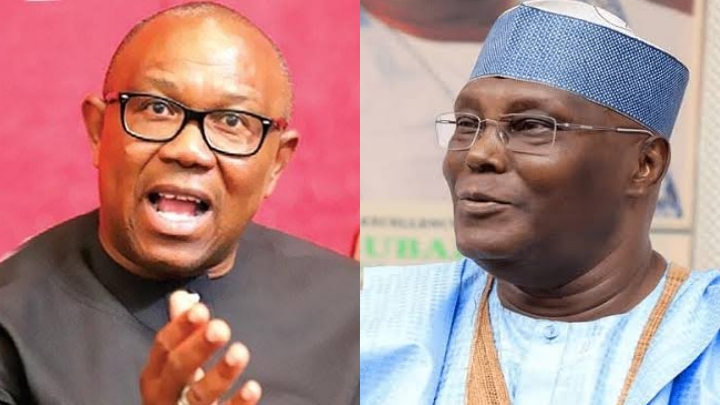
Tinubu vs. Obi: Opposites in a Moral Universe?

The current debate surrounding Bola Tinubu, the APC presidential candidate, relating to allegations of drug trafficking and money laundering in America, raises fundamental questions about morality which must be litigated in the Nigerian courts or in the political arena. All opposition candidates should harp on this case, especially Mr. Peter Obi who has sought to put the issue of moral character on the ballot in the 2023 presidential election.

By Chudi Okoye

“Love and marriage,” says a song first recorded by Frank Sinatra in 1955, “go together like horse and carriage.” In much the same way, politics and dirty tricks have long been seen as intricately linked. So much so that the portmanteau word, ‘politricks’ (which has a Jamaican provenance and implies politics characterized by perfidy), is an official entry in the Oxford Dictionary of Modern Slang. In the long, kaleidoscopic history of the world, going back even to the ancient dynasties of Sumer and Egypt, more practitioners of politics have been tainted than sainted.

The subject of political vice has been studied by philosophers and theorists down the ages, often as a departure from Plato’s abstract utopianism to the deft empiricism of Aristotle. We see it most vividly in Machiavelli who proclaimed that political practice always involved deception, treachery, and crime. And it’s seen today in what theorists call ‘the problem of dirty hands‘. Machiavelli, a foremost figure in the realist tradition of political thought, argued in his famous book, The Prince, that immoral acts were justified if they served the interest of the ruler. The book focused on the effectual truths of rulership, directly contradicting the dominant scholastic doctrines of the Renaissance era when it was published, especially those concerning political virtue. It’s not far from the Italian thinker to the grim concept of realpolitik that governs political practice today, in the domestic and international arenas.

If politics is not a noble but an inherently dirty game, per the popular claim, why do we persistently yearn for virtue in public officeholders? Why do we consider personal virtue a moral armament for public office and not merely a laudable ornament of personal disposition? We often think, in our ‘great man’ conception of leadership, that we need leaders who have courage, fortitude, conviction, stamina, decisiveness and composure. We long for leaders who are brave, intelligent, thoughtful, tactful, compassionate, competent, charismatic, visionary and inspirational. We admire those seen as good communicators, good listeners and good decision-makers who can manage, delegate or pick the right talents, etc. We also usually add to these, ethical qualities such as honesty, integrity, morality, probity, compassion and a sense of justice. We insist on these ideals of public virtue even though we rarely elect virtuous leaders. Puritanist America, for instance, elected shady Donald Trump, as it did even shadier characters in its past, despite the insistence of John Adams, founding father and second US president, that the American “constitution was made only for a moral and religious people.”

As in America, so almost everywhere else, going by the tracking of Transparency International and other agencies. So, most certainly, in Nigeria.

If our political leaders have not been virtuous in practice, why do we insist on the ideal of public virtue?

An American Saga
This question is fundamental to the issue now bubbling around Bola Ahmed Tinubu, flag-bearer of the All Progressives Congress (APC), involving sordid allegations of drug trafficking, money laundering and forfeiture of funds in the United States of America. There is some speculation that this might impact Tinubu’s chances in the 2023 presidential election, with some expecting the worst for the candidate.

It is likely that this issue will soon blow over and that at the end of it all, Teflon Tinubu may not really suffer any serious political setback. For one thing, though there seems to be a serious circumstantial presumption against his innocence, he was never personally indicted in the case – as his spindoctors insist in saying – and was thus never actually tried in court, let alone convicted. Also it seems, for whatever reason, that the Nigerian authorities have been reluctant to seriously pursue any of the investigatory leads in the case. Finally, there’s the curious fact that his political opponents – despite their constant cackling in the media – seem so far unwilling to test the matter in court. The diffidence of the opposition is baffling given the political capital they could gain from litigating the case. It’s even more surprising when you consider some evidential circumstances of this case against constitutional provision.

It may well be, parsing the recently released US court documents and also the claim of Tinubu’s spokespeople, that the APC flag-bearer does not have any personal legal liability in this matter. Yet, some untidy aspects of the case would seem to challenge that presumption. Tinubu’s personal US bank accounts were indicted, allegedly used as conduits for illegal funds. The amounts involved did not appear to correlate to any legitimate earnings at the time associated with him. The case involved a dodgy home address linked to Tinubu and even dodgier characters associated him. Moreover, according to the records, Tinubu did not contest the penalty of a huge forfeiture imposed on his accounts by the US authorities to settle the matter. Considering all these, there seems to be a prima facie case against Bola Tinubu in the whole US drug trafficking and money laundering saga that needs to be resolved within the legal jurisdiction of Nigeria.

Hesitation about Litigation
The case for litigation is compelled by the fact that the allegation touches on Tinubu’s qualification for the upcoming presidential election. Section 137 (1d) of the 1999 constitution (as amended) makes clear that “a person shall not be qualified for election to the office of President if… he is under… a sentence of… fine for any offence involving dishonesty or fraud (by whatever name called) or for any other offence, imposed on him by any court or tribunal or substituted by a competent authority…” On the face of it, it seems that Mr. Bola Tinubu has a serious case to answer.

I contacted several lawyers to test my perspective on this matter. Whilst some dismissed any notion of Tinubu’s culpability, all agreed that the matter is litigable. Yet, as at the time of penning this piece, there is no legal process filed by any of the opposition parties to test the matter in court.

This is rather baffling. Indeed it borders on campaign ineptitude, as the opposition parties appear to be squandering a hugely laden opportunity. On a purely tactical level, a legal sortie could have a spoiler effect: it would keep the issue on the front burner and also likely keep the incumbent party rattled and disoriented.

But beyond the prosaic calculation of campaign advantage, this case touches on the fundamental question of character and morality in our political culture. The issue affords us chance to make a definitive statement about the moral basis of our politics.

Moral Moment for a Moralizing Candidate
Incidentally, this issue of character and morality, along with ‘competence’, has been the major campaign platform of Peter Obi, flag-bearer of the Labor Party for the upcoming 2023 presidential election. So it is rather astonishing that Obi has uttered hardly a word on the Tinubu case.

In August 2020, whilst accepting the Democratic Party nomination to face then incumbent, Donald Trump, for that year’s presidential election, Joe Biden told America that “character [was] on the ballot.” It was a not-so-subtle dig at Trump who was considered unscrupulous. Biden ran with that theme throughout the campaign. Even at the presidential debates, he would point to Trump and tell America that the campaign was as much about character, honor and decency as anything else.

Mr. Peter Obi, to his credit, has consistently brought up the issue character in his campaign speeches. But he seems to bring it up mainly in self-reference. He doesn’t invoke the issue as a direct indictment of his opponents, only implicitly. The Tinubu drug trafficking and money laundering issue presents Peter Obi with an opportunity to go beyond rhetoric. His party ought to press the matter in court, and Obi himself should find an artful way to litigate the issue in his campaign outings, breaking it down for his audience without, of course, inviting legal jeopardy.

I bring up Peter Obi because, among the major candidates in the 2023 presidential field, he presents the best as a potential departure from the politics of the past, at least going by his governing claim and his insistent rhetoric of moral character and competence. Such rhetoric probably presents us with the most plausible path out of our current morass, offering a vision of technocratic competence built on a solid foundation of virtue and morality. It is a vision founded on sound theory.

Morality Matters
Notwithstanding the Machiavellian view of value-free politics, public virtue and moral character are critical to realizing the legitimate goals of a democratic state. These goals are, in the main, to maintain order and rule of law, provide security and promote the greatest happiness for the greatest number of people, to borrow Jeremy Bentham’s famous formulation. I use the word ‘happiness’ not merely in terms of Bentham’s so-called ‘felicific calculus’ but in the grand philosophic sense of the Greek term eudaimonia, which implies ‘a good human life’ or ‘a life of human flourishing’. Ancient Greek thinkers typically addressed themselves to the question of what virtues are necessary to achieve such a life and how to acquire those virtues.

The Nigerian constitution sets up for itself “the purpose of promoting the good government and welfare of all persons in our country,” a formulation which hints slightly at the Greek eudaimonia. Unlike in Greek thought, however, our constitution and its related statutes do not erect a test of piety for presidential qualification. They do not demand a high degree of moral rectitude. Nevertheless, they do require that our officeholders be above moral reproach. On one level, this is codified in various ethical standards, rules, norms and sundry precepts pertaining to public office that incumbents are expected to uphold. They are also, less formally, established in the sphere of personal values and private morality: the normative codes and moral universe guiding individual conduct.

These are the moral principles antagonized by Bola Tinubu’s American saga. The APC presidential candidate may not face a legal challenge if the opposition parties remain diffident or constrained by their political calculus. But Tinubu should face a moral accounting. The American drug trafficking and money laundering saga is one negative too many in Tinubu’s tally. He may not have been directly indicted by the Americans, but he is implicated through his bank accounts. There are too many unanswered questions related to this case which cannot be discountenanced simply because the Americans did not indict him. There are already too many other negatives, pointing to moral turpitude, related to this one person. We are dealing with allegations about his place of origin and uncertain provenance, certificate forgery, doctored date of birth and unaccountable wealth, all on top of his evident ill-health and frailty. This is far below what we should tolerate even in our utterly perverted system.

The opposition candidates, especially Peter Obi with a campaign anchored on moral character, should challenge the eligibility of this contestant whose presidency, were he to win, would even more deeply corrode our political culture. If the opposition candidates do not want to mount a legal challenge, they should at least litigate the matter of Tinubu’s ineligibility in their campaign trails. This is a test especially for Mr. Obi, if we are to believe that his persistent invocation of “character” is not a meaningless rhetoric.
Pray, what is the Point of Nigeria’s Finance Minister, Zainab Shamsuna Ahmed?

0
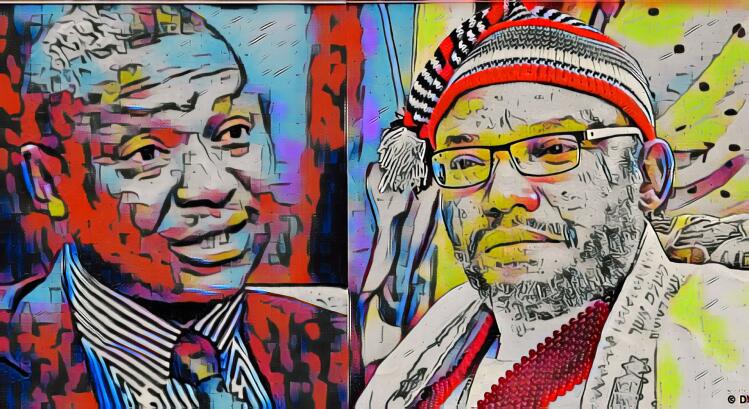
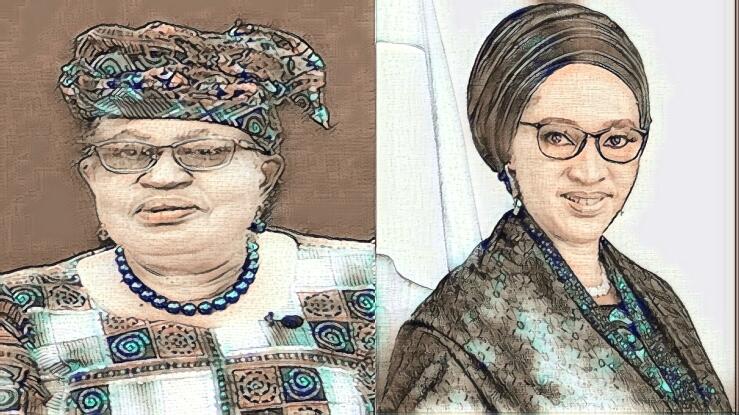
Nigeria's former and current finance ministers: Ngozi Okonjo-Iweala and Zainab Ahmed

Nigeria has tumbled from the majestic era of a highly cerebral and world-renowned economist as her finance minister, when her public debt was nearly zeroed out, to the travesty of an unremarkable misfit under whom the country’s economy has become remorselessly overleveraged.

By Chudi Okoye

She appears to think very little of publicly disagreeing with her professional superiors. So presumably she will not mind this little exercise in public reproach, despite its slightly irreverent approach.

A little less than two weeks ago, she got into a kerfuffle with the Central Bank of Nigeria (CBN) about the latter’s proposed remodeling of some Naira notes. Although her ministry’s permanent secretary is, by law, a member of the CBN Board, she claimed that her ministry had not been consulted about the proposed currency make-over and warned about the timing as well as some serious risks if the plan went ahead. This invited an immediate clapback from the CBN which insisted it had followed due process and secured needed approvals.

A little before this dustup, she had publicly disagreed with the president of the African Development Bank (AfDB), Akinwumi Adesina, over the problem of Nigeria’s public debt. The discord played out at a Nigeria International Economic Partnership forum in New York this September. In a pointed rebuttal of Dr. Adesina’s warning about the risks of Nigeria’s rising debt, she told the forum, without a hint of hesitation, that Nigeria did not have a debt problem, only a revenue problem. She had made the same claim earlier in an interview with a national newspaper, amid a surge in the country’s debt burden.

In the annals of peculiar statements made by supposed leaders of Nigeria, this one is right up there with Gen. Yakubu Gowon’s 1973 boast that Nigeria’s problem was not money but how to spend it. Perhaps, the then head of state wasn’t too far from the truth, given that Nigeria was earning a vast oil rent so soon after a traumatizing civil war, with the inflow of an unprecedented pile of petro-dollars which the country had probably not expected, much less planned for. But it was still an inarticulate and stupendously innocent – some think stupid, others arrogant – statement by a head of state, and it has haunted him ever since. Just as the military later assessed that Nigeria had a leadership problem in Gowon, leading to his overthrow in the coup of 1975, it is also clear that the country has a gargantuan finance minister problem in Zainab Shamsuna Ahmed. Gowon might be excused, if one were feeling generous, because the oil boom probably bamboozled the then 39-year old head of state who had just emerged from leading a war-worn country. But how can we excuse a 62-year old Zainab Ahmed making such a preposterous statement in the current zeitgeist?

Our finance minister’s claim that Nigeria does not have a debt problem appears to be based on a belief that the country has a relatively low debt-to-GDP ratio. According to data from the DMO (Debt Management Office), Nigeria’s total public debt stock as at June 30, 2022, including federal and state government debt, stood at $103.3 billion (₦42.8 trillion at the official exchange rate or about ₦94 trillion at the fast-falling parallel market rate). This clocks in at a 23.06% debt-to-GDP ratio, the DMO says, which the finance minister claims is well-within Nigeria’s self-imposed limit of 40%.

There are a couple of problems with this position. First of all, the DMO’s debt-to-GDP ratio seems to be at variance with data from multilateral institutions such as the IMF which estimates a ratio of 37.4%, a figure nudging the government-defined limit. Even so, the finance minister’s argument of a comfortable debt ratio ignores the fact that the debt limit set by government has been a moving target, growing consistently from 13.4% at the start of Muhammadu Buhari’s presidency in 2015. With a shifting target, it is nonsensical to argue that we are well within the imposed limit: we are, evidently because the ceiling keeps being raised!

Beyond this critique, however, it seems disingenuous to consider debt merely as a proportion of nominal GDP, ignoring its impact on the broader economy, especially with a tumbling Naira. The finance minister’s argument that Nigeria has a revenue problem might be correct, in the sense that it speaks to the country’s ability to pay, particularly given the burden of debt servicing on revenues. But it is ludicrous to deny the intrinsic risk of the country’s current debt burden. In a mono-modal economy such as ours which is highly susceptible to external shocks and which, additionally, is passing through a hyper-inflationary phase, a rising debt profile represents a huge economic drag. A high and growing debt level hinders long-term economic growth by preventing or minimizing capital investment, as we are seeing currently in Nigeria with a rising proportion of government loan dedicated to debt servicing and other recurrent expenditure. Fiscal disarticulations and real economic shrinkage could result where, as in our case, the burden of external debt repayment outstrips the net real benefits of external borrowing. High debt also depresses wages, and in this way destimulates the economy, again stalling growth.

A finance minister with a solid background in economics who understands these deleterious effects of debt would be more exercised and would pursue an aggressive deleveraging of the economy, especially if they had the clout to resist political pressure. We haven’t seen much of this with Zainab Ahmed, and this is perhaps why she compares most unfavorably to her penultimate predecessor, the cerebral Dr. Ngozi Okonjo-Iweala.

Ngozi vs. Zainab
It might seem somewhat improper to venture a comparison of these two subjects, Dr. Okonjo-Iweala and Ms. Ahmed, considering that one is so far outside the orbit of the other to justify a juxtaposition. Still, you can’t measure deviation if you don’t have a norm. You can’t know how far you’ve fallen if you don’t measure the distance from your previous altitude. To borrow from statistics, this is not so much about propinquity, a measure of nearness, as a measure of dispersion.

With that, let’s turn to our two subjects.

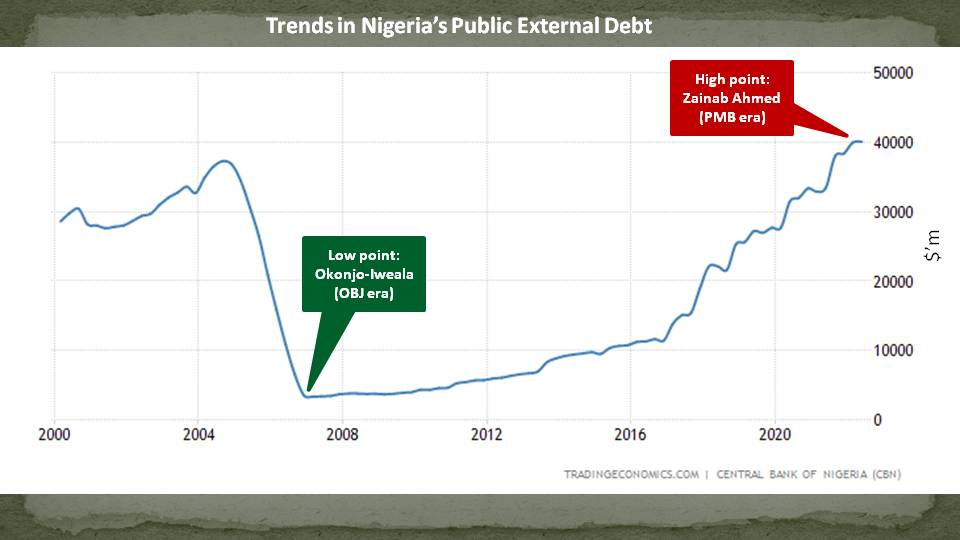
Zainab Ahmed became Nigeria’s minister of finance after the unceremonious exit of Kemi Adeosun on September 14, 2018. About a year later, on August 19, 2019, Ahmed was made Minister of Finance, Budget and National Planning, her portfolio thus expanded. In the four years she has been at the helm, Nigeria’s external debt grew 86%, from $21.6 billion in September 2018 to $40.1 billion as of June 2022. In the same period, the domestic debt grew 70% from ₦12.3 trillion to ₦20.9 trillion. Total debt, if we accept the DMO’s estimate, is 23.06% of GDP, as indicated earlier.

Trends in Nigeria’s Public External Debt

Contrast this with Nigeria’s debt profile under the illustrious Okonjo-Iweala. The external debt dropped by a factor of 10 from $35.9 billion in 2004, not long after she became finance minister, to $3.5 billion in 2006, the year she left office in her first tour of duty under President Olusegun Obasanjo. By the time Okonjo-Iweala returned, in 2011, to serve in the administration of President Goodluck Jonathan, Nigeria’s external debt stood at $5.6 billion and domestic debt was ₦5.6 trillion. The external debt would grow to $10.3 billion and domestic debt to ₦8.4 trillion by the time she left in 2015, but total debt still represented 13.4% of GDP, as we saw above.

These highly contrasted records are probably explained by the vicissitudes of the policy environment. But they also point up the stark differences in the backgrounds of the two finance ministers.

Ngozi versus Zainab. They share almost the same birthday, though six years apart, and both attended elite high schools. One was at Queens School Enugu, as well as St. Anne’s School and the International School at Ibadan. She went on to the Ivy League Harvard University where, in 1973, she graduated magna cum laude (“with great praise”) in Economics, aged 19. She proceeded to obtain a Masters degree, aged 24, from another of the world’s top colleges, the Massachusetts Institute of Technology (MIT), and a doctoral degree in Regional Economics, also from MIT, aged 27.

The other attended Ahmadu Bello University, Zaria where she obtained an accounting degree in 1981, aged 21, and then went on to secure an MBA in 2004, aged 44, from a state university in Ago-Iwoye, Ogun State (now named Olabisi Onabanjo University), an institution founded in 1982.

One has a professional resume that stretches from here to Timbuktu. She is a highly respected player in the most rarefied circles of global finance, trade and development. She was appointed finance minister by two presidents of southern Nigerian origin, one himself not without regard in global circles and the other a PhD holder. She came from professional renown and global celebrity to help rescue her home country. And what a success she was!

The other had various stints in Kaduna State ministry of finance and varied parastatals before being fetched up as finance minister by a president of northern Nigerian origin, a president with doubtful academic provenance. She was plucked from obscurity to the highest perch of national finance. And what a disaster she has turned out to be!

The difference in the accomplishments of these finance ministers is clear as day. Not only did one lead efforts to secure relief from Nigeria’s $30 billion Paris Club debt, she also set up an ‘Excess Crude Account’ where surpluses from crude oil revenues were lodged and used in ways that helped to reduce macroeconomic volatility in Nigeria. Perhaps most spectacularly, she led the National Bureau of Statistics to re-base the Nigerian GDP, thus establishing the country as the largest economy in Africa, with the prestige attending upon that distinction. The list of her accomplishments stretches from here to Timbuktu.

The other? Well, in her time Nigeria’s debt has ballooned, inflation is raging, the Naira has tanked, the Nigerian economy is sinking, and she appears to have little command over fiscal or broader macroeconomic policy.

Nigeria has had 22 finance ministers since independence (serving 24 terms), from Festus Okotie-Eboh (1960-66) to Zainab Ahmed (since 2018). The last three finance ministers have been women, Ngozi Okonjo-Iweala being the gender trailblazer. But we have gone from the incomparable Dr. Okonjo-Iweala to the confused and over-promoted Kemi Adeosun (she of the forged NYSC certificate fame), to the absolute train wreck that is Ms. Ahmed. The last two were appointed by Muhammadu Buhari. Go figure!

Ngozi versus Zainab. One used her influence in global finance to advance Nigeria’s independence from Western financial imperialism; the other has plunged the country deeper into debt. One is an avatar for Nigeria’s ascent in global respectability; the other, the emblem of her unmitigated decline.

When you elevate inferiority, you instigate mediocrity. That is the tragedy of Zainab Shamsuna Ahmed as Nigeria’s hapless and extremely unremarkable finance minister.

Buhari is a Strident Caution Against Electing Another Senescent Aspirant as President

0
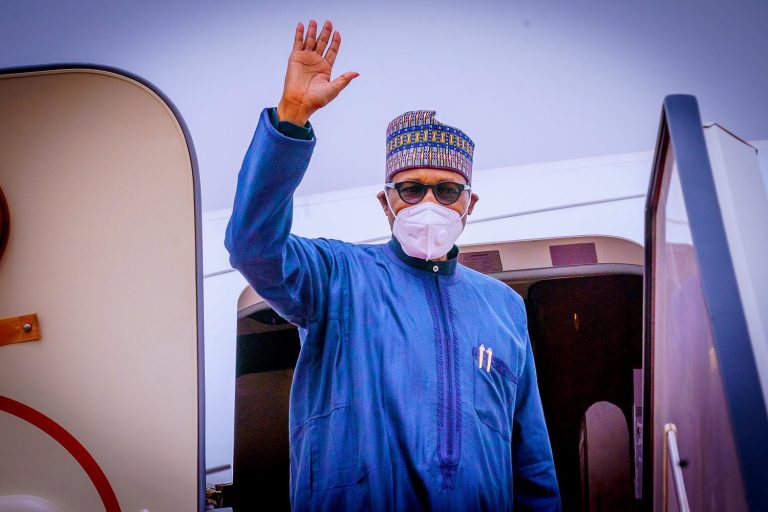
Buhari embarks yet again on official medial trip to London (Oct 31, 2022)

The advanced age and chronic illness of the Nigerian president, Muhammadu Buhari, have quite possibly helped to imperil his presidency and most likely caused wider malaise in the country. Nigeria must avoid the mistake of electing another aged and feeble leader in the coming presidential election. It should also seek a long-term constitutional remedy to avoid the problem of incipient gerontocracy.

By Chudi Okoye

Our president has gone AWOL again! He ducked out on October 31st, we have been told, for yet another ‘medical check-up’ in the United Kingdom. It seems the president needed another foreign trip to recover from his last foreign trip – you know, the one he made just a few days earlier to attend the World Bio Summit in South Korea. That’s the summit where, by the way, the president made nary a splutter, despite the utter size of his entourage and the heavy toll on our treasury. No doubt the president was exhausted from all that hard work he put in doing next to nothing in Seoul. Hence the well-deserved escape to London. This man is like a dilapidated jalopy in need of constant repair: a raddled old man running an addled presidency in a saddled country.

It’s either the president rushed abroad to recover from his last foreign trip, or he’s simply taken a temporary flight from the plethora of domestic problems plaguing the country he supposedly governs.

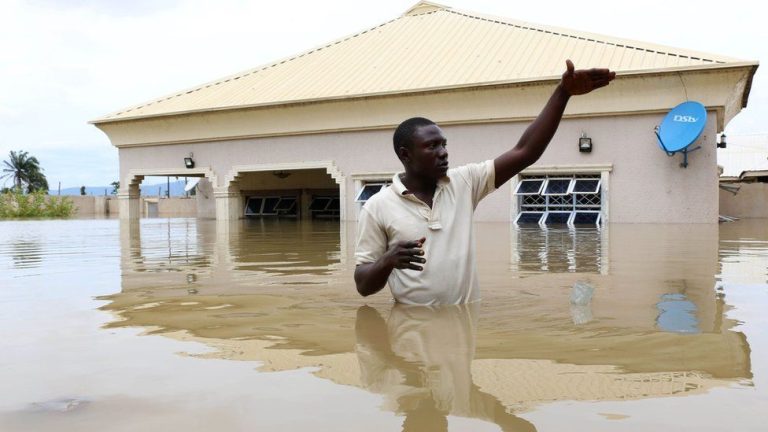
Several corners of our country are currently flushed, traumatized by tides of uncontrolled flooding caused by previous negligence. Many have lost their lives; many their livelihood and property. There’s reported terror in the nation’s capital, acknowledged by scampering foreign missions and even some government security agencies. There is widespread concern about an impending currency redesign proposed by the Central Bank, with certain hidden interests appearing to resist the plan. The country’s currency has taken a serious plunge, yet again, partly as a result. The oil sector, the federal government’s revenue mainstay, is in utter chaos, so there’s a revenue crunch. We are thus borrowing more to fund government spending, and yet more to service our burgeoning debts, ending up in an inescapable debt trap. The nation faces a fiscal cliff; the economy is tottering and seems almost out of control; there’s unmitigated misery all over the land.

What better time, then, for the leader of our country to go on the lam, to go seeking refuge in a foreign land!

It would be comical if it weren’t so tragic, if our leader’s foreign flights weren’t such a stain on the nation and a mighty strain on our treasury. We are lavishing the nation’s vanishing resources on a tarnished president, on a man with absolutely no ability or intent to continue governing our beleaguered country. Unlike the self-correcting parliamentary system in the UK where a leader who was out of her depth simply departed, what do we do with an aged president who runs out of steam mid-stream but doesn’t have the decency or integrity to quit?

Muhammadu Buhari is a screaming argument against the election of another aged and ailing president to pilot the affairs of our troubled polity. He embodies, in quite every sense, the disturbing pathology of ageing, including chronic debilitation. We have in him a man with little spark running a presidency with little sparkle. He is a strident alarm warning us against ignoring the risks of dotage in the coming election, as we seem currently, and curiously, to be doing.

Age and Governance
This is not merely a matter of age; nor is it about one being ageist. A scan around the world shows a current roster of national leaders with a wide range of age distribution. There are young’uns like Sanna Marin of Finland, Gabriel Boric of Chile and Dritan Abazović of Montenegro, who are all in their 30s. There are also the likes of Serdar Berdimuhamedow in Turkmenistan, Volodymyr Zelenskyy in Ukraine, Giorgia Meloni in Italy, Rishi Sunak in the UK and Irakli Garibashvili in Georgia, a pack that’s smack in their 40s. But then we also have others like Joe Biden and Donald Trump in the United States, Vladimir Putin in Russia, Alexander Van der Bellen in Austria, Luiz Inácio Lula da Silva in Brazil (who just won an election as president 12 years after his last term), and Benjamin Netanyahu in Israel (former PM who is now plotting a comeback), all in their 70s.

Africa too has its share of presidential graybeards. There’s for example Mr Paul Biya, now nudging 90, who has been president of Cameroon since 1982 (before that prime minister from 1975) and is currently the oldest serving leader of a state. Alpha Condé of Guinea was a little older than 83 as he wrapped up his presidency in September 2021. Alassane Ouattara, now headed for his 12th year as President of Ivory Coast, clocked 80 in January this year. Nana Akufo-Addo, the Ghanaian president, is 78. He is only a few months older than Yoweri Museveni, current president of Uganda who helped to topple Idi Amin (1971–79) and later Milton Obote (1980–85) but has remained president for over 36 years – since January 1986!

There were many other sit-tight vegetatives in African history before this lot. Who can forget the late Robert Mugabe of Zimbabwe, once a revolutionary who remained in office as president for 30 years (before that as prime minster for seven years) until he was tossed out in 2017, aged 93. He died in Singapore barely two years after leaving office.

There’s indeed a wide dispersion in the ages of state leaders around the world. But before anyone tries to justify our local gerontocracy on grounds that other nations also have leaders who are getting on, let’s consider the issue of fitness, mental and physical, not just age. Can anyone, for instance, look at Israel’s Netanyahu (73) and really say that Bola Tinubu, flag-bearer of the All Progressives Congress (APC) who claims to be 70, is in a better shape for being supposedly younger? Or that Tinubu is as fit and rude in health as the Russian dude, Putin, who is supposed to have been born in the same year as he?

Or could one deign to compare Biden, an avid biker, with Buhari, a pallid lagger, even though the two are very close in age, separated only by weeks?

Could one with a straight face compare the frenetic Trump with Atiku Abubakar, presidential candidate of the Peoples Democratic Party (PDP), who is presumably his age mate?

No! There is old and there is old. Our ageing leaders tend to be frail and unfit, both physically and mentally.

This is not simply about age but rather what is predicted by old age. Medical experts tell us that ageing and ill-health are highly correlated. Humans typically experience cognitive and physical decline with advancing age, with many geriatric syndromes experienced simultaneously. This is particularly the case in our environment with our abysmal health care system, which explains Buhari’s frequent foreign medical trips. Although the exact condition of Buhari’s health has remained a state secret, he has spent so much time on official medical trips – as of mid-August 2021 he had spent over 200 days on seven trips to the UK – that it is clear the president must be in dire condition. Alarmingly, the candidates of the two major parties have also themselves undertaken a not-infrequent medical trip abroad – even before the campaign had got fully underway and before they’ve encountered the rigors of office.

Physical and mental challenges are a serious concern, particularly when we consider the ability of our political leaders to keep up with the speed and complexity of social change. But there’s also the issue of demography and democratic representation. A geriatric skew at the apex of power is incongruous with the hefty youth bulge in the Nigerian population, with about 70% aged below 30 and the median age standing at 18.1. The United States of America has a much older population than Nigeria, having a median age of 38.8, more than twice Nigeria’s; yet, even in that country, there are growing concerns about dotage in political leadership. Recent polls by CNN and the New York Times, for instance, found that neither Democratic nor Republican voters seem excited by a likely rematch of Biden and Trump in the presidential election of November 2024, with one by that date aged nearly 82 and the other over 78.

Can you blame the Americans? Age matters. It matters very much. It should matter in our upcoming election in 2023, and in our future constitutional design.

Term Limit and Age Limit
Nigerian constitutions have usually stipulated a lower age bound for elective offices (40 years currently for the presidency) but, as in several other countries, never an upper bound. They prescribe term limits but never an age ceiling. This was the reason some of Nigeria’s notable political grandees came out of retirement to contest the presidential election in the 2nd Republic. Dr. Nnamdi Azikiwe and Chief Obafemi Awolowo were aged 75 and 70 respectively when they contested the 1979 presidential election; and they’d turned 79 and 74 when they returned for the 1983 contest. But of course, neither of them won. Buhari has somehow managed to succeed where those other septuagenarians failed, becoming the only head of government so far in our history to assume office in his 70s. Buhari was pushing 73 when he emerged as democratic president in May 2015, a clear 25 years older than the average inceptual age of all previous incumbents, military or civilian (see chart below). In fact, Buhari started his democratic tenure at an age older than Olusegun Obasanjo was when the latter ended his second term. Whereas Obasanjo – the next oldest in our pantheon of incumbents – ended his second term aged 70, Buhari is set to finish his second term pushing 81.

Nigeria: Head of Govt. vs Aspirant Ages

We are now witnessing a repeat in the current presidential election cycle. As we show in the chart above, where the average inceptual age of all incumbents before Buhari was 48, the average age of the top three candidates in the 2023 election would be 70!

It becomes quite glaring when we consider individual candidates. If Atiku Abubakar wins the 2023 election, he would assume office five months shy of his 77th birthday, and would be edging toward 81 as he wraps up his first term in 2027. If Atiku seeks re-election and wins, he would be almost 85 by the end of his second term! He would then become the oldest person ever to head the federal government of Nigeria, wresting that dubious distinction from Buhari.

The age issue is only slightly less gripping for Bola Tinubu. He’d be the second oldest ever to assume the office of president if he wins instead of Atiku, ranked behind Buhari. For his part, Peter Obi of the Labour Party would be 62 on assumption of office, the same age as Obasanjo had been when he became civilian president in 1999.

The key issue here is whether, in the coming election, we want a further tilt to senectitude, or whether we want a return to the central tendency of previous incumbent age. After the experience with Buhari, can Nigeria afford another ailing – almost cadaverous – president? Do we really expect an ailing presidential candidate, were he to win, to be able to effectively govern our equally ailing country?

This matter is not being discussed with the urgency it requires. It is not a major focus of political punditry, and it is not being litigated in the campaign field. The mountain of problems facing the country commends the imperative of an energetic presidency. As such, the age and health of the contestants should be a matter for critical scrutiny.

We should confront this issue in the current election cycle, but also, in the long run, seek a constitutional remedy. It is odd to have candidates running for public office who are well past the civil service retirement age. This is of course not peculiar to Nigeria. But there is no reason why we couldn’t blaze a trail for the world with a constitutional innovation that caps the upper age bound for elective offices. We could curb the tilt to gerontocracy with a combination of age limits and an innovative term limit. For instance, we could prescribe an upper bound of 74 for the presidency but also stipulate a one-term limit for anyone aged between 70 and 74. This should cascade to all levels of down-ballot offices as well.

Such innovation would be one way of freeing the country from creeping caducity, and ensure that political leadership has a level of vim and vigor befitting what is after all a youthful country.

A Pragmatic and Newly ‘Open’ Britain: Lessons for Nigeria

0
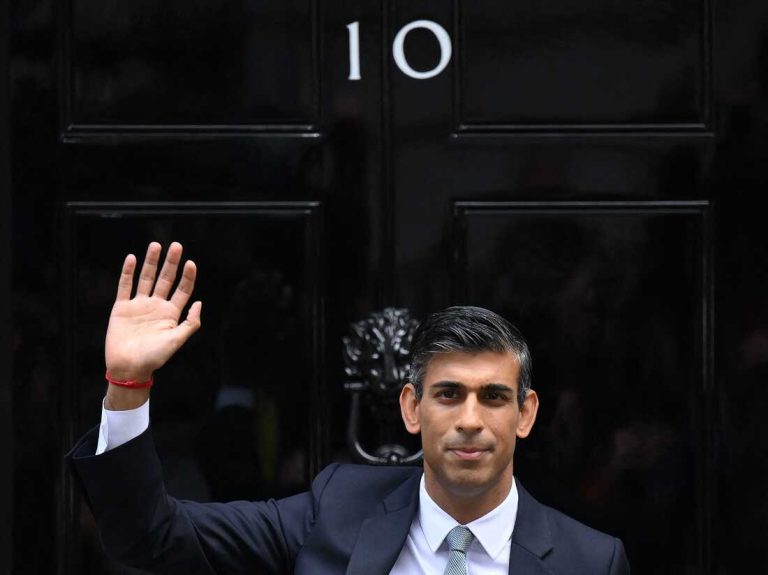
New British Prime Minister, Rishi Sunak

Britain has assembled a youngish, technocratic and racially diverse leadership strike force to tackle its current economic challenges. Nigeria, which is even more deeply mired, has much to learn from the pragmatism of the United Kingdom. But current political campaign trends and indeed the frontline of the 2023 presidential election contest do not inspire confidence.

By Chudi Okoye

Whatever residual grievances we may (rightly) hold against Great Britain for its imperial atrocities, we should take a moment to applaud what is unraveling in that country with regard to the constitution of its new government. A new administration is evolving in that sometimes jaded democracy that indicates some sort of progressive thinking in the British establishment, particularly on the racial front. While no one should imagine there’s now a new dawn of post-racial Britain, it is quite astounding what is taking place.

Surprisingly it is not the supposedly progressive Labour Party but in fact the Conservative Party – the supposed bastion of British tradition and backwardness – that is championing diversity in government. Having already given the United Kingdom its only female prime ministers to date (Margaret Thatcher [1979-1990], Theresa May [2016-2019], and Liz Truss [Sept-Oct 2022]), the Conservative Party is now widening the aperture of racial diversity in the hierarchy of British government.

News emerged on Monday, October 24, that the Conservative Party had selected as its new leader – in a most efficient manner and by almost uncontested proclamation – a 42-year old non-White person, Rishi Sunak, a British-Indian of Punjabi ancestry and East African passage whose grandparents immigrated to the United Kingdom only in the 1960s.

Having been confirmed the next day, October 25, as the new British prime minister, Mr Sunak spent the day expeditiously assembling his governing team. In that assemblage, we find too a laudable intimation of a seemingly newly evolving Britain.

There is in the new team Mr James Cleverly, a Black man with a British father and Sierra Leonean mother, who is the Foreign Secretary. Mr Cleverly had been appointed by Mr Sunak’s predecessor, Liz Truss, and he retains his position even though he had only backed the new PM’s candidacy at the very last minute. Cleverly was born in Lewisham, a south-east London borough which indexes 27% Black as against 13% in the nation as a whole. This clever Black man has become, for now, the global face of British diplomacy.

There is Suella Braverman, a 42-year old British-Indian with parents who emigrated to the UK from Mauritius and Kenya also in the 1960s. She reprises her role as Home Secretary, having also been earlier appointed to that post by Sunak’s predecessor.

There is also Iraqi-born Nadhim Zahawi who is now Chairman of the Conservative Party, an extremely important position for managing the nationwide party structure. He had held a varied portfolio in the brief administration of Liz Truss as Chancellor of the Duchy of Lancaster, Minister for Intergovernmental Relations and Minister for Equalities. He was briefly Chancellor of the Exchequer under the preceding prime minister, Boris Johnson. Mr Zahawi was eleven years old when his family fled Iraq at the inception of the rule of Saddam Hussein.

Our own Nigerian sister, 42-year old Olukemi Olufunto Badenoch (née Adegoke), had been appointed Secretary of State for International Trade and President of the Board of Trade by Sunak’s predecessor. She had backed Mr Sunak in the latest leadership contest, herself refraining from running, and she too has been retained in her position. Ms. Badenoch was born in England to Nigerian parents, Dr. Femi Adegboke and Prof. Feyi Adegoke, and she spent part of her childhood in Lagos.

There is as well Mr Dominic Raab, a Briton of Jewish ancestry whose father had migrated to the UK from the now defunct country of Czechoslovakia, fleeing the menace of Nazi Germany. He’s the deputy Prime Minister and Justice Secretary.

In Britain, the four great ‘offices of state’ (i.e. the most senior Cabinet positions) are those of the Prime Minister, Chancellor of the Exchequer, Foreign Secretary and Home Secretary.

As it is, three of those – Prime Minister, Chancellor and Foreign Secretary – are occupied by persons of minority heritage. The only exception is Jeremy Hunt, the Chancellor, who traces his roots to a family of landed gentry from the village of Baschurch in the Midlands civil parish of Shropshire. Even so, Hunt took over that important position, the second ranked in the British Cabinet pecking order, from another minority, Kwasi Kwarteng, a 47-year old born to Ghanaian parents who migrated to the UK as students in the 1960s.

With this extensive diversity at the very top of the British government, there is no question that we are witnessing one of the most inclusive phases in the constitution of the British government.

This trend might be seen in part as a new, if previously grudging, openness in British society, and there may be a sociological explanation for it. But it is also evidence of a deliberate tilt to technocratic pragmatism. These minorities now in the upper reaches of the British government got there mainly by meritocratic ascent. All are highly educated, and several attended elite schools. The new prime minister, for instance, attended preparatory school in the market town of Romney in Hampshire; boarding school at the exclusive Winchester College, also in Hampshire; and then Lincoln College at Oxford University where he graduated with a first class. He went on to obtain an MBA from Stanford University in the United States, studying with a Fulbright scholarship.

Kwarteng attended an independent preparatory school in London, went on to the exclusive Eton College, and then to Trinity College, Cambridge University where he obtained a double first class degree. He was at Harvard University for a year as a Kennedy scholar, and then later obtained a PhD from Cambridge.

Our own Kemi Badenoch studied Computer Systems Engineering at the University of Sussex, and later secured a Master of Engineering degree. She worked as a software engineer at Logica, studied and obtained a Bachelor of Laws degree, and then worked as a systems analyst at the Royal Bank of Scotland, as well as a director at the wealth management private bank, Coutts & Co, the eighth oldest bank in the world.

These cats have stats! They are youngish and all extremely qualified, and they form part of a formidable team now being put in place to run the British government. This technocratic team is being assembled because Britain is in dire straits. The country hasn’t quite got all the cylinders of its economy firing in the post-Brexit era, and the ruling party is assembling a strike force to rescue the country, led by an Indian wonderkind. It is not unlike what we have seen with major American corporations – including Microsoft, Google, Twitter, FedEx, IBM, Adobe, Gap, Starbucks, etc. – as well as European juggernauts Barclays and Chanel, among others, that sought out Indian CEOs to initiate a turnaround or drive growth whilst going through a period of uncertainty. The Conservative government of Britain is clearly toeing this global path of technocratic ascendancy.

This enlightened pragmatism is winning the UK government approving reactions from across the world. The financial markets, earlier jittery about the previous government’s confused plans, are warming up to the new administration. An earlier plunging British pound is picking up handsomely; the UK government bond rallied as the new team began to emerge, even as government borrowing (measured as PSBR – Public Sector Borrowing Requirement) is returning to earlier levels – before Truss and Kwarteng issued their trickle-down mini-budget shot through with debt-financed tax cuts for the rich. The new chancellor, Hunt, will set out his fiscal plan for the government on November 17.

Even as the market warms to the new team, or seems to, the world has also welcomed the talented diversity at the helm of His Majesty’s government. US president, Mr Joe Biden, who had been rather dismissive of Liz Truss, sent congratulatory messages expressing his astonishment that it was the Conservative Party that plucked a man of Asian descent to be prime minister. Well wishes have also poured in from India, Europe, and elsewhere.

One amusing – or shall I say, ironic – message came from Muhammadu Buhari. Yes, our very own Buhari. The man who has presided over the most extensive and most venal Fulanisation of the Nigerian government had the impudence to send the UK government a message applauding its openness and diversity. He said:

“As the first Prime Minister of British-Asian descent and the youngest in about 200 years, these milestones will be especially inspiring for young people across our 2.4 billion-population, 56-nation Commonwealth.”

This is par for the course for the Fulani revanchist in Aso Rock. We do remember, don’t we, Mr Buhari’s stout defense of the doctrine of self-determination in a speech he gave on 28 September 2015 at the United Nations, pleading the principle in favor of “the Palestinian people and those of Western Sahara” and urging that their “inalienable right must now be assured and fulfilled without any further delay or obstacle.” The same Buhari of course has sought to extirpate that very principle at home, seen especially in his vicious and vindictive pursuit of Nnamdi Kanu and his now proscribed IPOB (Indigenous People of Biafra) outfit.

No one, at this point, expects a sense of irony or self-awareness from this primitive man who it has been our unmitigated misfortune to have as president. But Nigeria, were it to attune itself to the zeitgeist, has much to learn from the unfolding scenario in the United Kingdom. A youngish, technocratic team of diverse racial composition is being put in place to pull the country out of its present challenges.

Over here, however, our country Nigeria which is in an even deeper trough – having been thoroughly misgoverned by a hopelessly incompetent, highly nepotistic and deeply corrupt administration, under the helmsmanship of the near-octogenarian, Buhari – is taking a totally different path. It is suffering the candidacy of two sickly septuagenarians, men who can hardly coordinate their reflexes and are totally bereft of ideas, in the 2023 presidential election.

Two countries, Britain and Nigeria, going through a period of crisis. One has engineered a leadership to meet the moment. The other seems to want, foolishly, to perpetuate its torment.

SE Leaders Must Act Decisively to Avert Crisis over Kanu’s Looming Legal Victory

0
Legal combatants: AG Malami vs. IPOB leader Kanu

Incarcerated IPOB leader, Nnamdi Kanu, won a stunning legal victory this week, with the Abuja Court of Appeal dismissing all the outstanding counts in the federal government’s treason case against him. The government, however, insists Kanu has not been acquitted and seems disinclined to release him from detention. Government recalcitrance could unleash a spate of violence in the South East and agitation elsewhere, except if regional leaders intervene to secure the legal result or find a political solution.

By Chudi Okoye

It has a whiff of Greek mythology and an unmistakable hint of political chicanery written all over it. On one level, it is a mesmerizing judicial victory; a grand vanquishment of the mighty federal government by an overmatched but scrappy Biafra agitationist. Yet, it could become a victory that revives history; one that rekindles a waning but toxic Biafra separatist movement, potentially hurting the South East’s chances in the arena of conventional politics. Especially in the upcoming presidential election.

Choose your allusion: A Greek gift. A Pyrrhic victory. A Catch-22. It might be all that, and possibly done by design. The question however is how to harness the opportunity afforded by the unfolding legal drama whilst avoiding the landmines probably being laid by canny political strategists.

News broke late afternoon on Thursday, October 13, that the Court of Appeal sitting in the Federal Capital Territory, Abuja, had vacated the seven remaining counts in a treason and terrorism case which had been brought by the federal government of Nigeria against Nnamdi Kanu, leader of the proscribed Indigenous People of Biafra (IPOB). The three-member appellate panel, led by Hon. Justice Jummai Hannatu Sankey, based its unanimous decision chiefly on the technicality that Kanu’s extraordinary rendition by the federal government – allegedly from Kenya to Nigeria – was an illegal act which made the terrorism charges against him incompetent and unlawful. “With [its] appalling disregard for local and international laws,” the Appeal Court ruled, “the federal government has lost the right to put the appellant on trial for any offence.” The court also argued that it was fatal to its case that the federal government failed to disclose where and when the alleged offences were committed, making the charges liable to dismissal.

This new Appeal Court ruling follows an earlier one delivered in April by the trial court where the presiding judge, Hon. Justice Binta Nyako, struck out eight of the 15 counts filed by the federal government against Kanu. The trial judge had argued that the liquidated counts were “incompetent” because they did not disclose any valid offences committed by the defendant. Whilst dismissing those charges, however, the judge had overruled the objection of Kanu’s lawyers by upholding the legality of the federal government’s forceful rendition of Kanu and the validity of the remaining charges. She upheld those charges on the ground that there was a “surviving bench warrant” for Kanu’s arrest which predated the 2021 rendition, having been issued by her in 2018; and that the rendition was lawful because Kanu had jumped bail. “There is a bench warrant for the arrest of the defendant,” the judge had insisted. “He is a fugitive that is wanted in court. The bench warrant survives until he is brought to court.” This is the argument now roundly rejected by the appellate panel.

Legal Wrangle
With the Appeal Court striking down the remaining charges against Nnamdi Kanu, the question now is whether the federal government will be inclined to release him in compliance with court order. It appears, for the moment at least, that there is some reluctance to do so. The Attorney General of the federation, Abubakar Malami, has already stated through a spokesperson that “Kanu was only discharged and not acquitted.” He claimed that the court’s decision was only based on the extradition of Kanu, and that it did not apply to those charges predating it which “remain valid issues for judicial determination.”

Experts seem to disagree on this matter. One constitutional and human rights lawyer, Luka Musa Haruna, told the BBC that although Kanu is now technically a “free man” and should be released, there is nothing preventing the federal government from re-arraigning him on different charges. Similarly, a Lagos-based lawyer, Eustace Odunze, told Awka Times that the Appeal Court’s ruling “completely sets [Kanu] free from detention by the government because the government committed an illegality of extraordinary rendition of [Kanu].” Odunze argued that “the decision also discharges [Kanu] from both current and further prosecution by the government on any post-rendition charges.” He noted however that since Kanu “was undergoing pre-rendition trial for which he has neither been discharged nor acquitted,” the Appeal Court’s ruling “may not have ousted the government’s right to continue that particular case at the lower court where it subsists.”

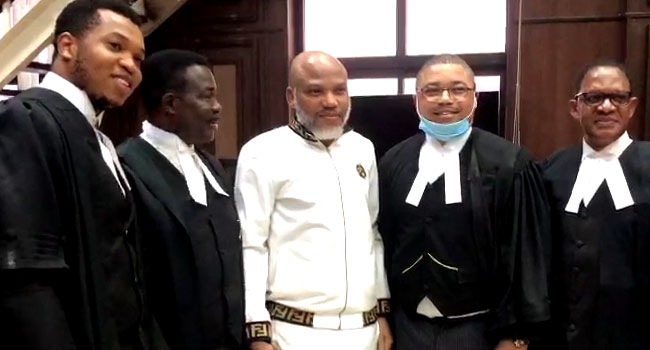
Kanu and his legal team

As might be expected, Kanu’s lawyers have a different view of the Appeal Court’s ruling. One of the IPOB leader’s attorneys, Aloy Ejimakor, wrote on Twitter that “no new charges can ever stick against [Kanu] because the extraordinary rendition has created a permanent barrier to his prosecution.” Another one of Kanu’s lawyers, Ifeanyi Ejiofor, offers an equally aggressive interpretation. He argues that the federal government is at liberty to challenge the Appeal Court’s ruling at the Supreme Court but he insisted that the government cannot re-institute the charges pending against Kanu before the rendition since they were the same charges that the Appeal Court had already vacated.

Similar to his colleague Aloy Ejimakor, Ejiofor argues that

“the declaration by the Court of Appeal that the Federal High Court has no jurisdiction to try… Nnamdi Kanu because of the illegality of his abduction and extraordinary rendition to Nigeria is an all pervading instrumentality that effectively bars any indictment of… Kanu in any court in Nigeria.”

Nnamdi Kanu’s lead counsel, Chief Mike Ozekhome, takes the argument further, telling Channels television that “Nnamdi Kanu was set free and discharged by the Court of Appeal” and that “the Supreme Court has said such a discharge amounts to discharge and acquittal.” Ozekhome urged the federal government to accept the ruling, noting that an appeal would “amount to persecution and no longer prosecution.”

We should not perhaps expect Kanu’s lawyers to offer anything but a maximalist interpretation of the Appeal Court’s favorable ruling. We will see if Kanu will be released imminently as his lawyers demand, or if the federal government will continue to detain him whilst exploring other legal recourse.

Political Implications
Whether or not Kanu will be immediately released, this latest court ruling has been received as some sort of triumph for the tested IPOB leader, reportedly sparking spontaneous jubilations across Igboland. The jubilation, if correctly reported, is understandable: it is a humane and spontaneous show of empathy for the person of Nnamdi Kanu who has languished in long and lonely detention since his capture last year; it is a sigh of relief from South-easterners who have been suffering the strangulating effects of IPOB’s sit-at-home campaign and the reign of terror associated with it; and it might be a triumphal exclamation from IPOB protagonists seeing this as a boon to their movement.

But there could yet be a different form of ‘jubilation’ manifesting elsewhere for reasons that may not be altogether benign. A judicial victory for Kanu, if not carefully managed, portends the resurgence of IPOB and a rekindling of Biafra agitation possibly in a manner that threatens Igbo claim in mainstream Nigerian politics. In particular, it could impact the political mobilization of the South East in the current presidential election cycle, possibly disorienting even the campaign of Peter Obi, the Labour Party presidential candidate who is currently making great strides in his quest for the Nigerian presidency. Herein lies the risk, which I will do my best to articulate below.

Potential Risks
There are two broad tendencies in Igbo politics that can be easily discerned. On the one hand, there is an otherish or outsider mentality, driven by an acute sense Igbo marginalization, which leads to a persistent separatist tendency or at least a desire for a semi-autonomous existence within the Nigerian federation. There is, on the other hand, an integrationist complex seeking admission to the apex of power in Nigeria, in a way as a corrective to the perceived marginalization. (In an earlier article, I had disaggregated these two broad complexes in Igbo politics into a model of five behavioral tendencies. See here for that article, and here as well where I did a follow-up). These strains have historical resonance, reaching back to the pan-Nigeria politics of Nnamdi Azikiwe versus the separatist drive of Odumegwu Ojukwu which led eventually to the Civil War.

These political tendencies are also, to some extent, class-based. The Igbos with favorable prospects in the political economy of Nigeria will find the unthreatening cadence of conventional politics appealing. Other Igbos, however, especially those at the margins who are more seriously impacted by the perceived marginalization of the South East, will find the pull of separatist rhetoric irresistible.

But we must not assume a strict class differentiation here. The radical rhetoric of Biafra separatism has cross-cutting ideological appeal, with avid adherents even within the relatively affluent strata of Igbo society. Part of the reason for this is the absence of an alternative logos. Mainstream Igbo politics tends to be sterile and transactional, bereft of any organizing or animating ideology, with mainstream political leaders seen mainly as self-seekers out to feather their own nests. Of course this is not unique to Igbo political leaders. It is an affliction of the entire Nigerian political class. But the egalitarian and acephalous nature of Igbo society places Igbo political leaders under greater scrutiny, and thus probably more graphically revealed in their shortcomings. As such, mainstream Igbo political leaders lack firm affinitive following among the Igbo rank-and-file.

There is, you might say, a vacuum in pan-Igbo political leadership. And it is into this vacuum that IPOB breathes its political radicalism.

Nnamdi Kanu and his cohorts embody that radicalist strain in Igbo politics. Though with a myriad personal faults, including a tendency to megalomania, Kanu serves as a fulcrum of Igbo disaffection, with a name recognition and personal magnetism that cuts across social circumstances – something which eludes any single mainstream Igbo politician today, except perhaps for Peter Obi. Kanu’s incarceration had hobbled his already proscribed IPOB to a great degree; the malevolent terrorism and wanton criminality unleashed by his associates on Igbo communities had also greatly damaged IPOB brand among the Igbos. Peter Obi emerged in these circumstances – a soft-spoken, mild-mannered, complaisant fellow squarely located in the mainstream of Nigerian politics. But, although Obi has presumptive appeal – especially among the youths, the urban dwellers and the intelligentsia as well as those in the diaspora, he does not aspire so much to a pan-Igbo essence as to a pan-Nigerian leadership. There remains therefore something of a lacuna in pan-Igbo political leadership.

If the new Appeal Court ruling occasions the imminent release of Nnamdi Kanu, he could re-emerge as a gravitational force for Igbo political radicalism: not in the sense of formal leadership but symbolically and charismatically (to invoke a Weberian distinction), notwithstanding the setbacks his IPOB group has suffered. The Igbos love a hero, a dike who overcomes great odds to accomplish great feats. If Kanu emerges from the cavernous entrails of federal detention with an irreversible judicial victory, there will be wild welcome awaiting him, a triumphal reception for a ‘hero’ who entered the lion’s den so to say and came out unscathed. Some admirers already laud him as the ‘Lion of Biafra’. He’ll enjoy a new level of empathy and admiration which could possibly translate into political leverage. This sentiment may not endure, but Kanu is savvy enough to exploit its window. Yet, there is no knowing how he might deploy such leverage. Will he mobilize his following for full engagement with conventional politics, perhaps even urging them in favor of a particular presidential candidate? Certainly Kanu will not have significant influence across all strata of Igbo polity, but he might hold sway with a swathe of the disaffected rank-and-file unenthused by conventional politicians but whose instincts were sublimated into mainstream politics with Kanu’s detention. His return could unlatch them from previous compromises.

If, on the other hand, the federal government continues to hold Kanu in detention in contravention of court order, there may be great upheaval across Igboland, hampering voter turnout or probably even preventing elections from holding in the Igbo country. Kanu’s IPOB associates are already threatening mayhem if he is not released imminently. No one should minimize the seriousness of that threat. We are dealing with a set of arguably irrational actors who might not see reason to modulate their reactions and not hurt South East chances in the arena of conventional politics. They will not be persuaded to act in the interest of the larger group, especially if they become convinced, based on the interpretation of Kanu’s lawyers, that the IPOB leader, having survived prosecution, is now being ‘persecuted’. We have only to recall the reign of terror visited upon Igboland in the course of Kanu’s trial to imagine what might be unleashed in the circumstance of a sabotaged legal victory.

The question then is whether the federal government will act in the interest of peace, or continue to prosecute the case against Kanu, holding him in detention despite the appearance of wanton persecution. Put differently, does the federal government have any incentive to pursue the path of peace? Or might the ruling party, All Progressives Congress (APC), in order to stall the supposed surge of Peter Obi in the run-up to the February 2023 presidential election, orchestrate the extension of Kanu’s case as a way to destabilize Peter Obi’s primary constituency, the South East? We have not seen any major party in Nigeria shrink from using dirty tricks to achieve its political objectives.

We are not clear yet about the formal reaction of the government to the Appeal Court ruling. Besides the statement released by the Attorney General’s office, the National Security Council has also issued a statement, after a meeting on Friday October 14, affirming the AG’s position that Kanu was discharged but not acquitted. The NSC said it was “considering the appropriate action to be taken,” and that the government would explore other legal instruments to pursue the matter.

In light of the developments, it is imperative that the political leadership of the South East should rally to avert what looks like a looming crisis over Nnamdi Kanu’s supposed judicial victory. So far, it appears that only the Igbo socio-cultural group, Ohaneze, as well as Alaigbo Development Foundation have weighed in on the matter. Both applauded the Appeal Court ruling and urged the release of Kanu from detention. There is not as yet a concerted intervention by the political leadership – not the presidential candidates or governors or legislators or party leaders from the South East.

It is important to have a concert of opinion from South East political leadership on this matter. The conflagration that could result if the federal government is not persuaded to release Kanu will engulf the entire region.

The South East political leadership also has a role to play, if and when Kanu is freed, to corral his post-release exertions into the mainstream.

The isolated interventions so far on display from Igbo leadership simply will not do.

Water Water Everywhere, Not A Drop Of Plan

1
Persistent flooding in Nigeria

By Chidera Michaels

The spigot from which all the evils bedeviling our people cascade is the stupefying dumbfoundedness of our leaders. That’s common knowledge. Their superfluous narcissism is rampant and bewildering. Besides all other problems besetting our people, the incessant flooding is hard to understand. We have water-related problems in the eastern part of the country. The recurring decimal is that people’s property and houses are drowned and destroyed by floodwater, the blacktops on the roadways are washed away, and there are no viable seaports or jetties on our seas and waterways. The absence of seaports and jetties is shocking since business is the life wire of people in that part of the country. And so, it seems to me that migrating from the eastern states en masse to other parts of the country in search of the amenities we can provide for ourselves is as dumb as it gets.

The ravages of floodwater are not new in the eastern part of that country. Kogi State and some other western states experience this problem as well. Of course, you could try to hide behind global warming as being a contributory factor in the constant flooding. But that suggests that other factors responsible for these floodings are under control. And this is where I come down on this: Checking floodwater is not the same thing as inventing a cure for cancer. Nor is it akin to finding a solution to world peace. Put simply, controlling erosion is not rocket science at all.

A second-year civil engineering student can design a sewage system to channel the floodwaters away from the surface into an underground sewage system. However, for that to happen, a sewage system must be built to receive the colossal amount of floodwater generated in the area. Given the perennial nature of the problem, it boggles the mind that this situation hasn’t been taken care of long before now. Whenever I see the few paved roads asphalted in the southeast with their shallow and narrow gutters (which usually get filled up with refuse and sand quickly), I wonder what the governments that designed such channels were thinking.

I said in an article I published in September of 2021: “Because of the menace of erosion in the Eastern region, an underground drainage system must be constructed so that floodwater is directed away from the surface. This is how it is done in advanced countries. Many cities and towns in Europe and America are under sea level. These cities and towns would be under the ocean without adequate erosion checks. New Orleans in the State of Louisiana is one such city. Others are Salton City in the State of California, Amsterdam in the Netherlands, and Copenhagen in Denmark. But the residents of these cities do not regularly complain that erosion is destroying their houses, as appears to be in eastern Nigeria. Our towns and cities are not under sea level. So, our erosion problem is nothing that an effective erosion check cannot take care of.”

But of course, a lack of a better sewage system is not the only thing responsible for this continued flooding. It has been widely noted that blocking the path of floodwaters with buildings and other structures is perhaps the leading cause of flooding in that part of the country. A prevailing phenomenon that is as disgusting as it is deplorable is the practice amongst the wealthy and influential in our society to show that they can defy the law without consequences. Such people built many houses and structures blocking the floodwater paths. In most cases, the buildings are situated close to the tip of busy roads and streets. And because these individuals are well off, the government does not torch such buildings.

Recently, however, the government of Anambra State appeared to have made a public spectacle of removing some of such structures from the flood paths. I am yet to see whether that was a mere show or a determined effort by the government to reopen the blocked flood paths.

Dredging the rivers and streams and widening and deepening the gutters will surely help in this effort. But dredging the River Niger will also help tackle the other reason our businessmen and women developed the habit of migrating out of the east in droves. I am told that eastern Nigerians have deserted the east in their thousands to Lagos and other areas because there is no viable seaport in the entire east. For a long time, I didn’t realize that state governments or private business entities could build and operate seaports and jetties by obtaining licenses from the federal government. So, why hadn’t the eastern states’ governments sought the rights to revitalize and operate the seaports at Warri, Port Harcourt, and Calabar? That may sound like a good question. However, I am aware that this is Nigeria. Because the Nigerian law allows such a practice does not mean that the eastern states’ governments would be given such licenses. One of the reasons for harboring such paranoia is the hostility of some influential Nigerians towards the Igbos of eastern Nigeria. An example is the published audio of the venom spewed by Kashim Shettima, the APC’s vice-presidential candidate, against the Igbos.

The article I referenced above, published in September 2021, said in a section of it: “The seaports at Warri, Port Harcourt, and Calabar must be revitalized and opened for business with all urgency. And the River Niger must be dredged and expanded to allow ships to reach Onitsha. The Suez and the Panama canals are artificial waterways created by linking oceans and seas where none existed before. The Suez Canal is 193 kilometers (120 miles) long, 24 meters (26 yards) deep, and 205 meters (244 yards) wide. And it was created to link the Red Sea with the Mediterranean Sea. The Panama Canal is an 82-kilometer (51 miles) waterway that connects the Atlantic Ocean with the Pacific Ocean. But the distance from Onitsha to the edge of the Atlantic Ocean is approximately 175 kilometers. This is a distance of 109 miles. And the area to be dredged along the River Niger already has water running through it, unlike the Suez and the Panama Canals. Therefore, the river only needs to be expanded and deepened. It should be done with dispatch to allow ships to reach Onitsha.”

So, the situation begs these questions: Why haven’t such oil-rich states like Delta, Bayelsa, Rivers, Akwa Ibom, and Cross River gotten such licenses from the federal government to either revitalize or build new seaports along their coasts? If a single state couldn’t do it alone, did they ask their contiguous states or the southeastern states to partner with them in the venture? On the alternative, why won’t the southeastern and southsouthern states unite to build one world-class seaport in the area? Should such a seaport be built in Warri or Port Harcourt, the Lagos seaport will become almost moribund in ten to twenty years.

Deviating slightly from the issue under discussion, has anyone noticed that the successive governors of Rivers State ran for President of Nigeria with the billions of naira they stole from the state government’s coffers? A fraction of this stolen money spent on their elusive presidential ambitions could have been used to expand, equip, and modernize the seaport at Onne. He could have immortalized his name forever if any of them had done this.

But forget the governors of the southeast and southsouth for a moment for being insatiable money-grubbing jerks. What about the business moguls in the eastern states? I’m talking about wealthy traders whose businesses depend on importing and exporting goods. So, what’s stopping them from pulling their resources together to build or revitalize one of the existing seaports in the eastern states? Ten or more billionaires from Anambra State alone could finance such a venture.

And here’s the perennial question that’s been bandied about for quite some time: Why do the Igbo businessmen and women in Lagos consent to being taken for suckers by the Lagos State government? Why are they constantly being asked to reclaim lands in Lagos State’s swampy creeks only to be evicted from the lands they reclaimed about a decade later? What’s up with that deal? Why can’t they see that they are being played for chumps? Don’t these wealthy Igbos in Lagos have any dignity? What must happen before they grow some senses? Do you smell another “Abandoned Property” imbroglio on the horizon as I do? That is possible, you know, should the Lagos State government have its way! Remember “Aku lue uno?” Translation: When wealth is brought home, it dignifies the one that accumulated and got it home. I’ve heard the Igbos described as being as smart as hell all my life. Where’s the proof?

The opinion expressed in this article are the author’s and does not necessarily reflect the editorial position of Awka Times. Chidera Michaels is an attorney and a Christian theologian based in Baltimore, MD, United States (email: chideramichaels@gmail.com).

Without a Correction, Economic Instability and Rising Insecurity May Derail the Coming Election

1
Presidential Indifference: Buhari has failed to tackle the insecurity in Nigeria (Awka Times reproduction)

Nigeria is beset by a torrent of security and economic issues threatening the upcoming election. Decisive action is needed to correct the situation and ensure a successful election.

By Chudi Okoye

Will the coming election in Nigeria be derailed by ongoing crises in other spheres of Nigerian life? This question demands an urgent answer as we observe the gale of confounding catastrophes clobbering the country.

As it is now, the gears of the electoral process are cranking up, seemingly unhindered, as we tread toward the presidential election in 2023. And yet, the fabrics of our economic and social order are cracking up in a dizzying spate. In the electoral sphere, we observe hopeful milestones of democratic progress, creating even an odd frenzy of rising expectations in some innocent corners. And yet in the real world, we witness only millstones of despair dragging the nation down a spiral of social declension. A semblance of Yeats’ ‘ceremony of innocence’ is unfolding as the electoral machine grinds on, unperturbed; yet, ‘anarchy is loosed upon [our land]’, marked by a toxic mix of rising insecurity, economic distress and social disorder. As ‘things fall apart’ all around us, one wonders if the election will hold at all, just as one ponders what, if it does, would be the manner of country bequeathed to the next administration. An absolute chaos awaits, after President Muhammadu Buhari’s annis horribilis.

We are in a season of both great and grating expectations. While we pray for the miracle of democratic renewal tomorrow, what are we to do about our present sorrows?

Everywhere one looks there is stark evidence of systemic upheaval. There is in fact a dark premonition of imminent collapse. Things have been sliding in the country for a while, but they appear now to have reached a snapping point. Of course there has always been some presentiment about Nigeria, with predictions in the past of imminent collapse posited by pundits frustrated with theorizing an inexplicable country. But things never quite managed to tip over. Now, however, there is near-universal consensus that Nigeria has become a failed state teetering on the brink of possible collapse. With a little bit of imagination, we can easily catastrophize aspects of the present crises to see how they might impact the impending election.

A Crumbling Economy
Let us begin with the economy. When economists talk of economic collapse or meltdown, they imply the presence of some specific adverse conditions. These include: prolonged depression, hyperinflation, high unemployment, currency crash, public finance crisis, debt default, and so on. All of these are present in Nigeria today, at different levels of severity.

The country’s economy is in absolute tatters. The Naira has plunged in value, the official rate dropping from $1=₦199 on May 29, 2015, the day Buhari bounded into office, to $1=₦416 currently, with the parallel market rate at $1=₦715.

The country is nearly broke, its sovereign funds depleted; and it is heavily indebted. The external debt stock stood at $40 billion as of Q1 2022, up 288% from $10.3 billion at the start of Buhari’s presidency, according to DMO (Debt Management Office) figures. The domestic debt profile is also daunting, rising nearly 140% from ₦8.4 trillion to ₦20 trillion. The country’s total public debt portfolio, domestic and external, stood at $100.1 billion (₦41.6 trillion at the official rate or ₦71.6 trillion by parallel market rate) as of Q1, pushing the country’s debt-to-GDP ratio to 36%. Nigeria spends as much as 86% of its revenue on debt servicing, compared to just 20% for South Africa which has about 2.5x Nigeria’s debt stock and over 2x the debt-to-GDP ratio. Clearly Nigeria’s is considered a higher risk than South Africa. One expert, Prof Ebenezer Obadare of the Council on Foreign Relations, recently warned that “Nigeria is staring down the barrel of financial bankruptcy.”

Economic Crisis in Nigeria (Dreamstime)

Other economic indices are equally glaring. Unemployment is running at 33.3% and under-employment at 22.8%, according to the National Bureau of Statistics (NBS). Food and commodity prices, including pump price, are sky high, leading to a Consumer Price Index (equivalent of inflation rate) of 18.6% as of June, the highest it has been since Jan 2017, according to NBS. Meanwhile, under Buhari’s watch, Nigeria might well have become the poverty capital of the world. With only about 16% of India’s population, Nigeria in 2018 overtook that country “as home to the world’s greatest concentration of extreme poverty,” as the London Guardian reported. Latest data from the World Poverty Clock shows that Nigeria and India now each has about 83m people living in extreme poverty, which represents a penetration of only 6% for India but a whopping 39% for Nigeria.

Meanwhile, the country’s economy is crippled by an acute shortage of fuel as well as frequent power outages on which Awka Times recently reported.

Amid the economic stress, there’s occupational unrest. The Academic Staff Union of Nigerian Universities (ASUU) has been on strike since February 14. The Nigeria Labor Congress (NLC) recently embarked on a two-day solidarity strike to support the ASUU action. And a strike is threatened by the Premium Breadmakers Association of Nigeria (PBAN).

Clearly, from the above, Nigeria is at an advanced stage towards economic meltdown. It could get worse if the Naira plunges further; if unemployment and inflation rates further increase; and if the crisis of public finance deepens, making it even more difficult to pay public sector salaries or maintain other recurrent obligations. Government bonds could become worthless. Nigeria could actually slide into debt default. We are already nudging the 40% limit in debt-to-GDP ratio set last year when it was increased from the previous 25% cap.

Economic meltdown often comes with its own intrinsic pain, but it is also often accompanied by social chaos, civil unrest and a breakdown of law and order. All of these tend to induce authoritarian responses from a state, an outcome that is antithetical to democratic praxis. This is one sense in which worsening economic conditions could derail the impending Nigerian election, if there’s no correction.

One could argue of course that the incidence of economic meltdown need not necessarily deter the conduct of a democratic election. A financial crisis that nearly crippled the global economy did not obstruct the US presidential election of 2008, though it forced the candidates at some point to suspend their campaigns. The UK government still went ahead with the conduct of several by-elections in the immediate aftermath of Black Wednesday – the Sterling Crash of Sept. 16, 1992. Long before that, Germany still held federal elections on Sept. 14, 1930, in the thick of the Great Depression that had started the year before. The US held a presidential election on Nov. 8, 1864 amid an economically devastating civil war. There are several such cases of political systems defying the cataclysms of their economic sector.

Despite these examples, the issue insists in a Nigeria with a nascent democratic culture and limited political institutionalization. As we have seen repeatedly in our history, the Nigerian state often betrays an instinct to authoritarianism at the slightest manifestation of restiveness in civil society, especially when there is a nexus to economic distress.

Rising Insecurity
It is not just economic crises that could impact the 2023 election in Nigeria. There’s also rising insecurity around the country, driven to some extent by secessionist and other forms of agitation but primarily by Islamic terrorism. Before Buhari assumed office, the Global Terrorism Index already ranked Nigeria among the countries most severely impacted by terrorism. Nigeria has remained in that cohort through the Buhari years, even with huge budget allocations ostensibly dedicated to fighting terrorism. If anything, under the watch of Maj.-Gen. Buhari Islamic terrorism has turned into an audacious insurgency, sacking federal prisons, overrunning security forces, and even threatening to abduct the president himself, presumably intending thereby to capture the Nigerian state. Outlying areas of the nation’s capital have been under siege. The capital itself is the unmistakable target. The insurgency seems intent on capturing the Nigerian state, some have argued, as a strategic part of transnational Islamic expansion. On this thinking, what we see unfolding is not mere banditry. It has territorial and strategic ambition. Not only that. Nigeria seems to be under attack by a bold and well-armed insurgency which may well have infiltrated the Nigerian security architecture and compromised the upper reaches of the security hierarchy.

Islamic insurgency has territorial ambition in Nigeria

As Islamic insurgency has escalated, Buhari has shown a weird insouciance about it. Foreign-traveling while the nation burns or simply ensconced in the capital, Buhari has seemed farcical and aloof in his response, creating wild conspiracies about his complicity. His government has displayed great reluctance and amazing cack-handedness in combating the menace. As the Nigerian Guardian reported on July 31st, experts say there is “no discernible strategy to wage war against terrorists,” and that “President Buhari has not only failed Nigerians but has also allowed insurgents to gradually make inroads and shut down governance.” This has made the Islamic insurgents even more brazen, and Buhari now commonly ridiculed as a ‘defeated general’. Recently, after the insurgents breached the Kuje Prison near Abuja, Buba Galadima, a former ally of President Buhari, told BBC Hausa service that he would not be surprised if the bandits kidnapped the president. “These bandits are disdainful to Buhari administration,” he said. “At the beginning of the government, everybody was scared of him (Buhari); expected him to be brave before he was now exposed to be toothless. Buhari knows nothing; he can’t do anything.”

Though Buhari has never seemed energetic or particularly warm in his public disposition, he has become more enervated lately in dispensing the duties of his office. He appears to be sick and insentient, as if he has succumbed to some form of mental retardation. The president, approaching 80, seems depleted, bewildered and out of his depth. He doesn’t seem to be able to work long hours, or able to cope with critical decision-making. “Currently, he won’t attend to files till 10am,” a recent report claimed, “and the moment it’s 5pm, he goes off duty. Even if Nigeria is on fire, he won’t make any decision. Nobody can see him again except members of the (Presidency) cabal and close family members.”

This is why some stakeholders have suggested that President Buhari should step aside and allow his vice-president, who is far better educated and 15 years younger, to take over the reins. The Northern Elders Forum has asked Buhari to throw in the towel. Buhari himself says that it has been tough for him governing Nigeria and that he is eager to go. But he seems determined to stick around until the end of his tenure.

There was some noise last week, an uncertain babble emanating from the ‘nattering nabobs’ in the National Assembly proclaiming their dissatisfaction with President Buhari’s handling of Nigeria’s security challenges. Finally awoken, it seems, from their privileged slumber in the chamber, the legislative members mumbled a half-hearted chant that ‘Buhari Must Go‘ and muttered some incomprehensible threat about impeaching the president if he doesn’t address Nigeria’s security problems in six to eight weeks. I won’t waste space on this, merely to mention it, because it isn’t going anywhere. The impeachment intent, even if serious, is unenforceable. The legislative math is implausible. And the logistics are, simply, impossible.

In spite of the legislative chicanery, the potential political impact of rising insecurity is widely recognized, by domestic and foreign observers alike. Not long ago, the British government cautioned that insecurity could likely derail the 2023 general elections. “Nigeria faces significant peace and security challenges,” the Director of UK’s Foreign Commonwealth and Development Office, Chris Beecroft, told Governors’ Forum in Abuja. “There is an active insurgency in the North East; farmer-herder conflicts are extending across the country; resource conflicts in the Delta; tension in the South-East; and banditry in the North West. The rise in conflict risks destabilizing Nigeria’s democracy in the run-up to the 2023 elections.”

He went further: “Conflict destroys lives, destroys livelihoods, [and it] destroys hope and ambition for the future. Conflict represents an existential threat to Nigeria’s unity and its development.”

This is precisely the point where growing insecurity could intrude into the 2023 electoral process. Without meaning to seem alarmist, it is easy to imagine how an escalation of insurgent threat to the Nigerian state, and a tepid response by the civilian regime, could provoke a direct intervention by an institution charged with defending Nigeria’s sovereignty and territorial integrity.

Perhaps this is why there has been some (admittedly fringe) talk about likely military intervention in the face of swelling insecurity. The idea isn’t raised necessarily as a welcome corrective. A few days ago, the presidential candidate of the African Action Congress and founder of Sahara Reporters, Omoyele Sowore, tweeted that “President Muhammadu Buhari #mbuhari is preparing Nigeria for a military coup d’état, everything he’s doing points to it!” Incidentally, a couple of days before Sowore’s intervention Buhari himself, speaking in Liberia, had also invoked the issue of military intervention, declaring that the only antidote is good government. Buhari was speaking ostensibly in reference to the recent military coups in Africa but he also adverted to the impending election in Nigeria, stating that the country is “working towards a free, fair, transparent, credible and acceptable outcome of elections and their results.” Buhari argued that “the deepening of democracy and good governance are essential antidotes to check-mate unconstitutional change of governments.”

We should not, of course, lightly presume the possibility of a military corrective to the present Nigerian crises. But this is not necessarily, as some may imagine, because the Nigerian state has finally shed such habit and has settled into a neo-Hegelian, end-of-history, liberal democratic order. We are unarguably in a far worse condition today than had prompted previous military intrusions into the country’s politics. Rather it is simply that the Nigerian military may be too vitiated as a force and too discredited as an institution to intervene at this particular point in Nigerian politics.

However, whilst cautioning against any lazy expectation of military intervention, we cannot casually dismiss the logic of it if insecurity escalates around the country, if the Nigerian state itself becomes more directly threatened, and if the civilian authorities continue with their ham-fisted response to the security crises. If it ever materializes, a military usurpation of power will put paid to the impending presidential election, especially if the military becomes convinced that neither the incumbent president nor any of those jostling to succeed him, would be effective as wartime commander-in-chief if the worst happens. Indeed, the clumsiness and ineptitude of Nigeria’s security forces in confronting what is but a ragtag insurgency, with seemingly easy inroads made by the latter, might prove tempting to any military adventurers out there lusting for power. Of course the sheer complexity of Nigeria’s governance problems might prove a deterrent to any such adventurism, but the calculus could change if things get much worse.

While the 2023 electoral process appears to be unfolding as planned, unimpeded by ambient cataclysms, the political risk of economic instability and rising insecurity cannot be discounted in any serious political arbitrage. The odds are only marginally higher than lower that the 2023 election will actually hold as planned. The odds will much improve if the current administration takes more serious steps, in the balance of Buhari’s tenure, to prevent an economic collapse or the fall of Abuja to Islamic insurgency.

Atiku Abubakar versus the South East: Political Usurpation and Electoral Consequences in 2023

1
Atiku Abubakar at Arise Interview (Awka Times reproduction)

This essay continues a series in which I have been examining how the leading political parties in the 2023 presidential election appear to have made choices colliding with the basic principles of Nigerian politics. Part 1 of the essay series discussed the ruling party, APC’s choice of a Muslim-Muslim ticket for the 2023 election. In this Part 2, I interrogate the opposition party, PDP’s ticket choices in terms of geopolitical zoning. I should say that in this piece, I focus only on geopolitical analysis, but this is not in any way to deny the salience of other levels of analysis which would include a class perspective.

By Chudi Okoye

Atiku Abubakar has a South East problem. It is almost certain that he faces an upset in that geopolitical zone in the coming presidential election, with the ascent of Peter Obi, the Labor Party candidate. But if the Peoples Democratic Party (PDP) flag-bearer is worried about being upstaged by his former PDP running mate, a discerning fella with a disarming manner who still calls him “my leader”, you couldn’t tell from his inscrutable smirk as he waved off the Obi threat in his July 22 interview on Arise TV.

There has been a suggestion, from pundit and political practitioner alike, that in addition to inspiring a new and highly energized wave of electorates, Peter Obi might cannibalize traditional PDP votes, especially in the South-East which has been an electoral mainstay for the party. However, far from showing any sign of perturbation in the Arise interview, Atiku dismissed Obi’s chances in the coming election:

“I really don’t expect the Labor Party to take as much votes from the PDP as people are suggesting. We could have seen it in the last election in Osun State. What [was] the performance of the Labor Party? This is a party that doesn’t have a governor, doesn’t have members of the national assembly, [and] doesn’t have state assembly members. Politics in this country depends on the structures you have at these various levels — at the local government level, at the state level, and at the national level. So, it is very difficult to expect a miracle to happen, simply because Peter Obi is in the Labor Party.”

Atiku dismissed the large following that Peter Obi seems to have amassed, noting that they were nowhere to be found in the recently concluded Osun State gubernatorial election. “After all,” Atiku sneered, “they were saying through social media, that they had more than one million votes in Osun state. How many votes turned out for the Labor Party?” He seemed also sneery of Labor’s chances in the northern hinterland, a major vote catchment area. “In the north,” Atiku thrilled, “90 percent of our people are not tuned to social media.”

It is biting, but not as catty a comment as an earlier taunt from Bola Ahmed Tinubu, presidential candidate of the All Progressives Congress (APC). At a rally a couple of weeks ago to drive support for his party’s candidate in the Osun State gubernatorial election, Tinubu had contemptuously dismissed what he called “mushroom parties” contesting in the election. He specifically mentioned the Labor Party, telling the crowd in his mocking drawl: “They will labor till they die. God will not make you laborers.” It was a vicious twist of Revelation 14:13 which the Labor Party soon parried as an invective against working people.

Whilst overtly dismissive of the Obi threat, Atiku was careful not to say anything that might alienate voters in Obi’s native geopolitical zone where the latter is expected to do the most damage to PDP. The South East has been an undeviating PDP stronghold, awarding the party a preponderance of its votes in the various presidential elections held since the inception of the Fourth Republic. In next year’s general election, which will be exceptionally competitive, Atiku and PDP cannot afford to cede ground too much in the South East. Certainly they must expect a significant swing to Obi’s Labor Party. But they will be hoping it would not be much, or such a switch as to pitch the party below the 25% threshold needed to log a state in the electoral tally.

In the 2019 presidential election in which Atiku led the PDP ticket, the party secured 76.3% of South East votes. So it would require a swing of over 50 percentage points to deny the party a 25% beachhead in the zone in 2023, though this will differ by state. Perhaps Atiku’s demeanor issues from the sheer improbability of such a swing – especially, as he said, to a party without a single elected seat anywhere.

Obi v. Atiku: Face-off in South East

Despite Atiku’s equanimity, the candidate cannot be insensitive to the sense of betrayal felt in the South East towards PDP. The zone has never fully voted for APC at the presidential level; as such, it cannot be much disappointed that the ruling party completely ignored it in constituting its 2023 ticket. But PDP has raised hackles in the zone for how it tackled the issue of zoning and power rotation. There had been an expectation that in this election cycle the party would zone the presidential slot specifically to the South East, having previously fielded candidates from the South West, North West, South South and North East, all with monumental support in the South East. This was also expected, given the high sense of alienation felt in the region under the presidency of Muhammadu Buhari. The Buhari presidency has made Nigeria feel almost like an alien nation to many Igbos. This sense of alienation, in turn, has spurred Igbo separatist agitation. And this agitation, in a vicious concatenation of effects, ends up despoiling the South East, for the particular methods employed by its propagators.

Given all this, it must be particularly galling to the South East not only that the PDP presidential primary was orchestrated to favor a North-easterner at its expense but that the zone was also denied the vice-presidential slot on the PDP ticket. For all the support the South East has given to the party, it must feel as if the zone has been outmaneuvered or simply betrayed by the PDP hierarchy. The Igbo socio-cultural group, Ohaneze, has consistently decried PDP’s decision.

Pacifying the South East?
In his Arise TV interview, Atiku seemed to be setting out the contours of the argument he might be making to mollify the South East. First, he argued that the issue of zoning is local to PDP and should not be conflated with APC’s northern incumbency under Buhari. In other words, he contended, it is wrong to presume a southern turn in PDP because of a northern incumbency in APC. Secondly, he argued that PDP’s zoning arrangement has always been between North and South as monolithic regions, and that PDP’s party and public offices have never been micro-zoned. Thirdly, he pointed out that the South dominated previous PDP presidential incumbency and in fact, fourthly, that the last PDP incumbent was a southerner.

These are without doubt powerful arguments. A party with 82% southern incumbency (by our estimate) whose last presidential office holder was a southerner should be justified in choosing a candidate, this time around, from the North, right?

Since Atiku has made what is essentially a technical argument, let’s take him up on that. First of all, it is incorrect to say that PDP zoning formula stipulates a rotation between a monolithic North and South. Section 3(c) of PDP constitution merely says that the party adheres to a “policy of the rotation and zoning of Party and Public elective offices in pursuance of the principle of equity, justice and fairness.” The section does not anoint a North/South rotation. It is merely a matter of political pragmatism that this construction has been read into the party’s constitution.

The question then arises as to why such pragmatism, or even a doctrine of necessity, could not have been invoked in favor of the South East which has suffered for its keen support of the party.

We can also quickly dispense with the argument that the last PDP presidential incumbent was a southerner. One could make an equally cogent case that the last PDP presidential candidate was a northerner, in the person of Atiku Abubakar himself! It should not matter that he did not win. In fact, if this matters at all, it should be to question the political wisdom of recycling a flag-bearer who previously failed the party.

Atiku’s point about southern dominance of PDP incumbency is a more complex one. Certainly as a matter of equity, one must acknowledge this southern skew and thus the legitimacy of northern claim. But this view holds only if one upholds Atiku’s monolithic North/South construction. The argument collapses once we deconstruct that formula. Let’s look again at the facts.

In the 1999 and 2003 presidential elections, PDP fielded a flag-bearer from the South West (Olusegun Obasanjo). In the 2007 election, a candidate from the North West led PDP’s ticket (Umaru Yar’Adua). In the 2011 and 2015 elections, PDP fielded a South South candidate (Goodluck Jonathan). And in the 2019 election, PDP fielded a North East candidate (Atiku Abubakar), as it is also doing in the coming election.

The above indicates that so far PDP has not favored either the South East or the North Central geopolitical zones in its presidential lineups. Between these two, the South East is arguably the more sensitive omission. We can dispense with the issue of the North Central for now. Although the zone has not produced a major-party flag-bearer or running mate in the Fourth Republic dispensation, it has fared quite well if we consider the broader distribution of head-of-government tenures in the post-colonial period. In the ~62 years since Nigeria gained independence, a person from the North Central zone has headed the Nigerian government 29% of the time, surely an overwhelming share in Nigeria’s six-part geopolitical construct. The zone gave Nigeria three military heads of government who had long tenures and/or were very influential: Gen. Yakubu Gowon (1966-75), Gen. Ibrahim Babangida (1985-93) and Gen. Abdulsalami Abubakar (1998-99). This zone and indeed all others have done far better than the South East which has only produced a ceremonial head of state (Dr. Nnamdi Azikiwe, in 1960-66); a military head of government assassinated after only six months in office (Maj. Gen. Aguiyi-Ironsi, Jan-July 1966); and a vice-president who served in an administration overthrown merely months into its second term (Dr. Alex Ekwueme, 1979-83).

The question then is whether we should confine our logic to the narrow technicality of PDP’s presidential incumbencies since 1999, which certainly favors a reversion to the North as Atiku implied. Or whether, in the face a strident South East agitation for the presidency as well as a searing secessionist agitation, PDP should have invoked a broader historical logic which compels a concession to the South East. One is inclined to argue the latter.

Atiku himself, even whilst floating the narrow logic of PDP tenures, did appear in the Arise TV interview to acknowledge the historical compulsion of a Nigerian president of Igbo extraction. He adverted to his own effort toward this end as seen in his consistent choice of a running mate of Igbo extraction every time he secured a presidential ticket:

“If you can go through history, I was given a ticket in 2007, I picked a South-easterner, an Igbo. I was given a ticket in 2019 , I picked an Igbo. And in 2022, I [have been] given a ticket, and I [have] picked an Igbo man again. Consecutively. This is just to show you my desire to unify the country.”

One could question the mindset of a politician who usurps Igbo opportunity at the top of the presidential ticket but quite happily nominates Igbos as subalterns – his running mats, sorry running mates. But that may be uncharitable. Instead, let us consider why PDP may have found it inexpedient to field a candidate of South East extraction as its flag-bearer.

The first thing is to recognize that PDP had lost the presidential contest in the last two election cycles, and as such, for the upcoming election the party would prefer an aspirant whom it considers its surest bet to regain power. In this regard, one wonders if the party felt jittery about Igbo vicissitudes in recent presidential elections. In the annulled election of 1993, Bashir Tofa ran on the platform of the National Republican Convention with Sylvester Ugoh as his vice-presidential candidate. He lost. In 2003 Buhari ran on the platform of All Nigeria Peoples Party with Chuba Okadigbo as his running mate. He lost. In 2007 Buhari tried again, this time with Edwin Ume-Ezeoke as running mate. He still lost. And of course Atiku himself lost in 2019 with Peter Obi as his vice-presidential pick. All running mates in these elections were Igbo.

It is not an edifying history. And it mightn’t have seemed auspicious to a party seeking a most propitious path back to power. So presumably it decided to look elsewhere.

The above attempts to put a rational spin on PDP’s ticket choice for 2023, proposing an electoral efficacy argument for the party’s decision. But the argument collapses on collision with an alternative history. For one thing, it ignores the repeated failures of Atiku Abubakar himself who has been running for president, without success, since 1993. If you are seeking the most promising candidate to reclaim the presidency, why entrust your ticket to someone who has been running for that office for 29 years without success, someone who failed in the very last cycle?

The electoral efficacy argument also ignores the successful alliance of Nnamdi Azikiwe’s National Convention of Nigerian Citizens (NCNC) and Tafawa Balewa’s Northern People’s Congress (NPC) in the First Republic, and the successful ticket of Shehu Shagari and Alex Ekwueme in the Second Republic. Any jitteriness about Igbo political marketability should have been dispelled by the fact of these successful collaborations, which occurred, by the way, either side of the Nigerian civil war.

In the contemporary setting, who can ignore Peter Obi’s monumental political surge, which is the more striking since he’s pushing from the platform of an inconsequential party. Of course that popularity is yet to be tested. But even if Obi ends up losing the 2023 contest, it might be less that he was a flawed candidate than that he ran on the platform of a fringe party. One wonders what might have been had PDP the foresight to have nominated Peter Obi, instead of its flawed preference, Atiku Abubakar.

PDP may have made poor choices in the composition of its 2023 presidential election ticket. The mistake could cost it the election. Or, the party might just squeak through, denied a resounding victory because of the South East problem which it brought upon itself.

PS: In the third installment of this essay, I will look at the import of the Labor Party flag-bearer’s frequent comment rejecting any support based on primordial sentiment.

Trial and Tenacity: After a 10-Year Slack, Bart Nnaji’s Electricity Project Gets a New Spark

1
Prof Bart Nnaji: CEO, Geometric Power

After a decade-long stagnation forced upon it by bureaucratic and political intrigues in the privatization of the Nigerian power sector, former minister, Bart Nnaji’s electricity development company, Geometric Power, is on the rebound. Nnaji told Awka Times that his firm is set to launch operations to transform power supply in its Aba (Abia State) franchise area, and hopes from there to explore opportunities elsewhere in Nigeria. He also said he is putting his gubernatorial aspiration aside for now to focus on his power sector project.

By Chudi Okoye

It happened again on Wednesday, July 20th. Nigeria suffered once more a precipitate power outage following yet another collapse of the country’s cranky electricity grid. It was the sixth system failure this year alone, and about the 140th since the Nigerian government began to implement the privatization of the power sector a decade ago. Nigerian homes, offices and businesses pay a hefty ₦876.6 billion a year in electricity bills, with the tariff seemingly hiked every six months or so, but it feels as if they are paying for recurrent darkness. The economic costs of the constant brownouts and blackouts are almost incalculable.

Nigeria lags behind all the countries in its population cohort in terms of electricity production. It produces just 5% Brazil’s output, 11% of Indonesia’s, and 21% of Pakistan’s. It’s not just these countries. Nigeria also plays second fiddle to some African countries. It produces only 12% of South Africa’s electricity output; 15% of Egypt’s; and 37% of Algeria’s. In a 2020 ranking of countries in terms of electricity production, the ‘giant of Africa’ came in 70th, far below South Africa (21st), Egypt (23rd) and Algeria (41st).

Nigeria’s challenges with power generation are all the more astonishing considering the provenance. The country got its first power generating plant installed – in the city of Lagos – more than a century ago, in 1896. The first electric utility company, known as the Nigerian Electricity Supply Company, was established in 1929. Yet, in many parts of Nigeria electricity, or a stable supply of it, remains little more than a dream.

Foray into Disarray
Nigeria’s epileptic power supply persists not for want of a reform agenda. There have been many efforts to reform the sector, many initiatives to fix the country’s notorious power supply problem. But many well-meaning protagonists involved in the process have come unstuck. One such player is Prof Bart Nnaji, the Enugu-born, world-acclaimed engineer, inventor and innovator who marked his birthday recently – he turned 66 on July 13, 2022 – and is staging a comeback in the Nigerian power sector, after nearly a decade in limbo.

Bart Nnaji has been hoping to help revamp the Nigerian power sector for the better part of two decades. He’s done so in various capacities. In 2000, along with joint venture partner Renatech International and US technical partner Cummins Power Generation, Nnaji’s company Geometric Power built and managed a 15-megawatt emergency power station in Abuja. The plant came on stream on November 7, 2001 and supplied power to the State House, the Abuja Central Business District and the headquarters of the Nigerian National Petroleum Corporation (NNPC), among other places, for 30 months without interruption. It was quite impressive.

Nnaji once served as president of the Independent Power Producers Association of Nigeria (IPPAN). He also served as Chairman Presidential Task Force on Power (June 2010 – July 2011), doubling as Special Adviser to the President on Power.

Fresh from his presidential adviser stint, Nnaji was picked as Minister for Power in President Goodluck Jonathan’s administration (from July 2011 to Aug. 2012), having had an earlier stint as Science and Technology minister (Aug. to Nov. 1993). Nnaji had picked up the power portfolio with zest and an ambitious plan for a transformation of the Nigerian electricity sector. However, the usual Nigerian syndrome – bureaucratic and political intrigue – hampered his efforts. In fact things got so touchy at one point that the urbane and self-effacing minister chose to resign his position, walking away from the privatization program he had been leading.

When Prof Nnaji resigned, there had been speculation in the media about ‘conflict of interest’ concerns since a firm in which Nnaji had a stake was bidding for some power companies that the government was selling off at the time. However, his stake in the company had not been unknown to the authorities, and it was widely reported in the media. More likely the issue arose because Nnaji had upset powerful interests with the privatization program and they decided to stop him.

Prof Nnaji told Awka Times that he had been concerned that the privatization program had occasioned the parceling off of national assets to private interests who did not have the requisite technical or financial capability to operate the newly privatized companies. He left, he says, because he “wasn’t going to be part of that.” A spokesman for Prof Nnaji added that the former minister had been the “lone voice in the wilderness protesting against the manner [in which] national assets were [being cornered] in the name of privatization,” and that he had upset some vested interests by speaking out. These interests, as reported in the media, included former heads of state and powerful businessmen, and reached into the presidency, precisely to the office of the then vice-president.

When Nnaji resigned his ministerial appointment in August 2012, the London Economist wrote a rueful article titled “A bright spark is extinguished”. The magazine said the ex-minister had been at “[war] with the vice-president, Namadi Sambo, who owns companies with interests in the public power sector,” and noted that this “may have hastened his departure.” The Economist’s headline was a clever construction; it was a double entendre which spoke to Nnaji’s nudged exit as well as the precarious prospects for President Jonathan’s “vaunted” power sector reform which the magazine argued was “flagging”.

The chaos that persists in the Nigerian power sector today, a decade after Nnaji’s exit, probably justifies the Economist’s dismal prognostication. Even though there has been some improvement, power supply remains spasmodic. There is still uneven supply across the country, with disproportionate provision in state capitals and industrial centres compared to rural areas, and more in the South than in the North. There remains also the problem of stranded assets and under-utilized capacity, with wide gaps between power generation, transmission and distribution. Ten years on, the privatization of the power sector in Nigeria has not delivered the expected dividends.

Bart Nnaji resigned as Power minister

Privatization of Chaos
The privatization program had been long on the cards following a process earlier initiated by the Obasanjo administration which culminated in the Electric Power Sector Reform Act of 2005. The reform became necessary after decades of extreme underperformance by the government’s power parastatal, National Electric Power Authority (NEPA, which Nigerians gave the humorous backronym: “Never Expect Power Always”). There was still no improvement even after NEPA was converted into a public limited company known as NEPA Plc (which Nigerians then dubbed: “No Electrical Power at All; Please Light Candle”).

The 2005 Act transformed NEPA into the Power Holding Company of Nigeria (PHCN), and set up a goal of unbundling the entire electricity value chain. It split the system into discrete spheres of electricity generation, transmission, bulk trading, distribution and regulation, to be operated by separate successor entities. This resulted in the creation of six generation companies (GenCos), 11 distribution companies (DisCos), and a national power transmission company. The intent was to see a gradual withdrawal of the government from the power sector in order to improve service delivery and ensure a wider and more stable supply of electricity across the country. The privatization of PHCN’s successor companies was undertaken over the period 2012 to 2013.

The privatization process remains incomplete, however. The power sector retains a wild and complex mix of government, quasi-public and private sector ownership. Transmission and bulk trading remain wholly under federal government ownership. Two of the GenCos are still owned by government but have been under concession to private operators. The other GenCos are privately owned, though they retain pockets of federal and sub-national government ownership as well. Even in the DisCos which supply electricity to homes, businesses and industries, the government still retains about 40% to 49% equity.

After a decade of partial privatization, the record of performance is not the least bit impressive. The unbundling of the transitional PHCN (which the ever-inventive Nigerians had christened “Please Hold a Candle Now”) was not without hitches. Its partially privatized successors have had mixed results. Whereas the privatized and concessioned power generating plants do not seem to be faring too badly, those under joint private and public ownership are struggling. There’s reporting that they are incurring heavy losses.

Another weak link in the value chain is at the level of the distribution companies, the DisCos. Several of them are not commercially viable, laden with debt arising from unpaid bills by end-users – one estimate indicated a loss of about ₦258 billion in just 11 months of unpaid bills in 2021, the bulk the bills owed by government agencies, departments and ministries. The government continues to pour money into these entities through loans which are unrecoverable and subsidy regimes riddled with inefficiency and corruption.

The weakest link in the electricity supply chain in Nigeria is the government-owned transmission grid, located in Osogbo, Osun State and managed by the Transmission Company of Nigeria (TCN). It is old, clunky, ill-maintained and grossly inadequate to met today’s challenges. No wonder it fails so frequently. Awka Times gathered that whilst on his ministerial post Bart Nnaji had been working on developing a super grid of 765kV which would have been a vast improvement on the current 132kV and 330kV lines which are prone to disturbances and outages.

Prof Nnaji believes the continuing crisis in the power supply sector owes at least in part to the stalled progress towards sector reform, especially the manner in which the privatization of PHCN’s successor companies was carried out. It might all have turned out differently had not the former power minister been forced to exit so abruptly.

Exit and “Witch-hunt”
Although Bart Nnaji had chosen to leave his ministerial post without any fuss, it did not prevent the authorities from subjecting him to the usual Nigerian “witch-hunt,” according to a source close to the ex-minister. As though his quiet departure were not enough, the authorities turned on companies in which the ex-minister was thought to have an interest. In one poignant case, the government announced a unilateral termination of a $23.7-million management contract which TCN had signed with a Canadian electricity corporation, Manitoba Hydro International (MHI), mistakenly believing that Nnaji had a stake in the firm. Manitoba Hydro is a provincial Crown Corporation owned since 1961 by the Province of Manitoba in Canada. It appears this was not known to government bureaucrats and politicians in Nigeria. Nnaji would be informed later, Awka Times learned, that the government had sent an emissary to Canada to investigate the ownership of MHI. There have been reports of issues with the technical competence of the Canadian corporation as well as its financial health. However, according to Nnaji’s spokesman, the presumption against the ex-minister as to ownership showed “the extent the government went to deal with Bart.” Eventually, the Nigerian government reversed its cancellation of the MHI contract, but this came after international condemnation of the action.

The authorities also targeted the private enterprise in which Nnaji actually had an interest, Geometric Power Limited, which he had founded in 2000 as Nigeria’s first independent power transmission company.

In April 2005 the old NEPA had reached a lease agreement with Aba Power Ltd (APL), a subsidiary of Prof Nnaji’s Geometric Power, giving the latter an exclusive license to operate the Aba ring-fenced area in Abia State.

The decision to build the Aba power project was rather fortuitous. The seed had been planted in 2004 when Dr. Ngozi Okonjo-Iweala, then Nigeria’s Finance Minister (and current Director General of the World Trade Organization), was touring the bustling but electricity-challenged Ariara Market in Aba with World Bank president, James Wolfensohn. Okonjo-Iweala and her guest appealed to Nnaji to consider building a power generation plant to service the iconic market.

Nnaji welcomed the suggestion, and initiated a process that culminated in the 2005 agreement with NEPA. However in 2013, as the power sector privatization program got underway, the Bureau of Public Enterprises (BPE), under the direction of vice-president Sambo – and in violation of privatization guidelines as the media reported at the time – unilaterally granted an electricity distribution license to the Enugu Electricity Distribution Company (EEDC) in which businessman Emeka Offor’s company, Interstate Electric, had acquired a 60% equity. The license covered all the five South-eastern states, thus overlapping the exclusive Aba ring-fenced area which the government had already granted to APL. The government thus created a conflict between the two licenses.

The conflict was a major blow to Geometric Power. Nnaji’s spokesman told Awka Times that the company had invested “millions of dollars” in the Aba ring-fenced area hoping to turn it into a model franchise with a consistent supply of electricity. Despite repeated reminders sent to the government to honor the existing GP/APL license, and even with a supporting court order, the Jonathan administration would not budge. It fell to the Buhari administration finally to resolve the issue. Following a long process of enquiry, Geometric Power finally regained control of the Aba ring-fenced area in February this year.

Commenting on the resolution, Nnaji said that “the [Jonathan] government sold what was rightfully ours to the people who acquired EEDC. So, they simply bundled Aba as part of EEDC. It was done knowingly. That is why we went to court, and we’re grateful this administration resolved the issues,” he said.

At an event scheduled for the hand-over to Geometric, BPE’s director general, Alex Okoh, said he was pleased that the “right thing was done”, and specifically praised Prof Nnaji’s tenacity: “I am pleased to announce that we are handing over this asset to a tenacious, very, very tenacious investor who has made a firm commitment to transform the Aba Ring Fence area into a model electric supply franchise, providing quality, stable and appropriately priced electricity to consumers, thereby unlocking the significant economic benefits of this commercial and industrial hub of the regional and national economy.”

Reset and Recovery
Prof Nnaji says his company has incurred huge costs to get back on track. According to him, Geometric had to pay Interstate Electric and EEDC about $26 million to recover the Aba assets, a 120% premium on the $11.8 million originally paid for the assets. Geometric drew down on a $50m facility from the African Export-Import Bank (Afreximbank) to make the payment.

Geometric’s new operation, which Awka Times learned is currently running at a cost of $600 million, is scheduled to be commissioned later this year. The company says its goal is to provide steady, quality and affordable power to Aba City as well as nine of the 17 local government areas in Abia State.

The Aba Power project is now at about 95% completion, according to Nnaji. The company says it has also refurbished, upgraded and modernized three old power substations inherited from the PHCN. Work has been completed on about 150-kilometre overhead power lines installed by ABB Powerlines, while rehabilitation work is being completed on four brand new power substations. In addition, Oilserv Ltd, an indigenous petroleum pipeline building firm, has completed a 27-kilometre natural gas pipeline from the Shell flow-station at Owaza in Ukwa West Local Government Area of Abia State to Osisioma Industrial Estate, where Geometric Power is located. Finally, three thermal turbines built by General Electric which Geometric had sent to the United States for maintenance, are back and have been reinstalled. Afreximbank had insisted on a re-certification of the turbines which had been lying fallow for long. Nnaji told Awka Times that it cost the company $8 million to complete the turbine re-certification.

Everything seems nearly set for the commissioning of Prof Nnaji’s Geometric Power project in Aba later this year.

Politics Can Wait
A resurgent Geometric is returning to its founding dream of becoming a major player in the transformation of the Nigerian power sector. For Prof Bart Nnaji, this is an all-consuming passion, a far stronger pull apparently than the tug of politics.

Earlier this year, it was reported that a group known as the New Enugu Coalition for Good Governance had secured an expression of interest form for Nnaji urging him to run for governorship in Enugu State, on the platform of the Peoples Democratic Party (PDP). Another group, the Association of Enugu State Young Professionals, also urging the former minister to run, has argued that the emergence of Nnaji in Enugu alongside Governor Chukwuma Soludo in Anambra State would catalyze the South East zone, turning it into one of the fastest growing economies in the world, as it had been in the First Republic.

Nnaji considered running for governor

It is uncertain however if Prof Nnaji will run in 2023. The ex-minister told Awka Times that he is putting any political quest aside for now to concentrate on realizing his dream for Geometric Power. “I believe my contribution to Nigeria is to build an effective and efficient power sector in the country,” he declared. Nnaji said he hopes to operate the Aba franchise as a model and eventually to target other opportunities in the South East and South South, and probably beyond. Nnaji also hopes that the Nigerian power sector will be further privatized, and that current license holders across the value chain will be willing to dilute their holdings in order to attract investment and expertise, particularly from global sources, that will drive operational efficiencies.

Asked to comment on the 2023 presidential field in terms of prospects for the power sector, Prof Nnaji told Awka Times that he was sure that Peter Obi of the Labor Party would do everything he can to strengthen the private sector and also to attract international investors. He also believes that PDP flag-bearer Atiku Abubakar might strengthen the private sector. He said however that he wasn’t too sure what Bola Tinubu of the All Progressives Congress might do.

After a decade of trial and tenacity, Prof Bart Nnaji’s Geometric Power is back on track and has a new spark. If the company delivers, its Aba franchise could yet become a model for the rest of Nigeria. Perhaps like the Sun itself, a template for stable electric light can yet rise from the East.

Pickets, Sticky Wicket and the Racket of Muslim-Muslim Ticket

1
Northern Christians protesting Muslim-Muslim ticket in Abuja, July 15 2022 (Awka Times reproduction)

A brazen decision by the ruling party, APC, to present a same-faith ticket for the 2023 presidential election seems to grate a befuddled nation, putting the fate of its candidates, some think, in a bit of a jeopardy.

By Chudi Okoye

“Oh God,” wrote St. Augustine in his famous book, Confessions, “make me chaste and celibate – but not yet!”

The Algerian Berber, who became Bishop of Hippo and one of the foundational Christian theologians known as the ‘Church Fathers’, was recalling the wayward ways of his youth and the supplication he had made to God as he struggled with Christian conversion and asceticism. Young Augustine asked God to cleanse and make him holy, but he didn’t want the Almighty to be too much in a hurry doing so!

It is a prayer that speaks to the frailty of human nature; a prayer pleading for a gradual, managed passage into a higher state of being.

We may well be doing same here upon this ‘blasted heath’ called Nigeria. We may be supplicating the gods to aid our passage from the purgatory of identity politics, marked by ethnic and religious preoccupations, into a paradise of post-primordial politics where none of that matters: we may be asking the gods to do all that for us but, a la Augustine, not just yet. Nigeria is a vast and varied country with immense problems and intense ethno-religious sensibilities which must not be assumed or wished away. We have much elemental impurities yet to purge from our body politic, too many atavistic injustices to redress in our nation-building effort, before we can hope to leap into the lofty realms of post-primordial politics.

But it seems some among us now wish to wave away or ignore these fundamental impulses of Nigerian politics. We can see this attitude in the unfolding drama of the 2023 presidential election.

A weird thing is happening on the road to 2023. Here we are, in the grip of great geopolitical tensions in our country arising, in part, from the perceivable surge of Fulani adventurism under President Muhammadu Buhari. There are religious and ethnic flashpoints everywhere, pushing the country to a precipice: an absolute reign of terror especially in parts of the North ravaged by Boko Haram/ISWAP Islamic insurgency, bandit lawlessness and armed herdsmen terrorism; separatist agitations convulsing the South East and also, to a lesser extent, the South West; and a cauldron of restiveness in the South South related to demands for resource control. Nigeria is boiling. Yet the president, who should be our commander-in-grief, has remained unbelievably insouciant.

Bizarrely too, amid all the turmoil, the three political parties leading the 2023 presidential field have made tactical campaign choices which seem to disregard the current upheavals and indeed the fundamental reality of the Nigerian polity. One party thought it wise to offer Nigeria a Muslim-Muslim ticket; another cynically dispensed with its own geopolitical zoning formula; and a third sanctimoniously disavows any support based on primordial sentiment. It is as if this triad of leading parties is deigning to disregard the ineluctable fundamentals of Nigerian politics.

I will be probing these parties’ behaviors in a three-part essay, starting with this first installment on the ruling party.

Same-Faith Aberration
Perhaps the most bizarre of these triad departures is seen in the choice of running mate for Mr. Bola Ahmed Tinubu, the presidential candidate of the All Progressives Congress (APC). After a protracted search for a ticket mate, Tinubu finally announced his choice on Sunday, June 10. He had settled on Mr. Kashim Shettima, a former two-term governor of Borno State and first-term senator.

Shettima and Tinubu: APC’s Muslim-Muslim Ticket (Awka Times reproduction)

The selection of Shettima does make sense on some level. On a personal front, he is well-educated and has had a fast-paced career that traverses academia, banking and politics. He also seems in some ways to be a politically astute choice. In choosing him, Tinubu might be seeking to replicate one of the more successful geopolitical parings so far in Nigeria’s democratic history: the South West/North East axis. Such paring had produced electoral victory for the Social Democratic Party (SDP) in 1993, with the Moshood Abiola/Baba Gana Kingibe ticket, though the election was later annulled by the military. The South West/North East paring also produced victory for the Peoples Democratic Party (PDP) in 1999 and 2003, with the ticket of Olusegun Obasanjo/Atiku Abubakar in both elections.

Tinubu may be looking to leverage this tested formula against the innovative North East/South South axis being fielded by PDP, with its Atiku Abubakar/Ifeanyi Okowa ticket. The APC flag-bearer probably considers that Shettima, as a stalwart of North East politics, might offer a bulwark against the outward surge of PDP’s flag-bearer who also hails from the same zone.

Although Tinubu is borrowing from a tested historical playbook, he is bucking history in some ways by presenting Nigerians with an audacious Muslim-Muslim ticket. The constitution of the Nigerian government, for the most part, has been such as to reflect the country’s ethnic and religious diversity, with the goal of making all sections of the country feel included in the task of nation-building.

The integrationist philosophy of the Nigerian government had its first flowering in the First Republic alliance of the Northern People’s Congress (NPC) and the National Convention of Nigerian Citizens (NCNC) which produced northern Moslem Tafawa Balewa as Prime Minister and southern Christian Dr. Nnamdi Azikiwe as President.

The integrationist ethos was maintained even in military dispensations wherein, when necessary, ranks and institutional hierarchy were overridden to ensure ethno-religious balance at the apex of power. Thus, as Head of the Military Government, Gen. Yakubu Gowon, a northern Christian, had southern Christians Chief Obafemi Awolowo as Vice Chairman of the Federal Executive Council during the Civil War, and later Rear-Admiral Joseph Wey as Chief of Staff, Supreme Headquarters. Gen. Murtala Mohammed, a northern Moslem, had Gen. Olusegun Obasanjo, southern Christian, as Chief of Staff. Obasanjo in turn had northern Moslem Maj. Gen. Shehu Musa Yar’Adua as Chief of Staff. Gen. Ibrahim Babangida, a northern Moslem, had, at various times in his Armed Forces Ruling Council, southern Christians Commodore Ebitu Ukiwe as Chief of General Staff and Rear-Admiral Augustus Aikhomu as Vice-President. Gen. Sani Abacha, a northern Moslem, had Lt. Gen. Oladipo Diya, a southern Christian, as Chief of General Staff. And finally, Gen. Abdulsalami Abubakar, a northern Moslem, had southern Christian Vice Admiral Michael Akhigbe as his Vice-President. The ethno-religious balance was thus scrupulously maintained by the military. The only aberration, incidentally, was the regime of Maj. Gen. Muhammadu Buhari, a northern Moslem, which had Maj. Gen Tunde Idiagbon, also a northern Moslem, as Chief of Staff.

The same integrationist ethos would carry over into the era of civilian presidential politics, reflected by most political parties in the nomination of the flag-bearers and running mates. This was the norm in the nine presidential elections held between 1979 and 2019.

There certainly were some exceptions to this norm: In 1979, the Nigerian Peoples Party (NPP) fielded a Christian/Christian ticket paring Dr. Nnamdi Azikiwe and Prof Ishaya Audu. Allowing an anachronism, the two were from what we now know as the South East and North West respectively, so there was geopolitical balancing. A more audacious ticket was presented in that same election by the Unity Party of Nigeria (UPN) which had Chief Obafemi Awolowo from the South West and Chief Philip Umeadi from the South East, both Christians! (It’s been revealed that UPN was forced to adopt a southern ticket after Awo’s search for a northern running-mate proved abortive.) But here’s the rub: none of those deviant tickets won the election, despite the surpassing political stature of Nnamdi Azikiwe and Obafemi Awolowo. Zik’s NPP carried only three of the then 19 states, scoring 16.8% of the votes. Awo’s UPN did much better but still fell short, winning five states and a 29.2% share of the votes. Both parties were beaten by the National Party of Nigeria (NPN) which fielded the relatively unknown Shehu Shagari and Alex Ekwueme as flag-bearer and running mate respectively, on a Muslim-Christian, North West/South East ticket. NPN beat out all the five parties that contested in the 1979 election, winning nine of the 19 states, with 33.8% share of the votes.

Since that 1979 election, all successful presidential tickets have reflected the same principle of geopolitical and religious diversity, making it almost a tactical imperative for any national party, especially at this stage of our democratic development. Of course there was the historical aberration of 1993 when SDP fielded Chief Moshood Abiola and Alhaji Baba Gana Kingibe, both of whom were Moslems. SDP won the 1993 presidential election resoundingly with that Muslim-Muslim ticket, carrying 19 of the 30 states plus Abuja, and a vote haul of 58.4%. More remarkable is the fact that SDP, with its innovative ticket, defeated the National Republican Convention (NRC) which had Bashir Tofa and Sylvester Ugoh as flag-bearer and running mate, one a Moslem from the North West and the other a Christian from the South East – the very same formula that had brought victory to NPN in the elections of 1979 and 1983.

Bola Tinubu probably sees himself in the mould of Awo as a stalwart of South West politics. But he’s also modeling his campaign on the SDP’s winning South West/North East, Muslim-Muslim template. He said as much whilst announcing Shettima as his running mate. “In 1993,” Tinubu argued, “Nigerians embrace[d] Chief M. K. O. Abiola and a fellow Muslim running mate, Baba Gana Kingibe in one of our fairest elections ever held.” Continuing, Tinubu declared that “[t]he spirit of 1993 is upon us again in 2023.”

It is doubtless an inspiring, if opportunistic, statement. Except that Bola Tinubu is not ‘MKO’ Abiola. Nor is Shettima Kingibe. Moreover, the circumstances are totally different.

Abiola and Kingibe: 1993 Muslim-Muslim ticket model (Awka Times reproduction)

Long before he ran for presidency in the abortive Third Republic, Chief Abiola had spent much time building relationships and goodwill across Nigeria. He extended his philanthropy to all corners of the country, as a result of which he received prodigious recognition, including a vast number of chieftaincy titles awarded to him from all corners of the country. He even took wives in several nooks of the nation. ‘MKO’ Abiola was gregarious; he was generous; and he had a surpassing national profile.

Bola Tinubu lacks almost all of the above attributes. He has an unprepossessing image totally contrasted to Abiola’s personal appeal and instant likeability. Granted, Tinubu is a canny political tactician probably in the same league as the redoubtable Awo, and he likely has sharper political instincts than MKO. Still, he lacks Abiola’s charm and magnetic personality which might have helped to erode resistance to the latter’s Muslim-Muslim ticket.

The issue isn’t only how Tinubu compares to Abiola. The contrasting profiles of their ticket mates may also be significant. Abiola’s running mate, Kingibe, was an urbane diplomat and a federal bureaucrat who had a cosmopolitan outlook and a public record shorn of any parochial blemish. Tinubu’s Shettima certainly has his appeal. As a governor, for instance, he notched up several awards from a fawning Lagos-Ibadan press axis, including ‘governor of the year’ awards given to him by the Nigerian Union of Journalists, Vanguard, Tell, NewsWatch, and a few other outlets. So he has a level of media exposure.

But the vice-presidential candidate comes with a certain corrosive baggage. Soon after he was announced as Bola Tinubu’s running mate, social media lit up with excavations of unsavory statements that he had previously made. One was a bizarre and rather disparaging statement he made in a chat with a South-western political buddy with regard to Igbos of the South East. Several other uncovered statements had him looking like he was supportive of, or sympathetic to, the Boko Haram insurgents. I won’t dwell too much on this point. Suffice it to say that the question of Shettima’s link to Boko Haram is still being litigated. There is also a yet to be controverted reporting that he had previously, for whatever reason, solicited amnesty for the terrorist group.

In sum, although indeed a Muslim-Muslim ticket once succeeded in Nigeria, there’s no guarantee that it will succeed this time around, especially with the apparent personal baggage of the APC ticket mates.

It’s not just the personal profile or image of APC’s standard bearers that is crucial. The historical ambience is also important. The Abiola/Kingibe Muslim-Muslim ticket had been floated in a highly regimented (though often chaotic) transition program which occurred in a political environment that was less fraught, from an ethnic and religious perspective, than what currently obtains. The polity was far less fractured. The Tinubu/Shettima Muslim-Muslim ticket, by contrast, is being floated amid rising religious tensions, with rampant persecutions of Christians in the Islamic ramparts of the country.

It cannot be gainsaid that a Muslim-Muslim ticket is an unwise and risky proposition at this precise conjuncture in Nigeria, certain to inflame the rude sectarian conflicts already destabilizing the country. Such a ticket, were it to prevail in the election, will certainly encourage further attacks on Christians, as it will convey an unmistakable signal of Islamic supremacy which will in turn further erode Christian confidence in, and fealty to, the Nigerian state. The security implications of a Muslim-Muslim ticket cannot be ignored.

Indeed, there was a July 15 report in the online media outlet, Peoples Gazette, which indicated that the Nigerian security service, the Department of State Service (DSS), had reached a similar conclusion and had conveyed its concerns to President Buhari through the National Security Adviser, Babagana Monguno. As might be expected, the presidency promptly came out to deny the said report, claiming that Buhari was not involved in the process that led to the announcement of Kashim Shettima as Tinubu’s running mate.

The denial makes no sense. Even the most cursory political analysis will point up the security challenges portended by a Muslim-Muslim ticket at this time. Were Buhari not implicated in an Islamic agenda as some suspect, or at least were he not retarded and thus less indifferent as the chief security officer of Nigeria, he might have vetoed the choice, especially as Tinubu had traveled to Katsina to confer with the president before announcing his running mate. We may recall that similar security concerns had caused President Obasanjo to force the shuttering of Rivers State governor Peter Odili’s campaign for the 2007 presidential election. In that case, the concern related to potential violent reactions in the North if Odili, a Christian and southerner who was considered a strong contender, were to emerge as president after eight years of Obasanjo, another Christian and southerner. Where Obasanjo acted decisively, Buhari has been divisive or derisively disengaged.

It is a show of sheer chutzpah for APC to float a Muslim-Muslim ticket in the present circumstances in Nigeria. Since independence, a Moslem has been at the head of the Nigerian government 57% of the time, versus 43% Christian incumbency. Estimates of faith distribution in Nigeria suggest a range of 50% to 53% for Islam, and 46% to 48% for Christianity, with traditional religion picking up the rump, according to the CIA’s World Factbook and Pew Research. Evidently, a Muslim-Muslim ascendancy in 2023 will further exacerbate the religious imbalance in the power-population ratio. This is the reason there’s been so much protest over the choice, across the political spectrum and in civil society, with over 10,000 Christians from across the 19 northern states storming Abuja on Friday, July 15, to demand an intervention by the president.

There’s no indication however that Buhari will intervene. It is quite possible that Buhari does not see anything wrong with Bola Tinubu’s Muslim-Muslim ticket. After all, he himself imposed that arrangement in his first outing as head of state. But, as our historical survey above shows, a Muslim-Muslim ticket is against what we might call the ‘Iron Law of Nigerian History’. Incidentally, on two occasions when this ‘law’ was violated, the emerging administrations were aborted. These were: Buhari’s military regime of December 1983 to August 1985; and the Chief Moshood Abiola election in 1993 which was annulled.

Given the historical precedence, it makes one wonder why Bola Tinubu would make such a gamble, or run into such a stumble, in his first major decision as a potential president. It also raises a concern as to whether the election will in fact be free from manipulation, given the apparent unpopularity of the choice among sections of the electorate. This is a quite legitimate concern considering the antecedents of the ruling party which controls the electoral system. The issues surrounding the 2019 presidential election, which Buhari had won under a cloud of controversies, are still vivid in our political memory.

The country is indeed on a sticky wicket. Religion matters still, greatly in fact, in Nigerian politics. Perhaps someday we will transcend the religious impulses in our politics and a same-faith ticket will not matter so much. We can certainly ask the gods to impel our politics toward that end. But, as in St. Augustine’s prayer, the gods should take their time doing so, to avoid a convulsive shock to our system.

PS: In the second installment of this essay, I will look at how PDP’s management of its primary also, like APC’s, collided with the fundamental ideals of Nigerian politics.