28 C
Awka
Tuesday, March 31, 2026

Trumpet With Certain Sound

Home Blog Page 10

2023: Populist Aspiration vs. the Force Fields of Nigerian Politics

0
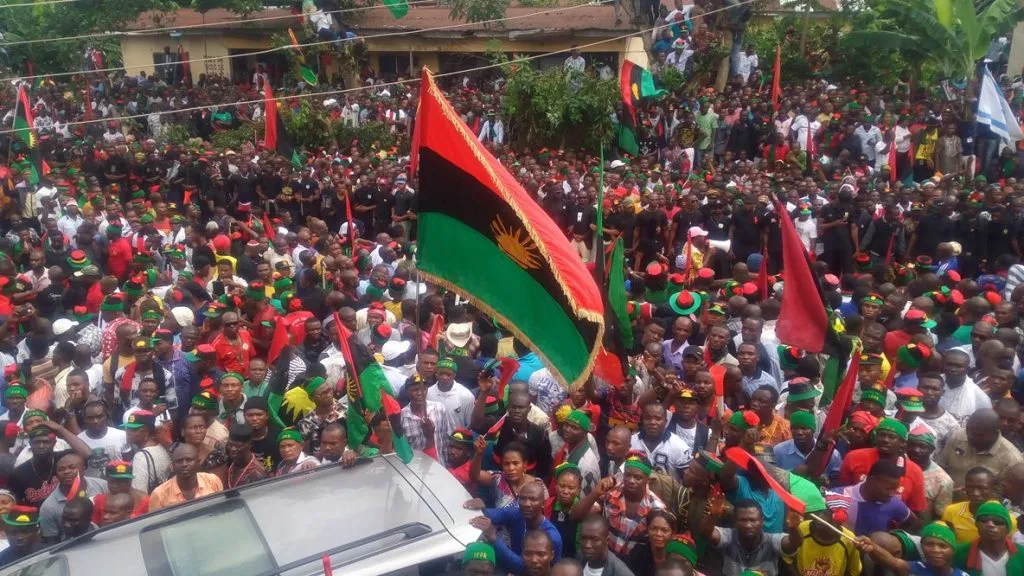
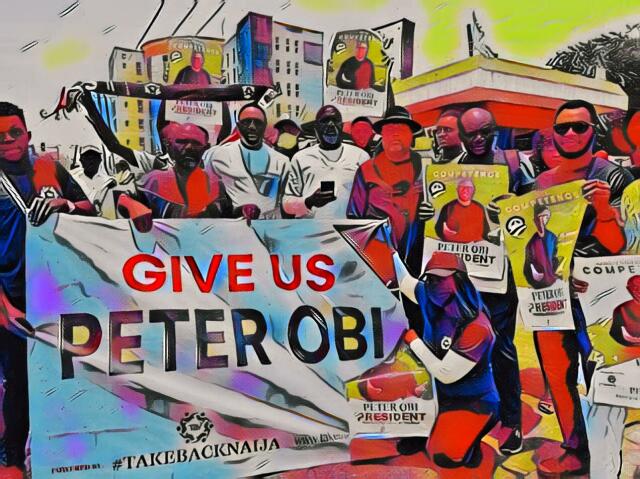
Peter Obi Supporters (Awka Times reproduction)

Presidential candidate, Peter Obi, is riding the wave of populist and progressive support which makes him a highly credible contender in the coming election. But he confronts the rigid force fields of Nigerian politics which are opposed to radical tendencies. Obi needs to build a cross-cutting class consensus for his candidacy, reaching out specifically to hegemonic stakeholders, if he hopes to win in 2023 and send his two leading (septuagenarian) opponents into political retirement.

By Chudi Okoye

What a time of it we shall have!

We are mere months from what might be a momentous presidential election in Nigeria, probably the most critical since the inception of the Fourth Republic in 1999, and the build-up is spellbinding.

In some recent articles I wrote concerning the 2023 presidential election, I hinted at possible challenges facing what some expect to be a radical shift in election result – that is, an outcome wherein a so-called Third Force prizes the presidency from the palm of the major political parties that have controlled it since the beginning of this dispensation. I wish to develop that argument further in this latest installment on the election.

I have written so much about the upcoming presidential poll because, with the arraignment of partisan forces now beginning to manifest, this may not end up like any of the elections we had between 1999 and 2019. Although a plethora of puny parties participated in those earlier polls, the tussle was often between two or three elite coalitions hewed from the same liberal-welfarist archetype which has dominated Nigerian politics going back even to previous democratic dispensations. The 2023 election is rapidly shaping up as a potential confrontation between fully mobilized conventional forces lodged in the two currently dominant parties seeking to preserve the status quo and a swelling rank of progressive and radical forces seeking to transform the Nigerian political economy.

After 23 years of misgovernment by the civilian political class, Nigeria is at a critical juncture. The Nigerian state has failed spectacularly as a categoric institution, unable to perform even the most basic functions of a state. We are all familiar with the grim indices of its failure. In fact there is ongoing debate among scholars and diplomats as to whether the Nigerian state is on the verge of failing or if it has already failed. If the Nigerian state has not totally collapsed, it may not be unconnected with the following facts: (1) Nigerian people themselves are self-organizing, through private non-state interventions, to provide to their communities political goods normally delivered by a state, including security and economic welfare; (2) the Nigerian state is preserved by Nigeria’s corrupt elites because it serves as a formal apparatus for their prebendal appropriation of public funds; (3) the international system props up the Nigerian state by providing diplomatic, economic and security assistance, in part to keep Nigeria’s peripheral economy viable for metropolitan interests, and in part because Nigeria’s continued existence is vital for regional cohesion in Africa.

A Progressive Corrective
If military intervention in politics were not already passé, and if the Nigerian military were not institutionally exhausted, there might already be a coup d’état to overthrow this wobbly Fourth Republic. After all, in the past the military had intervened under far less adverse conditions. But a martial correction seems improbable (though not impossible) in the current conjuncture. Instead, the 2023 election offers Nigerians the chance for a democratic corrective – much in the manner that military intervention might have previously hoped to do – if the growing progressive coalition triumphs in the upcoming presidential election.

The progressive forces are coalescing, rapidly and enthusiastically, around the candidacy of Mr. Peter Obi, the Labor Party flag-bearer. It was for this reason that, in a previous article I coined the words ‘Obisessed’, ‘Obisession’ and ‘Petermentum’ as literary devices to vivify the magnetism, the movement and the growing momentum of the Labor candidate. Although there have always been progressive (or radicalist) tendencies in Nigerian politics, they have often been schemed out of the political configuration and have rarely found mainstream electoral outlet. What Peter Obi offers is a potential mainstreaming of radical and progressive tendencies which hitherto had subsisted at the periphery of Nigerian politics.

Obi started his quest for the presidency as a mainstream aspirant chiefly concerned with what we may call the efficientization of the Nigerian government. His principal concern was the reduction of governance costs and a re-focusing of public policy planning away from consumption to production. Obi’s agenda had not seemed to resonate very much in his former party, PDP, resulting in his being outmaneuvered in the lead-up to the party’s primary. Reading the tea leaves, Obi had quickly decamped to the Labor Party where he was promptly selected as the flag-bearer. His candidacy has since caught fire in his new perch, powered by passionate support from a cross-section of eager youths, members of the enlightened urban professional class, and a primordial base of the Igbo South East. We have also seen growing support for Obi from organized religion, particularly from evangelical pastors, in an unabashed display of clerical activism quite uncommon in Nigerian politics.

But it’s not just the churches. Organized labor is also rallying behind Obi’s candidacy. Perhaps impressed by his record and growing popularity, the Nigerian Labor Congress and the Trade Union Congress have come out fully in support of Obi’s candidacy, pledging to avail their organizational structures for his cause.
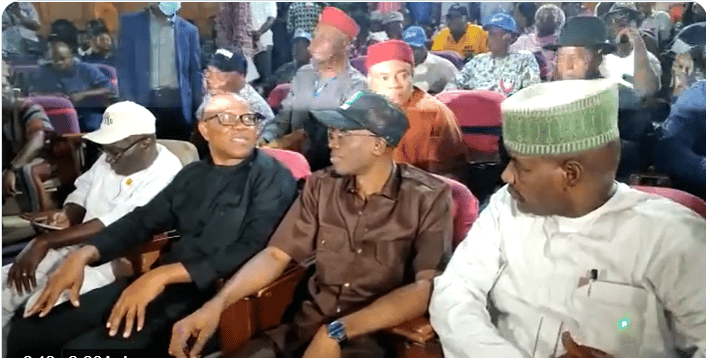
Peter Obi Meets with NLC Leadership

Organized labor’s support for Obi might simply have arisen from the appeal of his political message. But it might also be construed as a conscious play at entryism, a tactic sometimes used by left-wing forces to infiltrate mainstream parties in order to attain political power in an otherwise unfavorable environment. In this case it might not be so much the infiltration of a party as the appropriation of a candidacy.

This latter point – the potential for radical appropriation – is the centre of the matter. It raises the question of whether Peter Obi’s burgeoning radical base – comprising groups and organizations that may be considered radical, populist, progressive, or left-wing – portends a potentially radical tilt when he gets round to elaborating his policy agenda. There’s also the question of how the political system might respond to a potential radicalization of Obi’s platform. Obi’s originating agenda of governing efficiency and production-oriented policy-making could be challenging, in and of itself, to the distributive ethos of the Nigerian political economy, a real threat to the ruling elites who depend on Nigeria’s prebendal state for status and material accumulation. But Obi’s candidacy could be considered even more threatening if his initial agenda, disruptive as it might seem, becomes more radically inflected due to his dalliance with progressive forces like labor. In that case, he could face resistance not only from a political class dependent on the distributive state but also from a corporate and industrial class apprehensive of a potential radical capture of an Obi presidency. It is for this reason that I also, in my previous piece, coined the words ‘Obistacles’, ‘Obistruction’ and ‘Obistructionist’ to point up a potential systemic reaction to Obi’s progressive surge.

Nigerian State Dreads the Reds
The response of the Nigerian state to radical politics has never been accommodating; it’s been historically antagonistic. The British colonial government frequently tussled with labor and other militant groups like the Zikist Movement which it suspected of having socialist inclinations. Colonialist antagonism towards radical politics clearly influenced the ideological outlook of the Western-educated politicians who inherited power from the British, and as well the instincts of the British-trained military brass which later sacked the civilian leaders and held power for much of the post-colonial period.

The military was wont to attack any groups or organizations that it considered radical or militant, be they workers’ or student unions, academic or professional bodies, often using brutally repressive tactics against such groups. It rejected socialist precepts in all the constitutional frameworks it engineered for democratic transition, whether in the 1975-79 (Murtala-Obasanjo), the 1986-93 (Babangida) or the 1993-99 (Abacha-Abdulsalami) transition programs. The military also moved to neutralize left-leaning political formations, clamping down on any concerted effort at radical mobilization. For instance it would not register any left-leaning groups so they could participate in the transition to the Second Republic. It rejected the recommendations of the Political Bureau it had created which called for the adoption of a socialist ideology in Nigeria; this, despite the fact that the recommendation was based on the Bureau’s intake of about 27,000 proposals from sources across the political landscape. Instead, the military created by fiat two centrist political parties – one “a little to the right” and the other “a little to the left” – as political vehicles for the transition to the Third Republic.

Even at that, the military still annulled the 1993 presidential election won by Chief MKO Abiola, candidate of the “little to the left” party which had attracted a strong progressive base, partly through its alignment with the Nigerian labor movement (the president of the Nigerian Labor Congress, Pascal Bafyau, became a major contender as running-mate to Abiola).

Finally, following the collapse of Nigeria’s Third Republic experiment, the military orchestrated the emergence of centrist formations which in time coalesced into the duopolistic parties, the All Progressives Congress (APC) and the Peoples Democratic Party (PDP), which came to dominate the Fourth Republic politics.

The military of course often worked with, or for, the hegemonic interests In broader society.

A Reformist Consensus
If the Nigerian body politic has consistently rejected the ‘toxin’ of radical politics, what then is the likely consequence of Peter Obi’s growing alignment with populist and progressive forces? Will his movement become doomed like previous populist outings suppressed by military autocracies in behalf of hegemonic interests? Or, after 23 years of uninterrupted though chaotic civilian rule, do we have a different balance of forces, with hegemonic forces discredited and vitiated while progressive forces have become strengthened in the face of growing popular discontent? Have the two hegemonic parties so thoroughly misgoverned Nigeria in this Fourth Republic dispensation that a progressive coalition can successfully overcome the systemic resistance to radical politics and actually win power? Come to think of it, is it not possible that some enlightened factions of the hegemonic bloc would recognize that Nigeria is so broken and in need of repair that they might contemplate at least a temporary alignment with a reformist candidate like Peter Obi in order to resuscitate the economy and prevent systemic collapse?

With oil revenues dwindling, the Naira deeply devalued, debts mounting and lending sources drying up, fiscal planning in Nigeria is in turmoil. The economic basis for Nigeria’s distributive state is greatly weakened, and so its prebendal praxis is no longer sustainable. “The revenue of the state is the state,” writes Edmund Burke in his classic work, Reflections on the Revolution in France (1790). For the distributive state to remain valid, the Nigerian cow needs to be re-fattened, so to say. So, if only out of enlightened self-interest, the hegemonic political classes should be willing to tolerate a reformist candidate who can rebuild their mainstay, even one seemingly exposed to radical influences. Even the corporate and industrial bourgeoisie, which might ordinarily oppose a radical or progressive ascendancy in the political sphere, could back a candidate with a properly constrained reformist agenda. But they have to be offered the right incentives to come on board.

Peter Obi’s populist appeal is growing and his progressive base is broadening. But he needs a cross-cutting class consensus for his candidacy, if he hopes to win power and sustain his victory. It is important for Obi to develop a detailed policy agenda and clear political messaging which more fully articulates his progressive aspirations, beyond the sketchy, populist punditry he currently peddles. There is already some grumbling from ideological purists in the labor rank and file who wonder what Obi – a mainstream, a neo-liberal capitalist – has in common with their movement’s socialist ideology. Obi needs to assuage such purist anxieties on the left. At the same time, as Obi’s campaign develops, he should begin to build inroads into what, in a previous article, I called “the ethno-politico-religio-security complex that controls power in Nigeria.” Although Nigeria’s political system has shown a deep aversion to radical and progressive politics, to the extent that one doubts the possibility of revolutionary change in a civilian milieu, there may be opportunity for an unthreatening candidate with a reformist agenda who appeals to various economic and ideological interests. Obi will end up straddling two ideologically-opposed camps – labor/socialist and capitalist/neoliberal – both of which he needs if he intends to win. He should begin to craft a policy platform and political messaging that can appeal to both sides. Obi needs to make his case across the substratum of Nigerian politics, and resist being owned (appropriated) by radical and progressive forces. He needs to win support across the economic and ideological divides in society.

It is only thus that he can hope to surmount the monumental challenge he faces trying to overcome the force fields of Nigerian politics, in the process of which, let’s not forget, he might also be hoping to heave two hefty and hoisted presidential hunchos into horrifying retirement.
Personal Memo to the Leading 2023 Presidential Candidates

0
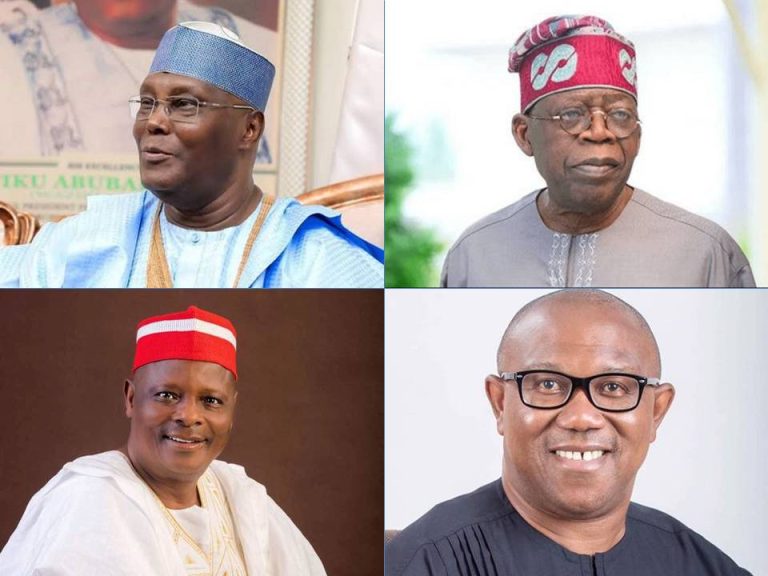
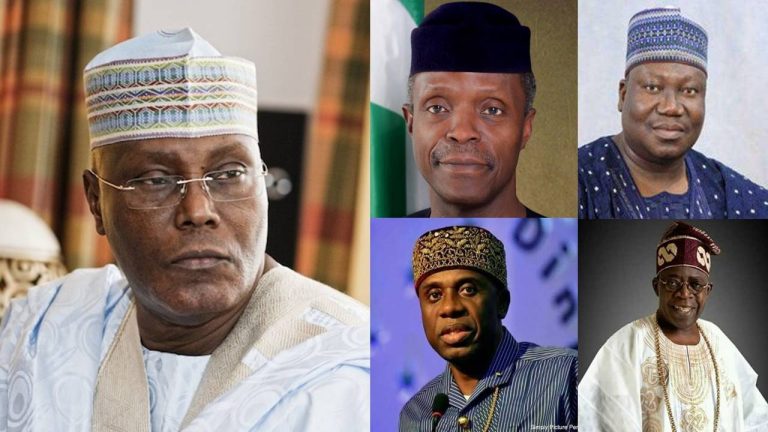
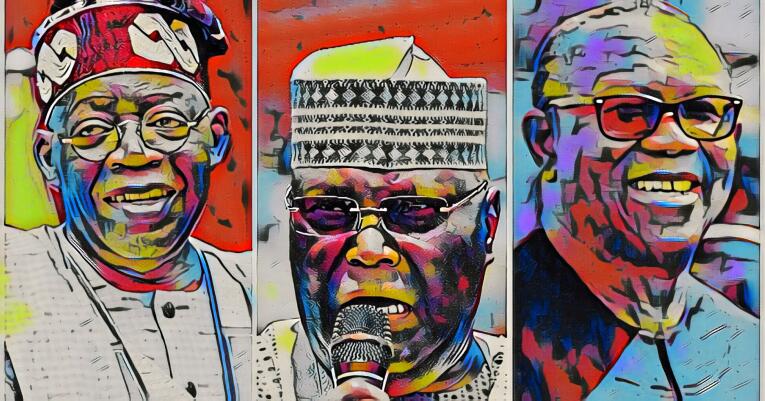
Nigeria 2023 - The Field-leading Triad: 'Atinuobi' (Awka Times reproduction)

By Chudi Okoye

Dear ‘Atinuobi’,

I am sending this memo simultaneously to the three of you who are currently leading the 2023 presidential election field in Nigeria. Though the field is full, I focus on the three of you for this simple reason: many are pledged, but few are fledged. You are set apart as the top triad in a field that’s crowded, even though hedged.

Well, it’s on, guys! It really is on now. I’d suggest you buckle up tight because it’s going to be a roary ride to February.

Oh I know, you came through your parties’ primaries in commanding form, each making a boss move that got you where you are today as flag-bearers. One of you, with a political machine that’s nonpareil, beat out a swarm of weighty aspirants in his party. One other of you, with an unquestioned hegemonic advantage, got his party to renege on a sacred promise it made to a very loyal geopolitical zone. The last of you showed incredible political agility when the party mentioned above decided to shaft his geopolitical zone. To avoid being nipped, he zipped over to some nondescript party where his star power and youth appeal got him quickly adopted as the presidential candidate.

So, yeah, the three of you got to the frontline of your parties by some sort of power play or nimble move. But check this, fellas: though you aren’t quite at statistical parity in terms of your electoral chances, you each have some Achilles heel that seriously impairs – and could even imperil – your presidential pursuit. My goal in this memo is to probe your circumstances to assess how you might make out in the coming election.

Warning: You may find this memo somewhat irreverent. It may hurt your pride a little, but please take it in your stride. I know you can.

Let me start with you, Triad Member 1: the slugger who vanquished a sitting VP, buried a Buhari bootlicker from one of the watery states, and pipped a pompous Senate president at the post in his party primary. Wow! Guy, you are the man! Everyone says you are the kingpin of politics in your geopolitical zone, and that you control your area almost like a Mafia boss. You built a formidable political machine which you have used over the years to install not only elected officials like governors and legislators but also government appointees, including commissioners and heads of parastatals. It’s such that it’s said you even control the treasury of the state you once governed, palming off a percentage of the state’s revenues which has enabled you to build an incredible wealth, so much so that you are now considered the wealthiest of any politician in the land. So you have a machine. You have money. And it seems you have no scruples whatsoever deploying your assets to achieve your target. Boomshakalaka!

But hey, though you may think the cards are stark for your competitors, they are not all stacked in your favor. Let me mention what I consider your handicaps and then discuss each in some detail. You have the machine, but there could well be emergent forces in this election cycle which may limit the efficacy of machine politics. You are also at once dreaded and distrusted by the hegemonic forces in Nigeria who feel you might be too hot to handle as a president. And you are certainly not an appealing choice for the growing army of idealistic youths who are coming into the fray hoping for a qualitative change in Nigerian politics. Of course with your stash of cash, you can smash your way through potential youth resistance, buying off some sizeable numbers of the hungry youths. Or, you may use primordial pull as spool to rope some unschooled youths into your web.

One other thing you could do might be to pad your manifesto with youth-friendly programs. Why not? It’s been done before by cynical politicians. But let’s be honest, our people don’t really study manifestoes. We have a vocal tradition. So it’s more what you say that will swing them to your ring side. Still, it’s funny just to picture you mouthing off some youth-targeted programs on the trail; it may be a case of Jacob’s voice and Esau’s hand, or simply political ventriloquism. You would sound totally inauthentic. So, all in all, I suppose you’ll lean heavily on your money and your machine, and maybe the phalanx of mercenaries under your patronage. With these, you stand a good chance in the coming election.

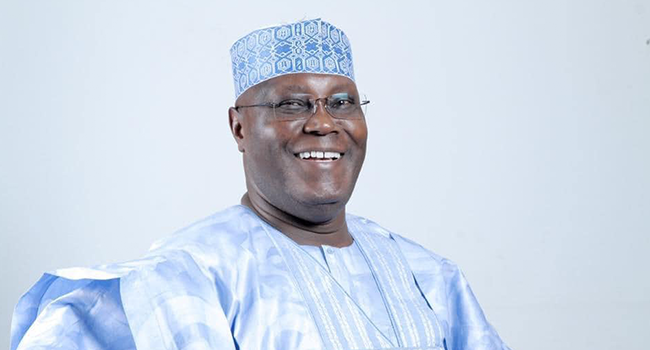
Triad Member 1 (Awka Times reproduction)

The sad thing though is to contemplate the kind of presidency we’d have in Nigeria, were you to win. Just as with your primary slam, you’d have lammed your way to the presidency using all means necessary. It would feel as if you snatched the presidency. And it would feel like a further dirtying of the country. The moral ambience would be grim as the country, drenched in the stench of a presidency you clenched, slides into deeper decay and decrepitude. You might have electoral victory, but you would certainly not have moral legitimacy as president. Many a Nigerian would not be proud to have you as president. Why do I say this? Here’s why. You will go down as the most corrupt president we’ve had so far. Because, even though Nigeria is as corrupt a country as they come, we’ve not actually had civilian heads of government that were too deeply implicated for personal corruption. Not Tafawa Balewa. Not Shehu Shagari. Not Ernest Shonekan. Not Musa Yar’Adua. And, well, not Goodluck Jonathan either. There certainly was corruption in their day. But these guys were never personally indicted, at least from public records.

You would be, if you won, the first president of Nigeria to be considered personally corrupt and morally bankrupt. We’d have a jaga-banned Nigerian president who couldn’t travel to fastidious foreign countries except with diplomatic immunity. A Nigerian president that might be susceptible to blackmail by the dark forces of international finance and commerce, especially with the very murky record you left with your financial dealings in America. Tufiakwa!

Now, let me turn to you, Triad Member 2: the one with hegemonic advantage. Dude, you’ve been running for president since 1993, before about 70% of the current Nigerian population was born! How do you feel, as an advanced septuagenarian, trying so desperately to lead a country with a median age of 18, especially as we’re just coming off a period of anemic gerontocracy with the incumbent president? You were once, for eight years, a resident of Aso Rock. Pray, what did you forget there that you are trying to recover? Tell us, please, so we can put it in the post and send to your manse in the Middle East, where we understand you are ensconced these days enjoying your loot from Nigeria.

Anyway, I am getting ahead of myself. Let me first say that no one should minimize your chances in this coming election. Though you should now be knackered, you’ve hankered after the presidency for so long that you might get it this time around. You certainly have the hegemonic advantage in the current set-up. What do I mean by this? Well, this will sound like a mouthful but no one should be doubtful about it: you would be preferred by the ethno-politico-religio-security complex that controls power in Nigeria, behind the façade of our democratic institutions. You are certainly one of them. You also enjoy the advantage that we have today a highly parochialistic incumbent in Aso Rock who might rather you won, being of same region and religion as he, than that power shifted to a different polisphere and thrust into the capricious hands of an avaricious member of his own party. In any case, this incumbent might not even consider you as an opponent, though you now belong in a different party. After all, in your political peregrination, you were once a member of the incumbent’s party. In fact, you helped to found the very party that you now oppose. Chai, my head hurts just tracking the zig-zags of your political journey. Maybe I need to take an APC!!

Yes, Mid-East man, you might actually win. We’ve seen recently some suspicious moves pointing to a possible orchestration towards that outcome. Since the bullion man above, Triad Member 1, purloined the primary of his party, we have seen some quickened defections from that party to yours, most of those defections, by the way, from a certain geopolitical region.

Still, you’ve made a lot of enemies. Powerful enemies. And you’ve offended the revenant gods of a certain geopolitical zone. I see that the president you once served, a wily but widely admired farmer and former soldier, has put on his shoulder the task of pushing you under the boulder. When you ran for president in the last go-round, he gave a Mark Anthony-like speech at some august gathering in Lagos, with you sitting right there, seemingly extolling but really pistolling you. You lost that election. Now you’ve stepped out again. And so has he! Whilst addressing some kids a few days ago on entrepreneurship and mentoring, the intrepid former president piped up again, totally unprompted, telling the kids that he regretted picking you as his second-in-command. And get this, my guy, his face looked like he was doing a ‘number two’ (i.e. defecating) when he spoke about you, his former number two! So disgusted was he.

The former president’s disgust cannot match the distrust you have now earned in a certain geopolitical zone – you know, the zone that your party finagled to give you the presidential nomination. I did some quick calculations and estimate that in the 2003, 2011, 2015 and 2019 presidential elections this perhaps too-loyal zone gave 84.4% of its total votes to your party, and only 5.9% to the other major party. The remainder of its votes was cast for candidates in the smaller parties, including – can you imagine! – the much-beloved warlord who once led the zone to war. All that, and your party would treat this zone with such disdain, snatching its opportunity to make room for another of your quixotic presidential runs. Not only that, even as the party began to cast about for your running-mate, the gunning spate against the zone continued. Yet again, it was bypassed. Well, the zone is now poised for its pound of flesh. You can expect a thrashing in that zone in the next polls, for all the bashing your party has meted out to it.

Triad Member 2 (Awka Times reproduction)

Still, your party has apparently calculated that it can afford to forego the votes from the zone. Perhaps, with what I am sure you are now cooking up, you might be able to snatch victory from the jaws of electoral improbability. We will see. But, guy, I shudder also to imagine the kind of presidency we would have under you. Like Triad Member 1, you have a corruption rap sheet in America the length of fabricated molue bus. In your own case, it was so bad that it seemed you couldn’t even be allowed to enter America because of your dodgy dealings and the corruption charges brought against you in that country. When you ran in 2019, America allowed a temporary suspension of the travel ban it had placed on you, because it felt you had a fair chance of winning. So, if you do win this time you might get a diplomatic pass. Maybe to some folks this won’t really matter. But, to have a personae non-grata as president… Chai, area will scatter!!

This now brings matters to you, Triad Member 3. What can one say about you, my guy? Ramrod straight. Firm and assured in your gait. From your record and the type of campaign you are running, some frenzied folks see you, just like the leading apostle of Jesus, as the rock upon which the church of Nigeria’s new polity will be built – a democratic haven in which the corrupt agents of Hades will not hold sway. Let us pray!

You certainly come with the receipts. Where the other candidates offer only deceits, you tout a governing record which some believe is unblemished, though sometimes embellished by you and your supporters. You have an occupational record, outside of politics, that appears to be clean, though it is lean in the details we can glean. But other than some complicated offshore financial dealings revealed in some foreign reporting, no one has accused you of engaging in any shenanigans as we find with the other contenders in the triad.

It is because of your seemingly unimpeachable record that some previously unreachable and unteachable folks have now begun to build what looks like an unbreachable support base for your candidacy. Folks like me insist that political structure matters in campaigning to win the presidency of a large, geographically variegated and socially differentiated country like Nigeria. You need the political machine to help you penetrate Nigeria and generate momentum for your candidacy, and also to mobilize people to actually vote on election day. But building a political machine takes time and it costs money. Right now, you are behind on both. You have been suggesting that just like government, a presidential campaign can be run on a budget, with great efficiency. As part of this, you and your supporters seem to be making great use of online assets, especially social media.

Maybe it will work for you, my guy. It’s a new theory of Nigerian politics that envisages a mixture of traditional formats of political campaigning, which can be expensive, with cheaper social media mobilization. We will see if it works. Though you should do well to remember what the INEC Deputy Director who’s in charge of Voter Education, Mrs Mary Nkem, said recently: “INEC does not conduct election on social media, nor do we count ballots on Twitter or Instagram.” That’s just it, brother. Online emotion must translate to offline action. Just remember that in the last presidential election, some 82.3m of Nigerians registered to vote but in the end only 28.6m voted, of which 27.3m votes were valid. Effectively, a 33.2% voting rate. Think about that.

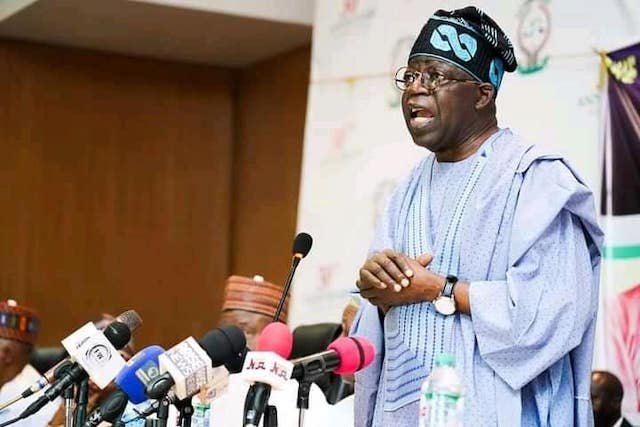
Triad Member 3 (Awka Times reproduction)

One other thing that’s worrying is your philosophy of campaign. You seem like a really nice guy who won’t have anything to do with negative campaigning targeted at specific individuals. The current presidential field, like the broader Nigerian political landscape, offers a target-rich environment for a populist candidate with a crusading mission. As I mentioned above, the criminal predilections of your main competitors are well documented. But it’s doubtful if you would take any direct aim at them. Your critique seems to be mainly systemic. Yes, you make general statements about “gangsterism” in Nigeria’s political leadership, but it seems you won’t name names or zero in on folks causing the very systemic distortions you criticize. To me, that’s inadequate. There’s a saying about being tough on crime and tough on the causes of crime. Same thing with systemic distortions. You have to call out the causes and the causers of those distortions. The problem is that if you don’t name names, it would look like you don’t have the balls, and it would raise a cogent question as to whether you can actually change anything if you win the election. I’d say go for it, my guy, or at least make sure you have some mercenaries to do this for you. It might help you to push through the force fields of Nigeria’s presidential politics. If you don’t, and continue to peddle your nice-guy politics against your opponents’ bulldozing style, it would be tough odds if you might actually win. But who knows, the wind is certainly behind your back, and you may be doing the very thing voters want, despite my misgivings. Good luck, dude! Hope your labor won’t be in vain.

So there you have it, members of the presidential campaign triad. I have addressed each of you in rather elaborate ways. I know some of what I have said to you is pointed. But this is how I feel. And it might be how lots of folks out there feel too. It’s now up to you to see if my candid words will help you amend your campaigns. Our country has suffered for too long. One hopes the outcome of this election will begin to offer them much-needed respite.

By the way, guys, did you like the portmanteau word I coined from your names, ‘Atinuobi’? Cool, right?

Yeah, I’m slick like that!

Sincerely,
Chudi Okoye

The Gladiators and the Pitter-Patter of ‘Petermentum’

4
The Warrior and the Political Reformer

The political ascent of Peter Obi is evident; some even think his presidential quest is providential. Does Obi have a date with destiny, or will ‘Obistructionist’ forces rise up to impede his progress? The wind may be in Obi’s sails, but there may be ‘Obistacles’ ahead he and his supporters should prepare to confront.

By Chudi Okoye

There is no longer any serious doubt about it. At this point in the 2023 presidential election cycle, we have three, not two, credible candidates in the race. If the current trend continues, the 2023 election will be a vibrant three-way contest – though this does not mean, as yet, a presumption of equal chances for the three top candidates. Yes, we have a powerful duopoly – comprising the All Progressives Congress (APC) and the Peoples Democratic Party (PDP) – which currently dominates the institutions of the Nigerian government. It is also incontrovertible that the two major parties are currently the only ones, in the traditional sense at least, with the political structure to mount a national campaign. But there is no doubt that Peter Obi, in the four weeks or so since he dumped the PDP and jumped into the Labor Party (LP), has acquired a national profile and a name recognition rivaling those of the older gladiators in the major parties: Atiku Abubakar of PDP and Bola Ahmed Tinubu of APC. It is an astonishing achievement.

There’s no question that the party chieftains are now taking a closer look at Peter Obi. They had been so very busy, these two big kahunas, working to earn Fortuna’s favor to clinch their parties’ presidential tickets. And they’ve since been striving to settle the internal dissensions that followed from the primary conventions. But now they are gazing up from their exertions only to find that some mild-mannered smarty in an ill-bannered party has made himself into a credible contender in the coming presidential contest.

Some of Obi’s supporters have taken to calling themselves the ‘Obidients’. It is an awkward buzzword, likely invented by some wag among the candidate’s throng of ‘Obisessed’ supporters. That word, evoking submissiveness, seems at odds with Obi’s change-oriented message. But it is trending nonetheless. And it suggests that a cult-like following may be building up for this weirdly charismatic Labor Party flag-bearer, especially among his massing base of youthful but yearnful supporters. It is a populist phenomenon we haven’t seen in recent time in Nigerian politics. You’d have to look outside of politics to find such fervent following.

As Peter Obi’s presidential profile begins to bloom, the challenge of it is starting to loom. And it seems the mainstream political leaders are beginning to take notice.

Just a few days ago, a video circulated showing the governor of Edo State, Godwin Obaseki, reacting to the poor performance of his party, PDP, in the just concluded Ekiti governorship election. Clearly in a pensive and even apprehensive mood, the governor said the future of politics in Nigeria is changing. He specifically brought up the problematic of Obi and his supporters:

“I do not know whether you are closely watching what is going on; the level of disenchantment with the existing parties. I am sure in all of our homes here, we have so many people now who call themselves ‘Obidients’. I don’t know whether you have them in your house. Just ask them, ‘which party are you?’, they say ‘Obidients’. Do you understand? They do not want us; they are not talking about APC or PDP. They are looking for alternatives. And they are many; there are much much more. You see all of them queuing for their PVCs now. They are not looking in the direction of APC or PDP. They are looking for alternatives. If we do not curb this…, if we do not make our party attractive, I don’t know what will happen in the next elections.”

It was a dead giveaway. But the governor was not alone. A week before Obaseki’s somber articulations, Olisa Metuh, a lawyer and stalwart of PDP who has held various key positions in the party, spoke in vernacular to BBC Igbo bemoaning the exit of Peter Obi from the party. He spoke at length about Obi’s quality, admitting that the latter’s exit has hurt his party. He even allowed that he had mulled the idea of boarding Obi’s departing train, but reluctantly decided otherwise.

Gov. Godwin Obaseki and Olisa Metuh

It isn’t only PDP that seems to be reacting to the Obi phenomenon. On the same day that PDP’s Metuh was baring his heart to BBC, Bola Tinubu was flagging off his presidential campaign in Ekiti State. It struck me, watching a video of the event, that the first words out of the candidate’s mouth, at least in that short video, was a stream of salutations to the “great Ekiti youths” and the youths of Nigeria generally. It was an obvious pandering to the growing dynamism of youths in this election, a trend presumably favoring Peter Obi’s candidacy.

It’s not just the politicos that are starting to react. Obi’s surge has long been tracked in the media, especially on social media platforms where it generates a fare of frenzied discussions. But now, even the more perceptive media pundits seem to be becoming enthused by Obi’s prospects, with one well-known media scholar and ink slinger coming forth recently with what he called ‘the Peter Obi Tsunami’. He’s not the only mainstream writer caught up in the euphoria. Another pundit, a professor of political science no less, also writing recently, described Obi’s political surge as a “seismic movement.”

We do not need to buy into a tsunamic or seismic metaphor at this point to acknowledge Peter Obi’s political surge and rising profile. Nor do we need such to recognize the threat he likely represents, and the likelihood that if the surge continues there may be an ‘Obistructionist’ reaction, with a mélange of ‘Obistacles’ conjured up to stop his momentum.

Threats and ‘Obistacles’
Peter Obi projects the image of a complaisant, soft-spoken, harmless fella merely seeking to enforce simple correctives to the chaotic operation of the Nigerian political economy. Do not let that fool you. He represents a triple threat to the prevailing orthodoxies in Nigerian politics and public administration.

One: He is Igbo and there is still, even now – fifty-two years after the civil war – a powerful ruling bloc opposed to Igbo political ascendancy. Obi’s election would be a historical correction for the Igbos of the South East, but in this it would unsettle some ossified power blocs which consider Igbo political exclusion an immutable geopolitical imperative.

Two: Although Obi is yet to articulate a coherent ideology of governance (neither have his competitors, by the way), his rallying cry for frugality in public sector spending and his insistent talk about switching from consumption- to production-orientation in public policy reveals an instinct to fiscal conservatism. This stands as an ideological critique of the prevailing mode of accumulation in Nigeria and a rejection of the governing orthodoxy which construes government spending, however undisciplined, as a legitimate redistributionist practice. Obi’s election would be transformative since he is seeking to overturn, or at least to sanitize, the chaotic orthodoxies and the prevailing ethos of Nigerian public administration.

Three: Obi’s personal asceticism and saintly affectations represent a piercing moral critique of the indulgent, decadent and meretricious style of the governing elites. In this latter respect it is notable that Obi, usually equable in his public disposition, has begun lately to ratchet up his rhetoric, decrying the “gangsterism” in Nigerian government; claiming that “70 percent of those who are in politics today should not have any reason to be there”; and saying that “politics in Nigeria is a case where lunatics have taken over the asylum.” He also says that “[Nigeria] is the only country where the worst is leading,” seemingly in agreement with those, like myself, who consider the country a kakistocracy.

Given the above, it must be expected that Peter Obi’s political surge, should it continue, will be vigorously resisted by the governing parties. This will come in all forms. At an innocuous level, expect the competitive campaigns soon to create their own buzzwords, seeing how ‘Obidients’ has helped to quicken the pitter-patter of Petermentum (if I may coin a word). Gov. Obaseki hinted at some concern about this. The competitive campaigns will be looking to show that their flag-bearers also have enthusiastic followership. If I may, then, just to keep the political theatre buzzing, let me suggest ‘Tinubullients’ for the ebullient supporters of Bola Ahmed Tinubu; and maybe ‘Atikuherents’ or ‘Atikuvocates’ for the adherents and advocates of Atiku Abubakar. Those campaigns can thank me later!

Competitive response to Peter Obi’s political surge will of course go well beyond a battle of buzzwords. I can imagine the major parties creating a team of ‘Tinubullies’ to ‘dis-Atikulate’ Obi’s political operation. I hope you noticed earlier the Freudian slip in Gov. Obaseki’s comment about Obi’s popularity. He had begun to say “If we do not curb this…,” but then he caught himself and immediately pivoted to a politically correct statement, one about what to do to cope with the situation. That slip was revelatory. It raises the possibility that the entrenched parties might not shrink from employing any means necessary, including a deus ex machina, to squelch Obi’s political surge. It is a major concern, given the antecedents of these governing parties and their hegemonic allies.

The question then becomes how Obi and his campaign, as well as his supporters, are hoping to meet that resistance.

Resisting the Resistance
Peter Obi reminds me of the line in Shakespeare’s Macbeth where Lady Macbeth says of her husband: “Thou… art not without ambition, but without the illness should attend it. What thou wouldst highly, that wouldst thou holily.” The lady is certain that her husband would want to become King of Scotland, as prophesied by the witches, but she worries that he is too virtuous – “too full o’ the milk of human kindness” – to do anything untoward, such as committing regicide, to attain his dream.

Obi certainly ain’t a saint. He can’t be, being a banker, trader and politician all rolled into one! (We can’t forget so quickly his cluttered financial dealings revealed in the Pandora Papers, though no charges have so far been filed against him). But he has successfully created a public persona as a decent dude who generally plays by the rules. This is of course an admirable quality we should expect in our public officials. But the key question in this election is this: how does an apparently rule-obedient player (with a fervent base of ‘Obidients’ to boot!) cope with diehard competitors dogged by infamy who would not shrink from bending the rules in their bid for power? Is Obi disadvantaged by his affectations of moral rectitude?

We heard sordid allegations of malfeasance in the recent primaries processes, particularly in those of the two major parties where it was alleged that a grotesque ‘dollarization’ of the process greatly influenced the outcome. We also heard valid claims of rampant vote buying in the recent Ekiti gubernatorial election which likely also influenced the outcome. And same is predicted for the upcoming Osun State governorship election. Osun is an APC-governed state, like Ekiti.

Whatever we saw in the primaries or state election, we can expect far worse in the 2023 presidential election, given the characters involved and the issues at stake. Ekiti was the first major election conducted after the enactment of the Electoral Act 2022. We certainly saw some welcome improvements in election administration including, as the British High Commission which monitored the election reported: “timely opening of polls, better functioning of the Biometric Voters Accreditation System (BVAS) devices for accrediting voters, and the transparent and efficient electronic transmission of polling unit results to INEC’s results viewing portal.” But the election was blighted by vote buying, as many, including the Embassy, reported.

How will a supposed ‘straight shooter’ deal with this and other as yet unimagined electoral malpractices? Mind you, it is not only in the election proper that we should expect the use of dirty tricks. We are already seeing some pre-emptive strikes, with the reported harassment of supposedly pro-Obi crowds seeking to register to vote in parts of the country, and the intimidation of INEC (Independent National Electoral Commission) officials who are prevented from facilitating the registration.

That is precisely the challenge for Peter Obi. The candidate’s personal profile is certainly rising. But there are some challenges. For one, his fringe party, Labor, suffers significant structural disadvantages against the governing conglomerates, APC and PDP, which have extensive national infrastructure in place to fight the presidential election. Additionally, Obi might be said to suffer a kind of ‘moral impediment’ for his apparently ethical approach to politics, playing against political gladiators seemingly without any scruples.

Yes, yes, I know: Peter Obi has slain many a political monster in his day. He did so repeatedly to rescue and ride out his gubernatorial mandate in Anambra State. Each time, he was able to enlist the services of learned lawyers and fearless jujumen at the superior courts who rebuked the jejune imbecilities of the regional monsters. But that’s just the point: those were regional monsters. The monsters marauding the forests of presidential politics in Nigeria are of a different order and are altogether implacable.

It is certainly not a hopeless situation. Obi is tenacious. And he is backed by a moral army that seems to sense an opportunity for change in Nigeria’s otherwise static and unyielding political system. Obi needs to nurture his followership. His party needs to build a national political machine to take on the incumbents, which can be done in part by setting up a command center to coordinate the disparate self-started groups working in behalf of Obi’s bid. This can also be done by working out a tactical accommodation with some of the other small parties, including Rabi’u Kwankwaso’s New Nigeria Political Party (NNPP), though merger talks with the latter seem to be stalled. (Party mergers may now be out of the question, anyway, since we’re past the deadline for intending parties to notify INEC, which is nine months to the election, according to Section 81(2) of the Electoral Act). Obi and his party need to launch a massive funding drive to be able to mount a national campaign. The party also needs a rapid-response team of lawyers and politicos to react to any shenanigans that may arise in the course of the campaigning. And, for God’s sake, Obi needs to stop acting holier-than-thou – saying, for instance, that he isn’t “desperate” to become president, that he doesn’t need a political structure, or giving the impression that he can run his campaign on a shoestring. These may excite some segments of his support base, but they could also, potentially, depress the field.

This coming election may likely be one of the most exciting in Nigeria’s presidential history, given the antinomies of Old vs New Politics. The major political parties have great advantage over the fringe entities in terms of the mechanics of the election, with their extensive, well-primed field infrastructure. They also have flag-bearers who are undisputed heavyweights, who additionally might be preferred by the hegemonic forces of Nigerian politics. But, though these parties can play quite rough to win, they are weakened to some extent by their choice of these very candidates who may have severe ethical challenges, on the one hand, or may be unsellable in some geopolitical zones, on the other. Both major party candidates also seem like clunking dinosaurs from a bygone era who are acutely unsuited to the current zeitgeist of youth-animated politics.

The irony is that we have an alternative in Peter Obi who has a strong resume; is running a campaign anchored on competence and a cogent critique of the status quo; and, from all appearances, may be free from the ethical burdens of the mainstream contenders. But Obi’s party is not nearly as strong as the competition. Sure, the candidate is enjoying a soaring level of personal popularity, but you need far more than that to win the Nigerian presidency. You also need what I would call the Three Ms of modern competitive politics – Money, Machine and Mercenaries. The question is whether Obi is willing, and how fast he’s able, to bulk up on the Three Ms to take on the major party juggernauts who might not be invincible after all.

The theory of Peter Obi’s candidacy is captivating. It is the praxis that his supporters should hope doesn’t become frustrating.

Nigeria 2023: Political Hazards and a Game Theory Argument for Electoral Alliances

1
Presidential Candidates: Tinubu, Atiku, Obi and Kwankwaso

Party primaries for the 2023 presidential election in Nigeria have now been concluded. However, the outcome is somewhat disequilibrating: it has thrown up two opposing juggernauts in each arm of the governing duopoly, APC and PDP, whilst setting up a dynamic for a viable – though not yet formidable – Third Force from the stack of fringe parties. The situation could create an ambiguous ballot outcome, suggesting the need for electoral alliances that would produce a clear winner, and a system-preserving outcome, from the election.

By Chudi Okoye

It is quite possible that no single political party will win a clear majority of votes in the first ballot of the upcoming 2023 presidential election in Nigeria.

Let’s be clear: This is not a firm prediction that one is making – not this early in the presidential election cycle. We are nine months out to the election, and this is a really long time in Nigeria’s frenetic democracy. No; this is rather an abductive (i.e., analytic but tentative, speculative but not improbable) hypothesis that one is proposing based on current observations and historical analysis.

It is quite a tall order for any political party to meet the constitutional requirements for ballot victory in a presidential election. The constitution requires a majority of the national votes and a minimum of 25% in at least two-thirds (i.e. in 24) of the 36 states and the Federal Capital Territory (FCT), Abuja. This is a hurdle that either arm of the governing duopoly – All Progressives Congress (APC) and Peoples Democratic Party (PDP) – might find hard to cross in the coming presidential poll. Certainly, the duopoly maintains a strong hold on the institutions of power in Nigeria: it controls 95.4% of Senate seats; 96.1% of House Representatives seats; 97.2% of governorships; and 93.5% of state assembly memberships – all these, in addition to controlling the presidency. Still, although one arm of the duopoly will likely win the upcoming presidential election, the prospect is not without some hazard.

On paper, the federal ruling party, APC, with its advantage of incumbency, should not have any difficulty meeting the constitutional threshold. The party secured about 55.6% of the national votes and over 25% of the votes cast in 33 states and Abuja in the 2019 presidential election. However, APC is unquestionably damaged by its seven-year governing record, which – all things being equal – should be fresh in the minds of voters as they go to the polls next February. The party is also hampered by the perceived parochialism of the president, Mr. Muhammadu Buhari, a disposition which has inflamed Nigeria’s fractured federation under his watch. APC is also burdened by its choice of flag-bearer for the 2023 presidential election, in the person of Bola Ahmed Tinubu, a political juggernaut no doubt but who suffers severe reputational handicaps. Suspicion persists about his ethical antecedents, specifically about the source of his seemingly inexhaustible personal wealth. Tinubu also faces persistent questions about his personal health – a crucial concern in the succession of Buhari whose presidency has been dogged by issues of ill-health. There is concern that the president’s debilitated state has allowed secret cabals to hijack his agenda, tilting same towards extreme corruption and particularism. And there is fear of a repeat with the potential accession of Mr. Bola Tinubu, another sickish septuagenarian with impaired health and impaled morality.

In light of the ruling party’s handicaps, the main opposition party, PDP, should have no difficulty meeting the constitutional threshold for victory. After all in the 2019 presidential poll, PDP met the 25% threshold in 29 states plus FCT Abuja, although it lost the election, having secured only 41.2% of the national votes – 15 percentage points behind APC. But PDP is also disadvantaged for reneging on its zoning principle which should have allowed for a power shift to the South. The party’s decision to abandon its zoning principle is sensible for evident strategic reasons, as I argued in a previous article. But it might hurt the party in the next election. For one thing, it had led to the defection of Peter Obi, the party’s 2019 presidential running mate who hails from the South East geopolitical zone, one of PDP’s erstwhile strongholds. Mr. Obi, who has since joined the Labor Party (LP), is working up a storm on the hustings, suggesting probably that a shellacking awaits PDP in the South East in the upcoming election. PDP has also been injured by the defection – for entirely different reasons – of another party stalwart, Rabi’u Musa Kwankwaso, a former two-term governor of Kano State, who is reported to have joined the New Nigeria People’s Party (NNPP).

As for the fringe parties, the prospects are not unpropitious, but they are not commanding either. These parties performed quite poorly in the 2019 presidential election, collectively pulling in a pitiful 3% of the votes though they represented about 97% of the field (inversely, APC and PDP, which represented about 3% of the field, secured 97% of the national votes). Certainly the dynamics have changed from what they were in 2019, but not so dramatically that any of the minor parties has a chance of winning the election on its own.

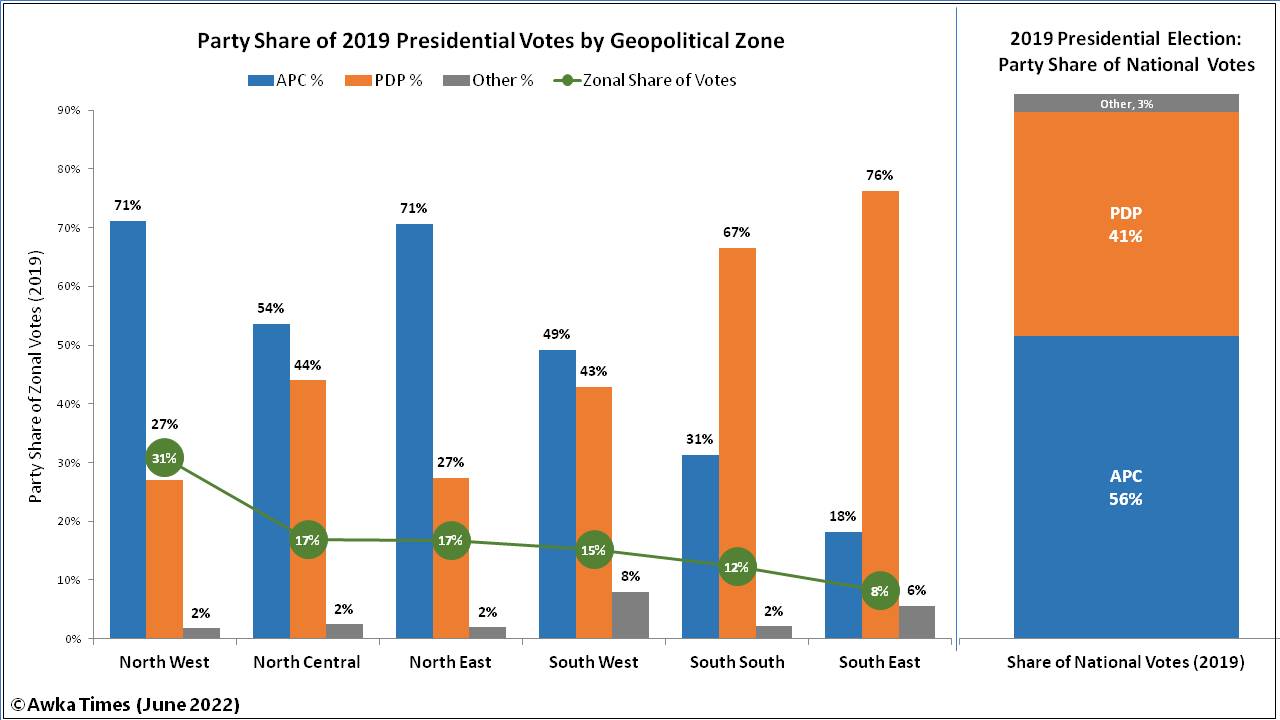
Summary of 2019 Presidential Election Results (Awka Times)

All the above argues for alliance formation between sets of political parties in the lead-up to the 2023 presidential election. The dictates of game theory (and its dynamic variant, theory of moves) compel such alliances, despite the vagaries of such alliances in Nigeria’s political history. By alliances, I don’t mean strictly political party mergers which could lead to some presidential flag-bearer conceding the top slot to a different contender in the merger partner. Maybe, at this juncture in the cycle, that ship has sailed! I include all forms of strategic and tactical collaboration, from not campaigning too hard in each other’s stronghold, agreeing an armistice so to say, all the way to and including a pact for power-sharing after the election.

Let’s consider the imperative of alliance building from the perspective of game theory. The primary goal of game theory, which is widely applied in military and business strategy, is to develop an understanding of the structure of incentives that could predict behavior in complex systemic settings. As applied to politics, game theory can cover several areas including policy making, democratic participation, electoral behavior, electoral alliance and political coalitions. I will reference game theory here only in connection with electoral alliances.

I mentioned above that the political duopoly of APC and PDP has had a stranglehold on power in Nigeria, with absolute control of all the levers of power. Currently, in terms of executive leadership, APC controls the presidency along with 22 states, including North West and North Central where it controls 11 of 13 states; North East where it splits the six states evenly with PDP; the South West where it controls five of six states; the South East where it controls two of five states, and the South South where it controls just one state. The PDP controls 13 states in all, including five in its South South stronghold; five of the 19 states in the North; two in the South East; and one in the South West. It is a picture of absolute duopolistic dominance.

It is possible, however, that the political duopoly could lose some of its purchase on power in the 2023 election. The most significant factors that could induce a dip in duopolistic power, as indicated earlier, are APC’s abysmal governing record, on the one hand, and the fracturing of PDP with the departure of two party stalwarts, Peter Obi and Rabi’u Kwankwaso, on the other. These developments have changed the dynamic and competitive topography in the presidential game, moving from a two-player setting in 2019 (APC-PDP) to a four-player setting in 2023 (APC-PDP-LP-NNPP). In terms of zonal breakdown I expect, even with these developments, that the duopoly will still maintain its strongholds in the South West (APC) and South South (PDP), though not without a serious challenge by the newly envigored fringe parties. However, the duopoly will face much stronger competitive pressure in the South East and in the entire North, likely losing significant vote share to Peter Obi’s Labor Party in the South East and also a sizeable share across the North – especially in the North West – to Rabi’u Kwankwaso’s NNPP.

If these changes in the competitive landscape turn out, as expected, to be significant, we might end up in a politically fraught situation wherein neither of the two major political parties nor any of the newly vitalized fringe challengers could secure an outright majority. Instead, one of the major parties would likely pull ahead of the others with a slim plurality of the votes. The party with the plurality lead could still form a government, based on Section 134 2(a) of the 1999 Constitution (as amended), in so far as the party has secured no less than 25% of votes in each of at least two-thirds of the states and Abuja. But such would only be a minority government, which will face ominous challenges, reminiscent of the extreme instability the country faced in the First, Second and Third Republics.

The parties can prevent this outcome by forging strategic alliances to improve their electoral chances and governing ability. I envisage several possible axes of such electoral alliance, including: (i) APC overture to NNPP, wherein the major party attempts to exploit the disgruntlement of the ex-PDP Kwankwaso gang, using the latter’s reputed ground game to shore up its northern defense against probable PDP onslaught; and (ii) PDP rapprochement with the Labor Party, which could help the party to avoid total annihilation in the South East. This option now seems unfeasible, given PDP’s choice of Governor Ifeanyi Okowa of Delta State as the running mate to its flag-bearer, Atiku Abubakar. As a South South native with an Igbo ancestry, Mr. Okowa’s selection is a nuanced choice designed to help the party defend its South South stronghold whilst remaining competitive in the Igbo South East. Political leaders in the region, wary of the minoritization of Igbo politics portended by Obi’s fringe play, would welcome the choice of Okowa as the next best thing after losing the flag-bearer and running mate slots in the party. But it remains to be seen how the broader South-eastern electorate, resenting the short shrift and electrified by Peter Obi’s candidacy, might react in the end.

If these alliances are not possible, we can also think of another option, (iii) Labor Party merger or other strategic collaboration with NNPP. This is in fact being openly canvassed, even in the media.

A Labor Party/NNPP alignment is a politically feasible and also a highly rational option. We might imagine the two fringe parties currently facing – to use game theory concepts – a Prisoners’ Dilemma: each has an advantage which places it in a kind of Nash Equilibrium (or even, as an economist might say, at Pareto Optimality) wherein it might seem that they can’t improve their electoral payoffs by collaborating with one another. Peter Obi, with his lacerating message of frugality and economic recovery, is enjoying much popularity in his campaign, far more so it seems than NNPP’s Kwankwaso. But then, Obi’s Labor Party currently has not a single electoral seat to its credit, versus Kwankwaso’s NNPP which has one Senate, four House of Reps and 13 state assembly seats. Each of the two parties could press forward on its own believing it would gain nothing from a political collaboration that would require its candidate to stand down for the other. However the parties could far improve their odds against the entrenched duopoly if they could find a workable arrangement. The collaboration would enable the two parties to play competitively in both the North and South, leveraging on Obi’s personal popularity and Kwankwaso’s ground game in the North. This might in fact resolve to a dominant strategy for both parties (again to use a game theory concept), the one that maximizes their payoff whatever either of the entrenched parties does.

We thus arrive at a potential triad of electoral alliance-sets in a “cooperative” 2023 presidential election game (to use a parlance of the field). Of these, (i) and (ii) are mutually consistent while (iii) is mutually exclusive with the other possible outcomes in the triad.

The remaining question then is to consider the potential payoffs from a systemic perspective. It might be controversial, but I would argue that (i) and (ii) are the more rational choices in this regard. Either would lead to a clear majoritarian outcome and ensure that a stable government emerges from the 2023 election. If these choices prevail, the PDP/LP alliance could sail through the finishing line with a slim majority, which could be vastly improved if the party goes for a dominant strategy by moving to re-align with Kwankwaso’s NNPP. If APC, instead, deploys a similar dominant strategy by aligning with both LP and NNPP, it too could end up winning by a wide margin.

An alliance of LP and NNPP is rational but some might find it unsettling from a systemic perspective. The alliance would dilute the electoral potency of the major parties whilst being itself unable to achieve either a plurality of the national votes or the required 25% in two-thirds of the states. This is not to deny any systemic utility from an LP/NNPP alliance. There certainly could be, inhering in the possibility that it would firm up the fringe parties as a viable third option in the matrix of choices for the electorate; one that would be in a stronger position to win power through an accumulation of victories in subsequent state and federal elections.

In other words, either of the major/fringe alliance options proposed above – (i) and (ii) – would dilute duopolistic control of power but ensure systemic stability, whereas the fringe/fringe alliance – (iii) – would weaken the duopoly, positioning the fringe challengers to take power in subsequent elections. But in so doing, this option could also create systemic instability which could result in an authoritarian intervention similar to what we experienced in the earlier Republics. It is a gnawing concern I had articulated in an earlier article, framing it this way:

It is certainly unclear whether a ‘revolutionary’ outcome, if it materializes, will be accepted by the entrenched oligarchy in Nigeria. We have only to recall the ‘coup’ of June 12, 1993 when the military regime of Gen. Ibrahim Babangida annulled the legitimate election of Chief M. K. O. Abiola, on grounds which are still being debated but which certainly had to do with the threat the result posed to the prevailing political order.

Days after my piece was published, I read in the newspapers that outspoken elder statesman and former minister of aviation, Chief Mbazulike Amaechi, expressed a similar concern. The concern about a system-stressing outcome should not be seen as an attempt to preserve the status quo. Rather, it is to recognize the value of incremental change in Nigeria’s volatile ecosystem.

If the players in the upcoming election choose to act rationally, they would forge electoral alliances in any of the forms constructed above. But, of course, it remains to be seen whether or not our political players are governed by rational instincts.

We shall find out soon enough.

Niggling Doubt Amid Evident Political Surge Driving Peter Obi’s Campaign

0
Peter Obi: The Phenom of the 2023 Presidential Election in Nigeria

Peter Obi’s presidential campaign has taken off. The candidate is riding what seems like a favorable, even frenzied, wave of public sentiment. But… but… does basic political arithmetic justify heady optimism about Obi’s chances in the 2023 election?

By Chudi Okoye

Revolution!

That frightful word.

Or that risible word.

Depending on your perception. Or your apprehensions.

Is a revolution afoot in Nigeria, or is it not?

If it is, tell it not in the ornate palaces of Nigeria’s political elites. Tell it not to the country’s pretentious political pundits perched on their rarefied pedestals with premium access.

Whatever it is that’s happening today in Nigeria, vast swathes of the established cognoscenti seem oblivious or contemptuous of it.

Are they missing something?

In the year 1970, amid the Black civil-rights uprisings and inner-city conflagrations roiling the United States of America, the author, poet and jazz/soul musician, Gil Scott-Heron, wrote his iconic poem titled “The Revolution Will Not Be Televised”. The poem was then set to music, released on Scott-Heron’s album, Small Talk at 125th and Lenox. The art song was re-recorded in 1971 and included in the artiste’s new album, Pieces of a Man.

The song has become an anthem of revolutionary protest, along with other classics such as: Sam Cooke’s “A Change is Gonna Come”; Nina Simone’s “Mississippi Goddamn”; Public Enemy’s “Fight the Power”; Marvin Gaye’s “Inner City Blues” and his “What’s Going On?”, Stevie Wonder’s “Living for the City”; James Brown’s “Say it Loud”; Bob Marley’s “Get Up, Stand Up” and his “Redemption Song”; Bob Dylan’s “Blowin’ in the Wind”; Grandmaster Flash and the Furious Five’s “The Message”; Lauryn Hill’s “Black Rage”; and several other revolutionary anthems stretching back to Billie Holliday’s 1939 steamroller, “Strange Fruit”. On our own shores, pretty much Fela Anikulapo’s entire oeuvre might be considered of the revolutionary genre.

All these songs can be invoked at this moment of what I would call political surge in Nigeria, a tumultuous lead-up to the 2023 presidential election. But Gil Scott-Heron’s assertion that “The Revolution Will Not Be Televised” seems particularly apposite for our moment. Many of us, accustomed to the encrusted drudgery and putrescence of the Nigerian polity, still doubt the possibility – let alone the reality or sustainability – of the political surge we are witnessing. The more cynical amongst us simply won’t acknowledge its potency. You could argue, invoking Scott-Heron, that the ripples of change will not be evident to many of us until maybe they lead to an explosion.

Maybe such doubt is justified, and maybe the doubters who dismiss the ‘shouters’ will be proved right in the end. But this moment’s revolutionary thesis seems cogent and insistent, as far as I can see: A stodgy political primaries process has regurgitated two wobbly septuagenarians in the major political parties, Atiku Abubakar in the Peoples Democratic Party (PDP) and Bola Tinubu in the All Progressives Congress (APC), setting up their bid to succeed another senescent septuagenarian, Mr. Muhammadu Buhari; in a country with a median age of 18 going through near-total collapse, this is arrant provocation demanding a radical youth resistance. It is almost unimaginable that the dispossessed youths of Nigeria would not rise up in protest, though they haven’t always seemed progressively or radically engaged.

We certainly should not deny or discount what we are witnessing. It seems to be real. However, it is a different thing altogether whether this incipient movement will sustain its fervor and evident vigor through to the election and beyond. It is uncertain if the political surge will actually lead to a purge or dislodgement of the dominant elites who maintain a vice-like grip on Nigeria. And it is certainly unclear whether a ‘revolutionary’ outcome, if it materializes, will be accepted by the entrenched oligarchy in Nigeria. We have only to recall the ‘coup’ of June 12, 1993 when the military regime of Gen. Ibrahim Babangida annulled the legitimate election of Chief M. K. O. Abiola, on grounds which are still being debated but which certainly had to do with the threat the result posed to the prevailing political order.

Whilst wholly acknowledging the indubitable reality of the current political surge, I myself remain skeptical about a revolutionary upset in the 2023 election cycle – as some more hopeful observers seem to expect.

The presidential flag-bearer of the Labor Party, Mr. Peter Obi, who decamped from PDP, one arm of Nigeria’s partisan duopoly, seems to be becoming – some of his supporters insist he has already become – the embodiment of the frustrations of hapless Nigerians at various rungs of society. He has become Peter the Slate, shall we say, on whom teeming numbers of voluble citizens are scribbling their disaffections. This is the stuff of political popularity. And it is striking that the flag-bearer of a political party that was all but invisible in the last presidential election is getting almost same air-time as the candidates of the major parties in the current cycle.

We can’t quite yet – this far out from the February 2023 election – assign a precise statistical value to Peter Obi’s popularity (or his celebrity, as some dismissive observers imagine). However, we might be able to establish an initial baseline number that could help us begin to project the opportunity for Peter Obi and his Labor Party in the 2023 presidential election.

Analysis of the 2019 Presidential Election Data

As we find in the featured chart above, the ruling party, APC, secured 56% of national votes in the 2019 presidential election; PDP secured 41%; and the fringe parties – all 71 of them in that cycle – chalked up a meager 3% of the votes.

If we drill down to state-level results in that election and look specifically at PDP’s scores, we find that the party had some of its highest share of votes in the South-eastern states. Those states comprised three of the party’s top five states by share of votes, and five of the top ten.

In total, the South-eastern states made up 15% of PDP’s overall vote haul in that election, as I derive in my summary stats.

Mr. Peter Obi, a former governor of one of the South-eastern states, Anambra, was running mate on the PDP ticket, alongside flag-bearer Atiku Abubakar. So, we might make a reasonable assumption that, given the momentum he is building behind his current candidacy, the bulk of the South East votes might swing to his Labor Party in 2023. If we make a further – equally reasonable – assumption of an 80% swing, then it means, by my calculation, that Obi would have migrated to Labor with a baseline of about 12% of PDP votes in tow. This re-weights to about 5% of the total national votes in the 2019 election.

Let’s remember that this estimated national baseline share of 5% accrues from the South-eastern states only. We should now consider Obi’s potential inroads elsewhere, particularly in the denser conurbations of southern Nigeria – primarily in areas with large concentrations of Igbo voters. Lagos and Port Harcourt come especially to mind here. Ditto for Kano, Kaduna and Abuja in the North, if the Labor Party – as expected – chooses a strong running mate for Obi from northern Nigeria.

But, given Obi’s growing popularity, it would not be unreasonable to expect him to cannibalize APC’s base as well, not just that of his previous party, PDP. The impact of APC cannibalization, however, is likely to be limited. The South East made up a measly 3% of the party’s total votes in 2019, amounting to about 1.5% of the national votes. The Labor Party will have to burrow deep into APC bastions in the South West, North West and North Central, in the latter two of which it will be competing in a four-way race with APC, PDP as well as former governor Rabiu Kwakwanso’s New Nigerian Peoples Party Party (NNPP). But even in these competitive geographies, Peter Obi’s message of frugality and sound economic management should resonate with the lumpen mass of dispossessed and disaffected Nigerians who have suffered from the profligacy and depredations of the governing duopoly.

Then, we have to factor in the massive surge in voter registration, presumably driven by Obi’s insurgent candidacy, especially among the usually apathetic youths and the professional class. We cannot also discount some potential for rural inroad, however limited it might be.

This political surge among the masses is important in another significant sense. It is not entirely clear if there is unanimous support for Obi’s presidential bid among Igbo political elites. For instance we had news recently that Ebonyi State governor, Dave Umahi, who contested in the just concluded APC presidential primary, has said that Ebonyians would not be voting for Peter Obi in the 2023 presidential election. Perhaps this is not an unexpected statement from Umahi, coming fresh from his party’s primary. But this wholly unnecessary statement likely reflects a deep-seated fissure in Igbo politics between what I would call the “majoritarians” who want to stay within the major political parties and the “minoritarians” operating in fringe parties.

The majoritarian camp includes some current and previous governors such as former Imo State governor Rochas Okorocha, former Abia State governor Orji Uzoh Kalu and current Imo State governor Hope Uzodinma (and probably the current governors of Abia and Enugu states, Okezie Ikpeazu and Ifeanyi Ugwuanyi respectively). The camp also includes federal legislators like former Senate president Ken Nnamani in APC and Senator Ike Ekwerendu in PDP. The minoritarians include the likes of Peter Obi himself and maybe Senator Enyinnaya Abaribe, recently reported to have dumped the PDP but whose current partisan perch is unclear.

This is a political fissure that could potentially impact Obi’s performance in the South East, the geopolitical zone which is supposed to provide the absolute baseline of support for his presidential bid. The good thing is that the South-eastern political elites will likely have very limited influence in the presidential election, given the groundswell of pro-Obi sentiment swelling in the region. The only issue, however, per my earlier analysis, is that South East votes constitute but a minuscule proportion of the national vote – merely 6.4% of the two major parties’ national vote haul in the 2019 presidential election. That could change significantly with the current political surge seen in the massive voter registration triggered by Peter Obi’s candidacy.

With time, we should be able to make a holistic projection for Peter Obi, as input factors become more stable for statistical modeling. Right now there’s no polling data; and it would be noisy anyway, were it available. But the legacy data from the 2019 presidential election gives us a starting baseline.

Reaction to Peter Obi’s candidacy runs the gamut from cynical disregard to idealistic optimism and cheery certainty about his chances in the 2023 election. While I don’t subscribe to cynical insouciance about Obi’s candidacy, I also do not believe in unwarranted optimism or exaggerated expectancy. Election is a game of numbers, as much as it is of emotion. And the path to electoral victory often follows from clear-eyed polling and analysis of voting intentions, intermittently performed to enable a campaign to adjust where necessary – to leverage its strong points and to mitigate its vulnerabilities.

I am sure that Peter Obi’s campaign, whilst riding the wave of frenzied sentiment apparently flowing towards the candidate, is crunching the numbers to improve the party’s odds against the muscular machines of the major parties.

Obi and the Labor Party do not need to defeat the governing duopoly in the 2023 election cycle to have made a mark on Nigeria’s political landscape. Certainly, the fundamentals are challenging, considering that PDP will defend its stronghold in the South South; that APC will do the same in the South West; and that the whole of the North will be an intense battleground for four parties: APC, PDP, NNPP and Labor. However, Obi would have transformed the dynamic of contemporary presidential politics in Nigeria if he comes out of the 2023 election winning a sizeable share of the total votes (no less than 15%) and 25% or more in at least 10 states of the federation. Such a result would pull Labor out of the speculative pack of fringe parties, setting it up as a viable third party – fitting for Nigeria’s three-way majoritarian ecosystem – to take on the governing duopoly in subsequent elections – including state and federal elections.

Now, that would be indeed a revolution worth televising!

I wish them the very best of luck. Honest, I do!

Nigeria 2023: The Peter Obi Insurgency

5
Insurgent Candidate, Peter Obi, of the Labor Party

Presidential aspirant, Peter Obi, lamed and tamed in the primary process of one of the major parties, PDP, decamped to a fringe Labor Party where he promptly picked up nomination and is mounting a formidable challenge for the presidency. What are his chances in 2023?

By Chudi Okoye

In the run-up to the presidential election primary of the Peoples Democratic Party (PDP) which held on May 27, 2022, some political leaders from the South East, fearing the vicissitudes and an unfavorable outcome from the process, decided to leave the party for more promising pastures. The presidential aspirant, Peter Obi, a former governor and erstwhile vice-presidential candidate, was part of that minor wave of party switchers. Obi bolted from PDP just before the primary election got underway, to join the Labor Party. It was smart timing that enabled him to stay in compliance with the relevant rules of the Independent National Election Commission (INEC).

In very short order, a popular Peter Obi was able to snag nomination as the Labor Party’s presidential flag-bearer, after several aspirants in the party enthusiastically stepped down for him.

There is something of a momentum building up behind Obi’s candidacy, powered by his apparent appeal to the youths and educated professionals. Certainly, the major political parties cannot afford to ignore Peter Obi’s momentum, which will likely be strongest in the South East, his native region, as well as a swathe of the denser conurbations across the South. Obi’s emergence complicates the calculus somewhat for the major parties. He might not have much of an impact on the parties’ choice of personnel, but I fully expect that his growing momentum and issues-oriented campaign will serve to radicalize the platform of the mainstream parties, likely forcing more rigorous thinking within their policy development units. This will surely be a salutary development.

I believe Peter Obi will have a significant impact on the presidential election as an issue driver and a policy thought leader. He will also drive democratic participation, as witnessed in emerging reports of a surge in voter registration, especially among eligible youths, since his migration to the Labor Party. Obi will certainly be a boon to Labor, a 20-year-old party which managed to secure only 0.019% of votes in the 2019 presidential election and currently has no seat in either the Senate or House of Representative, and has no governorship or House of Assembly seat (it once had a two-term governorship seat in Ondo State).

We will wait to see, however, if Peter Obi’s flight to the fringe will foster the presidential quest of the South East geopolitical zone, and prove a successful strategy for him personally. It is doubtful if any politician, not even one as fortunate and formidable as Peter Obi, can win the presidency from the periphery of Nigerian politics.

And it’s not just in Nigeria. No fringe candidate has been able to win the presidency in modern times in the United States of America which, like Nigeria, operates a duopolistic multiparty system. In the 1992 presidential election, for instance, Texan billionaire and business magnate, Ross Perot, ran as an independent (non-partisan) candidate. He ran again in 1996, this time as a third-party candidate under the aegis of the Reform Party, a fringe political outfit he had formed in 1995 based on a movement started by his grass-roots supporters in 1992. He lost to the Democratic Party candidate, Bill Clinton, in both elections despite heavy spending and strong grassroots mobilization. He did not win a single state in either election, polling 18.9% of the popular vote in 1992 and a dwindled 8.4% in 1996.

Contrast Ross Perot’s performance with that of Donald Trump, another iconoclastic political outsider who had had an unsuccessful run as a fringe candidate in 2000. Trump won the presidency in 2016 when he ran on the mainstream platform of the Republican Party.

There is everything to be said for controlling the structures of a political party, especially those of a mainstream party in a diverse polity such as the United States or Nigeria. There could be an argument that Peter Obi should have stayed in the PDP – which he joined only but a few years ago – to deepen his contacts in the party hierarchy. Nigerian politicians are usually ambulatory, we know, in part because they have no ideological anchor and are entirely transactional in their political behavior. Even at that, the spectacle of Obi’s skedaddling is nothing but dizzying.

He had spent eight years as Anambra State governor under the aegis of the All Progressives Grand Alliance (APGA); with the party, he fought off many challenges to his mandate. Obi had contested in the Anambra State governorship election of 2003 on the platform of APGA, but his opponent, PDP’s Chris Ngige, was fraudulently declared winner by the electoral commission, INEC. Obi challenged that decision in the courts. After nearly three years of litigation, on March 15, 2006, Chris Ngige’s supposed electoral victory was overturned. This enabled Obi to assume office as Anambra State governor on March 17, 2006.

However, barely seven months after he assumed office, Obi was impeached by the state’s PDP-dominated house of assembly, and was promptly replaced by his deputy, Virginia Etiaba. Once again, Obi headed to the courts, to challenge his impeachment. He won the challenge and was re-instated as the governor on February 9, 2007.

Then there was the skirmish with Andy Ubah. Obi had had to leave office on May 29, 2007, after Ubah was declared winner in an election held that year at the culmination of the four-year governorship tenure that was supposed to have started in 2003. Obi returned to the courts once more, this time arguing that the four-year term he had won back in the 2003 election actually started running when he assumed office in March 2006. In a dramatic ruling delivered on June 14, 2007, the Supreme Court of Nigeria upheld Obi’s contention, ordering that he be returned to office to complete his term. This ended Andy Ubah’s tenure, which had lasted all of 14 days. Obi served out his first term, and on February 10, 2010 he won a re-election, again under APGA, governing thereafter until the end of his second term on March 17, 2014.

Still, after this rather checkered but charming history with APGA, Obi abandoned the party just months after leaving office in March 2014. This, after vowing on video not only that he would never leave but that he would “die with APGA“. Obi had acquired an ambition for federal office and probably felt that APGA, a regional (one-state) party, was not an auspicious platform for his new pursuit. Impatient to stay back and build APGA into a federal platform, Obi elected to join PDP, the same opposition party he had done battle with throughout his governorship tenure in Anambra State. PDP welcomed him with open arms, and, though relatively new to the party, he would be fielded as a VP candidate in the 2019 presidential election, running with the party’s flag bearer, Atiku Abubakar.

And yet here we are: just three years after PDP fielded Obi as running mate on its presidential ticket, Obi scuttled off again, this time to a fringe party, to contest against his former PDP ticket mate. It is ironic that the leading Igbo presidential contender feels he can only find a political home in a fringe party. This is feeding a dynamic leading to the minoritization of Igbo politics.

Look, I don’t mean to sound overly critical of Peter Obi, or to be unsympathetic to his motivations. I am told, on good authority, that forces in APGA were threatening him because he stood in the way of their corrupt embezzlement of state funds. Similarly, I hear that certain elements in PDP, feeling threatened by his profile of incorruptibility, were digging around trying to derail his presidential prospect within the party. If this is all true, one can understand Peter Obi’s compulsion to dissociate himself from political machines that might have been trying to harm him or taint his reputation.

Yes, a case can be made that he should have stayed to fight those retrogressive forces within his previous parties. Corruption is rife in Nigeria. It pervades our public institutions; it is ubiquitous in the private sector; it is endemic in our culture. One plausible argument then is that any political crusader who really wants to make a difference should stand his ground within the theaters of corruption in Nigeria and change them from within.

However, a credible case can also be made that one needs to stand outside a system to be able to change it. Every system follows a rigid logic of self-preservation, and therefore will resist or even eliminate any internal process that does not conduce to its preservation. For this reason, it may require an external force to effect a systemic change. This is like Newton’s First Law of Motion, the law of inertia which (greatly simplified) states that an object will not change its motion unless a force acts on it.

Perhaps, as in classical Newtonian mechanics, so in politics. Perhaps this is what Peter Obi’s repeated flights from the scene of political crime imply. His plea could be that he fleas in order to free himself from systemic snare, the better able to stir up a confrontation of the system.

It is an understandable revolutionary strategy; one that is in fact justified by many instances of history where it took an outsider to change the trajectory of a nation.

But then there is Newton’s Third Law of Motion, commonly known as the law of action and reaction. It says – again greatly simplified – that when two objects interact, they apply forces to each other of equal magnitude and opposite direction. Anyone trying to take on Nigeria’s entrenched oligarchic system better be ready to confront its resistance. You need persistence, you need endurance, you need constancy and fixity of purpose. You cannot get flustered by mere flutters within a regional party like APGA, or by shenanigans in the primary process of a party like PDP.

I certainly wish Peter Obi well in his new endeavor. I would be thrilled personally if he pulls off a meritocratic revolution as his giddy supporters are hoping.

While wishing Obi favorable auguries in his current quest, I myself am skeptical about his chances. Consider this: We are now witnessing an incredible power struggle in the presidential primary process of the ruling party, All Peoples Congress (APC), as contending power blocs jostle for advantage on ticket leadership. It would seem that a northern power bloc that has dominated the party (and the country) is unwilling to concede power to the South. We saw the very same dynamic in PDP which, presumably, had led to Obi’s decampment from that party. There also, the northern cabal closed ranks to prevent a potential power shift to the South.

If we are witnessing this much drama, this much tenacity and raw power struggle just at the primaries stage, is it plausible that a fringe insurgency started just one year to the presidential election – even one kindled by the electricity of a candidate like Peter Obi – can usurp the entrenched political oligarchy in the general election? I sincerely doubt it.

But the value and excitement of Peter Obi’s insurgency may not be the plausibility of him winning the 2023 presidential election. No, the Nigerian juggernaut cannot be turned that quickly, in my view. Rather, we may be at the starting- (not yet the tipping-) point of a long-term process which, if sustained, could lead ultimately to a revolutionary disruption of the entrenched politics of Nigeria. There are certainly revolutionary pressures in Nigeria – there have always been. The trouble is that such pressures have never found a mainstream political outlet.

What Peter Obi offers is a potential mainstreaming of revolutionary tendencies that hitherto had subsisted only at the margins of Nigerian politics. This means that he can enlarge the political base for that revolutionary endeavor. Not just in terms of the number of people recruited into the movement. He could also enlarge the composition of political constituencies supporting the movement.

To achieve this, Peter Obi needs to consult and recruit widely. He needs to build a political coalition transcending ethnicity, transcending democracy, transcending class even – an alternative political coalition to take on the established forces. He has started doing this, as his movement is incentivizing diverse politically apathetic demographic groups, including the youths, to become cognizant of the issues and to register to vote. Obi can also join forces with other fringe parties – for instance the Young Progressive Party and African Democratic Congress, among several others.

To do this, he also needs to articulate a coherent agenda, a revolutionary manifesto depicting the organizing philosophy of his movement. Right now, he speaks in off-handed ways on a vast range of topics, much in the manner of a media or political commentator. He needs to think more as a political revolutionary, someone leading a movement with clear-eyed revolutionary tactics. He needs to build a structure to sustain the movement – all across the country.

This will take time and resources. It will also require patience and dedication. This is where I worry about Peter Obi. Does he have the patience to stay for the long haul? Will he abandon the Labor Party, as he did APGA and PDP, if he finds more felicitous prospects elsewhere? It is instructive here that even after his defection to the Labor Party, Obi was still, seemingly, genuflecting to PDP’s Atiku Abubakar, calling the latter “my leader”. Perhaps this was just Obi practicing his own brand of “politics without bitterness” (a la Waziri Ibrahim of blessed memory). But I have heard hints suggesting that this may be more an opportunistic nod to the mainstream stalwart from a politically efficacious part of the country.

This is my challenge to Peter Obi: To stay the course on his current revolutionary enterprise and make lasting, glorious history. This is a long-term political project which goes beyond the search for short-term electoral opportunity. I sincerely hope that Peter Obi is in it for the long haul. I support him for the possibility of that long-term revolutionary project, not necessarily for the plausibility of his electoral victory in 2023 – although that would be a boon to the revolutionary cause if he can pull if off!

Nigeria 2023: Projecting Overall Scenarios from the Presidential Primaries

1
Abubakar, Osinbajo, Lawan, Amaechi, Tinubu: 2023 Presidential Aspirants

The 2023 presidential election in Nigeria promises to be a closely fought contest. A once-dominant political party, PDP, now languished in opposition, senses an opportunity in an anguished nation to re-take power from a tarnished ruling party, APC. But the challenger party itself has vulnerabilities that could be exploited by the ruling party to retain power. Strong geopolitical, institutional and personal factors are at work that seriously complicate the picture. What are the likely outcomes from the primaries, and what would explain those outcomes?

By Chudi Okoye

Political party primaries for the 2023 presidential election in Nigeria are currently going on, amid an extended deadline granted by the Independent National Election Commission (INEC). Results received so far, along with my own prognostications, suggest very strongly that the Igbos of the South East are losing out in the frenetic bustle of primaries horse-trading. Igbos have missed top-ticket nomination in the Peoples Democratic Party (PDP), and they are poised to lose it too in the All Progressives Congress (APC), barring any last-minute surprise.

This is a depressing outcome for the Igbos who have been arguing, with insistent fervor, that it is their turn to produce the next president of Nigeria, based on principles of political and constitutional equity, on explicit zoning rules and unwritten conventions of the major parties, and as well on the ideal of power rotation long the aspiration and occasional practice of the Nigerian political system. This primaries outcome probably means that an Igbo person will not emerge as president in the 2023 election, except if Peter Obi pulls off a surprise win from the fringe pedestal of the Labor Party, where he seems to be mounting a momentous campaign.

Igbo loss in the primaries will be jarring to some, and it can be explained from the elemental framework of Igbo political marginalization which, sadly, continues to resonate. However, beyond this residual context, there could be a more compelling reason why the Igbos are losing, one rooted in the logic of rational choices made by the political parties to maximize their electoral advantage.

A rational choice explanation might be more helpful for an insightful post-mortem on the primaries. It also offers a more pragmatic framework for a pre-mortem on Igbo prospects for vice-presidential nomination after the de facto primaries.

Primaries Post-Mortem
Igbo prospect in the ongoing primaries may be disheartening for the Igbos, but the outcome is scarcely surprising. A careful reading of the antecedent dynamics should have revealed – and probably did reveal to some astute observers – the implausibility of the Igbo quest. I myself anticipated the outcome, based on basic quantitative modeling, the result of which I had shared privately with friends.

There are several rationally-intelligible factors, exogenous to the Igbos, which might explain the evolving primaries debacle confronting them. Let’s explore them below.

The most compelling exogenous factor is raw, dispassionate calculation by the political parties on how best to maximize their advantage in what is expected to be a highly competitive presidential election in 2023. The primary objective of most political parties is to win elections and retain power, so they can implement their agenda, whatever those may be. Parties may have other goals but most follow a vote-maximizing strategy. This means that at all times parties will prefer to field candidates who will secure for them the largest pool of votes in any election. On this score then, the question before the major political parties going into the 2023 presidential election is which candidate best guarantees them the largest haul of votes across the geopolitical zones. Given the individuality of Nigeria’s geopolitical zones, the major parties at least will be looking for presidential aspirants with trans-zonal appeal able to drive the utmost electoral penetration across the country. It is perhaps a tough comment to make but none in the lineup of South-eastern aspirants, either in PDP or APC, has the political stature or electoral potential to meet these parties’ strategic needs.

The current distribution of advantage between the governing parties makes this an imperative concern. Today, APC dominates in the North West and North Central where it controls 11 of 13 states, as well as the Federal Capital Territory. PDP holds only two states (Sokoto and Benue) in these politically hegemonic zones. APC splits the six states in the North East equally with PDP. In the southern part of the country, APC controls the entire South West, leaving only Oyo State for PDP. The reverse is the case in the South South where PDP controls all the states, except for Cross River which has gone to APC. In the South East, the major parties control two states each, while the All Progressives Grand Alliance (APGA) controls one state, Anambra.

The electoral import of this distribution is evident. It is quite lop-sided. The current ruling party, APC, controls the FCT along with 22 states which include the economically and demographically dominant megalopolitan centres of Lagos and Kano, and the politically important states of Katsina and Kaduna. For its part, PDP controls 13 states, mostly in the South, which include the economically strategic oil-producing states in the South South. Each of these mass parties controls strategic areas the other covets which they will hope to defend. So there is a strong dynamic of both defensive and aggressive play to be expected in the upcoming presidential election.

This is more so because 2023 is likely to be a change election. Not to be giddy about it, given the abysmal condition of Nigeria with all socioeconomic indices plummeting, we could be at an inflection point similar to that which led to the ousting of PDP in 2015, with the defeat – for the first time in Nigeria – of a serving president. The ruling party, APC, dreads the moment. The opposition party, PDP, craves it. Each therefore will want to field a flag-bearer who best enables it to maximize its opportunity, whether to defend its own stronghold or to make an aggressive inroad into the opponent’s territory. This was the prime motivation for each party as they planned their presidential primary elections, a driving motivation superior to any other consideration, including any antecedent zoning arrangement or power rotation convention they may have erected. This electoral imperative explains, to a large extent, the choice of flag-bearers the parties have made or will make.

PDP Flag-bearer, Atiku Abubakar

PDP’s selection of Atiku Abubakar was based on a calculation that he offers the party the best chance of advancing in the North, where it currently controls only five of 19 states. The party probably considered that Abubakar, a wealthy and well-connected former VP who has been running for this office since 1993, has what it needs to defend its southern strongholds, to retake lost states in the North West and North Central, and to make incursions in the South West.

APC Calculus Atikulated
The emergence of Atiku Abubakar in PDP clarifies APC’s primary field, potentially narrowing it to a realistic option of three aspirants, each with specific strengths and unique weaknesses. Against initial permutations favoring Asiwaju Bola Ahmed Tinubu (which I never shared, by the way – see reasons further below), Atiku Abubakar’s emergence in PDP could likely lead APC to lock on Ahmad Lawan, the Senate president, or perhaps to bite the bullet and go with vice-president Yemi Osinbajo. Some permutations also favor Rotimi Amaechi, the transport minister.

Ahmad Lawan has certain advantages. Atiku Abubakar is from Jada in Adamawa State, in the North East. Lawan is from Gashua in Yobe State, also in the North East. So it might make sense for APC to pick Lawan, to give Abubakar a run for his money in his native zone. This will also enable the party, APC, better to defend its northern stronghold against the Abubakar onslaught. The risk here, however, is that it means the two major political parties will both have flag-bearers from the North, a highly unpalatable scenario after eight years of Buhari. Such an outcome will likely bolster Peter Obi’s insurgent campaign, as much more of the southern electorate might flock to him – perhaps far more than might have done otherwise, disgusted with the insensitivity of a northern-dominated field. It is perhaps for this reason that APC northern governors are reportedly demanding that the party’s 2023 presidential ticket be zoned to the South. Some initial reading of this public move sees it as a tactical intervention on behalf of Bola Tinubu against Buhari’s opposition to the latter. But I beg to differ.

The APC northern governors’ intervention, to the extent that it is effective, will likely favor vice-president Yemi Osinbajo or Rotimi Amaechi. Osinbajo makes sense, perhaps even eminently so. His selection would produce a palatable national field in the upcoming election. So we might end up with a frontline field comprising Atiku Abubakar from the North; Yemi Osinbajo from the South West; and Peter Obi from the South East. That would make the election a traditional three-way ethnic majoritarian contest.

The risk for APC in going with Osinbajo, however, is that it might enable Atiku Abubakar to make inroads in the North. A defensive calculus for the North dictates the choice of Ahmad Lawan. But of course there is the problem of perceived northern dominance mentioned above. There is, specifically, a non-trivial risk of APC alienating an aggrieved South West if its two leading lights are rejected. The question for APC is to decide which of its strongholds in the North and South West is at a greater risk following PDP’s nomination of Atiku Abubakar.

Some commentators have argued that APC will implode if Bola Ahmed Tinubu is not selected, the more so if he is discarded by disqualification. These observers claim that the South West will be “implacable,” and even that “Tinubu will be forced to enter into a deal with Atiku [Abubakar] that may end the chances of APC in the South West,” as one friend put it to me. Perhaps. But I myself do not in any way see APC imploding or the South West going rogue over a rejection of Tinubu, if that were to happen. A rejection of Tinubu will no doubt create some raw feelings in the South West, but this could be alleviated if Yemi Osinbajo is picked. Even if he’s not, I don’t really foresee a South-western implosion. The South West zone has just had a VP (Yemi Osinbajo) for eight years, and it has benefitted tremendously in the era of Buhari presidency, especially at the expense of the South East. Before the current dispensation, the South West also had eight years at the helm with Olusegun Obasanjo, a scion of the geopolitical zone, as a preeminent president.

The South West can certainly be pacified because it is currently focused on consolidating its position as part of Nigeria’s hegemonic duopoly, with the incipient minoritization of the South East. So why would it undermine its ascendant position and throw it all away if either of Osinbajo or Tinubu, or indeed both of them, were denied APC nomination? The South West is playing a long game, and it will not combust because of Bola Tinubu or Yemi Osinbajo’s defenestration. It will simply negotiate some concessions and bide its time.

Demographic Imperative
At his current age of 65, a sprightly Yemi Osinbajo has a window to jump in again in 2027 were he not chosen this time, especially if Atiku Abubakar, who would be 81 then, wins the presidency in 2023 but is considered too old to seek re-election. Age was another exogenous factor that seems to have worked in Abubakar’s favor, against the putative claim of the South East. There was a demographic compulsion for Abubakar, and I expect that he might have leaned in hard to call in favors, knowing that this would have been the end of the road for him had he not been nominated. The South East had little chance against this conspiracy of demography.

There is a similar compulsion in the case of the South West’s Tinubu who, despite the alleged downward massaging of his age, would be 75 in 2027 and 79 in 2031. Tinubu is supposedly younger than Abubakar, but he’s in a far frailer frame health-wise. He’s also dogged by issues of personal hygiene, including a persistent suggestion of urinary incontinence which probably suggests an older age than he claims. It is interesting that the chairman of APC’s primary screening committee, John Odigie-Oyegun, made an elliptical reference to age when he submitted his committee’s report. He indicated that his committee could have disqualified more than 10 of the 23 aspirants it did, but he noted that the committee was keen to keep more of the youthful aspirants. At a robust 63 and with his education and solid experience, Ahmad Lawan probably offers a fine balance between experience and relative youth, a deadly combination to deploy against PDP’s septuagenarian nominee, Abubakar, in a close election. On this score, he does tie with Yemi Osinbajo who is in his age cohort. However, Lawan as Senate president is less tightly bound up with the multifarious failures of the Buhari administration than Osinbajo who, as VP, inherits the burden of the Buhari administration and would suffer that handicap in the general election. Some might consider that the vice-president would be better off returning as a top-ticket candidate after some temporal distance from the dismal record of his administration.

This is probably why some permutations favor the emergence of Rotimi Amaechi as the APC flag-bearer. The transport minister, aged 57, certainly has some cross-cutting appeal. He has purchased an endearment to the northern power brokers, not just with the pro-North spending of his ministry but also with his general pro-North political demeanor. He is also said to be Buhari’s personal favorite, whatever one can make of that claim. In addition, although Rotimi Amaechi has not particularly favored the South East with his ministerial spending or shown any pro-Igbo proclivity in his political disposition, he could be accepted by the Igbos nonetheless, merely as a matter of electoral pragmatism, although Peter Obi’s momentum limits the appeal of Rotimi Amaechi to the Igbos.

Tinubu’s Boo-boo in Abeokuta
One factor disposing in favor of Yemi Osinbajo (and Amaechi, by the way) is that he does appear to have a malleable character. This certainly recommends him to the northern power brokers who prefer having amenable figureheads in power (though Osinbajo’s religious fervor might be a concern). In contradistinction to this, Bola Ahmed Tinubu suffers particular ‘handicaps’ for having his own independent power base, being himself a power broker in the South West, having enormous wealth and being rather rashly disposed. All of these would worry the northern puppet masters who must fret over their ability to control Tinubu, were he to be invested with the enormous powers of the presidency. This concern has been a constant of northern politics across the vicissitudes of Nigeria’s democratic history. It prevented the global colossus that was Dr. Nnamdi Azikiwe from winning real power at the federal level. It prevented the political tactician and supremo of Western Nigeria politics that was Chief Obafemi Awolowo from ever becoming prime minister or president. It scuttled the presidential mandate of Chief MKO Abiola, a global giant with unimaginable wealth and contacts.

Bola Tinubu in Abeokuta

And it is a major handicap for Asiwaju Bola Tinubu. Northern power brokers would never allow a southerner they cannot control to accede to the awesome powers of the Nigerian presidency, if they can help it. A meek Goodluck Jonathan, yes. A gregarious Obasanjo, yes (esprit de corps and all that). But not a Zik, an Awo, or an MKO. Certainly not an Emeka Ojukwu. And most likely not a Bola Ahmed Tinubu. The Asiwaju unwittingly tickled these atavistic northern fears when he gave a rather arrogant speech in Abeokuta this week bragging about his political influence and his instrumentality to the emergence of Buhari and Osinbajo as president and VP respectively. He also touted his kingmaker status in the South West and his independent wealth. To cap it all, Tinubu insisted on his entitlement to the presidency, adding, for good measure, a threat about reprisals if he is not selected. It was a most ill-advised speech, politically infelicitous at any time but downright balmy in the middle of APC’s primary process. No wonder his team moved to clean it up 48 hours later. But the damage may be irreparable. I never rated Tinubu’s chances anyway, for the reasons given above. But the Abeokuta speech may have sealed his fate.

VP Nomination Pre-Mortem
There will be disappointments and ill-feelings all around whatever selection a party makes in a contested primary. It will be no different with the major political parties in the ongoing Nigerian primaries. But these parties can assuage whatever disappointments that arise from their choice of flag-bearers by following up with nimble VP nominations.

Unfortunately, here again the permutations do not particularly favor the South East.

Let’s look at the case of PDP. The party selected Atiku Abubakar as its flag-bearer, among several reasons, for a more competitive play in the North. But although PDP will expect Abubakar to make inroads in the North, it cannot expect an unimpeded incursion into APC strongholds there if APC makes a defensive choice by nominating Ahmad Lawan, a fellow northerner. For this reason, whilst seeking inroads in the North, PDP will want to shore up in the South: to defend its stronghold in the South South; remain competitive in the South East; and make an inroad in South West. Its chances in the South will depend a lot on its VP nomination. If the party wants to play a defensive game in the South, it might choose a VP nominee from the South South – perhaps governor Ifeanyi Okowa of Delta State who has a pinch of Igbo heritage, or even governor Nyessom Wike of Rivers State who had a barnstorming performance in the presidential primary with his haul of 237 votes, to the winner Abubakar’s 371. If the party feels sufficiently secure in its control of the South South and considers that it can fend off likely APC incursion, it might gamble with a VP nominee from the South East. It has a smattering of workable choices there, including Senator Ike Ekwerendu of Enugu State, or, as some have suggested, Emeka Ihedioha of Imo State. But the compulsion of a South-eastern VP nominee is unclear to me.

PDP VP Prospects: Govs Wike and Okowa

The South East is a highly competitive political zone. It has the least number of states; yet, whereas all other zones (barring the North East) are one-party dominant conglomerates, the South East is home to all three governing political parties. There could be even further fragmentation of electoral franchise in the South East with the defection of Peter Obi and other political middleweights to the Labor Party. There are certainly pockets of opportunity in the South East that might persuade PDP to select its VP nominee from that zone. But the zone is so volatile and schizophrenic that it is hard to think of any dominant political figure or tendency that could impose enough order to maximize the electoral yield for any one party. PDP might well decide that it cannot brook the South East’s multiple personality disorder and that it might be better off investing in a vice-presidential nominee elsewhere. It will remember that this is a geopolitical zone where Obasanjo beat Ikemba Odumegwu Ojukwu (in every single state) in the 2003 presidential election, and where Buhari was defeated despite running with zonal stalwarts Chuba Okadigbo and Ume-Ezeoke in 2003 and 2007 respectively! The South East is a stout beast! Very hard to grasp.

The question of the geopolitical origin of a VP nominee is also non-trivial for APC. If the party does not choose vice-president Yemi Osinbajo as its flag-bearer, it could play defense and choose its VP nominee from the South West, to assuage any general raw feelings in its mainstay but also specifically to fend off any disruptive moves by an aggrieved Bola Tinubu. On the other hand, it might want to play offense and choose someone from the South South, taking the fight to PDP. Cross River State governor, Ben Ayade, might be a consideration in this regard. But it is unclear what appeal he has in the zone beyond his own state. The governor’s likely poor performance in the primary makes him an unlikely VP prospect. A more interesting choice might be Rotimi Amaechi, if he does not land the top ticket himself. The party might choose to pair him with Lawan or with Osinbajo. Much of this will depend on his primary performance. The transport minister will certainly be helpful in defending APC’s advantage in the North (given his favored profile in the North), and he is alleged to have significant financial wherewithal which could counter the famed financial clout of PDP’s Nyessom Wike.

APC might briefly consider picking a VP nominee from the South East. It might perhaps weigh up former Senate president Ken Nnamani, who is also a presidential aspirant. Alternatively the party might consider Ebonyi State governor, Dave Umahi. However, I don’t see APC nominating either man as VP candidate. At 73, Nnamani would be too old to serve as vice for any of the party’s three presidential prospects: Osinbajo (65), Lawan (63), and Amaechi (57). It’s also unclear if Nnamani has much residual political clout. As for Umahi, switching from PDP only very recently, it is unclear if he can deliver any other state beyond Ebonyi, if that even! Given all this, I think that APC might give the South East a pass in terms of VP nominee.

So, bottomline:

If APC goes with Yemi Osinbajo or Rotimi Amaechi as flag-bearer, it might be compelled to choose Ahmad Lawan as VP nominee to counter PDP’s Abubakar juggernaut in the North. An Osinbajo/Amaechi ticket is improbable because it will leave the party’s northern flank vulnerable to Atiku Abubakar. One crucial consideration here is that Osinbajo cannot again be VP, he can only move into a top-ticket role. In this sense, he is different from Lawan and Amaechi who can serve in either role. So if APC wishes to pay homage to its South-western mainstay, and if Lawan is needed to shore up its northern flank, the dictates of game theory will compel an Osinbajo/Lawan ticket, as opposed to an Amaechi/Lawan ticket.

For its part, having selected northerner Atiku Abubakar for the top ticket, PDP might want to play defense by choosing a VP nominee from the South South. The party might consider a VP nominee from the South East, to scoop up opportunity left by APC’s rejection of the zone. But Peter Obi’s momentum in the South East will likely make the zone less an attractive option, all things being equal. This leaves the South South as the more probable (and more sensible) option for PDP’s VP nominee.

From the foregoing, we can see that geopolitical logic and other considerations disfavor the choice of a presidential flag-bearer from the South East in either of the two major political parties. Political calculus also disfavors the South East in the selection of VP nominee, although the zone has a slight chance with the PDP. All of this adds fillip to Peter Obi’s insurgent campaign on the platform of the Labor Party. This is a subject I explore in the third and final installment of this primaries series.

Nigeria 2023: Predisposing Reasons Why Igbos Lost Major-Party Presidential Primaries

0
Head of Government Tenures in Nigeria

Party primaries for the 2023 presidential election in Nigeria are underway and results are either in or they are expected shortly. The Igbos of South East Nigeria, who are insisting it is their turn to produce the next president, seem to have been schemed out in both of the major political parties’ primaries. What are the reasons behind the expected Igbo primaries loss in the mainstream parties?

By Chudi Okoye

Political party primaries for the 2023 presidential election in Nigeria are underway and results are known in some cases but still expected for others. Of the two major political parties, the Peoples Democratic Party (PDP) and the All Progressives Congress (APC), the former has already completed its primary and announced results, but the latter is yet to conduct its own primary. The Independent National Election Commission (INEC) had initially set June 3rd 2022 as the deadline for the conclusion of all party primaries. However INEC, granting a request from the political parties, had extended the deadline to June 9th. This deadline extension has had an impact on primary dynamics, especially with regard to the two major parties.

This article is the first installment in a three-part essay on the primaries that I have written. The analyses in this series of articles is based on known primaries results, along with my own prognostications where primaries are yet to hold and results thus unknown. These essay installments attempt to parse the primaries holistically, considering various factors that inform the political dynamics of the primaries. This first installment is written with the specific intent of exploring the primordial portents of the primaries for the Igbo people of South East. It explores some of the predisposing reasons why the Igbos may not fare well in the primaries, at least in those of the major governing parties. The second installment will offer a departure from predisposing circumstances and a specific focus on Igbo predicament and focus instead on a positivist analysis of the primaries. It explores likely scenarios from the primaries based on rational choices made by the political parties as they gear up to fight the presidential election. A final, short, installment of this series will examine the prospects for former Governor Peter Obi’s insurgent campaign for the presidency.

Let’s dive in!

Slippery Primary
The known results of the 2023 presidential election primaries and my own projections are indicating a disturbing, though not an altogether unexpected, fact for the South East: the geopolitical zone has lost out big time – yet again! Much to their chagrin, Igbo aspirants participating in the primaries have failed or will fail to gain nomination in both of the two major political parties, PDP and APC, in a repeat of the historical short shrift often meted out to the region. This time, the treatment has forced a petulant flight to fringe parties by a few Igbo political leaders, notably the erstwhile VP candidate, Peter Obi, who has pitched his tent in the Labor Party. The Igbos had made a most compelling and, be it said, a most clamorous case for securing the presidency in 2023. But the unfolding primaries scenario makes it clear that an Igbo person will not emerge as president in the 2023 general election, barring an improbable upset from the fringes where Igbo hope now hinges.

This has to hurt. This has to hurt real bad. The Igbo case for the presidency is unassailable, if considered from the angles of normative justice and political equity. The Igbos have consistently made this case, led by Ohaneze, the Igbo socio-cultural and advocacy group, and such other groups. Some Igbo frontline politicians have made this case as well. Even outside of the Igbo polisphere, a few non-Igbo protagonists such as Pa Ayo Adebanjo, leader of Afenifere, the Yoruba socio-cultural organization, have pointed to the historic injustice of continuing to exclude the Igbos from the apex of power in Nigeria.

Ohaneze President, Prof. George Obiozor

The poignant reality of Igbo political exclusion is depicted in the featured chart above. The chart identifies all the heads of the Nigerian federal government since independence in 1960, and aggregates incumbent tenures by region and regime type.

The grim arithmetic of Nigeria’s political history, as depicted in the chart, is that the Igbos of the South East, who are considered one of the three major ethnic groups in Nigeria, have had the least share of tenure at the top of the Nigerian government, far lower than all other regions bar none. Its only claim at the top was the tumultuous six-month stint of Maj. General Johnson Aguiyi-Ironsi, subsisting between 16 January and 29 July 1966, which ended anyway in his ignominious assassination. 1966! This means that an Igbo has not occupied the commanding height of the Nigerian federal government for more than half a century. Even in the 23-year period since the inception of the present Fourth Republic, we have seen presidents and vice-presidents picked from the North, from the South West and from the South South: all areas, that is, except the South East.

This grim history engenders an abiding sense of political marginalization among the Igbos who seem to want nothing but to be re-integrated into the broad Nigerian commonwealth.

Plot Against the ‘Dot’
Igbo feeling of political marginalization has become even more acute with the particularistic proclivities of the present administration headed by President Muhammadu Buhari.

Igbo relationship with Buhari is the stuff of tragic pathology. I won’t get into any recondite engagement of the subject here. It suffices simply to say that it seems there’s little love lost between the two sides, the Igbos and Mr. Buhari. The Igbos’ political fortunes have indubitably stagnated in the age of Buhari, perhaps more so than in any other era since the end of the civil war. If we are to speculate, it seems that a reputedly vindictive Buhari is determined to repay the history of Igbo rebuff of his presidential ambition. All through Buhari’s long electoral quest for the presidency of Nigeria, spanning the period 2003 to 2019, he garnered some of his lowest votes from the Igbo people of the South East. In 2003 when Buhari ran on the platform of the All Nigeria Peoples Party (ANPP), he got a pitiful 5.6% of the South East vote, even though he had an Igbo man, Dr. Chuba Okadigbo, as his running mate. The Igbos instead gave nearly 70% of their vote to then incumbent president, Gen. Olusegun Obasanjo, a Yoruba man. The pattern repeated in 2007 when Buhari ran again on the platform of ANPP against a fellow northerner (and fellow Katsina State indigene), Umaru Musa Yar’Adua, and once again with an Igbo man, Edwin Ume-Ezeoke as his running mate.

In 2011, Buhari tried yet again for the presidency, this time on the platform of the Congress for Progressive Change (CPC), with a Yoruba pastorpreneur, Tunde Bakare, in tow as his running mate. The Igbos rewarded him with an even smaller share of their votes – less than half a percentage point!, and instead swarmed to his rival, incumbent president Goodluck Ebele Jonathan, a pseudo-Igbo southerner for whom they amassed nearly 98% of their vote. In 2015, Buhari finally won the presidency – on his fourth outing – under the aegis of APC, but again hardly with the help of the Igbos: they stayed with Buhari’s opponent, president Jonathan, giving the latter over 91% of their vote and a mere 6.7% to Buhari. The retired general squeaked through that election with 54% of the national vote. Still, even in 2019 when Buhari sought re-election as a sitting president, the Igbo states gave him a grudging 18.2% of their votes, the bulk of their ballot going to Atiku Abubakar, Buhari’s opponent in that election.

It is an indisputable history of electoral rebuff. Little wonder an apparently pained Buhari, attending an Institute of Peace forum in Washington DC on July 22, 2015 shortly after he had won the presidential election, propounded his famous ‘5%/97%’ rule. He told a forum attendee – in an answer somewhat unconnected to the question she had asked him: “I hope that you have a copy of the election results. Naturally, constituencies… that gave me 97% cannot, in all honesty, be treated, on some issues, [as] constituencies that gave me 5%. I think this [is] political reality.”

Buhari has lived well up to that threat ever since. There has been a systematic marginalization of the South East throughout the Buhari presidency, in everything from federal appointments to fiscal allocations, with the region granted the barest benefits required by the constitution. With Buhari, there has not been much ‘democracy dividend’ for the denizens of the South East.

President Buhari at the Institute of Peace in 2015

Even the way Buhari talks about the region reveals something of an underlying dyspathy, such as when he dismissed the secessionist group, Independent Peoples of Biafra (IPOB), as “a dot in a circle”. It was a pejorative comment widely interpreted as a reference by the former army general to the strategic encirclement of the South East, a greatly shrunken region miniaturized with the dissolution of Nigeria’s regional monoliths and successive rounds of state creation by the military.

The above then is the historical and ambient context of the ongoing presidential primaries. They are not taking place in a vacuum. It would seem that under Buhari we have seen an utter disarticulation of Igbo politics, with various paths of Igbo political quest seemingly foreclosed. As we are finding with the politics of the primaries, the Igbo quest for the Nigerian presidency in 2023 has now all but fizzled out, with the contrived outcomes for the Igbos. A long cherished Igbo objective of political restructuring, one shared with other southern geopolitical regions, has perished under the rigid obduracy of the Buhari presidency. Even the separatist quest for a Biafra Republic, which should have been handled with diplomatic finesse, has been compelled into a militant resistance, such that it has now turned into a raging pestilence visited upon the Igbo people by its frustrated but ill-tempered protagonists. Igbo politics, at present, is in total disarray. Even worse, the minoritization of Igbo status – that is, the relegation of Igbo people as a major stakeholder group in the Nigerian project – seems well advanced, orchestrated by the ethnic strategists plying the Buhari presidency, and as well by the missteps and miscalculations of Igbo people themselves.

Let’s acknowledge that it isn’t only the Igbos that have suffered under the Buhari presidency. There is widespread discontent after seven years of Buhari’s incompetent and highly particularistic presidency. Nigeria has suffered unprecedented levels of economic hardship and insecurity under his watch. There’s an explosion in Nigeria’s sovereign debt, loans imbibed for the benefit of particular sections of the country. But far worse in these years of pestilence are the invidious policy and personnel decisions of this aloof and deeply chauvinistic president which have ripped the fragile bonds holding Nigeria’s disparate peoples together. Buhari is not a Nigerian nationalist; he makes no pretentions to being a statesman. His Fulani particularism has created sparks of political agitation in the southern parts of country, ranging from demands for a looser federal structure to full-blown secessionist agitation. As he prepares to leave office in about a year’s time, Buhari will bequeath to his successor a tattered economy and a battered polity, a shattered country splattered with spools of his unbelievable incompetence.

Under Buhari, the national mood has darkened tremendously: Yoruba nationalism has hardened, minority restiveness has widened, and irredentist sentiment has surged to a revolutionary level among the Igbos of the South East. The Igbos have indeed experienced the worst of Buhari’s exclusionary politics.

It is tempting to conclude, when confronted with the gripping graph of Igbo political marginalization, that the recent primaries were deliberately manipulated to deny Igbo ambition for presidential accession.

Most likely they were. But even if the politics of the primaries were forbidding, there is a cogent question about Igbo preparedness. The reality is that Igbo primaries prospects are circumscribed not just by exogenous constraints but also by political ineptitude and other deleterious contradictions among the Igbos themselves.

Missteps, Miscalculations
On the surface, all shades of Igbo opinion are agreed on the imperative of Igbo claim to the presidency. Igbo political leaders yearn for a greater stake in Nigeria. And they consider an accession to the upper suite of the presidency as an expression of the equal citizenship of the Igbos in Nigeria and evidence of their re-admittance to the apex of power after the civil war. There seems to be some consensus on that, and on the goal of securing the presidency for the Igbos in the 2023 election cycle.

Yet, because of their colliding interests and conflicted persuasions, Igbo political elites haven’t seemed able to develop a unified strategy to achieve that goal. There are so many Igbo aspirants (at one point they made up 30% of the entire APC and PDP field), many of them political and intellectual lightweights. There has not been any meaningful discussion of rationalizing the Igbo field, perhaps even to agree on a consensus Igbo candidate. I am not sure there was ever a starting discussion to that effect. The sheer number of Igbo aspirants in the field would not have conveyed a message of seriousness to the other geopolitical players, more so when it is unclear how much collective effort the Igbos have made to cultivate them. Little wonder they have been unwilling to cede the field to the Igbos.

With a seemingly inchoate Igbo field and a lack of geopolitical strategy, is it even guaranteed that Igbo delegates will vote for Igbo aspirants in their own party? The result of the PDP primary answers that question in the negative, with shaming reports that 80 of the 95 Igbo delegates (a whopping 84.2%) voted against Igbo aspirants! This betrayal might not be unconnected with the excess Dollar liquidity alleged to have attended the PDP primary. We will see how it shakes out in the APC primary, where we expect no different incentive structure.

It isn’t just delegates that betray the Igbo’s presidency agenda. Some notable Igbo political leaders don’t seem particularly moved by the vociferous declamations about Igbo presidency. They are instead openly backing non-Igbo aspirants. Among these, according to reports, are Orji Uzoh Kalu of Abia State and Hope Uzodinma of Imo State, both in the APC seemingly backing Senate president Dr. Ahmad Lawan of Yobe State, in the North East geopolitical zone. These politicians have been criticized for undermining the Igbo project, but there is no evidence that they are paying the slightest attention to such censure. We can’t blame Igbo primaries setback on exogenous constraints only. The actions of Igbo politicians are a contributory factor.

To these factors we must add another which helps to explain the primaries debacle confronting the Igbos, an explanation based on rational choice theory of politics. I will attempt to provide that explanation in the second installment of this primaries series.

See you at the next installment!

Solving the Searing Security Crisis in the South East

2
Property destruction in Anambra State

We need to move beyond the anguished complaints, beyond the blame game and flame throwing, and find ways to solve the swirling anarchy and internally-generated rampage (IGR) consuming the South East of Nigeria.

By Chudi Okoye

We have had all manner of reactions to the spate of violence currently sweeping across the South East of Nigeria. There is trepidation in the face of gratuitous terrorism. There is widespread revulsion at the vileness of those perpetrating the violence. And there is consternation as to why Igbos of all people, famed for their common sense and zest for life, should engage in self-destructive behavior bordering on collective harakiri. Even more: there is astonishment about the timidity and incoherence of Igbo leaders who seem to be cowering, or at best stuttering, as the orgy of horrific violence has swept across their homeland. The reign of terror persists in Igboland amid a reign of error on the part of Igbo leadership.

What we have espied the least, in specific Igbo reaction or broader interventions, is rigorous thinking on how to tackle the growing violence and insecurity. There’s an avalanche of blame; pundits are throwing flame hither and thither; but few have come up with game-changing suggestions, beyond calling for action to be taken. This piece aims to help with that, to offer some fragments of ideas which, if fleshed out, could yield practical solutions to the scourge.

First, though, it is necessary for us to properly characterize the current crisis in Igboland, as so many seem befuddled by it or have utterly misconstrued the situation.

Crisis in Igboland
What in God’s name is going on in the ‘land of the rising sun’? Why is Igboland imploding, and how come its so-called leaders have stayed silent or otherwise appear incapable of rising to the unfolding challenge? How is it that Igbo people at large seem to have become frazzled in the face of terror? These Igbos: A brave people who held ground, for longer than anyone expected, against an overwhelming Nigerian force in the Civil War. These Igbos: A plucky people who boldly confronted previous outbreaks of robberies, kidnappings, ritual killings and other forms of terrorizing criminality in their land. This was the case when the vigilante group, known as ‘Bakassi Boys’, took on and successfully liquidated the fearsome ‘Eddy Nawgu’, a sorcerer cum occultist and alleged criminal kingpin who menaced Igboland in the 1990s. How come these same Igbo people now appear stupefied by the latest outbreak of criminality, quavering under its violent gaze, seemingly unable – even within the upper reaches of its leadership hierarchy – to think their way out of the dire situation?

Part of the reason for the apparent paralysis of Igbo people is confusion over the true character of the current crisis. Just as in the ‘Eddy Nawgu’ saga, where a vile criminal enterprise was veiled as an occultist and pseudo-religious vocation, we have at present wanton criminality and terrorism perpetrated under the banner of Biafran self-determination. We need to understand the evolution of the struggle.

Mass of IPOB supporters

The Indigenous People of Biafra (IPOB) insinuated itself into popular Igbo imagination as a radical group striving in behalf of Igbo nationalism. At first, IPOB fearlessly articulated Igbo discontents, and in so doing easily seduced wide swathes of the Igbo population, though many were uncomfortable with the virulent and cantankerous style of its leader, Nnamdi Kanu. Gradually however, and perhaps inevitably, IPOB has devolved into a tyrannical and increasingly obstreperous enterprise, transmogrified in successive stages into the image of its loquacious leader. The movement has turned into a mania, and it seems to some that Kanu and his coterie have appropriated the deep-rooted discontents of a marginalized people to advance their own quest for power and other gains. Though it has long been proscribed by the Nigerian government, IPOB continues to project itself as a political movement, its critique of Nigeria and its rhetoric of self-determination ever the sharper. However, with Kanu’s apprehension and current confinement, IPOB seems to be suffering a pathological disorder: it has become decidedly unhinged in its messaging and strategy.

IPOB has suffered other setbacks as well. The grassroots of the group seems now to have been hijacked by a rabble of deviant leadership factions pursuing varied interests far removed from IPOB’s ostensible political mission. Among the factions now holding sway we have some dodgy elements using the IPOB banner for nothing but bloody-minded criminal extortion. We have others too, hot heads from a dispossessed and disgruntled underclass, seemingly using IPOB to wage an undisguised class war.

It is important to expand on this class perspective. Igbo culture embodies a strong materialist ethos and has a high achievement orientation, driven by an absolute belief in the possibility of social mobility. The pressure to achieve is high and, in a culture lacking ascriptive norms, status is gained as social reward for personal endeavor. This is part of the reason Igbos are so widely dispersed, as they seek opportunities wherever possible. It used to be the case that most Igbos, whatever their station, believed that they could “make it”, that the world was their oyster and they could get ahead with striving. But we now have a swelling underclass in Igbo society – perhaps not unlike the lumped masses at the bottom of the social strata elsewhere in Nigeria – without such sanguine or optimistic outlook on life. In a materialistic culture such as the Igbos have, this creates a groundswell of despondency and resentment. It also drives an instinct to nihilism and anarchism, a rejection of orthodoxy and the social contract, creating a pernicious desire to ‘burn it all down’. IPOB gave vent to this instinct which was bubbling below the surface before it came along. And it has resulted in a veritable reign of terror and class warfare which threatens to usurp the group’s rhetoric of Igbo nationalism.

This dynamic – of revolution morphing into terrorism – is not unknown in history. For instance, the French Revolution of 1789 successfully overthrew a corrupt monarchy and its aristo-clerical base. But it soon ran out of control, resulting in Maximilien Robespierre’s Reign of Terror. This eventually brought in Napoleon Bonaparte as a corrective who then tamped down the revolutionary fervor.

There is something of that, a criminal appropriation of political struggle, going on with IPOB. The group seems to have lost its way with its increasingly fiery revolutionary rhetoric and destructive tactics. But, worse, this has given way to a surge of criminality in its flanks as diverse factions have begun to use the platform of the group to prosecute all manner of private, sub-group agenda, including a terrorization of the very people in whose behalf IPOB is supposedly striving.

Leadership Lacuna
The criminal upsurge is happening, to some extent, due to the failure of leadership among the Igbos. This is a point others have made as well. It is often argued that contemporary Igbo leadership lacks a centre of gravity; that current Igbo leaders do not have the stature and vision of first-generation Igbo political leaders like Dr. Nnamdi Azikiwe; and that it is the failure of mainstream political leadership that created the opportunity for a grassroots entrenchment of IPOB and its factions.

I totally agree with the critique of Igbo leadership. I suspect, though, that Igbo leadership is stymied by the ambivalence in the Igbo mind. At some base level, we Igbos feel aggrieved about our experience in Nigeria – the persistent specter of Igbophobia; the continuing political marginalization; the indubitable fact that we have to work harder to achieve similar outcomes as other, ascendant, tribes; our continuing stigmatization by other tribes, etc. This creates a cloud of anxiety and resentment in the Igbo mind. But we are also apprehensive about leaving Nigeria, especially since we are so widely dispersed even where despised, and have binding affinities and assets (some immovable) strewn across the country. We need the canvass of Nigeria to paint Igbo genius, some seem to think.

Given the above, one imagines that it is difficult for Igbo leaders to articulate a common agenda for all Igbos. Igbo leadership is hampered by the republican nature of the Igbos, as it can’t fully represent the kaleidoscope of preferences and orientations among the Igbo people at large. Igbos are not like other major tribes with institutionalized hierarchies of leadership, wherein leaders can claim to speak for the generality of their people. Igbo polity is cephalous (it has recognized leaders), but not in the authoritative and historically institutionalized manner of other major tribes in Nigeria. Igbo traditional rulers, for the most part, lack pedigree and do not have the same ‘traditional’ or ‘charismatic’ authority, in Weberian construction, as their counterparts. The politicians and governing elites who exercise ‘legal-rational’ authority come from all social classes and all walks of life, and are typically nouveau riche types and buccaneering arrivistes without leadership pedigree.

To summarize, Igbos seem to be trapped in a contradiction of social dynamics: Politics says we should leave Nigeria because we are denied sway; Economics compels us to stay; and Sociology limits our leaders, as they are unable to articulate a coherent and persistent set of pan-Igbo preferences.

So, then, what is the solution to the ongoing anarchy and terrorism in Igboland? How do we forge order from the swirling instability?

Resolving the Crisis in Igboland
The reason for the foregoing discussion was to lay the groundwork for holistic suggestions to tackle the ongoing security challenge in Igboland. I present below sketches of some specific ideas, in the hope that they could be developed further by relevant stakeholders:

1. Agree on a theory of the situation: There are many, conflicting, explanations for what is going on in Igboland. Some blame Fulani infiltrators and bandits, while others choose to blame some ‘Unknown Gun Men’. The Fulani attribution is not unfounded: Fulani menace in the forests of Igboland has added the milieu of insecurity. As for the theory of Unknown Gun Men, this is in the main a grand obfuscation. My own perception, as I have laid out here, is that the culprits behind the current menacing of Igboland are chiefly renegade IPOB and ESN (Eastern Security Network) factions with their own deviant agenda. It is important to identify of the culprits, the better able to engage them. And engaging them should include a combination of carrot and stick: a muscular confrontation, coupled with constructive dialogue. You cannot fight or parley with people you purposefully refuse to identify.

2. Set up a Pan-Igbo Security Conference: We have seen isolated efforts to tackle the current crisis by individual Igbo leaders, such as the Anambra State governor, Prof Chukwuma Soludo’s recent visit of Nnamdi Kanu, the putative leader of IPOB, at the facility of Nigeria’s secret police, SSS, where he is being detained. We may applaud the new governor who presides over a state currently the epicenter of IPOB/ESN insurgency, especially with his visit couched as part of wider consultations with critical stakeholders to ensure lasting peace and security in the South East. Still, we saw an immediate rebuke of the governor by the insurgents who threatened reprisals, which they carried out. This was followed by the gruesome murder and decapitation of a state lawmaker, Mr. Okechukwu Okoye, representing Soludo’s constituency. The message couldn’t be starker.

In light of this, we need collective action coordinated across the spectrum of Igbo leadership. A starting point should be a pan-Igbo security conference involving all governors of the South East, all presidential and gubernatorial aspirants, all traditional rulers and town union presidents, Ohaneze, business leaders, etc. They can’t obviously discuss intricate security strategy at such a large and open forum. But this will communicate an Igbo-wide determination to tackle the security deterioration. The conference will then set up a close-knit committee (something the Anambra State governor has initiated but it needs to be regionalized) to come up with a comprehensive plan. As part of the arsenal of mitigation, the conference should seek avenues for a constructive engagement and rehabilitation of the brigands, whilst also seeking a firm legal recourse for the more egregious atrocities. This effort needs to be led by politically authoritative figures, as Soludo is doing: their goal of driving development and boosting internally-generated revenue will surely be undermined by the internally-generated rampage raging across the region.

Gov. Soludo visited Nnamdi Kanu in detention on May 13, 2022 (Soludo: Facebook)

3. Set up a Regional Security Apparatus: The Pan-Igbo Security Conference should consider setting up a regional security outfit for the entire South East. We have equivocated on this for too long. Compare the flabby indetermination of South East governors to the snappy resolution of their counterparts in the South West. There, the governors got together in early 2020 and set up the Western Nigeria Security Network (WNSN), otherwise known as Operation Amotekun, after wide consultations with varied wings of Yoruba leadership. Amotekun is a remarkable achievement, created through perspicacity and sheer force of will. It is the first formal regional security outfit initiated by a geopolitical zone in Nigeria. The South-western governors provided funding, equipment and other enabling resources to facilitate the operational take-off of Amotekun. Even when the Nigerian federal government appeared to question the constitutionality of a regional security force, the South-western governors galvanized their state houses of assembly and promptly created legislation giving legal force to Amotekun. Where is the South-eastern regional force?

4. Co-opt the Federal Government: Whatever regional solutions the South East may conceive, it has to enlist the resources of the federal government (FG) as the protector-of-last resort. The FG has the ultimate monopoly of legal violence under our constitutional order, so it can’t be ignored in this case. It is possible that the FG, which has so far refrained from direct intervention, may be being hesitant to intervene in Igboland having been criticized for its Operation Python Dance. There are indeed some who believe that the current horror of terror in the South East came about as a result of misguided and heavy-handed actions by the Nigerian government. Regardless of the antecedents, the South East needs to establish its own independent security outfit which will nevertheless work with the police and other security services, much like Amotekun.

5. Drive Media and Mass Re-Orientation: The suggestions for a security conference and a South East regional security apparatus may be seen as ‘hard’ options in the spectrum of available choices. There is need too to consider a ‘soft’ but likely no less effective option in the form of a mass re-orientation campaign. Igbo masses seem perplexed and confused by the ongoing events, torn between their instinctual support for regional self-determination and fearful resignation to the dictatorship of terror. Igbo governors and other political leaders, traditional rulers, religious leaders etc. need to speak to their people’s confusion and fears. We Igbos need to disambiguate the issues of political autonomy, which can be pursued through constitutional engineering, and the current mayhem purveyed as political agitation. Criminality has been smuggled into our legitimate struggle, thus muddling the issues in the imagination of Igbo rank and file. We need to confront that confusion. We need to mobilize the Igbo media; get our opinion leaders to write with greater clarity repudiating the menacing of Igboland by our very own. The state governments too need to launch an elaborate campaign to educate the masses, perhaps enlisting the support of the traditional rulers, as well as other structures of Igbo communal life.

6. Get IPOB to Speak More Clearly: Nnamdi Kanu and his IPOB lieutenants need to speak with greater clarity. They created this mess by unleashing a philosophy of struggle that targeted the Igbos themselves, instead of their presumed ‘oppressors’, including enforcing a senseless sit-at-home which then morphed into a morbid terrorization of Igbo populations. Even now, IPOB leadership is still gargling as if it has water in its mouth. It has not totally repudiated the sit-at-home idea, as it still insists it will hold whenever Kanu appears in court. IPOB leadership has also not condemned the perpetrators of terrorism against Igbos in any clear terms: we hear instead nonsensical statements from them threatening the brigands that they “will be judged by Biafra if [they] don’t stop.” What the hell does that mean? And how will such an effete statement stop the drug-dazed, heavily-armed and venom-envigored figures marauding the ramparts of Igboland? It is a joke. IPOB needs to flush out the water in its mouth. Although Nnamdi Kanu seems now to be only a symbolic figure and may have lost operational control of IPOB (an unintended consequence of his incarceration, perhaps), he can help in this regard, even from his detention lair.

I hope these suggestions, or other better ones, will be considered by key stakeholders in Igboland. We need radical thinking to resolve the situation, and not the flim-flam we are accustomed to hearing.

Still, We Rise!

0

By Chudi Okoye
(Tribute to Maya Angelou: “Still I Rise”)

You may slight us with your mockeries
Or spite us with your hateful forgeries
You may grind us into the very muck
And even bind us to the rueful murk
In which you and your brood are stuck
Still, like air, we rise.

You have cornered most of the easy riches
In this nation formed in hesitant stitches
From colonial caprice and cynical speeches;
You use state might to mask your laziness
And punish us who have vibrant business
Secured through grit and sheer hardiness
Still, like the morning sun, we rise.

Are you unsettled by our Igbo boldness?
Or perhaps nettled by our pesky brashness,
Which you invoke to vent your ritual vileness?
You steal the oil wealth from our deep South
By making yourselves Masters of the Scout
But look now at the foams in your mouth!
You got everything sewn up by sheer trickery
Yet you have nothing under your rich livery
And so you blame us for your endless misery
Still, unperturbed like the eagle, we rise.

Did you want us to be totally broken?
And suffer your lies with pain unspoken?
You exploit our compatriots who are unwoken
Using wads of dirty currency as your token
You corrupt their consciences, those lost Igbos
The Roaches, Ozodimgbas, Okpeazus, Omaghis
Their wonted greed feeds your vaunted need
And they grasp while their kin gasp and bleed
Still, like a waft of sapid fragrance, we rise.

Out of the hurts of our own miserable history
Pounded at the pediment of Nigeria’s ‘victory’
We rise
We Igbos rise!
We rise as the Sun rises from the East
Imbuing sheer possibility onto human life
We rise
We Igbos of the East
Breathing plausibility and, yes, even sensibility
Into this geographical expression
Into this historical depression
Sometimes known as Nigeria
We rise
We rise
We Igbos rise!