28 C
Awka
Tuesday, March 31, 2026

Trumpet With Certain Sound

Home Blog Page 24

The Incredible Shrinking Awka Town

0

The primordial Awka town is shrinking in size and authoritative influence, a result of territorial encroachments and political marginalization.

By Chudi Okoye, Ik Cino Otti and Emeka Ral

It might be an interesting exercise to depict the territorial expanse of Awka town as it had been prior to colonization and compare it to what it is today, years after Awka became a capital city.

It might also prove illuminating to estimate the economic value of Awka possession when Awka people owned all the lands in their ancient town, and compare that to the total value of lands now owned by Awka indigenes in the converged conurbation called Awka Capital Territory.

In both cases we will likely discover a shrinking of Awka landed possession, even as Awka population has increased over time. A gradual erosion of Awka territorial possession is taking place right before our eyes, driven by government expropriation of Awka lands and by the increasingly audacious encroachment of Awka domains by the peripheral communities surrounding Awka town.

These territorial intrusions are proof of Awka political weakness at this point in time.

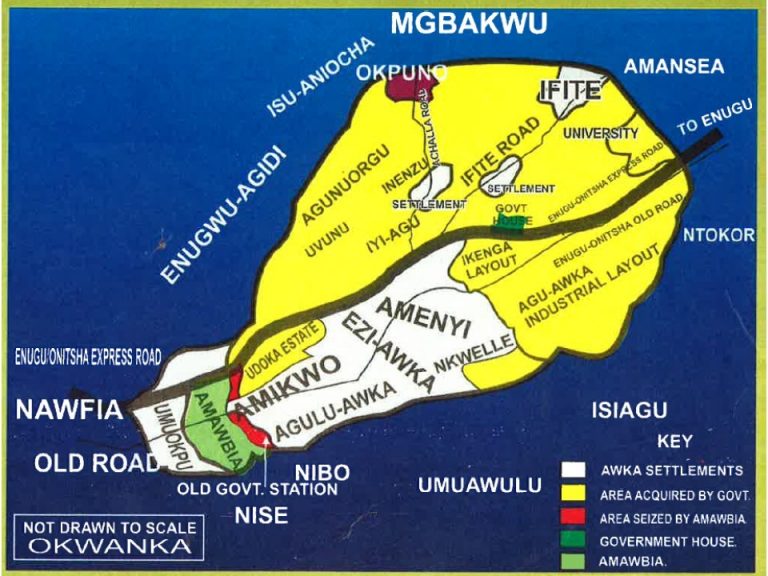
Nothing typifies more vividly the weakness of Awka town today than the case of Ugom. The ownership of this patch of land, currently the site of the Anambra State governor’s residence, is in contention. The site had once been reserved for the colonial government and today hosts the headquarters of Awka South LGA, Anambra State Police Command, Magistrate Court and federal prisons, along with the Governor’s Lodge. Awka people have long considered this land a grant to governments though it remains putatively Awka land. But Amawbia people have continued to assert a claim over the Ugom land, with their claim ubiquitously declared even in formal documents. On the official website of the Amawbia town union, it is unequivocally stated that the Governor’s Lodge is located on Amawbia land.

In contrast to the frenetic efforts of Amawbia people, Awka has not risen to emphatically assert its claim over the land despite historical affirmation of her title.

The history of Ugom should be considered unambiguous.

In 1904, following colonial pacification of the Awka area in the wake of the Agulu-Amikwo war, the British soldier and administrator Major (later Lt-Col Sir) Harry Claude Moorhouse, convened a meeting of Awka people to announce that the British Colonial Government had officially taken over the administration of Awka. He requested that Awka should provide a parcel of land where the incoming administration would be located. In response, the Awka spokesman at the meeting, Okolobu Ezikuno, promised that Awka would provide a suitable site. Eventually, two options were presented to Moorhouse and he chose the present Ugom site, apparently due to its hilly topography and proximity to three natural streams – Okika, Ogba and Obibia. As Moorhouse himself explained in a dispatch to his superiors in England on January 3rd, 1905:

“The one I finally settled on is about ¼ hour from the Agulu Quarter of Oka, is high and open on 3 sides, has an excellent water supply, a spring for drinking purposes in a ravine which cuts into the hills about 100 yards from the site of the European quarters (Okika spring) and a stream about ¼ mile away for washing, bathing etc. (Obibia stream); the top of the hill is a plateau with plenty of room to build European quarters, it then slopes away sharply and again becomes flat the ground falling away sharply and from the second plateau which should ensure good drainage”.

Similar to Moorhouse, a notable colonial anthropologist, Northcote W. Thomas, also observed in a report for the government (Anthropological Report on the Ibo-speaking peoples of Nigeria, 1911) that “in Awka town, the Amikwo quarter lies all round the government station. Men own land individually, and the boundaries are marked off by sticks.”  

These accounts show that Ugom did in fact belong to Awka and that it was ceded to the British authorities for settlement and colonial administration. It is therefore surprising that Amawbia now claims ownership of that area. Even more unsettling is the fact that the state government which is resident in Awka appears to tolerate this claim. The media, perhaps taken in by Amawbia propaganda, also abets this claim, with some reporters signing their dateline as “Government Lodge, Amawbia”. Even mapping tools like Google have fallen for this fiction, with depictions that tend to extend Amawbia boundary over the Government Lodge. Amawbia-sponsored social media content is also replete with this claim. All these have helped to crystallize the impression that the Anambra State governor resides on Awawbia land.

The reasons for the cession of Ugom land to the colonial government are known in Awka lore. For one, it was to protect the purity of Awka way of life. Awka ancestors saw Awka people as a special breed, and they were extremely protective of Awka culture and traditions. This attitude was often expressed in their unwillingness to assimilate strangers, and in their emphatic disapproval of mixed breeding. This did not mean that Awka people – who were themselves noted sojourners – were xenophobic. On the contrary, Awka often welcomed settlers but were more inclined to situate them on the peripheries of the cultural community. This happened with Amawbia people themselves, and it was the case too with the colonial government.

The other reason for the peripherization of settler communities had to do with the protection of Awka trade secrets. Awka ancestors did not want strangers in their midst to learn the secrets of blacksmithing, the mainstay of Awka artisanal economy. According to Amanke Okafor, “it was for those reasons of secrecy that Oka kept no slaves. Slaves found in Oka were few and in transit. Like the Jews, the Oka people kept their population pure. They did not encourage mixing. They seldom admitted other people to Oka citizenship and when that happen[ed] it was as a reward for significant services rendered to Oka town.”

Perhaps, looking back, Awka might have been better off assimilating the stranger communities into its fold. Had this been the case, Awka might have prevented the territorial losses that it suffered over time as these peripheral communities in time became autonomous and started to claim land allocations from Awka as their patrimony. Some even became adventurous, overtly or surreptitiously encroaching into adjoining Awka land, just as Amawbia is doing now with regard to Ugom. These territorial provocations did result in occasional wars, and in political tensions that persist even to this day between Awka and neighbors like Amawbia.

The irony of this is that the very thing that Awka ancestors sought to prevent, namely cultural mingling, has become a reality in contemporary Awka society.

The encroachment into Awka land continues even to this day, often with the connivance of some Awka indigenes. Amikwo and Umuokpu have seen the worst of it. Amawbia had at one time sued Igweogige-Amikwo village and others claiming that the land stretching from Old Awka Government Station to Omuko village belonged to them! Amawbia later abandoned that claim. But on another occasion it laid claim to all the lands housing the Federal Science and Technical College (formerly known as GTC), Paul University and almost the whole of Amikwo quarter. Similarly, in yet another audacious intrusion, Nawfia town joined by Amawbia went to court against Umuokpu village (and by implication all of Awka), the two claiming that they shared a common boundary at obubu mmia Umuokpu (by Eke Umuokpu market). The implication of this brazen claim was that Umuokpu-Awka village did not exist!

It is not only Amawbia that has attempted to claim ownership of Ugom. Nibo town has done so as well. It is on record that the first ever conflict between Awka and Nibo which later degenerated into a full-blown war around 1505 AD was over these same Ugom lands. Nibo had trespassed on the Obibia stream axis where the Governor’s Lodge would later be located, claiming it to be its own. This resulted in a clash between the two communities, with Awka emerging victorious after capturing Obikpo, a fearsome mercenary that Nibo people had hired. Victory meant that Awka retained ownership of the Ugom land up until the time it was ceded to the British colonial government in 1904, and in the period ever since.

Notwithstanding this historic defeat, Nibo design on the land never abated. In 1974 people from Nibo yet again trespassed the land across the Obibia stream claiming that it was not owned by Awka. This time, rather than put up an armed confrontation, Awka sued Nibo for the trespass and won.

But again Nibo people would not relent. They had appealed the judgement relating to the 1974 trespass. Also, as Amawbia began to assert its own claim over parts of Ugom, Nibo had sued arguing that it was the rightful owner, not Amawbia. Awka was able to intervene in the matter to rebuff the claims of both Nibo and Amawbia.

Still, Nibo and Amawbia claim continues, much as it had done in historic time. This leads one to wonder whether Awka cession of the land to the colonial administration had not been a conscious calculation to quash the restiveness around Ugom by just handing it over to a foreign power. It is not an improbable speculation!

These territorial assaults on Awka are matched by an unrelenting political assault on its status as a capital city. Amawbia’s undisguised coveting of Awka land is no less irksome than its egregious attempt to brand itself as the “seat of government”. Awka may not today be fighting a shooting war with Amawbia, but there is no doubt that Amawbia still wages a furtive warfare against Awka using modern means – social media branding, cartographic distortions (as seen in the Google map above), signpost defacement (there are reports that signposts naming Awka as headquarters of Awka South LGA are removed or maliciously defaced), manipulation of journalists (encouraging them to report the Governor’s Lodge as a site located in Amawbia), etc.

But Amawbia’s effrontery is hardly answered by Awka these days.

Whereas the parent body of Awka Development Union (ADUN) has not bothered to set up an official website, its Amawbia counterpart runs a professional website where it details the glories of the town as a seat of government from colonial times to the present. Amawbia has been busy making a public claim, putting its fingerprint all over Ugom, driving a strategic public relations agenda to ingrain Amawbia into public consciousness as the real seat of power in Anambra State. Amawbia seems to speak with a sense of certainty, asserting her ownership of the Ugom land and projecting a status as the real power centre while Awka stutters, consumed by its own internal leadership rifts, bickering over banal and barely consequential matters.

As Amawbia fights the war of perception, the fear is that it could actually parlay this into real political gain, to a point where it could begin to position itself as the de facto capital of Anambra State. There are already signs that this might be becoming the case. For a start, there is the reluctance of successive state administrations to fund the development of the Three Arms Zone – the site in Agu Awka area where the Government House, Governor’s Lodge, Banquet Hall and House of Assembly are to be located. This project, if completed, would force the final relocation of the governor’s residence into an uncontested territory in Awka. But this project remains unfunded. Why?

It is unclear if Awka leaders are even pressing the issue.

While the state government refuses to kickstart the Three Arms project, there are emerging reports that the current governor, Obiano, barely shows up these days at the Awka Government Offices, that he has in fact built an office near the current Governor’s Lodge at Ugom out of which he conducts government business.

There are serious implications if this is the case. It is possible that while Awka is navel-gazing – consumed by internal squabbles over ADUN PG and Eze Uzu titles – its nifty neighbor to the southwest lobbies to stall the migration of power from what it considers its own land at Ugom. Proximity does matter in the dispensation of administrative power. Amawbia has all the incentive to forestall the move to Agu Awka.

So while Awka people and their leaders wallow in perennial leadership struggles, the peripheral towns surrounding Awka are peeling off landed assets from the regional juggernaut. More insidiously – in the case Amawbia – Awka is also likely losing relevance as the administrative centre of Anambra State.

In these various ways, territorial losses and administrative usurpation, Awka prestige as a state capital is shrinking right before our eyes. If Awka could get its act together, it should start a campaign to force the relocation of the Anambra State governor from Ugom to Agu Awka.

ACTDA MD: Awka People to Blame for Slum!

0
ACTDA Chair
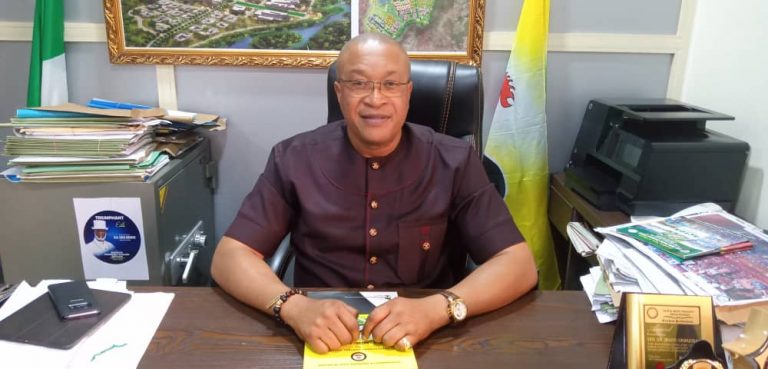
MD/CEO of ACTDA, Ven. (Barr) Amaechi Okwuosa

ATM Interview with MD/CEO of ACTDA, Ven. (Barr) Amaechi Okwuosa

“…They can’t eat their cake and have it.”

The dismal state of infrastructure in Awka, the capital of Anambra State, is a much-mentioned issue, and the focus of detailed reporting in this month’s edition of Awka Times. As a capital city, Awka has seen major changes in its urban landscape with the location of major government institutions in the city. These include the State Secretariat, the State House of Assembly, the headquarters of the state judiciary, the Government House, and the official residence of the state governor (the Governor’s Lodge), to mention a few. The spread of government establishments has added to the pressure on Awka infrastructure.

The infrastructure pressure arises not just from massive population growth driven by expansions in the governmental and non-governmental sectors, but also by increased rural-urban migration. The population growth is also driven by remigration: the return of sizeable pockets of Awka and other Igbo emigrants displaced by religious and political volatility in other parts of Nigeria. Awka infrastructures are creaking under the weight of these massive population shifts.

Awka Times thought it would help to find out how the Anambra State government plans to alleviate the decay of infrastructure in Awka capital city. ATM Editor, Emeka Ral, accompanied by our reporter Stella Nzekwe, sat down with the MD/CEO of Awka Capital Territory Development Authority (ACTDA), Ven. (Barr.) Amaechi Okwuosa, to interrogate the issue of Awka infrastructure. The Authority is charged with the responsibility of coordinating infrastructural development in the capital territory.

The interview was focused, and Ven. Okwuosa was forthcoming, at times appearing – under skillful questioning by our editor – to blame Awka residents for the dilapidation of the city’s infrastructure. We present the interview below, very lightly edited for brevity and clarity.  

Awka Times Magazine (ATM): Could you briefly describe the responsibilities and objectives of the Authority.

ACTDA MD: The Awka Capital Territory Development Authority (ACTDA) which was inaugurated on May 15, 2014 is an independent watchdog and regulatory a body for any development activities within the Capital Territory. It is overseen by myself as the Managing Director/Chief Executive Officer. It was primarily created to amongst others, accelerate infrastructural development of the Awka Capital Territory; prepare a Master Plan for the Capital territory and for land use with respect to town planning within the Capital territory; Implement Awka Capital Territory Master Plan; Provide infrastructural services in accordance with the Master Plan; and enforce compliance to appropriate standard within Awka Capital territory in collaboration with other relevant authorities. Our vision is to build a cosmopolitan city with excellent infrastructure and [is] the preferred investment destination in Africa. As you may well know, the present state of Awka is unacceptable, as it is lacking in key excellent infrastructure required of a cosmopolitan city that spurs investments.  

ATM: We hear about the Structure Plan of Awka and Satellite Towns produced under Gov. Peter Obi and a subsequent Awka Development Control Manual by the current government. Is the Agency still implementing these plans?

ACTDA MD: At the moment, the provisions of the Development Control Manual within takes precedence over the previous plan. What we are compelled to follow at the moment is as stated in the Development Control Manual for Awka Capital Territory, under the Awka Capital Territory Development Authority. The Structure Plan is there as a guide, but when you look at the main mandate for ACTDA, we are mandated to produce a comprehensive master plan for Awka Capital Territory and that actually envelops the Structure Plan and other areas not contained in it. It is more like an improved version of the document that the former governor produced. So, this is holistic and contains all the attributes of what you would see in first class cities of the world.

ATM: Could we look at what specific achievements the Authority has been able to record within its short period of existence.

ACTDA MD: There are quite a lot. For instance, the Manual that we have now which meets with international requirements. That’s one. We have commenced the production of the master plan. Though it is not complete yet, but we are into it at the moment. Thirdly, there has been a very clear distinction within our development control. We have areas designated for high density, and others for low density. We also have industrial areas. Now, it is very clear that things are not muddled up as it used to be. There is clear-cut demarcation in terms of development within the Territory. We’ve been able to start up regeneration in some areas. Revamping exercises have been ongoing. There are some slums that we’ve been able to restore from sordid states in which they were. ACTDA has been able to set a clear line regarding our standard for approval of building plans. Unlike what we met before, we now have a data of all the approvals we grant which is easily referred to in case of discrepancies. We are also very strict when it comes to approval of building plans. It is now compulsory that before we grant building approvals, there will be site inspection. We also engage in constant follow-ups to ensure that the construction follows the approved plan. Under the current dispensation, we’ve been able to enforce the observance of setbacks on roads. It used to be business as usual, but now, even with your approval, you must observe the setback. We’ve been able to enforce “no building zone” under the high-tension cables. When we were established, there were lots of buildings under the high-tension cables. On former Abakiliki Road (now Club Road), most of the structures there that contravene the current were put in place before ACTDA was established. We have demolished some of them, and others have been cut off. That would show you that we mean business. There is a law prohibiting people from building on waterways. Most of the structures that infringe that law were constructed prior to our establishment. But now, there is no approval given to individuals or firms without going through those basic rules, and at the moment, there are certain areas where we don’t approve businesses or charities like churches that may cause noise pollution. From my predecessor to myself, we’ve built quite a few structures, including many roundabout. Under my tenure, I built the Ring Road Roundabout. You would also see so many parks around. Places that were used for open defecation have been turned into beautiful green areas with flowers. There is one at Amawbia which has just been completed at the site of the accident which took place in December last year, when a petrol tanker overturned. We’ve revamped the place. At the moment, we are rebuilding the Amawbia roundabout which will be one of the best tourist attractions around with a bell tower that is over 100ft high and pure sterling silver. It will be like a tower of light that will be seen from every part of Awka.

On road, we’ve been able to take into cognizance the need to embark on road expansion and construction of new roads. There are so many estates. At the moment, we have Millennium Estate that is coming up and that will be the best estate made up of smart houses and the ability to regenerate itself. The plots are currently on sale, and people are showing interest.

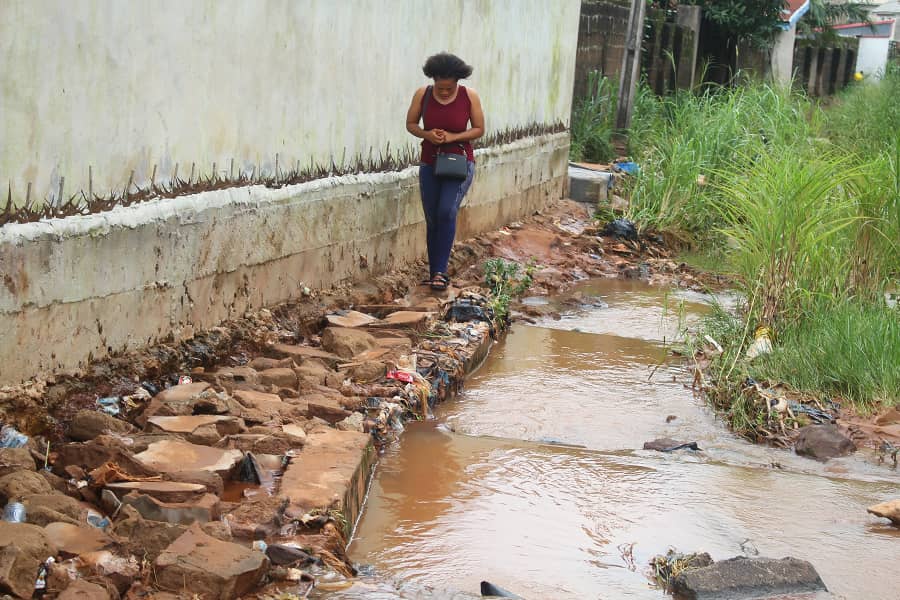
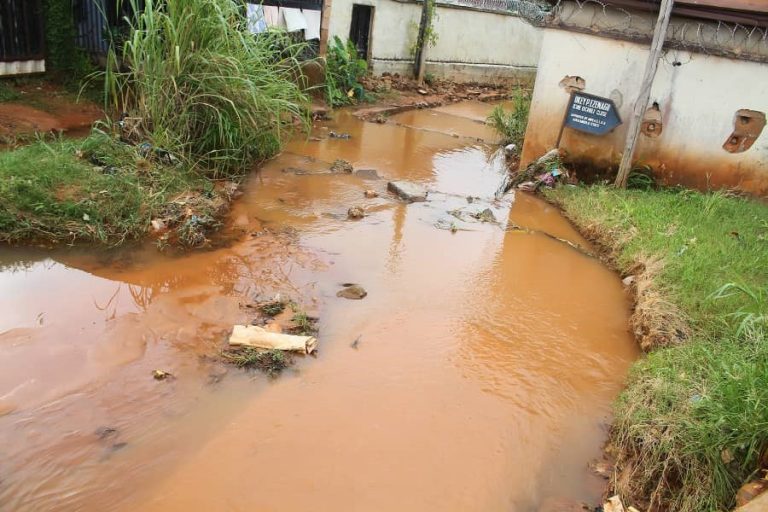
When it comes to flooding and other areas, it was a mayhem before we took over. One of the major causes of flooding within Awka and the capital territory is manmade and negligence. Most of the drains were blocked intentionally by indigenes, land speculators, and people who felt that doing so was in their interest. Last month, we embark on major desilting work around Court Road, Works Road, parts of Zik Avenue, Dike Street and Obunagu Road. It was quite atrocious what we encountered along Obunagu Road. A stretch of about 200 meters, certain individuals used reinforced concrete to fill up the drains. Some build restaurants, car garages, houses, perimeter fences, and others on the drains. I had to bring them down. And whenever it rained (no matter how little) the whole place would be flooded. Now, I am proud to tell you that the situation has been arrested and we spent over eight million naira to do that because we had to hire special machines for the exercise. In other areas, you have about 10 meters and 5 meters, but that was the highest we encountered. There was a particular man we decided to fill his to the ground level, and erected his fence directly on the drain. We had to pull it down. So, we’ve achieved a lot. We’ve been able to mediate among striking members of the community. Our goal is not just to demolish houses. We want to bring sanity and peace to the community.

One of our major achievements is in the area of sensitization. I believe in direct contact and dialogue. Most times when people know the reason why they should do the right thing, they would do it effortlessly. When you use coercion, they may do it but it would be counterproductive, because when the fear of that force is no longer there, they would revert to the status quo. However, when they know that it is in their own interest, they continue along that path. For instance, when I embarked on enforcement of grass cutting, [I told them that] they shouldn’t do it because it is government’s responsibility. I had to explain to them the cause of the incessant bouts of typhoid and malaria is dirty environment. If your environment if clean, you have less incidence of vermin, mosquitoes, etc. But when you have bushy surroundings, obviously you have mosquitoes, snakes and others around. As you know, some major carriers of salmonella and other bacteria and viruses that cause little sicknesses are vermins. I made them to understand that it is their civic responsibility to keep their environment clean, and not the government’s. No if you walk along the Amawbia-Amansea motorway, you would see that we are cutting the grasses there and the private individuals are mandated to cut theirs. When they fail to do that, we will fine and prosecute them.

We’ve also been able to educate the people to be their brother’s keeper. In the past when kidnapping was rife in the state, people were kidnapped and kept just a stone throw from their houses and nobody would know because the whole place was overgrown. That informed our decision to bring out a plan regarding the perimeter fencing which we’ve already enforced along the expressway. Soon, we shall be going into the town. There must be a clear view from the outside. We have this false sense of security deriving from lock-up fences and high walls. In effect, it is much more hazardous and dangerous to have high walls around your house. If something is going wrong inside the house, no one would know. Somebody could even come in and shoot you without anyone knowing. But when these fences are in line with the prototype we have produces, people would know when something is going wrong and they can come and help you. This false sense of security of “once I lock the gate then I’m safe” is not true. There have been instances where people’s houses were set on fire and just because nobody could get in, the children, disabled and aged were burnt alive. But when you have that open space, people can come in and help you. That’s one of our achievements. We’ve been able to enforce it, and we have more than 95% rate of success.

ATM: [You] mention[ed] some shanties and slums which the Authority has reclaimed. If you don’t mind, Sir, could we have specific examples.

ACTDA MD: Of course, we have the Millennium City now. There were a lot of shanties around that place. They were illegal occupiers, most of them non-indigenes of Anambra state, without mentioning name to avoid segregation. Some of them settled [there] and from cattle rearing, they started building up the shanties. We also had to sack them from the Old Ikenga Hotel axis. The current site of the International Conference Centre also had a shanty. Another spot was close to the Amansea Cattle Market which has remained a continuous battle, as they keep leaving and returning.

ATM: How is the Authority funded and how much funding support does it receive from the state government?

ACTDA MD: What I need to tell you is that all our activities and projects are being funded by the state government. That’s number one. Number two, we generate IGR through building control and development control.

ATM: ACTDA is resident in Awka which is the heart of the state capital. Is there any rapport or synergy between the Authority and the town to ensure better achievement of its objective?

ACTDA MD: The capital territory cuts across seven local government areas. Awka city is one of the town in Awka South Local Government. You have Nibo, Nise, Amawbia, and a host of others. So, I do not want us to always focus on Awka town. But having said that, we work in synergy with all the towns that are within our area of jurisdiction. Awka is a bit peculiar, due to the intrinsic nature of the geopolitical issues within Awka town. There is a divide. I observed that when I came in. Some parts against the others regarding who the traditional ruler should be. But that’s not our problem as it happens in some communities. What we do here is that we go with whoever the government has recognized. Not that [they] tell us what to do, no. That is by the way.

We synergize with them. For instance, we had an issue with a waterway that had been blocked. It runs across Umuzocha, Umudioka, down to [Kwata Junction]. From Regina Caeli where it started, it used to be a very huge waterway that was constructed just immediately after the civil war. I understood, when I spoke to them, that it had been there even before Nigeria’s independence, but was demolished during the war. It was about 10-12ft wide and about 8ft deep. We now found out that some land speculators had started covering it up. At a place, it was 2ft wide and 3ft deep. So, you can imagine the volume of water coming from 10-12ft wide and 7-8ft deep being compressed to 2ft by 3ft. So, there was a heavy rain, and almost the whole houses there were affected. Initially when I got there they were very recalcitrant and hostile but I found out that most of those exhibiting the violence were non-indigenes from Ebonyi and Enugu states. I engaged them and that was when the landlords and people of Awka came out, including the chairman and youth of the community. They rallied round us and we were able to mark the structures. We pulled them down and they themselves had gone ahead to start pulling down theirs. Only very few difficult ones are still resisting but we are waiting for the rains to stop because we can’t tamper with that when it rains there. So we intend to go in there probably [later this month] December or [in] January to start demolition. Some of them have actually, on their own, pulled down their fences and moved backwards. So, there is a synergy.

ATM: Some have said that there is lack of government attention towards the inner city of Awka, with greater focus paid to the developing sections of the town. If you are aware, there are serious issues of flooding in many parts of the town, particularly in the Agulu/Umuogbu area. Are there plans to develop the inner community of Awka?

ACTDA MD: The government of Chief Dr. Willie Maduaburochukwu Obiano is one that has human touch. I don’t really agree with you that the inner city is being neglected. The truth is that the villagers are very hostile to government agencies when it comes to enforcing building control and development control. There are some of them that have built on areas where they are not supposed to build. Even when they were building, I personally went in there at Amudo, Umuogbu, Umudioka, Umuzocha, Umubelle, Umujagwo, Umueri and virtually all the places, including Umuoranma and Amenyi. When you ask them to stop building, they would say it is their great-grand-father’s land. You mark a place and direct them to stop building and they would agree. By 3:30pm on Friday they are amassing building materials and moving them to site, knowing that it is weekend when government officials do not go to work. By night, work begins and continues during the day and at night. By the time you arrive the scene on Monday, you’d find structures that were not there obviously built in the wrong places. Because they block the waterways, water must flow. The next day they would come around and start screaming about being neglected. But they are the people causing the problem. So, I am appealing to the Awka community to do the needful. If they want development in the inner city, then they must allow government functionaries to assist them. But at the moment, no. You can’t eat your cake and have it.

ATM: There is the notion by some that the Awka people do not provide adequate support to government in terms of making land available for developmental purpose. On the other hand, the Awka people feel that they have done more than enough in this regard. From your end, Sir, what is the true situation?

ACTDA MD: I want you to understand that under the current law on acquisition of land, government has control over land. By the Land Use Act, the federal government owns all lands. So, the government can acquire any land for overriding public interest. That is the much I can say on that. Awka happened to be one of the most enlightened within this area, even during the colonial era. But it is quite unfortunate that the founding fathers of Awka decided to cluster at one place. It is not my fault, but their own mannerism. They clustered in one place and left other parts. Government would surely make use of empty land. So, you can’t come out and cry that they took your land when you are not making use of that land. And the owners of all lands that have been taken by government were duly compensated, both in land and money sometimes between ten to twenty percent of the land in addition to the monetary compensation. There has not been any case where the government would forcefully take land from the community. If you do not make use of your land and the government needs it, the government would make use of it.

ATM: Sir, some feel that in the long run, future generations of Awka may have no place to call home given the volume of land that’s been acquired by government. More so, would it not make more developmental sense to spread government institutions across the six local governments that make up the Awka Capital Territory, thereby putting less pressure on Awka land?

ACTDA MD: Of course we are doing that. It is not true that government has taken more of lands belonging to the Awka community. The problem here is that Awka people spread their tentacles to lands within Awka. There are some areas taken from Amawbia, but Awka people refer to them as Awka. Same with those taken from Okpuno and Isiagu. Isiagu, Okpuno, Nibo, Nise, and Amawbia are not Awka. There is a parcel of land acquired from Isiagu for which they have been compensated. I was there last week for demolition because some people have encroached on the land and most of them are from Awka. The same thing obtains at Iyiagu Estate which is supposed to be Okpuno but Awka people have gone there and encroached. The same thing is playing out at Cornerstone Estate, where after being duly compensated they came back [and] started parcellating and selling lands that have been acquired by government. They moved from the compensatory plots given to them and started selling others. I don’t agree that Awka land has been taken. On your fear regarding how your children will feel, well, come to think about it, Awka is receiving the best infrastructural development. Don’t you think that your children will feel happy that they are living a better life than those in other places that are not so developed? That’s part of development. At Onitsha for instance, which is arguably an older city than Awka, most of the people from Onitsha live as tenants within Onitsha with better means of livelihood. So, it is left for you to develop. Most Awka people today are living in Abuja someone else’s land and building there. Most of you are in Lagos, buying land and building houses in somebody else’s land. C’mon, what is good for the goose is good for the gander.

ATM: Let’s look at infrastructure, Sir. There is the notion that after over twenty years of capitalhood, Awka is not at par with its sister state capitals created same time it was created. Worse still, some like Abakaliki which came after it seem to have overtaken it in the infrastructure race. Given the place of Anambra in the south east and Nigeria, there is the notion that Awka should be much better.

ACTDA MD: What you are saying is arguable, depending on the way you see it. If you were referring to Awka inner city, like I explained to you it is much more difficult to get into a place where there was no plan. It was a rural area and there was no plan so they did what they thought was best for them and now we come in with new rules and laws. That’s one of the reasons why the government is focusing on building new estates and developing areas that are easier to control. We need the cooperation of indigenes. Most of my staff have been beaten up by Awka people (not just Awka, but Nibo and other communities) when they go into the communities to enforce building and development control. They attack them. They see them as visitors. “This is my property and you have no right to come and tell us what to do.” So you can’t eat your cake and have it. Though it is now changing because I have been able to engage and explain to them. For us to be able to sanitize Awka town and build basic infrastructure, a lot of ancestral homes will go. Are you prepared?  The biggest resistance is from the people of the town. I say this because I have experienced it. There are some buildings that are in the way obstructing the passage of electricity cables, but the owners would rather die protecting their homes. For instance, go to Amenyi at Imoka you will see the mayhem there. They won’t allow any development to pass through the area. Some of them worship those trees or whatever it is they worship there, and I don’t have anything against it but there have been instances where we’ve gone there to work and the monkeys would attack and they tell you not to touch them. But frankly speaking I told them if the monkey looks for my trouble, I’ll give it to him because they are so wild. You could buy a loaf of bread and they would have the boldness to attack and take it from you. That’s not what you’re supposed to see in a civilized town. I don’t have anything against Awka but I’m just giving you an example. So, there is this institutionalized belief and way of life that we need to change for development to come in.

ATM: Thank you, Sir. On a final note, are there major milestones we should be looking forward to in the coming period?

ACTDA MD: Yes, there are major milestones and we have room for improvements. We are heading towards the building and construction of more roads. We have the International Conference Centre (ICC) that will be one of a kind in the whole south east. It seats more than ten thousand people and has a lot of facilities around. We have Golden Tulip Hotel though it is in Agulu which is also part of the capital territory. It is about the only five-star hotel you have in this area and we intend on building more. The Millennium City which I told you about will be one of a kind and the administration of the present governor, Chief Willie Maduaburochukwu Obiano, is keen on making Anambra state a user-friendly state where people can come in and go. Look at security, before this administration came in, you [couldn’t] move around in most places in Awka, especially when it [was] late. But today, people move about freely. We’ve managed to play down the rift between some communities. I was involved in one episode last year. There is this cultural migration the Awka people perform once in a year called Imoka. People move from Amenyi to Umuokpu through Amawbia. In the past, there had been bloodshed. Last year, I happened to be around and I was able to avert a major crisis at Amawbia. I believe that in ACTDA today, everyone is free to come here for assistance. So, the milestones we are looking at are under infrastructure, education, security, and human development. We are up to it and we are doing our best. But remember, the Awka people should not always complain about their losing their land. They are getting the highest percentage of development and that should assuage their pangs.

Options for Viable Peace in Awka

0

The current leadership crisis in Awka has been long in the making, engulfing the kingship, town union and other institutions. There are ongoing court cases to settle the claims and counterclaims, and it is unclear when the legal hazard will abate. To resolve the leadership imbroglio, there need to be creative crisis-management interventions in the short term, and also imaginative solutions for institutional reform in the long run. A little-known group, True Awka People (TAP), is taking the first tentative steps towards finding viable solutions.

By Chudi Okoye

Tony Okechukwu arrived early at the peace conference venue that morning of August 23, 2019, braving a torrential rainfall that had threatened to upend the day. In spite of the dampening effect of the downpour, Engr. Okechukwu seemed to be in high spirit. He was wearing an immaculate white tunic, his face radiated confidence, and his manner was ebullient.

Little wonder that Okechukwu was in abundant mood that morning. He had come to conference clutching his dramatic “victory” in a recent appeal court ruling in Enugu which appeared to finally dispose of the long-running case concerning the leadership of Awka Development Union Nigeria (ADUN).

To Okechukwu, the ruling was dispositive and his victory conclusive. So he had come to conference determined to invoke his victory but ready for compromises, as he told Awka Times, in pursuit of peace that had long eluded the Union.

Feeling perhaps that he had strategic advantage from his legal victory, Okechukwu had endured extreme journey hardships the day before as he made his way from Abuja to Awka, to attend the conference. He told Awka Times that morning of conference about his hazardous flight from Abuja, re-routed first from Asaba to Enugu and then to Port Harcourt. But even a near crash in Port Harcourt, Okechukwu said, did not shake his determination to get to the conference.

How odd then that after all that determined peregrination, the much-vaunted conference – convened by the True Awka People (TAP), the newest peace mediation group in Awka – blew up in Tony Okechukwu’s face. Other key invitees had not bothered to attend or merely sent surrogates. And after a short tense wait, Okechukwu himself fled the forum in frustration. Yet another hopeful mediation effort had come to a hopeless end. Since that disappointing outcome, the supposed losers in the ADUN case have filed another suit challenging Okechukwu’s presumed victory. And so the squabble over who leads the ADUN, as well as the broader contention over Awka kingship stool, continue in their benumbing drama.

Origin of Awka Leadership Crises

The current leadership tussles have dragged on far longer than most political crisis in contemporary Awka history. There is not, if the measures are taken, much redeeming quality to the present conflicts. They are not, for instance, principled disagreements about the best way to develop the Awka economy. Neither are they a debate on how to maximize allocations from the state government. Or yet how to maximize revenue generation to finance municipal development in Awka. They are equally not a difference of opinion on how to engage a state government that seems somewhat inattentive (some say even hostile) to Awka welfare and strategic interests.

No, none of that. Instead, according to some involved Awka leaders, the centerpiece of the crises that have engulfed the Awka community for the better part of seven years turns on ego, religion, and what some consider pecuniary motivation.

Chief Dilim Okafor, a prominent Awka leader, put it rather starkly in a statement obtained by Awka Times. “What is happening”, according to him, “is that some people have refused to let go [of] their penchant for greediness and unwholesome ego trip… People are not sincere to themselves. The whole crisis in Awka center[s] on [control of] the revenues collect[ed] from Awka main market… Other issues are not [all that important].”

Chief Okafor told Awka Times in a follow-up telephone call that an unknown cabal controls the Eke Market revenues, and it is unlikely that successive ADUN PGs (from Engr Nzekwe Ibe to Dr Amobi Nwokafor) have been connected or even conversant with the intricate machinations involved in collecting and disbursing the stallage revenues. He offered a ready solution: “Let us arrange a meeting of all past PGs and ask them to look into who and who collect[s] the rents from the market.” Chief Okafor argued that if there is greater accountability for the market revenues, it would detoxify the politics of Awka leadership.

A Lagos-based marketing professional, Kene Nweze, agrees with Chief Okafor. “Thank God [that Chief Okafor] has bared the face of the masquerade,” he wrote in a report accessed by Awka Times. “The picture is now very clear. It’s clear that there is a lot of gain in that office of PG, [hence] the endless struggle for this post,” he argued.

Chief Abolle Okoyeagu, former deputy governor of Anambra State and one-time secretary general of the ADUN, has a similar view on what is driving the crises. He told Awka Times that in his time the ADUN focused on the search for solutions, often bringing representatives from national branches to brainstorm on how best to achieve the development of Awka town. Okoyeagu said that in contrast “the officers that came after us politicized the ADUN, only looking for what they will get from Eke Awka [market]. That brought about rivalry for position and profit.”

With material interests hugely impacting the dialectics of Awka leadership crises, it is perhaps unsurprising that the conflicts have appeared so far impenetrable. Contenders and factions are rigid in their positions, rejecting legal outcomes and peace mediation efforts that threaten their particular interests.

A materialistic conception of Awka leadership crisis is attractive: It is clear and simple. It has additional force coming from folks like Okafor and Okoyeagu who are leading lights in the arena of Awka politics. It is probably the clash of egos, the collision of ambitions, the prebendal pursuit of power and prestige, that converge to create the unyielding pathologies of Awka political crises. They are seen in the ADUN rivalries, in the accusations and counter accusations between Eze Uzu and Ndu Ọzọ, in the calculations of the factions supporting one or the other protagonist. These are the “fertilizing agents” at the root of Awka crises, as one source put it in the report secured by Awka Times.

The materialistic perspective can certainly become overstated. It can appear overly reductive, foreclosing other insights that may also explain the Awka crises. It may be that in the end it is the behaviors of men that determine the success or failure of a political system. But behaviors are not formed in a vacuum. Instead, they are shaped by the social formation and systemic architecture within which they occur.

Systemic Stresses

Political theorists often conceive of the state as a system, with structures (political institutions, civic associations) created to perform specific roles. In advanced systems, these structures are created by well-defined rules to perform functionally differentiated roles. These roles become inputs into the conversion processes of the system, yielding outputs that produce effects in the society. These effects generate feedback loops which in turn trigger new inputs. In this way, the system persists in a continual, predictable order.

Awka too is a system with its own structures which include the apex governing institutions – the Ọtọchal Awka, Eze Uzu and his Council, Kingmakers, Ndu Ọzọ, Izu Awka, the ADUN and other authoritative entities performing the ‘output’ roles of rule-making, rule-implementation and rule-adjudication; and the vast variety of other political or civic institutions, formal and informal, performing ‘input’ roles such as interest articulation, interest aggregation, political mobilization, socialization and communication. The latter includes lower echichi groups (Ndu Ajaghija, for instance), village councils, age groups, women’s groups, social clubs (Pacesetters, Ambassadors, Okwanka etc.), market associations, and various other institutions like media, churches, schools and so on.

A major systemic issue in Awka concerns the fact that the constitutive rules that create many of its governing bodies, and the regulative rules that govern their behavior, are not optimized. The rules themselves are in some cases ambiguous, and the structures they establish often functionally undifferentiated. If, in the past, there was a clear differentiation of roles in Awka, the absorption of some Awka governing institutions into the administrative machineries of the modern state government and the relegation of others does create an ambiguity that Awka must deal with. What are the proper roles of Awka governing institutions in the modern democratic setting, and how can these roles be properly codified?

The absence of a Grundnorm on which the constitutive and regulative rules are based has been a source of constant disorder in Awka. And we have seen – whether in the crisis of ADUN or in the interaction of Eze Uzu and Ndu Ọzọ, or indeed in other interactions among the governing elites – persistent evidence of constitutional crises often translating into serious political crises.

Often by design error, but also due to regrettable deviancy, the constitutions of Awka have not proved capable of regulating political behaviors in a manner conducing to political order. It is indeed an irony. A polity like Awka, deeply jealous of its democratic traditions, should adopt detailed and highly regulative constitutional law to govern political behavior. But this is not the case, hence the crises we see in Awka.

Many of the political eruptions in Awka actually involve some kind of constitutional question:

  • The three traditional rulers Awka has installed since 1959 all faced challenges to their legal status
  • The contest between the incumbent Eze Uzu II and Ndu Ọzọ is at its core a constitutional question
  • Same with the stand-off between Eze Uzu II and the Awka Council of Kingmakers
  • The ambiguity surrounding the roles of Izu Awka and even Ọtọchal Awka is a constitutional matter
  • The relationship of Eze Uzu and the ADUN, often crisis-bound, certainly raises legal questions
  • And, of course, the crisis within the ADUN itself is by and large a constitutional crisis
  • Not least, the role of the state government in Awka affairs frequently raises a legal conundrum

Clearly, the major issues in Awka politics often arise from legal and constitutional ambiguity.

Awka political crises require imaginative interventions. New ideas and new approaches are needed. These must include short-term solutions to deal with the exigent situation in the town, as well as longer-term solutions to promote institutional reform. The search for such solutions is the focus of the True Awka People (TAP), a peace mediation group working to resolve Awka political crises.

The immediate focus of the TAP group is to reconcile the warring factions. It considers this a necessary pre-condition for longer term reforms. The TAP approach is to disaggregate the interlinked issues of Awka kingship, the ADUN and Ọzọ Awka Society crises, tackling each separately.

ADUN Crisis: Short-Term Solutions 

TAP members have deep familiarity with the ADUN crisis. Some have been involved in ADUN leadership or in pre-TAP conciliation efforts. As such, they have significant insights on the crisis. For the short term, the group is adopting the following conflict resolution methods:

  • Withdrawal of Court Cases: TAP considers that the suits and countersuits filed by different camps will not produce a viable result, so it is actively lobbying all sides to withdraw the court case.
  • Meeting of Past PGs: TAP conducted extensive stakeholders interviews as precursor to face-to-face stakeholder conferences. Two conferences held so far, though with uncertain results.
  • Concert of Stakeholders: With mixed results from the two conferences so far convened, and in light of the recent resumption of litigation, TAP is attempting to use a concert of highly respected Awka statesmen and stakeholders to persuade the combatants to withdraw the suits and agree to a joint ADUN election.
  • Caretaker Committee: The proposed joint election is to be conducted by a caretaker committee to set up which a prior approval should be sought from government. It is important for Anambra State Government to show greater impartiality in the matter.

Kingship Crisis: Short-Term Solutions 

TAP has not yet begun to focus on the kingship issue, although Awka Times is aware that the issue is within scope. There are many short-term options for an inroad into the kingship issue.

  • Peace Conference: TAP has mooted the idea of a Truth Commission to tackle the deeply entrenched kingship crisis. TAP has not initiated any specific actions on this front. It will require great diplomatic skills to persuade the two kingship claimants, along with their factions within the Ọzọ Awka Society, Council of Kingmakers and other structures, to commit to such a conference. TAP strategy here must be pursuit of peace through strength. That is, while seeking a diplomatic resolution, Awka must apply some pressure on the rivals by raising the threat of a demand for mutual surrender.
  • Mutual Surrender (Nuclear Option): In the event that a peace conference is impossible to organize, or if organized, fails to end the kingship rivalry, TAP should ask both kingship contenders, Eze Uzu II, Gibson Nwosu, and Ọzọ Augustine Ndigwe, to stand down, in a kind of mutual surrender. Awka could devise a combination of inducements and pressures force the option of a simultaneous surrender, if it becomes necessary.
  • Building Pressure: To build pressure, TAP should consider a Third Force strategy. This means building a coalition of non-aligned elites and mobilizing the masses around a Third Force. Planning for the Third Force should be done secretly. But once announced, the group should do the following:
  • Kingmakers, Ndu z and Other Title Holders: Try to peel off support for either crown among these elite groups.
  • Silent Notables: Reach out to silent and uncommitted Awka notables. Most of them are probably disgusted with the deterministic choice currently on display and are choosing to stay out of it. TAP should draw up a list of such notables.
  • Socialization and Mobilization: Mount a campaign to educate the populace, using the public media and other grassroots-level tactics
  • Plebiscite: Conduct a plebiscite at home to record public support for the Third Way
  • Awka in Diaspora: Reach out to Awka people in the Nigerian and global diaspora
  • Potential Legal Action: As a last resort, threaten legal action. Both contender do suffer some legal jeopardy.
  • ANSG: TAP should lead effort to persuade Anambra State Government to withdraw support for Nwosu and help to prosecute the Third Way, in the interest of peace in the capital city.
  • Inducements: Whilst building up pressure as outlined above, the Third Force should also seek ways to incentivize the two contenders. This might include financial rewards, honorary acclaim, positions within the Anambra State Government, etc. to afford them a dignified and face-saving exit.
  • Regency Period: TAP should recommend that Awka should ask Eze Uzu II – consulting with Ndu Ọzọ, Council of Kingmakers, and Anambra State Government – to select someone from his village, Amikwo, to serve as regent for six months – in accordance with the Traditional Ruler Amended Constitution of 1986 – until the selection of a new Eze Uzu.
  • Selection of New Eze Uzu: With a regent in place, Nkwelle Village, which is next in the succession line, should be invited to nominate a homegrown candidate for the next Eze Uzu, and not transfer the mandate to some other village.

Long-Term Solutions

A major contradiction of contemporary community leadership in Awka is that the institutions of kingship (Eze Uzu) and Awka Development Union Nigeria (ADUN) – both of which are relatively new in the annals of Awka leadership history – do enjoy statutory recognition, whereas their older counterparts – which have served Awka for millennia – do not. The relegation of the primordial leadership institutions in Awka is particularly vivid in the case of Izu Awka and Ozo Awka Society.

But even the “new” leadership institutions are not without their own handicap. Whilst ostensibly imbued with statutory authority, these bodies are nonetheless unfounded in the Nigerian constitution. They are entirely dependent on the state government for the legal validity and funding. Thus, not constitutionally founded and yet without cultural provenance, these entities have tended to defer to a state government which regulates and remunerates them. 

The foregoing sets up the background for TAP’s long-term solutions for leadership reform in Awka. Much of TAP’s long-term ideas centre around constitutional reform, institutional revitalization, and behavioral reorientation. TAP has come out with a blueprint with the following strategic thrusts:

  • To develop a unified constitution that will regulate Awka governance institutions. Such a constitution will originate from the peculiar cultural precepts of Awka people, recalling their rich history and heritage. The constitution will of course incorporate the appropriate federal and state laws, recognizing their respective authority, but it will be anchored on the fundamental precepts and cultural norms that give Awka its unique identity as an ancient civilization.
  • To reposition Izu Awka as the apex authority in Awka which harnesses other Awka institutions to ensure the emergence of a Great Awka Society that is peaceful and progressive.
  • To develop a governance structure that will empower Izu Awka to handle all matters concerning Awka people, without infringing the Nigerian Constitution or any other extant Federal or State Government rules and regulations.
  • To register Izu Awka with the Corporate Affairs Commission (CAC) as a corporate entity; create an Awka Single Account and develop a fiscal system through which all funds for Awka should be received; and empower Izu Awka to administer such account and seek legal assistance on behalf of Awka people.
  • To strengthen the Eze Uzu institution so that it can effectively play its role as the embodiment of Awka custom, tradition, culture and way of life.
  • To glorify the Eze Uzu institution and accord utmost respect to any incumbent Eze Uzu, enabling him to discharge his duties in a manner that reflects the prestige of the institution.
  • To revive Awka traditional Judicial System in a way that supports statutory institutions, allowing local disputes to be resolved through communal conflict resolution mechanisms; this may also help to unburden the Government’s judicial and law enforcement
  • To reposition the Awka Development Union Nigeria (ADUN) so that it can carry out its developmental and administrative functions to the greatest benefit of Awka Town.

TAP recognizes that its proposals for institutional reform will flounder if not founded on moral revival. As such, it is advocating the reorientation of Awka leadership towards service and personal integrity. A TAP report obtained by Awka Times bemoans the excessive “greed” that seems to drive leadership aspirants in Awka, and urges “anyone wishing to serve [Awka to] forget every form of personal quest but see it as a call to service.”

The road ahead for leadership settlement and peace in Awka will be long and arduous. It will not be easy to solve the deep-rooted crisis. Nor will it be easy to reform and streamline Awka leadership institutions. However, a creative and determined approach could help Awka resolve the immediate challenges, to clear the Augean Stable and then begin the long journey to institutional development.

  • Dr Chudi Okoye is the Secretary of the True Awka People (TAP)

Meditations on Awka Leadership Crisis

0
Ili Ji7
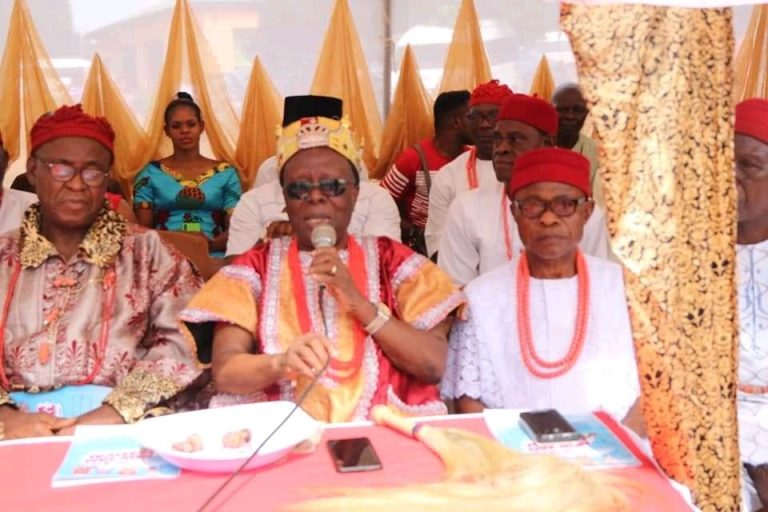
HM Eze Uzu II Obi of Awka, Dr Gibson Nwosu, addressing an audience

Awka polity is going through a serious leadership crisis. The pursuit of power, prestige and perquisites among elite factions has led to a rupturing of local leadership institutions. This threatens Awka political stability and undermines its relevance in Anambra State politics.

By Chudi Okoye

Cartoon Title

Scottish philosopher Thomas Carlyle once proclaimed, in his acclaimed ‘Great Man’ theory, that “the history of the world is but the biography of great men.” That theory was later quite forcefully rejected by the English polymath, Herbert Spencer, who argued that those Carlyle considered “great men” were merely products of their social environment. Be that as it may, Awka history appears to have surged or plunged in consonance with the nature of Awka leadership in any given era.

History has bequeathed Awka society a variety of local leaders. Some were known for their sobriety, others for their notoriety. Some have been hesitant, sought out to be anointed; others agitant, all but self-appointed. Some have been voluble and strident; others unflappable and silent. All told, Awka leaders have come in different packages, travelling with their varied appendages. And there is today a whole muster of them, a variegated cluster. With the profusion of ‘leaders’ comes some confusion of values and the absence of a leadership agenda, making the town’s future somewhat slender.

Leaders versus Leadership. Not always fungible, these terms. One term refers to mortal beings in formal or informal roles trying to represent, direct or guide a group in pursuit of some private or social goals. The other refers to the presence of certain metaphysical qualities such as charisma, confidence, vision, nobility, decisiveness, authority – all of these qualities needed to nurture, coach, motivate, innovate, influence or otherwise inspire social groups and move them to achieve collective goals.

Leadership is kinetic. But not so in contemporary Awka society.

Over a generation ago the redoubtable Chinua Achebe declared that “the trouble with Nigeria is simply and squarely a failure of leadership.” Achebe’s piercing critique of Nigeria could well have been written specifically about contemporary Awka town. For, surveying the scene today in the decaying capital city of Anambra State, it feels for all the world like a rudderless hulk in need of bearing and masterful steering. But where are the dedicated leaders to revive the desiccated town?

The leadership crisis in Awka has never been more acute than it is at present. And it is time to really interrogate the issue – from a non-partisan perspective, as we do in this maiden edition of Awka Times.

Some key questions to kick off: What is the real problem with leadership in Awka: Is it that the town’s leadership is incapable, or that Awka community itself is ungovernable? Are the town’s leaders simply unremarkable, or the followers themselves unbiddable?

Awka énwé ézè! is an age-old maxim which once denoted the rejection of a centralized kingship system and the abhorrence of entitled leadership in Awka culture. This adage shows that although classical (i.e. precolonial) Awka society had its own political hierarchy, Awka political organization was highly decentralized and participatory. Awka did not abide any sense of entitlement among its leaders. This attitude persists to this day even as Awka fumbles with a newfangled monarchy and an experimental town union administration attempts to manage the town within the democratic superstructure of modern of Nigeria.

Awka énwé ézè! has turned into Awka énwéré ézé! In the time when Awka was an autonomous village republic, with a pastoral simplicity to community life, it did not see a need for a formal architecture of leadership. But as colonialism and postcolonialism ensued, Awka came to be subsumed into the larger political framework of Nigeria. A need thus arose for a formalized hierarchy of leadership to represent Awka in the new political entity. But this new hierarchy has remained somewhat exotic, constantly colliding with the republican instinct in Awka political DNA. It has resulted in recurrent eruptions of leadership crisis which render Awka a toothless juggernaut in its environment. In this way, alas, does Awka énwé ézè! translate into Awka énwéré ézé! A once formidable republic has become toothless with the adoption of kingship.

It is undeniable that habits of leadership and followership are yet to be properly cultivated in Awka, (though, with economic distress making a mistress of many, sycophantic self-abnegation is on the rise). This is evinced in the persistent crisis of leadership in the town. The triggers for these tensions can be found in growing elite power struggle and increased civic mobilization that are the reality of modern Awka society. But the root causes relate to deeper historical, cultural and structural factors in Awka society. Resolving the crisis requires a change in elite behavior, but also a reform of Awka governance structures to reduce the institutional frictions that exist today. Institutional reform is necessary for Awka to move from the current instability to political order.

Crisis of Political Transition

A sixty-year process of political transition (1959 to 2019) has been afoot in Awka. In this period, Awka governance function has come to be fully integrated into the Nigerian governance system through the establishment of a statutory chieftaincy rule (later monarchy) and town union administration. This transitional period has seen the ascendance of the statutory leadership institutions in Awka and the gradual marginalization of their primordial counterparts. The decline of the older leadership organs as Awka transitions from a segmentary lineage-based village republic with achievement orientation to an increasingly stratified society with ascriptive orientation is becoming evident (see Want a King. Won’t Kiss His Ring! in this edition of Awka Times). It has added to the crisis of leadership, marked by institutional and personal rivalries, instability and generalized sense of leadership failure in Awka town, as shown by the Awka Times survey published in this edition.

Leadership failure is the bane of modern Awka polity. We see it in the deleterious effects of elite power struggle and institutional rivalries which have intensified recently. We see it in the seeming inability of the political and elite social classes in Awka to articulate a hegemonic vision for Awka ascendancy; their lack of internal class consensus and inability to mobilize the mass of Awka indigenes around a set of shared community objectives; their apparent lack of will or political resources to impose order on a restive, crisis-ridden society in which they have class advantages; and their lack of technocratic competence to engage external actors or mobilize external resources to deliver good governance, peace and prosperity in Awka. This depiction indicts the Awka governing elites as a social class, although I do recognize and salute the patriotic and philanthropic efforts of leading members of the elite acting in their individual capacities to uplift their hometown (see Awka Times Person of the Year, 2019). Our focus in this edition of Awka Times is on the failure of the ruling elites as a class, to document their rivalries since the onset of monarchic transition in Awka, and to explain why, as Achebe would put it, the elites have failed to rise to their leadership responsibilities.

Aspects of The Leadership Crisis In Awka

The grim evidence of leadership crisis in Awka abounds. Almost all of the local governing institutions in Awka are infected by the crisis – from Ọzọ Awka to the beleaguered Awka traditional ruler (Eze Uzu) institution and the Council of Kingmakers, to the Awka Development Union Nigeria (ADUN). Even Izu Awka, the Awka general assembly, and the semi-spiritual offices of Ọtọchal Awka and Eze Imoka, have not been spared the contagion. There are also village-level reverberations and, no less, a denominational dimension with an inexplicable stand-off between Awka community and the Catholic Church over burial rites (see On Dust-to-Dust).

Much of the crisis currently convulsing Awka has festered for years, seemingly intractable, and it is approaching volatile levels. As things stand now, Awka appears to have two de facto monarchs: the incumbent Eze Uzu II Obi Gibson Nwosu and the challenger Ọzọ Augustine Ndigwe, apparently crowned “Eze Uzu III”; there are two Presidents-General of ADUN: Engr. Tony Okechukwu and Chief Amobi Nwokafor; and two distinct Ọzọ groupings: the established Ọzọ Awka Society and the nascent groupoid, Ọzọ Ivbe. Many other cultural institutions in Awka appear also entangled by the rigid logic of rupture and cleavage in the apex institutions. The inescapable consequence of the crisis is that Awka sovereign institutions are beginning to ‘decay’ and are facing a loss of legitimacy. On the whole, Awka polity is experiencing an unprecedented level of instability and political disorder.

But the evidence of the crisis is not merely turmoil and stalemate in the political arena, grim as this has proved to be. There are inevitable reverberations in other social domains, including many cultural spheres as well.

Like many other towns Awka had its share of communal crisis in the past. But on the whole Awka had avoided the type of violent conflagrations that had torn other towns apart. Now, however, Awka itself appears to have succumbed to similar contradictions of local governance that afflicted other towns.

Awka Leadership Crisis and Government Neglect

With Awka politics in turmoil and the town’s political leadership weakened by partisan exertion, Awka barely registers in the hallways of power in Anambra State. Divided, distracted and demobilized, the hierarchy of Awka leadership is unable to compel authoritative allocations in behalf of the town (see Policy Failure and the Slumification of Awka and Road Infrastructure Decay in Awka Capital City). As a sad testament to the town’s political weakness, a state government seated on Awka ancestral lands in large part feels utterly distant and unresponsive to Awka strategic interests, with those in its high command – aliens, no less, from once-inconsequential townlets under Awka tutelage – exploiting (and possibly stoking) the partisan rivalries in Awka. You can feel their disdain in interactions with Awka community.

Using eminent domain powers, Anambra State Government brazenly impounds choice lands in Awka, offering grudging compensation to voracious village speculators while its functionaries orchestrate the redistribution of same lands to their own compatriots. They announce grand plans to turn Awka into a South Eastern ‘miracle’ – dazzling announcements designed to impress the locals and their political representatives. But these announcements are seldom supported with meaningful budgetary appropriations, as Awka Times found in interviews with the leadership of ACTDA. Because there is little coordination among Awka  representatives, because these representatives – emerging from largely unmeritorious political party recruitment processes – lack the requisite technocratic and political skills, they can be – and are – easily manipulated, easily fobbed off with gratuitous patronage from government high command. These representatives often return ‘triumphantly’ to Awka assemblies with the measly handouts eked out from the halls of power, to be proclaimed instant heroes by an achingly credulous community.

Authoritative allocations at any level of government are a game of power. What a community or any group secures through statutory allocation is directly proportional to the political forces that it can muster, and as well to the political skills of its representatives. If a local community is divided, with factions working against one another and its larger strategic interests ill-defined or left unattended, such a community stands at a distinct disadvantage in bargaining against more adroit communities whose representatives in any case dominate the commanding heights of government. Such, sadly, is today the fate of Awka with its lingering leadership crisis.

From circumstantial evidence, Awka seems to be so thoroughly neglected by the resident government that it is often considered the least developed state capital in the South East, if not Nigeria. For, after nearly three decades carrying the cross as capital city for Anambra State, Awka is groaning under the weight of that responsibility, lumbered with little but chaotic urban development, poor infrastructures, dearth of educational opportunities, high unemployment, youth marginalization, community unrest, insecurity and cultism – all these maladies underpinned by a constricted and prismatic local economy teetering between primitive subsistence and unplanned modernity.

The full cost to Awka community of the ongoing leadership crisis has not yet begun to be calculated. It is a matter that we will explore in a subsequent edition of Awka Times. But here we outline some of the obvious costs of the crisis. There are: the lost or pared allocations from government; neglect or disdainful treatment of Awka by the authorities; the social and economic costs of infrastructure decay; the loss of investment opportunities; the breaking of social bonds and erosion of social harmony; the loosening of norms and loss of cultural identity; and even – something that nobody is talking about – the issue of brain drain resulting from the alienation of Awka intellectuals who recoil from the atavistic animosities in their town, thus failing to avail talents that could help to drive Awka modernization.

Alas Awka, once a leading Igbo town with a storied antiquity (an Awka that figured in Igbo creation legend!) is today flagging and dragging, sagging under the weight of its unfulfilled promise and now distressingly lagging behind less comparable towns with perhaps more enlightened leadership. This indeed is a low point for Awka, a dismal conjuncture in its long history.

How did Awka come to such a sorry pass?

Leadership Crisis and Awka Development

There are many factors which might explain why a town, state or country may suffer socio-economic stagnation or decline. Such factors have been documented in the extensive literature on development and underdevelopment. It will be futile to try to reduce all explanation to one single factor. However, there is often a correlation of political culture and socio-economic condition in most analysis of the rise and fall of social systems. There is theoretical disagreement on the direction of causality – with classical Marxian sociology emphasizing economic determinism while its neoclassical counterpart, built on Weberian sociology, asserts the overriding salience of cultural and political ethic for economic outcomes. But whatever the theoretical tendency, a relationship between political culture and socio-economic condition is established in social theory.

On the strength of such theoretical consensus, then, I argue that there is an intricate causal connection between the poverty of political leadership in Awka and the condition of socio-economic malaise evident in Awka society today. I argue further that the causal relationship is bi-directional, with political leadership failure further dislocating the economic system which spawned it in the first place, thus leaving Awka trapped in a vicious cycle of political, cultural and socio-economic degeneration. Even worse, I argue still further, there is not at present the precondition for transformational change: such is the state of settled anomie in Awka that we do not have sufficient class consciousness among the governing elites to impose a coherent and cohesive agenda of enlightened class dominance on Awka society; nor, alas, do we have revolutionary pressures arising from the bottom of society – from the lumpen mass of dispossessed indigenes – to force a radical overturning of their oppressive social conditions. A revolution from the top or the bottom of Awka society is desperately needed to redress the dire societal conditions, but there is not sufficient consciousness or readiness among the social classes, at the apex or the rump of society, to drive such a correction.

Left on its own therefore Awka society – like the conceptual “object at rest” in Newton’s First Law of Motion – will continue to drift, wallowing in the immutable logic of its own underperformance. Clearly, something needs to be done, a radical intervention to force a change in the course of Awka history, in line – shall we say – with the principles of Newtonian physics!

But what can be done? The irradicalism of the lower classes renders them unreliable agents of social change. A better approach to Awka social transformation, I argue, is to mobilize the Awka governing classes, to radicalize the elites and turn them into a revolutionary force, to pluck the elites from their apparent lethargy, liberating them from whatever constraints – intellectual, cultural or institutional – that prevent them from playing their historic role. We must re-edify the Awka governing elites, and empower them through aggressive constitutional and institutional engineering to play their historic role in Awka social transformation.

We should also consider civic leadership training for those at the helm of Awka affairs. Ancient Awka, as we know, was an acephalous republic with a segmentary social structure. It had a lineage-based leadership system with autonomous constituent villages and weak central institutions. Awka political organization was diffuse and non-hierarchical. Moreover, leadership was based on an achievement ethos rather than ascription. Anyone with means and motivation, regardless of their technocratic or political skills, could find their way into leadership positions. This phenomenon endures to this day, with the result that leadership incumbents and aspirants in Awka tend to have highly uneven levels of political skills and acumen. This is the case with regard to the traditional title institutions (Ọzọ Awka, Ndichie etc.) and the statutory bodies (ADUN, Eze Uzu). Civic consciousness is still lineage-oriented, and political leadership skills are not deeply ingrained. Perhaps this affects the quality of leadership available in Awka. We see a lot of leadership jostling but little display of leadership vision or skill. It may be necessary therefore to improve the quality of leadership with tailored training.

Awka also needs to consider setting up a community advocacy group to undertake the strategic work of interest articulation and interest aggregation on behalf of the town. This group, transcending local and state administrations, should probably be named Awka Capital City Development Task Force or simply Awka Policy Advocacy Group (APAG). Its role will be to articulate Awka strategic interests and lead the effort to aggregate such interests into formal government policies that will benefit Awka. It should harness Awka political resources in a systematic way, working with various Awka leadership bodies. This will make Awka political lobbying effort more effective, avoiding the disaggregated and uncoordinated approach we have now which is often counter-productive.

The establishment of such a body is critical especially in light of the current trajectory of the Anambra state government’s Awka capital development initiatives. Since Awka became capital in 1991, as we show in this edition of Awka Times, two significant changes have occurred that seem detrimental to the town. One, the original capital development philosophy adopted by the Abulu government, which planned for development to radiate outward from the Awka core, was later rejected for a centrifugal model when Governor Ezeife came in.

Then, later in 2015, Governor Obiano changed the name of Awka Capital Development Authority to Awka Capital Territory Development Authority.

These two events imply a decentralization of development initiatives, probably with a lesser focus on the Awka core than might otherwise have be the case. Capital territory development fund is a finite resource. Any deflection to the peripheries is evidently an opportunity cost for Awka.

The constitution of this task force is extremely important given the political efficacy of competitive communities with better representation in the government and administration of Anambra State.

The aliens running the state government resident in Awka often proclaim their intent to turn Awka into a Dubai-like miracle. It is all largely empty political talk, of course. But that does not prevent the Awka governing elites from seizing that vision to devise an indigenous growth agenda for Awka.

Resolving the Leadership Crisis

Admittedly, the suggestions we offer above deal with medium to long-term strategies to resolve the leadership crisis in Awka. There is yet another dimension to the issues related to the question of crisis resolution. Grand plans are needed for the long-term transformation of Awka leadership. But there is an urgent need for intervention strategies to resolve the current leadership contentions confronting Awka community.

The need for immediate solutions is more acute given the well-meaning but ultimately failed or failing interventions led by several crisis mediation groups and individuals. There is, for one, Awka Pacesetters Club which made serious efforts, undertaking an elaborate scheme of conference and shuttle diplomacy to resolve the leadership crisis. There is the earnest effort by another informal group, the “True Awka People” (TAP), organizing largely through social media. After two years of trying, TAP is still slugging away at it but the group has yet to achieve concrete results. There have been many other interventions.

The leadership crisis in Awka has persisted, and is now even calcifying, for many varied reasons. These reasons range from the intricacies of the issues to the peculiar constellation of forces and, not least, the quality of intervention strategies (see Options for Viable Peace in Awka in this edition).

There is a need to rethink the models of crisis resolution so far attempted because they have clearly not been effective. Awka has faced deep fissures and testy convulsions in its internal politics before. But it has always managed to pull back from the brink.

The occasion calls once again for the intervention of Awka statesmen, if any still exist, to rescue the town. Smart, statesmanlike solutions are needed to stem the current crisis, so that the real work of long-term transformation of community leadership can begin.

Policy Failure and the Slumification of Awka

0

Awka looks very much today what a capital city should not: an unprepossessing and slowly decaying municipality, trashed by its inhabitants, lacking effective local leadership, and neglected by the resident state government which makes fabulous plans for infrastructure development but has done very little, across administrations, to stanch the sprawling slumification of the capital city.

By Chudi Okoye

It is truly a tale of two consequences. The soaring dream of urban growth that was ignited when Awka was made a state capital is slowly materializing, but it comes with a searing nightmare of sprawling slumification in Awka inner city. No one can dispute the strain towards eutopia in Awka; but the sprain of dystopia is equally undeniable. Awka, simply put, is urbanizing without much evidence of modernizing.

Such a prismatic apposition as we see in Awka today is fairly common in the early phases of urbanization: the result of tensions between the forces of modernization and resistant tradition. However, in the case of Awka it might be more a manifestation of policy failure than anything else – a lack of policy imagination and a slack, otherwise, in policy implementation.

From Jubilation to Tribulation

There had been jubilation throughout Awka land when the military regime of General Ibrahim Babangida, on August 27, 1991, created nine new states in Nigeria and Awka was designated as the capital of the new Anambra State.

It had all looked very promising from the vantage of that vintage year. The new state meant a localization of power, a government with the policy machinery and the resources to bring development closer to the people. There were wild dreams of rapid transformation in Anambra state in general, but particularly in its new capital. Ndi Anambra had a reputation as development-conscious, hard-charging achievers with prodigious intellect, enterprise and industry. It was thought that a combination of such traits with the birth of a new state government was the trigger needed for a take-off, with modernization achieved in the new state perhaps faster than anywhere else in Nigeria. Governments of the day issued patriotic summons to Anambra indigenes around the world soliciting homeward investment (akuluo uno). There were even allusive references to the “can-do” spirit of post-war reconstruction which powered Igbo resurgence a mere generation after a devastating civil war. Anambra was the core Igbo state, and with the localization of power would come rapid social transformation, symbolized by the creation of a befitting capital city.

That had been the hope; the heady expectation at creation. But, alas, the reality has fallen far short of the hope. Today, the dream of a rapid modernization of the state capital is fast flickering out, even though the state itself is on the move. There is little ‘capital feeling’ anymore, residents told Awka Times in street interviews, what with decades of neglect and poor infrastructure development by successive governments. Twenty-eight years after the creation of the new state, parts of its capital city look for all the world like patches of urban squalor. It is such that Awka is considered the least developed amongst its peers in the South East, perhaps the most backward in Nigeria.

“Let us look at Awka as a state capital,” senator Andy Uba had told reporters in 2017; “Awka till today remains the worst capital in the whole of Nigeria. Its present infrastructural state does not justify its status as a capital city,” he said.

“Awka is like a glorified local government,” says Mr Godwin Eneemo, a former gubernatorial candidate under the Progressives Peoples Alliance (PPA) now with the People’s Democratic Party (PDP). According to newspaper reports, Mr Ezeemo has said that “a state normally has a befitting capital. But the reverse is the case in Anambra. You can easily drive past the capital [Awka] without knowing you’ve passed. No infrastructure, roads are bad everywhere. Same is seen in Onitsha, Nnewi and other major towns. Nothing is working.”

The Awka Times Person of the Year 2019, Dr Okey Anueyiagu, chairman of an eponymous foundation rebuilding Awka schools, offered an even more devastating assessment of the city. “I do not think of Awka as a town that has reached, let alone sustained, the level of development expected for a state capital,” he told Awka Times in an interview published in this edition. “Nor do I think,” he said, “that it can attain that level of development in this century! If one may venture to be blunt, the town is a glorified slum in terms of its infrastructural development.”

General State of Infrastructure in Awka

The irony of the infrastructure decay in contemporary Awka is that Awka people actually did a great job of maintaining their town when they had full responsibility for it in the precolonial and postcolonial periods. Awka was then largely inhabited by an indigenous people who took pride in their lived environment. An 1899 colonial source quoted in Prof Elizabeth Isichei’s book, Igbo Worlds, noted that when colonial forces first came into Awka they encountered a settlement that was well-ordered, the best in the Igbo country. They were amazed to notice how clean and functional Awka people kept their roads and homestead.

Fast forward several decades to the early postcolonial era. Notable diarists in Awka have reported that prior to the Nigerian Civil War and in the immediate aftermath, Awka people had well-ingrained habits of social and domestic hygiene. Market traders instinctively cleaned their stalls and surrounding areas; streets and pathways and compounds were swept; street gutters and storm drains were frequently cleared by organized community effort.

Today, all that has changed, thanks to the rapid influx of immigrants, the growing alienation caused by densification and urbanization, the sense that Awka has become a no-man’s land, and above all the incidence of policy failure on the part of state and local government administrations.

Nearly three decades after it attained capital status, through a succession of twelve administrators, most critical infrastructures remain poorly developed in Awka. From roads to water and electricity supply to other elements of the built environment, the state of Awka infrastructural facilities leaves much to be desired. In part the pressure on Awka infrastructure is a result of rapid population growth driven by the inward migration that came with the attainment of capital status. This had been expected. But political instability in the early years and subsequent policy fluctuation meant that there was inadequate planning for infrastructural provision, environmental sanitation, erosion control and other social services. As a result, Awka is suffering an urban blight characterized by extremely poor sanitation, mountains of garbage all over, unregulated building patterns, uncontrolled street trading, noise pollution, overcrowding, undeveloped walkways, as well as inadequate and deteriorated road networks creating traffic chaos and congestion.

There are so many dimensions to the infrastructure crisis in Awka:

  • The most obvious is the deplorable condition of transport infrastructure, particularly Awka roads. As of today, there are two major routes leading into Awka capital city, namely: Enugu-Onitsha Expressway and Awka-Agulu-Ekwulobia road. These roads have remained more or less in the condition that they were at the inception of the state, with little improvement. Inner city roads are a complete shambles, built in some cases in a manner defying all planning or engineering logic. As we report in this edition of Awka Times, the capital city as a whole is a squalid habitation with a perplexing mesh of messy roads.
  • Wet infrastructure in Awka is probably the most appalling. Public water taps in the capital continue to run spottily despite repeated promises of amelioration by successive administrations. There was once talk of a ‘Greater Imoka Water Scheme’ and a ‘World Bank-Assisted Water Scheme’, but none was executed. Same too with the promise of a Federal Government-assisted water supply for Awka drawn from the adjacent Ezu River. One can imagine the sanitary and health condition of a capital without viable systems for potable water supply, water treatment, flood management and other wet infrastructure, especially in a tropical rainforest city that experiences six to eight months of rainfall in the year.
  • Energy infrastructure is another area of stupefying insufficiency. There is constant power failure, with electricity supply even more erratic in the inner city. One administration after another has expressed its intent to improve power supply. Most recently the state government set a goal of achieving a minimum of 15 hours of electricity supply daily, but this modest target remains a mirage. The Ministry of Public Utilities is working with the energy supplier, Enugu Electricity Distribution Company (EEDC), to expand capacity. The firm recently upgraded its distribution facility at Agu-Awka to a 15 Mega Voltage Amp (MVA) injection substation, and started the installation of another 7.5 MVA by the Anambra Broadcasting Service (ABS) area in Awka. EEDC claims that it has invested billions of naira to improve its infrastructures. Still, Awka remains severely undersupplied, particularly in the inner-city core of the capital. In spite of the erratic supply, EEDC still sends outrageous bill estimates to its Awka customers, because it is yet to fully roll out its Distribution Transformer Metering (DTM) programme which will rationalize the billing system. Customers are thus underserved and overcharged.
  • Government (institutional) infrastructure is another surprising area of official neglect. To this day, the Anambra State Government House is situated on a road construction facility left behind by Lodigiani Nigeria Limited, the firm that built the busy Onitsha-Awka-Enugu expressway in the 1980s. There is no State House! The ultramodern Three Arms Zone complex envisioned by Gov. Chinwoke Mbadinuju (1999 to 2003) to host the three arms of government is yet to be built, after a well-advertised flag-off by Governor Obiano in 2014.
  • The long-planned purpose-built conference and events centre in Agu-Awka area is only beginning to be developed – fitfully at that – and the hope is that it will be completed before Obiano leaves office in two years, to avoid being abandoned by a future administration. The risk is real if Obiano’s party, All Progressives Grand Alliance (APGA), which has ruled Anambra State for 13 years with mixed results, fails to retain governorship of the state. Anambra is the only state where the party is in power.
  • Housing issues are also an aspect of the urban infrastructure crisis in Awka, resulting from the rapid densification that came with the capital status. Many parts of Awka, including the hoary Agu-Awka area, are being converted into residential estates to address the growing housing demand, some through public-private initiatives. But planning and affordability remain critical issues.
  • There are even now no recreational and sporting facilities of international or even national standard in Awka. A recent Awka Times video documentation, posted on our website, shows that the Awka mini stadium has yet to upgraded, and is not even maintained, with its few provisions vandalized. The whole site is turning into a crime scene!

The grim examples multiply. So many problems to rectify. But the question is: why is Awka still not getting the attention befitting a state capital?

Justification, Procrastination

Every incoming administration in Anambra State has announced earnest plans for the modernization of the capital city. In the early days, there was talk of turning Awka into the “Aso Rock” of Anambra State. As if that was not grand enough, another administration proclaimed its dream to turn Awka into another “Dubai”. But none of these plans has been fully implemented, or even pursued with any degree of seriousness or consistency.

Anambra State authorities have over time have tended to blame the situation on the scarcity of funds and an alleged refusal of Awka people to release lands for development. But more likely the reason can be found in policy fluctuation and government failure.

In August 1991 when Awka became capital, it was considered by the government of the day as a semi-urban settlement… [with] a largely indigenous population [which] lacked any discernible urban structure and was also lacking in both engineering and infrastructural facilities.” Government assessment at the birthing of the state was that “as a State Capital Awka was ill-equipped in all respects to play the roles implicit in its new status. It was soon to witness increased political activities, influx of population made up mainly of returning civil servants; and as a Seat of State Administration it had also to prepare itself for increased tourist activities.”

The government felt that there was a need to develop the capital city. Since then, a series of development plans have been trundled out by successive administrations.

The military administration at the inception of the new state (headed by Navy Capt. Joseph Abulu), which ended four months after the inception of the state, clearly had little time to develop an elaborate plan. It did manage to produce a Preliminary Master Plan (PMP), finalized in its last month, which conceived of a centripetal capital territory development radiating outwards from the Awka city core.

However, upon coming into office in January 1992, the first democratically elected governor of the new state, Dr Chukwuemeka Ezeife, dropped the master plan, arguing that it was “deficient”. He condemned the plan’s “shallowness of content and general lack of professional touch.” After attempting and failing to work with the consultants to modify the plan, the Ezeife administration sacked the consultants and turned to the Nigerian Institute of Town Planners (Anambra State Chapter) for a new plan. The NITP obliged, pledging that it would do its best to develop a city plan that would be the envy of other African cities.

In August 1993, a new plan was published named Awka Capital Territory Master Plan which rejected the organizing philosophy of the PMP. Instead it adopted a centrifugal model of development according to which development should start from the hinterland and move towards the centre (the capital). This was an inversion of the PMP’s centripetal model, and the genesis of government neglect of Awka.

Governor Ezeife’s tenure did not last long. But with this decision he had laid a very faulty foundation for successive administrations. All his civilian successors including Chinwoke Mbadinuju (four-year tenure), Chris N. Ngige (over three years), Peter Obi (almost eight years) and the incumbent Willie Obiano (five and a half years in) adopted that centrifugal model and built on it. They all placed greater emphasis on development of infrastructure, especially roads, everywhere else in the “capital territory” except Awka. Even worse, there is little continuity in planning because each administration wants its own contractors and its own achievement markers, carrying on largely as if no plans existed before it.

In 2007, the year Governor Peter Obi regained power (after his purported impeachment and the three-month interregnum of Virginia Etiaba), he set up a cooperation agreement with UN-HABITAT to provide technical assistance in the preparation of an urban development plan for Awka Capital Territory. The plan, named Structure Plan for Awka Capital Territory (2009–2028), was completed two years later in 2009. In it, Governor Obi stated as follows:

Upon my assumption of office as the Governor of Anambra State, I discovered to my astonishment that there was no Structure Plan for any of our cities in Anambra State, including Awka the State Capital. A closer look at our major cities of Awka, Onitsha, and Nnewi revealed that these cities are inadequately planned and managed. They are currently largely characterized by outdated physical layouts or no planned layout at all, poor drainage structures and inadequate sanitation, uncontrolled street trading, mounds of solid waste or refuse, overcrowded and congested transport systems and inadequate and deteriorated road facilities. The result is intolerable overcrowding, congestion, noise and pollution.

Peter Obi developed structure plans for Awka, Nnewi and his native Onitsha. And he did achieve some success in implementing the Onitsha plan. But by most accounts, he failed to implement the Awka plan to any significant level as at the time that he left office in 2014. As reported in Wikipedia:

Governor Peter Obi implemented just a few of the UN-HABITAT’s recommendations, managing to tar less than five kilometers of urban roads, improve waste collection and upgrade schools and the teaching hospital. His government also began installing water pipes along the popular Nnamdi Azikiwe Road and Ifite Road but he left office without providing a credible citywide public water supply.

Governor Peter Obi was once, in December 2012, invited a meeting with Awka people where he made three solemn promises, swearing that he would fulfill them by March 2013 (a full year before the end of his term) or he would resign. These promises included the completion of the Awka stadium project; the construction of a befitting Anambra State shopping mall at the site of the defunct Ikenga Hotels; and the construction of a modern Three Arms Zone. Awka people, through their town union, pledged maximum support and co-operation for the actualization of these projects.

Sadly, none of these projects was ever completed. And Mr Obi adamantly refused any further meeting with Awka leaders until he left office.

Little wonder then that when his successor and current governor, Willie Obiano, came in his verdict was that nothing much had been done in terms of Awka city development. The governor therefore set about developing his own plan for the development of the state capital.

In 2009 Obi’s administration had passed a law setting up the Awka Capital Development Authority (ACDA) to lead the development of the state capital. But Obiano had a different plan. Right off the bat he chose to change the founding law, altering the name of the agency to Awka Capital Territory Development Authority (ACTDA). Governor Obiano inaugurated the board of ACTDA on May 15, 2014, charging it with a mandate to “transform Awka like Dubai did from 1990 to 2013.”

ACTDA’s mission as mandated by Obiano is to “build a model economically sustainable community” in Awka. Its vision, as stated, is to turn Awka into “a cosmopolitan city with excellent infrastructure [which will make it] the preferred investment destination in Africa.”

The two broad areas of ACTDA mandate are development control and strategic futuristic planning. The development control function empowers the authority to enforce compliance with planning and building standards. ACTDA has already produced a Development Control Manual pursuant to this charter.

The strategic role of ACTDA enjoins it to accelerate infrastructure development and infrastructure service provision in Awka Capital Territory, starting with the preparation and implementation of a new master plan for the capital territory. ACTDA appears to have started work on the preparation of a new “holistic” master plan which, Awka Times learned, will incorporate the main planks of the Structure Plan produced under Peter Obi. The master plan is yet to be completed.

Development control is the area where it seems that ACTDA has made the most advance. In an interview with Awka Times, the MD/CEO of ACTDA, Ven. Barr Amaechi Okwuosa who took the helm in April 2018, ticked off the achievements of the agency. He said that it has now set clear and strict planning guidelines in Awka, and that site inspection is a must for very development. According to the MD, some of the rules being enforced include the observance of setbacks on roads and no-building under high-tension cables or on waterways. He also stated that planning approval would be denied if there is risk of noise pollution.

Barr Okwuosa claimed that ACTDA has started work on flood control, a major issue in Awka. He noted that flooding is often caused by intentional human activities including drainage blocking by residents and land speculators. He said that ACTDA recently embarked on major desilting work around parts of Awka, including Courts Road, Works Road, parts of Zik Avenue, Dike Street and Obunagu Road. He also said that the agency mediates between communities, tries to sensitize the community about cleanliness, enforces grass cutting, and has undertaken work removing shanties in the International Conference Centre, Ikenga Supermarket and Millennium City areas. “It was quite atrocious what we encountered,” he exclaimed. But he said that ACTDA has achieved “more than 95% success rate” in its clean-up work.

The ACTDA MD stated that his agency has embarked on the regeneration of some slum areas in Awka Capital Territory; that it has expanded some roads in Awka and built structures like the Amawbia park and Amawbia roundabout; and that it is collaborating with private investors to build estates like the Millennium City estate where work has already started.

Whilst perhaps ACTDA is sharpening its teeth in the area of development regulation, it is quite hard to corroborate its claims on structure development and maintenance against the evidence of Awka Times’ investigation. Our reporters, slumming through the inner city of Awka, came away with slamming images and a video documentary which present poignant evidence that much of Awka has experienced none of the regeneration work that ACTDA is claiming. There is unmistakable evidence of slump and slumification in Awka inner city. Even in the major roads and outlying areas where ACTDA presence is perhaps more noticeable, work has barely started, or the scale is miniscule compared to what might be needed. There simply is not adequate investment being set aside for the regeneration of Awka. There isn’t under Obiano, and there wasn’t before him.

Paucity of Funding

Little wonder, then, the grim verdict of Chief Abolle Okoyeagu, deputy governor of Anambra State during the Dame Virgy Etiaba interregnum, that ACTDA is rudderless. “Since ACTDA was created, very little funds have been given to it to function,” he told Awka Times. “If ACTDA is well funded what did the officers do with money, as Awka remains without any facelift? [ACTDA] office is empty. The government is deceiving Awka. Aguleri has 25 new roads constructed by Obiano and none in Awka,” he lamented.

Awka Times picked up the issue of funding scarcity with ACTDA MD. But he would not be drawn, saying only that the agency is funded and also does generate some revenues internally through development and building control. It is unclear how significant ACTDA’s internally generated revenue (IGR) might be.

According to the original founding instrument of ACTDA, funding for the agency should comprise the following, among others:

“(a) a take-off fund provided by the state government immediately after the commencement of the law for the operations of the authority”

“(b) a mandatory yearly contribution of not less than 10% of the capital expenditure budget of the state for the first ten years of operation of the authority.”

Since ACTDA MD would not elaborate on the agency’s funding, it is impossible to be certain about its funding situation. We cannot be certain at this time if former deputy governor Okoyeagu is right about funding paucity at ACTDA, or what to make of ACTDA MD’s economical answer. That said, the evidence of infrastructure dilapidation in Awka does seem to support the suggestion that ACTDA has been starved of funds. It is unclear though if this arises from a deliberate scorched earth policy or simply a result of generalized budget constraint across the government.

No government ever has all the funds it needs. How an administration applies the available funds however points to its priorities. Going by this, it seems that successive administrations in Anambra State (including the current one) have never counted the development of Awka capital city as their priority. They have all paid scant attention to Awka even with extant laws mandating funding allocation for Awka capital city evelopment.

Blaming the Victim

Successive administrations have tried to blame Awka people for their own predicament. ACTDA MD, Barr Okwuosa, spurned a variant of such blame in his interview with Awka Times. He said that Awka “villagers are very hostile to government agencies when it comes to enforcing building and development control”. According to him, the problem has to do with the settlement pattern in Awka inner city. People build indiscriminately, he said, and “when you tell them to stop they will tell you that it is their [ancestral] land and they are ready to die there. [They put up structures that] block the waterways. Water must flow. [And so when there is flooding] they would come around and start screaming about being neglected. But they are the people causing the problem.”

The MD contended that the issue with Awka inner city is not willful neglect by government but the difficulty of penetrating the inner city due to the pattern of settlement. “If you are referring to [the] Awka old city, it is much more difficult to get into a place where there was no plan… For us to sanitize Awka,” he told Awka Times, “a lot of ancestral homes will go. But the owners would rather die protecting their homes than allow you to go in.” Okwuosa said that this is why ACTDA is focused on building new estates and developing areas that are easier to control. He said that the inaccessibility of the inner city, and the resistance of the villagers, make it difficult.

I am appealing to Awka community, they should do the needful. If they want development in the inner city, they must allow the government functionaries to assist them. But at the moment, they don’t. You can’t eat your cake and have it.

Another reason often adduced to explain why the state capital is not well-developed is that Awka people are unwilling to release their lands for development purposes. It is unclear what to make of this claim. For a start, all Awka lands are in the firm grip of the Anambra State Government which has not been shy about asserting eminent domain powers over those lands. Way back in 1992, Governor Ezeife devised a legal instrument called ‘omnibus acquisition’ which enabled Anambra State Government to expropriate Awka lands, including community farmlands and homesteads. The expropriation of Awka land has continued across administrations, with paltry compensations paid to the original owners.

Barr Okwuosa also blamed land expropriation on traditional Awka settlement habits. He argued that the “founding fathers” of Awka chose to live in interstitial clusters, and this has continued with their descendants. As he put it:

It is not my fault. It is their own mannerism. They cluster in one place and do not make use of their land. Government will surely make use of emptiness. So you can’t come out and cry that they took your land when you are not making use of the land. And if you don’t make use of the land, when the government needs the land obviously government will use the land. [In any case, for} all the lands that were taken by the government, the owners were duly compensated… There has never been any case where the government will forcefully take land from the community.

Undoubtedly, the difficulty of penetrating Awka inner city could be a problem even for state agencies like ACTDA. The difficulty could arise as much from the resistance of the physical environment as from the mental and emotional resistance of inner-city dwellers. But this is not peculiar to Awka people. All over the world, modernizing agents of state have encountered similar physical and atavistic resistance as ACTDA allegedly encounters in Awka inner city. But examples abound of successful penetrations of inner-city cultures with imaginative policy programmes, firm implementation and optimum resource commitment. In the end, therefore, the degeneration of Awka inner city is a policy failure on the part of Anambra State government and its agencies, including ACTDA.

Awka deserves greater attention from the resident state government. As the capital city of Anambra State (the obi of the state so to speak), the condition of the town strongly indicates how the sitting government is judged. As with a household, a government which abandons its own obi (state capital) perhaps due to parochial and shortsighted calculations, besmirches its own reputation and sets itself up to be harshly judged by history.


TAP Report on Contemporary Awka Political Crisis

0

[ihc-hide-content ihc_mb_type=”show” ihc_mb_who=”4″ ihc_mb_template=”1″ ][real3dflipbook id=’9′][/ihc-hide-content]

TAP Blueprint for Reform of Awka Institutions

0

[ihc-hide-content ihc_mb_type=”show” ihc_mb_who=”4″ ihc_mb_template=”1″ ][real3dflipbook id=’8′][/ihc-hide-content]

OKWANKA ROUGH SKETCH OF AWKA TOWN 2012

0

[ihc-hide-content ihc_mb_type=”show” ihc_mb_who=”4″ ihc_mb_template=”1″ ][real3dflipbook id=’7′][/ihc-hide-content]

STRUCTURE PLAN FOR AWKA AND SATELLITE TOWNS

0

[ihc-hide-content ihc_mb_type=”show” ihc_mb_who=”4″ ihc_mb_template=”1″ ][real3dflipbook id=’5′][/ihc-hide-content]

AWKA DEVELOPMENT CONTROL MANUAL

0

[ihc-hide-content ihc_mb_type=”show” ihc_mb_who=”4″ ihc_mb_template=”1″ ][real3dflipbook id=’4′][/ihc-hide-content]