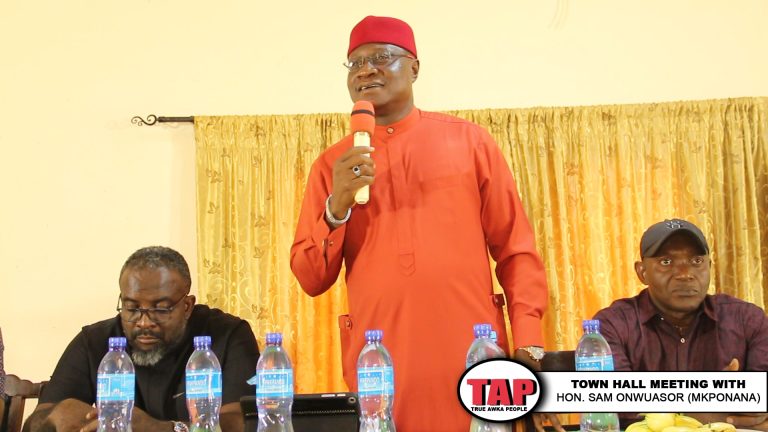
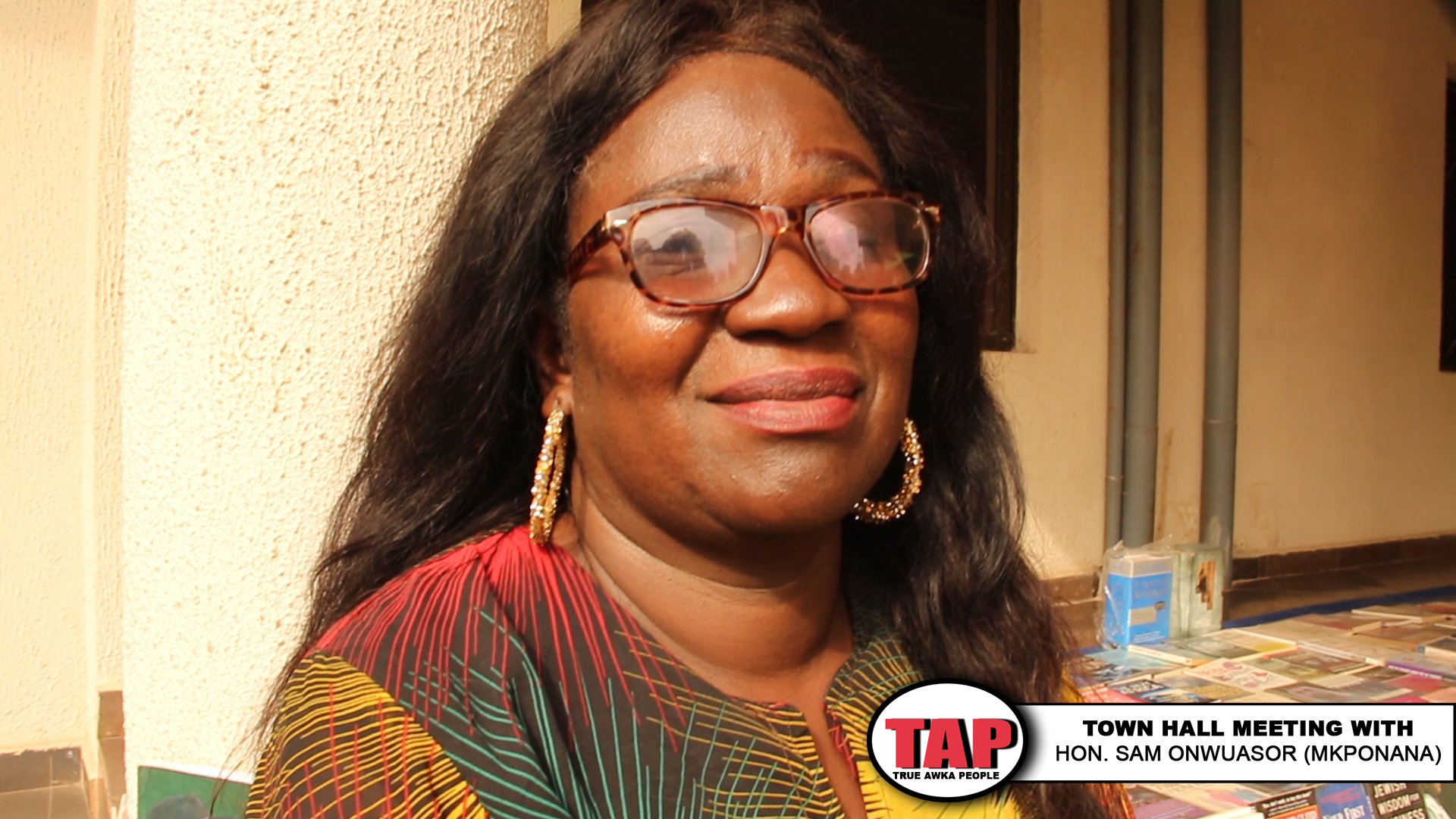
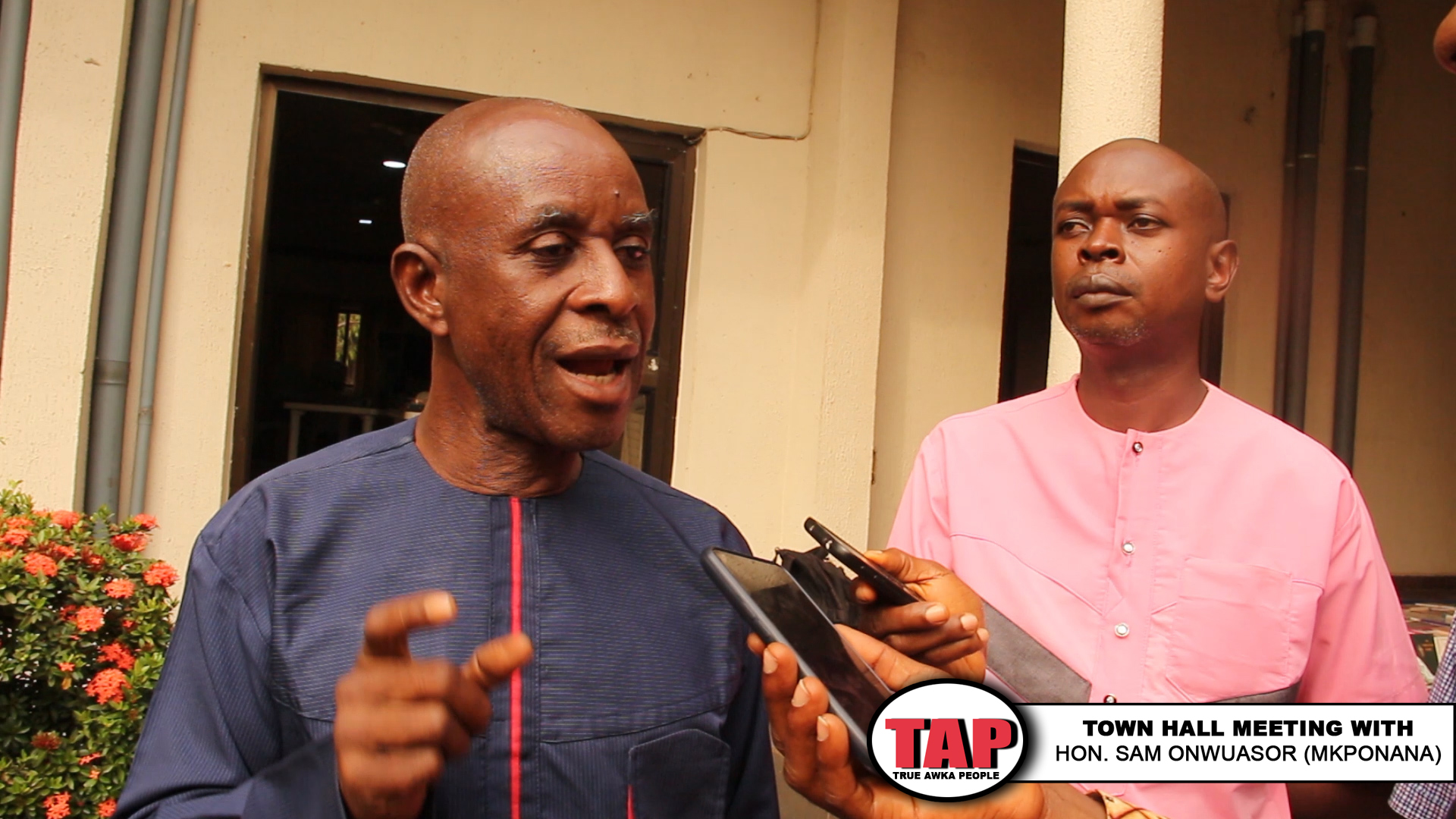
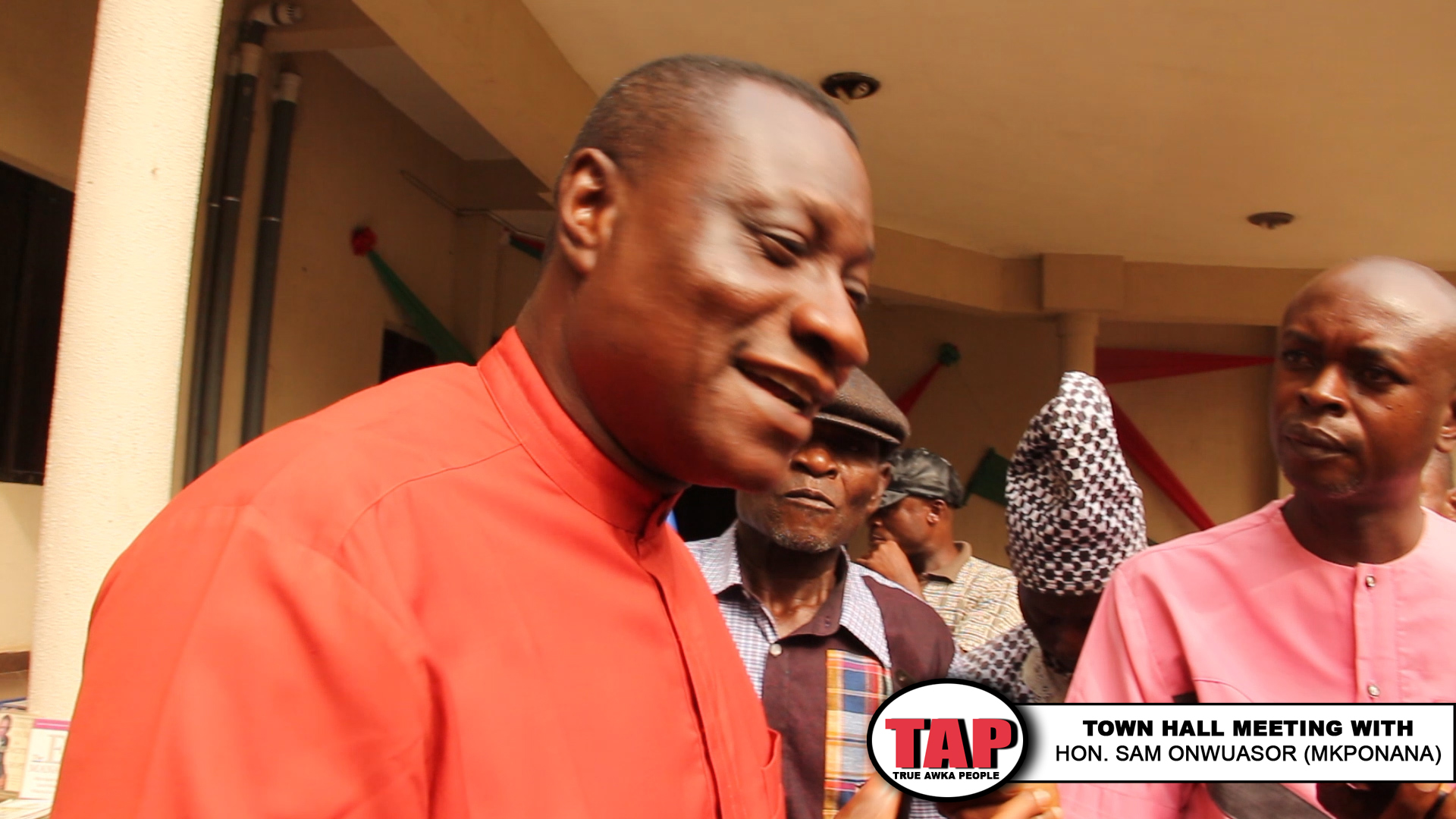
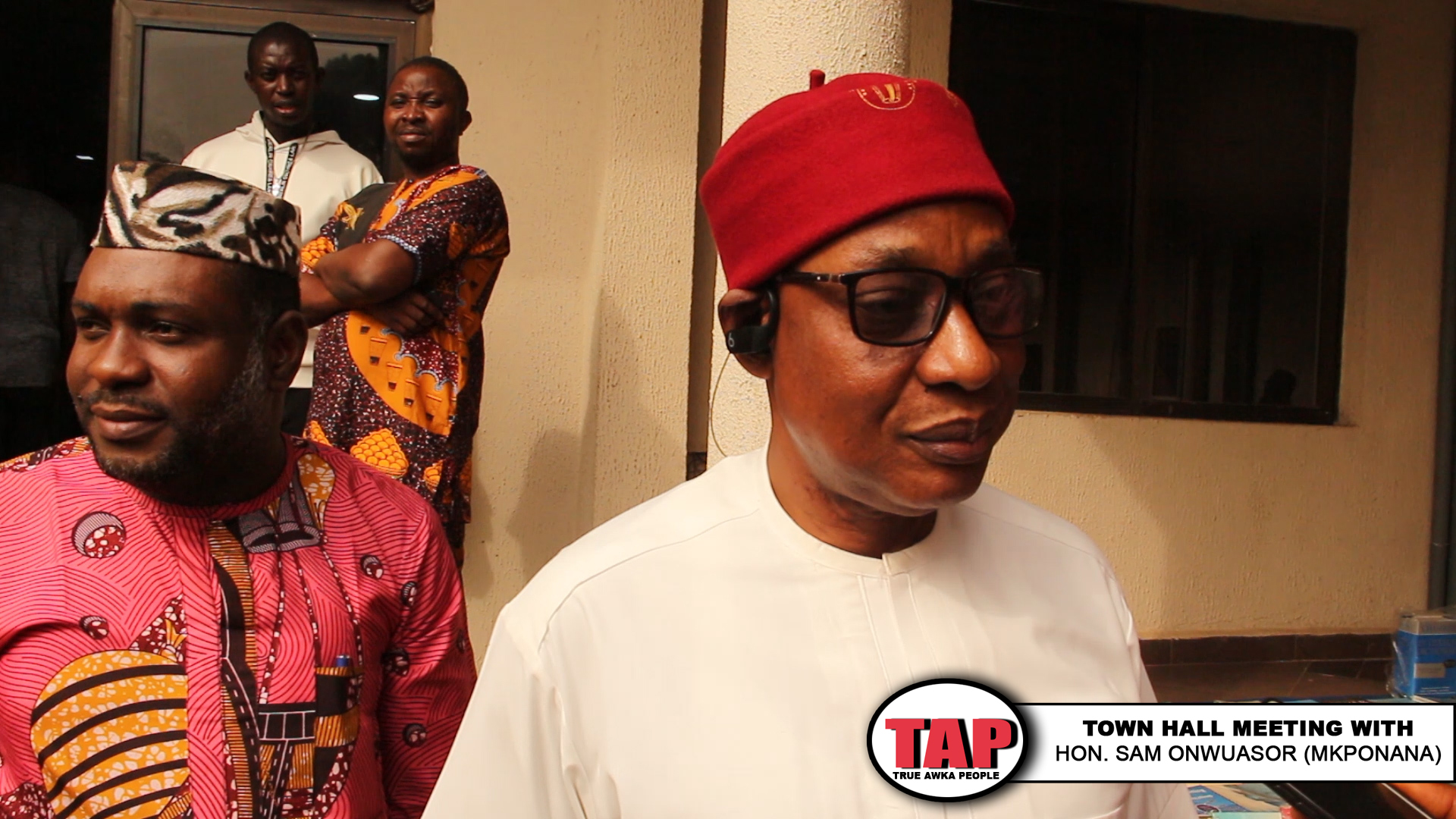
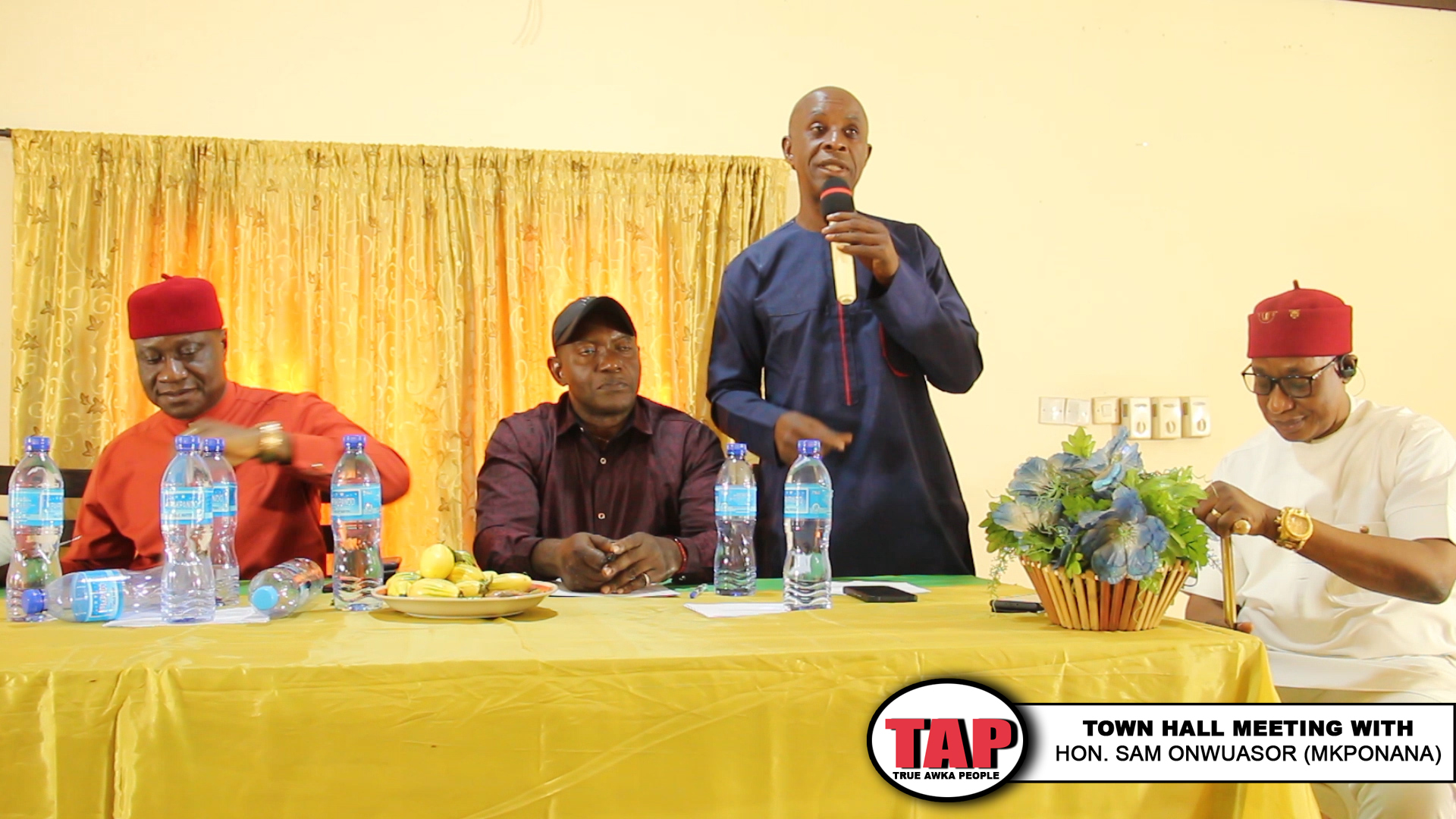
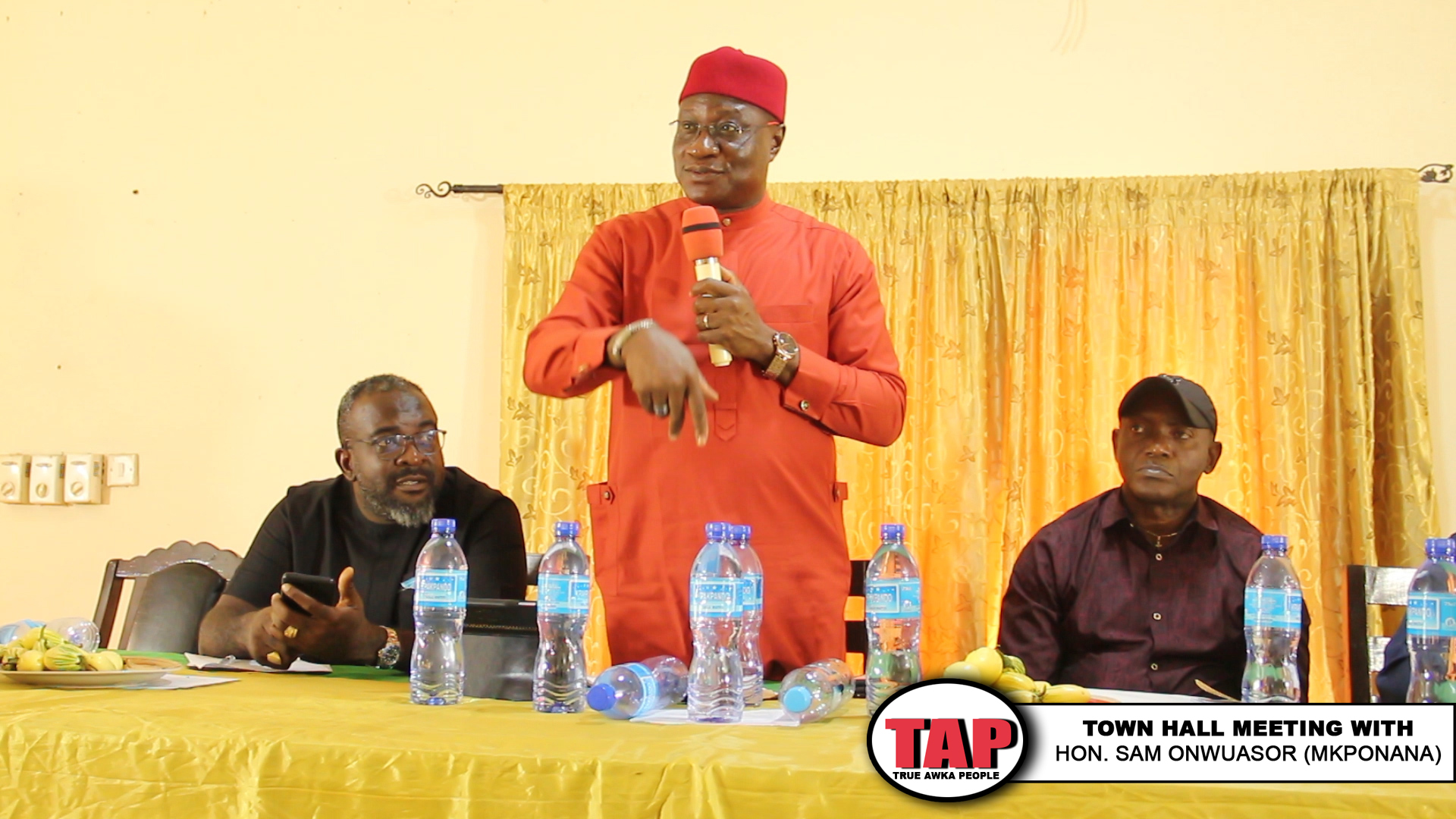
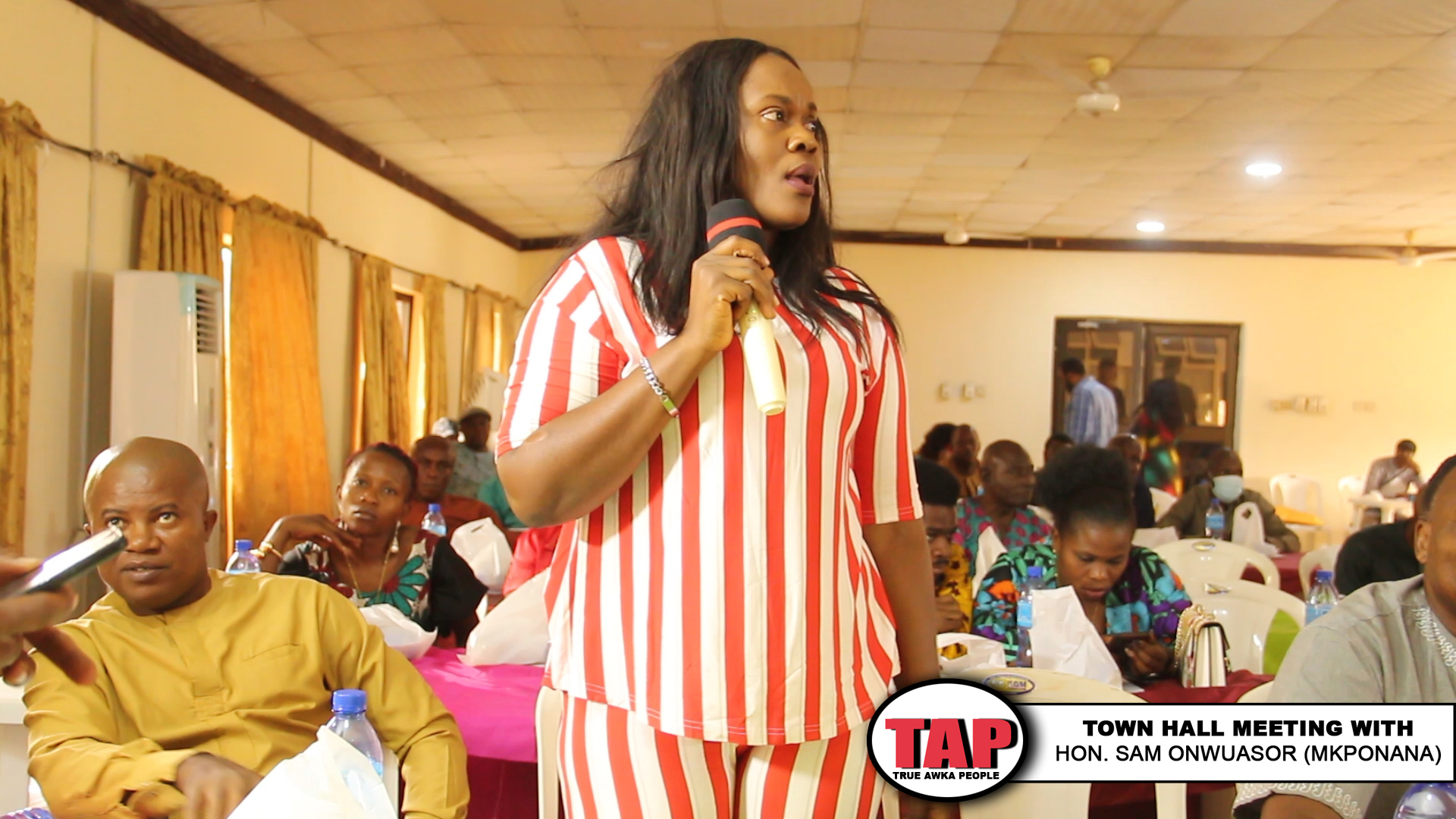
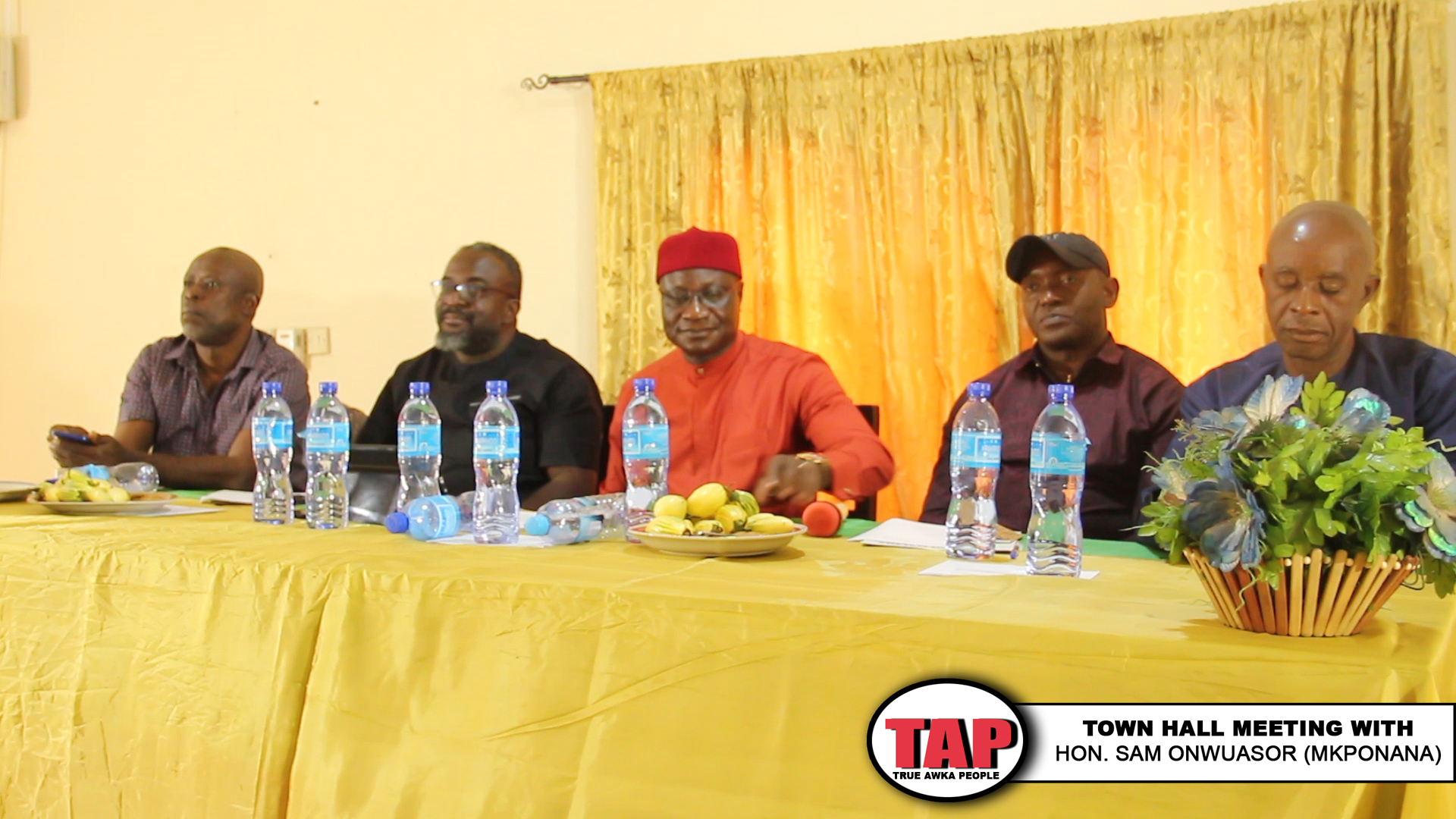
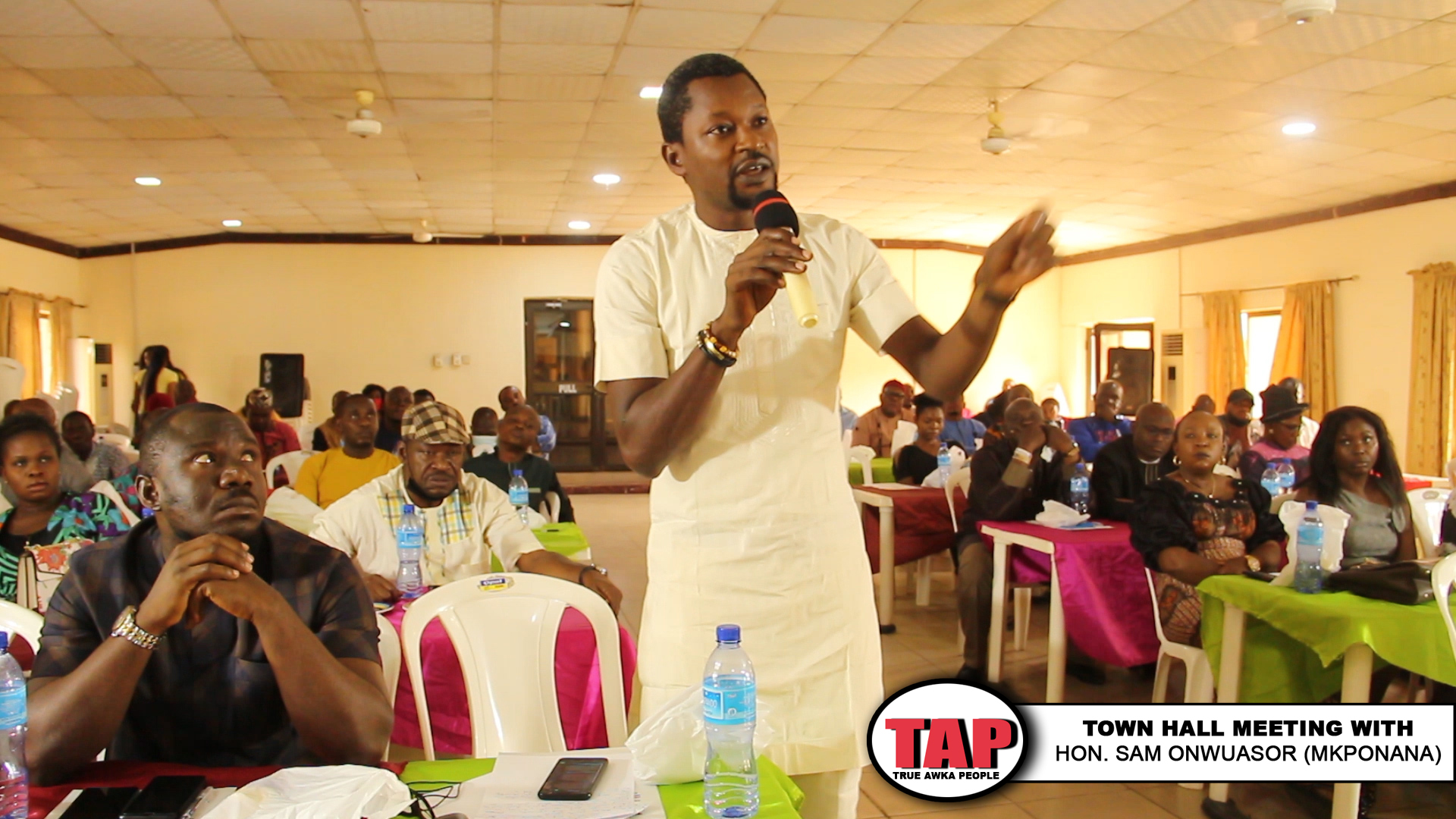
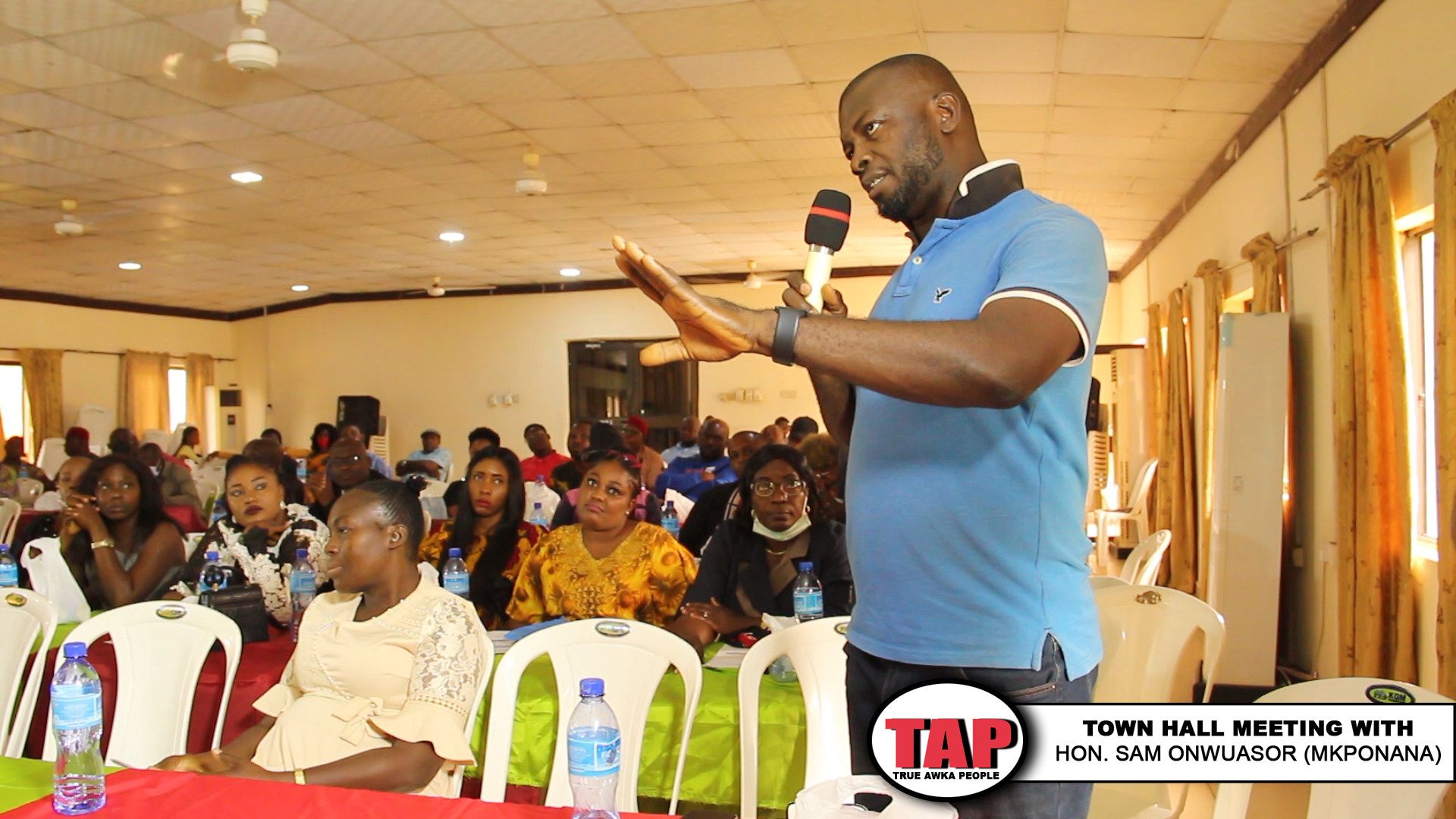
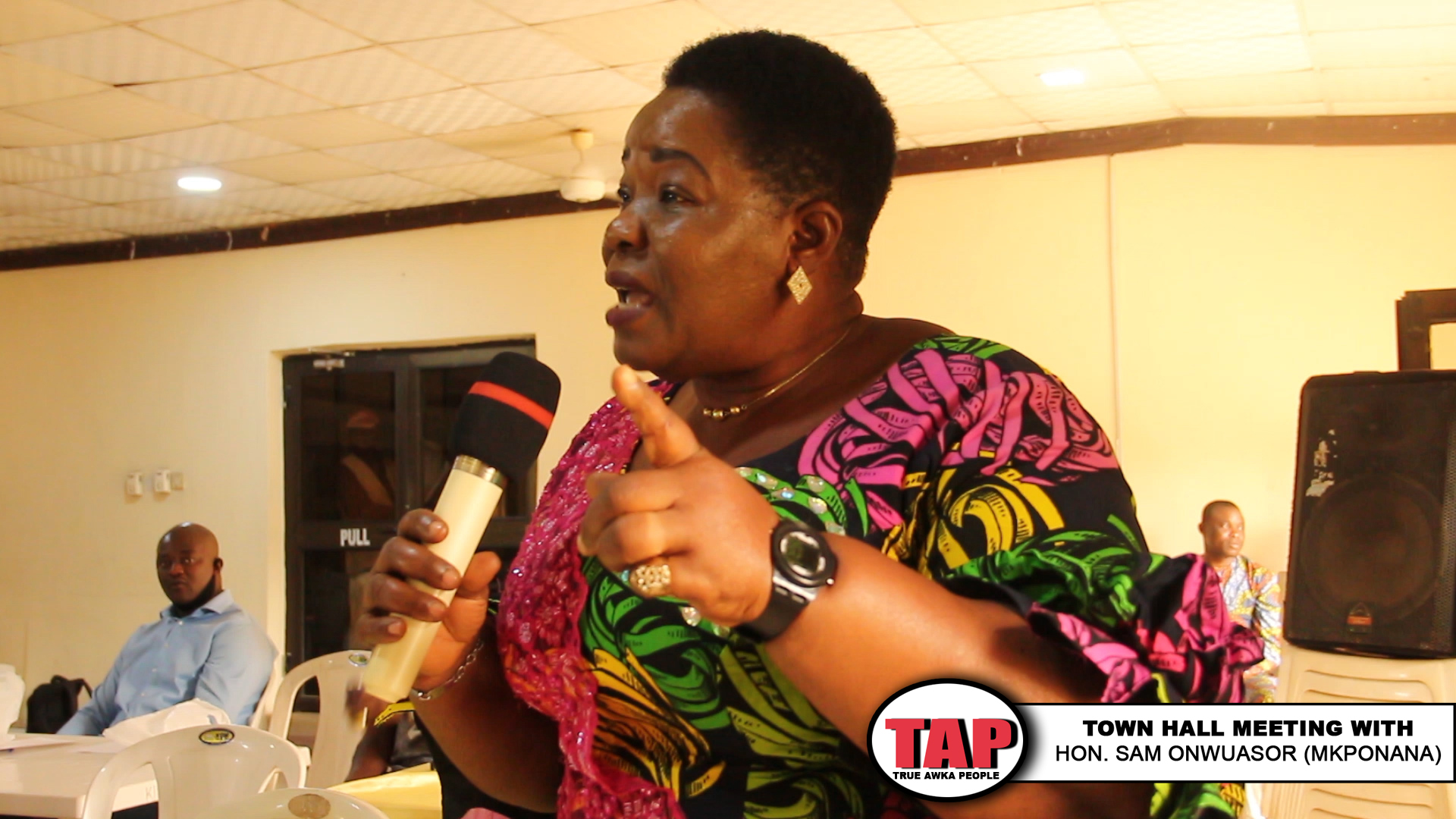
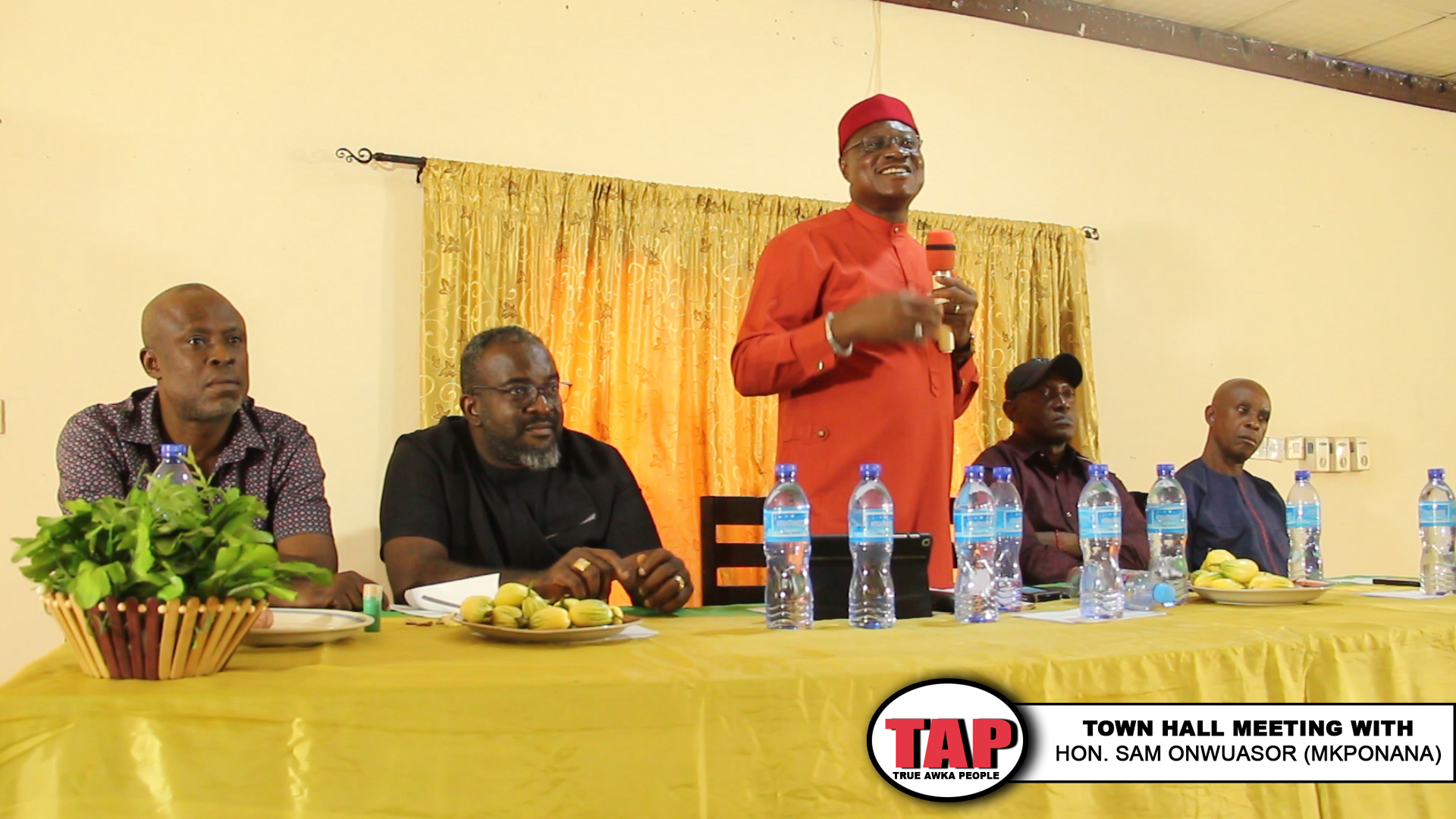
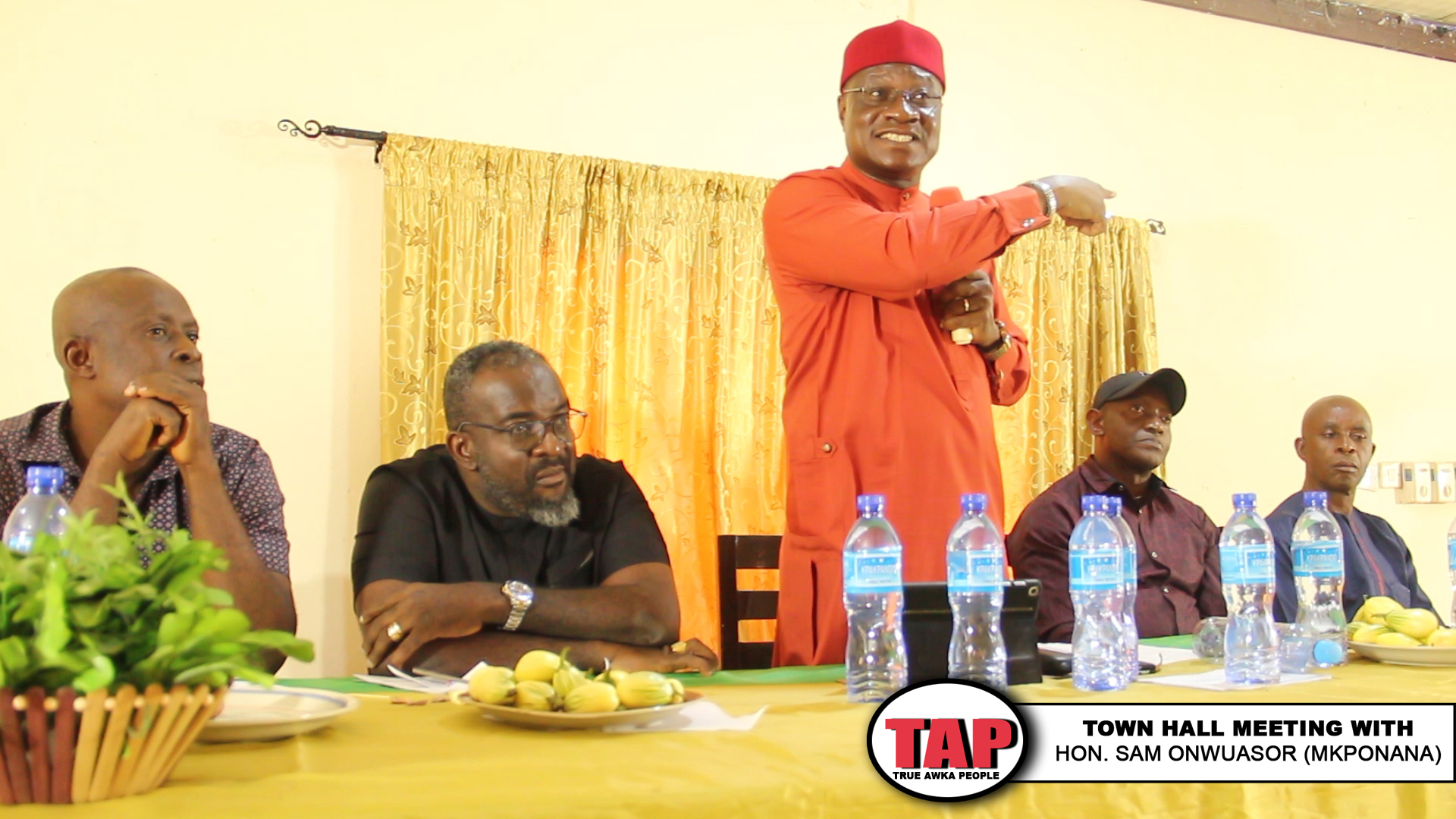
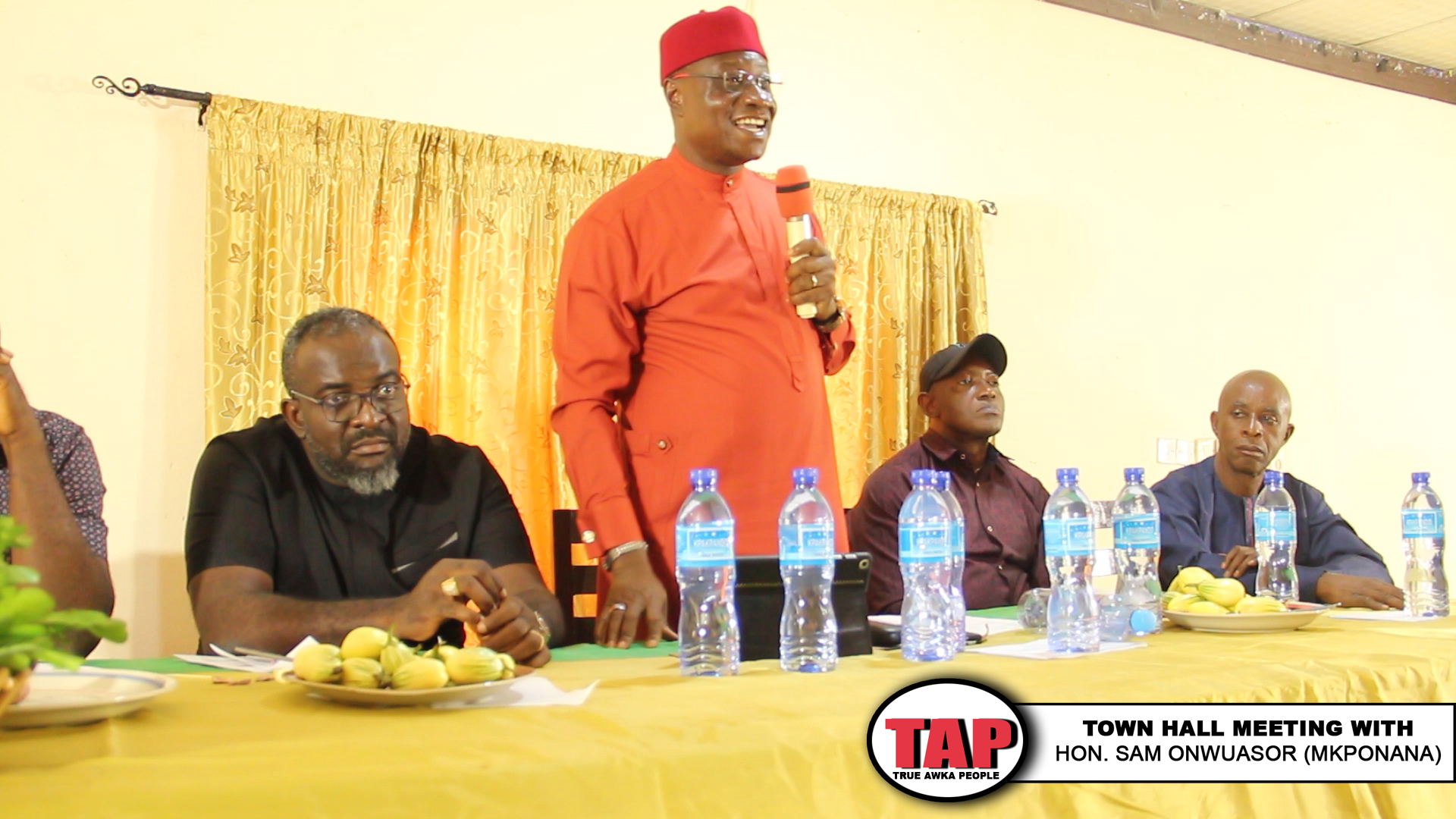
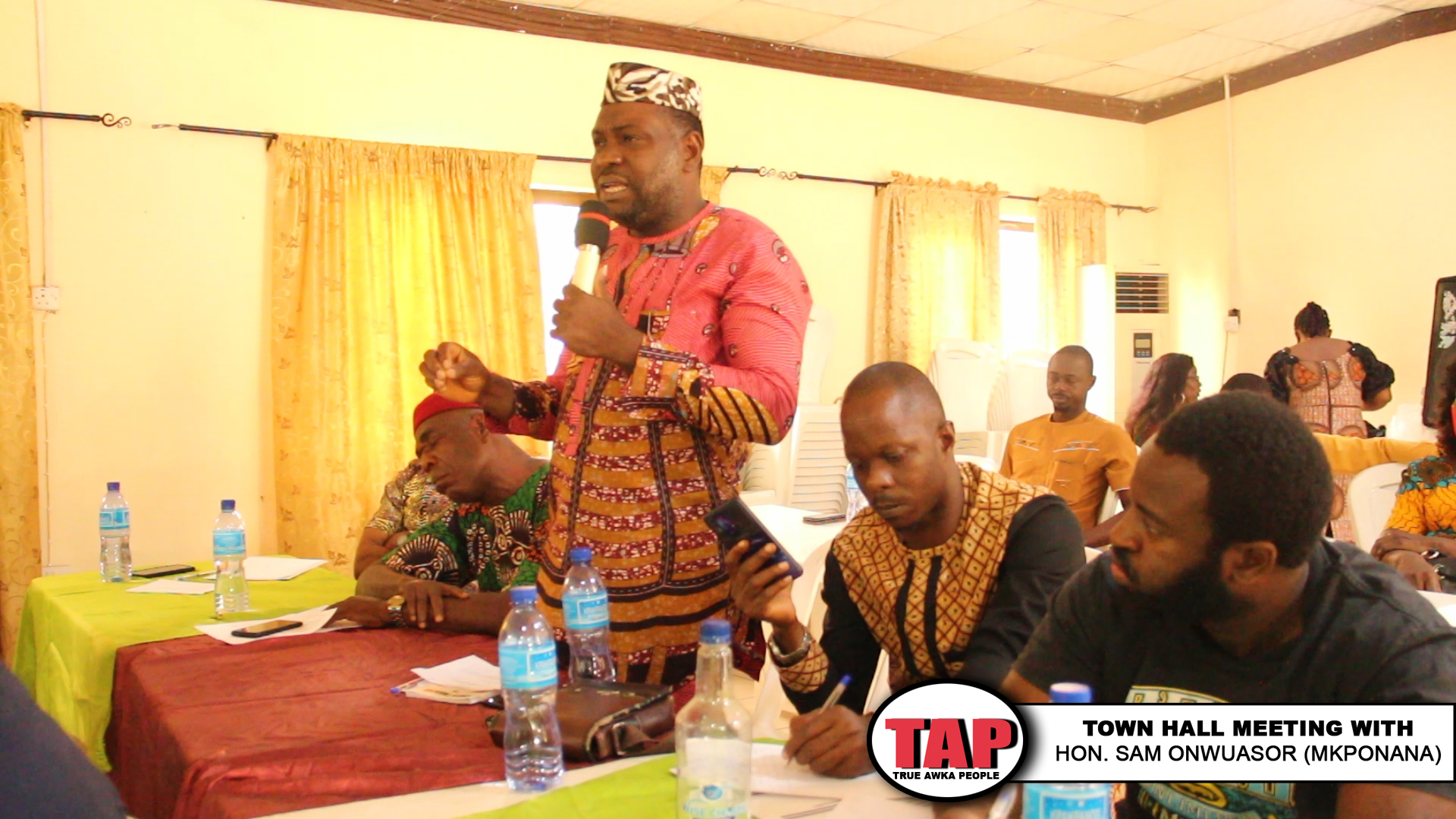
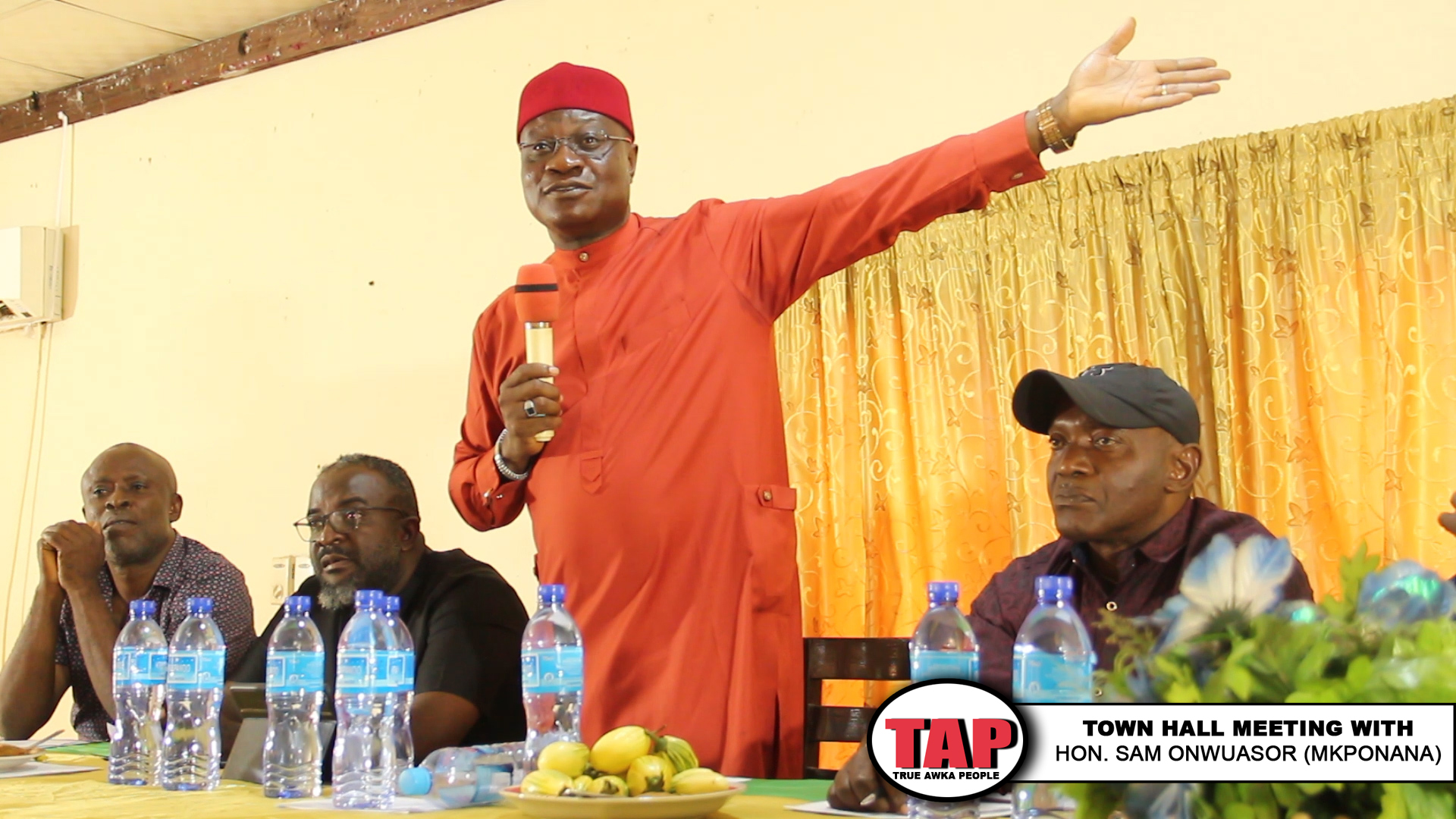
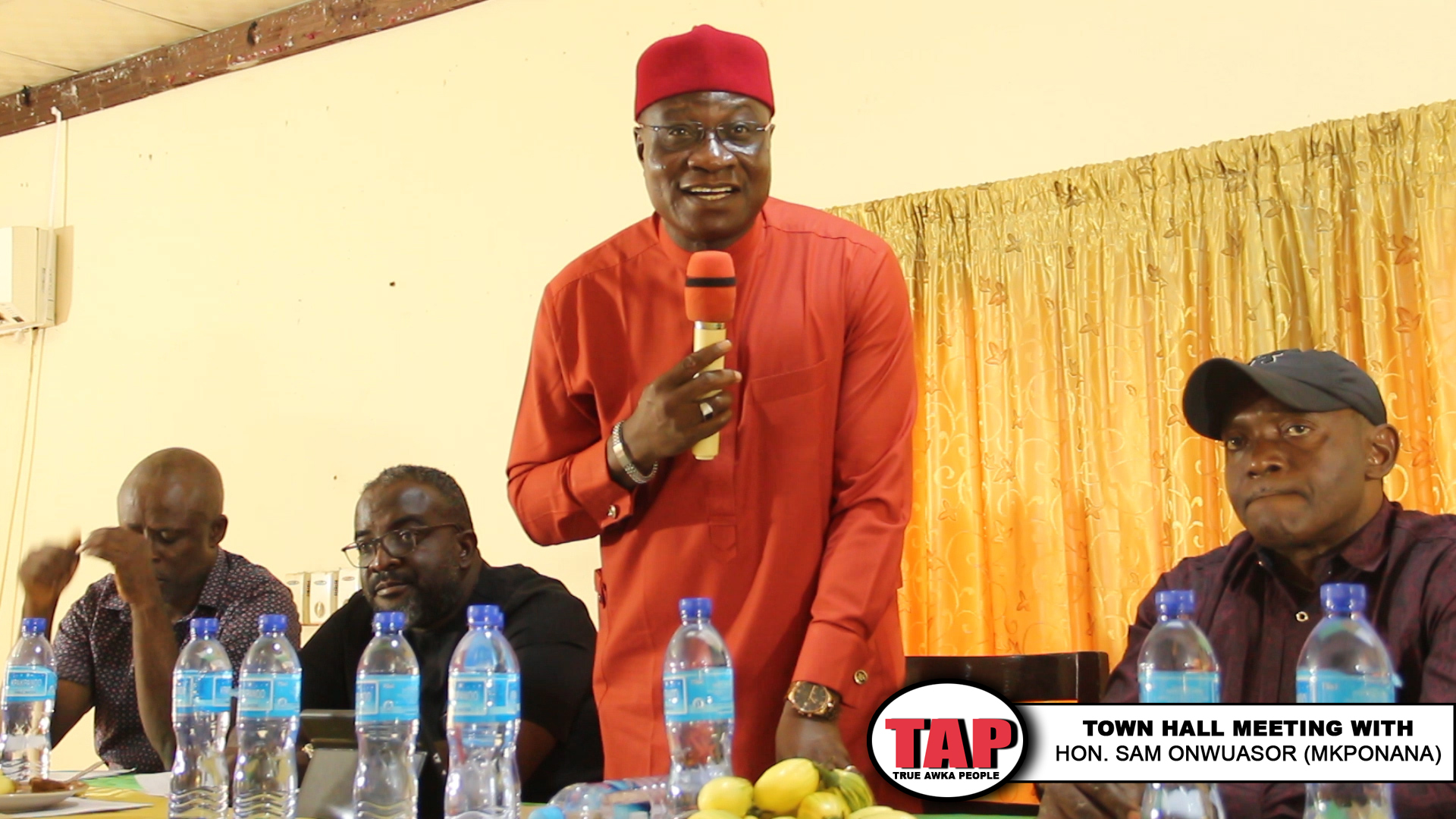
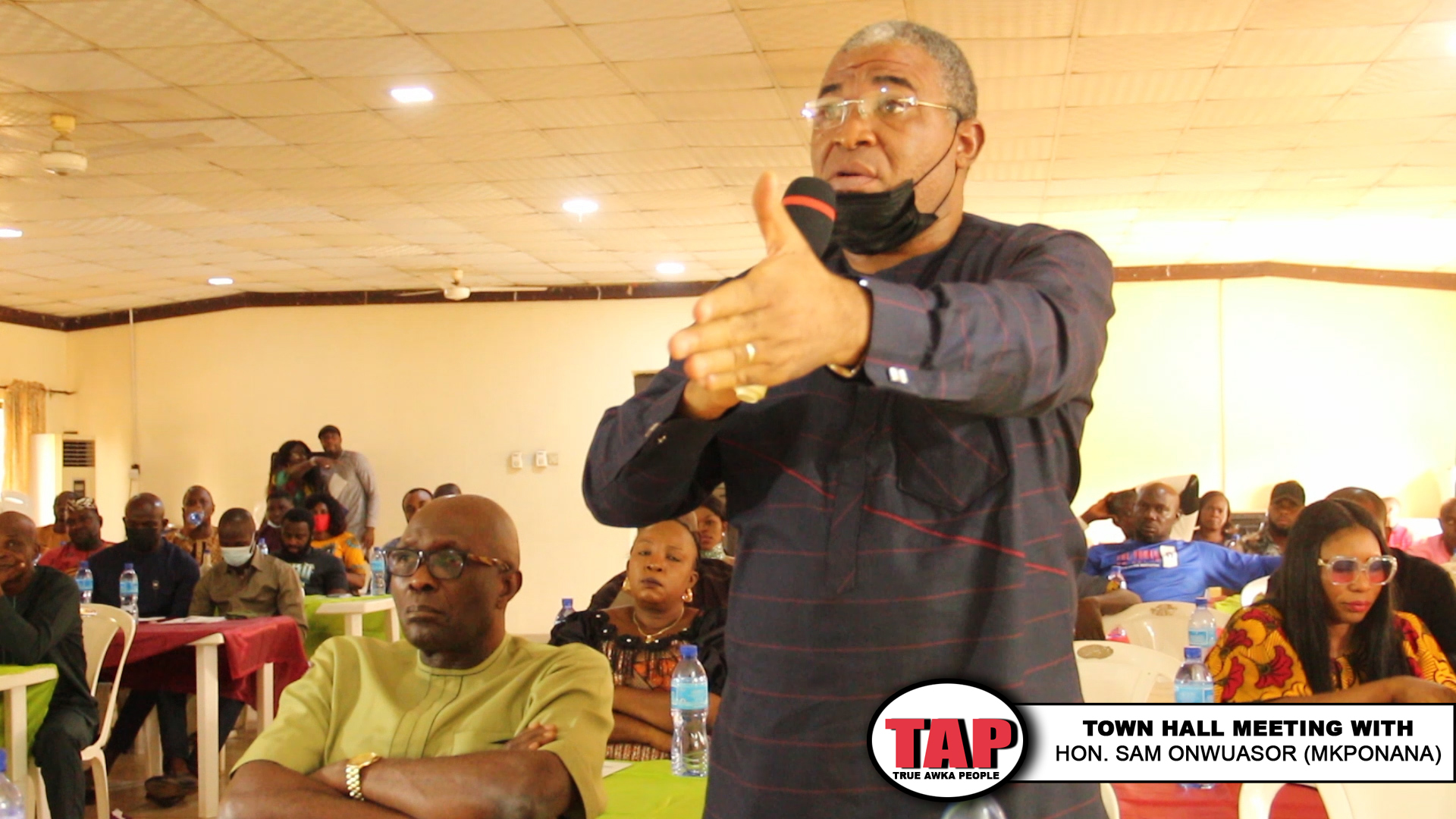
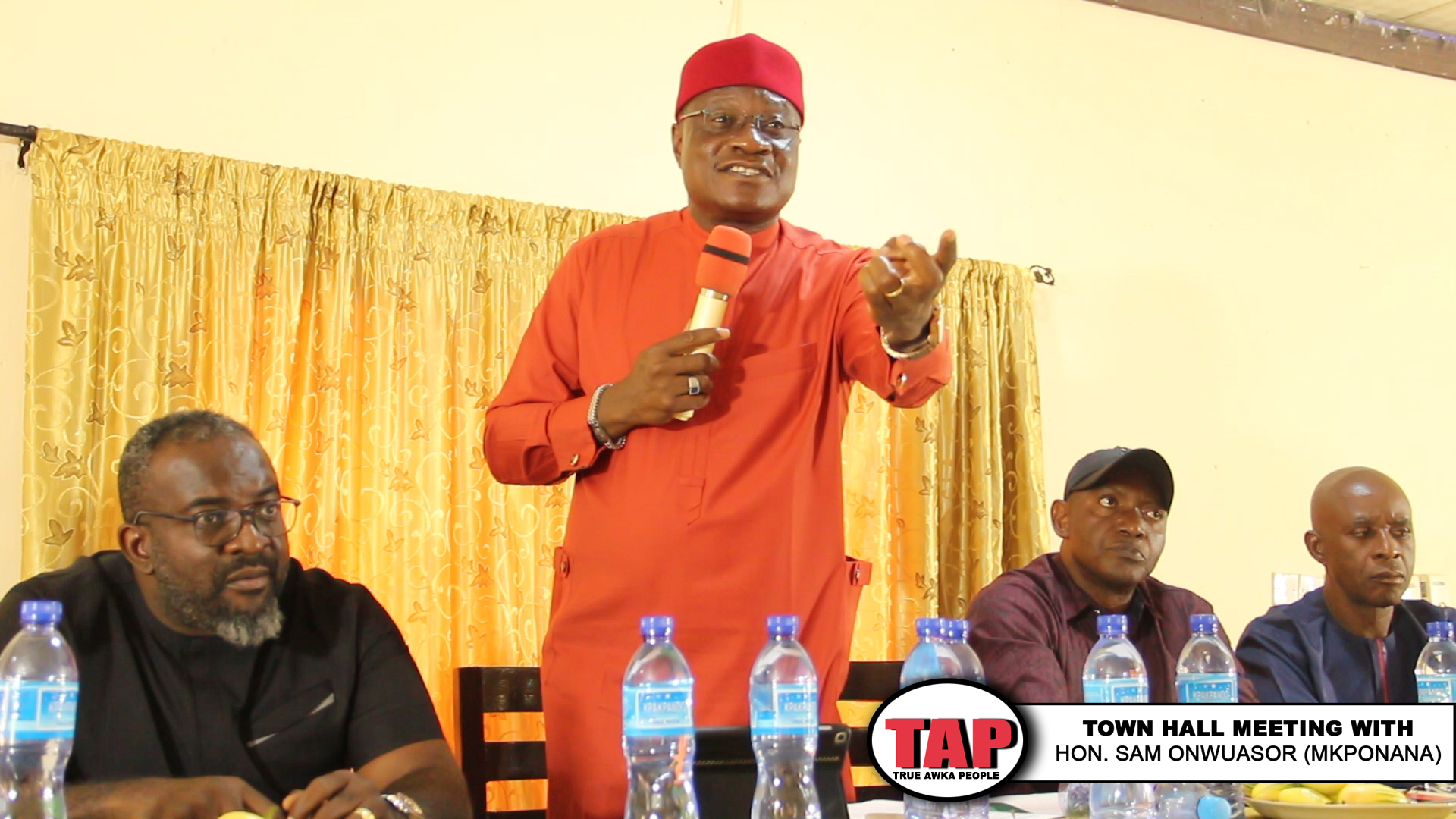
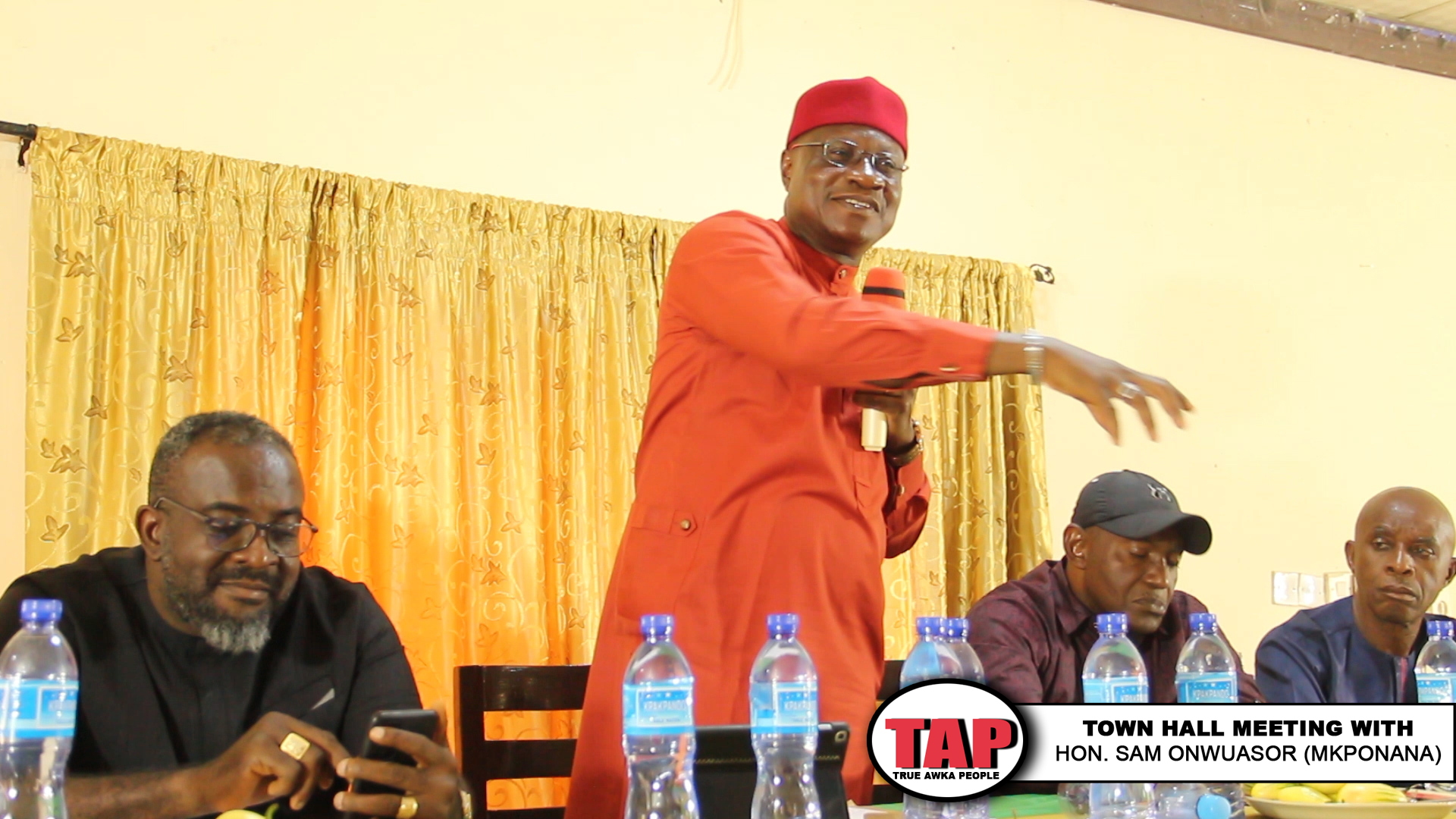
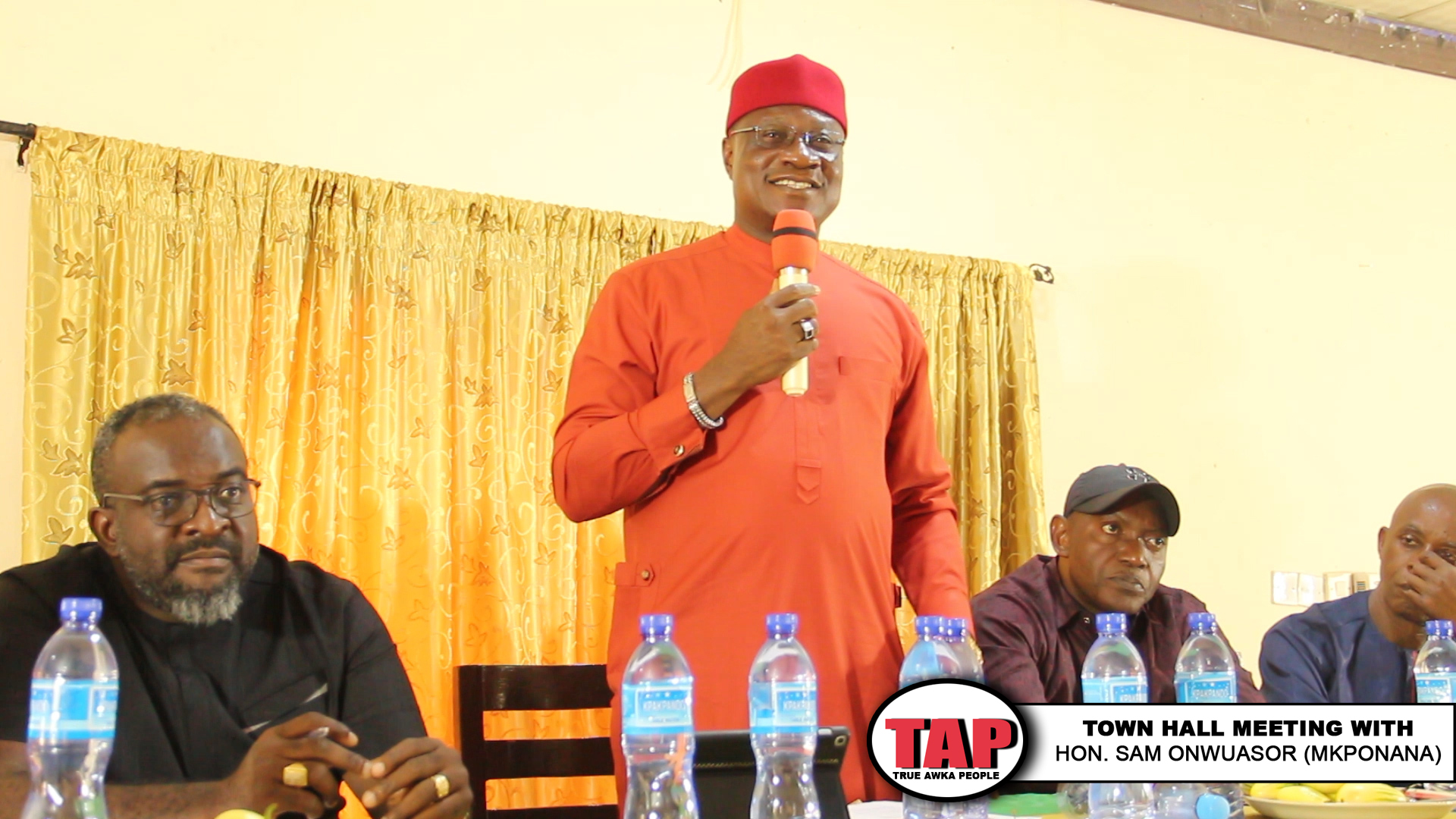
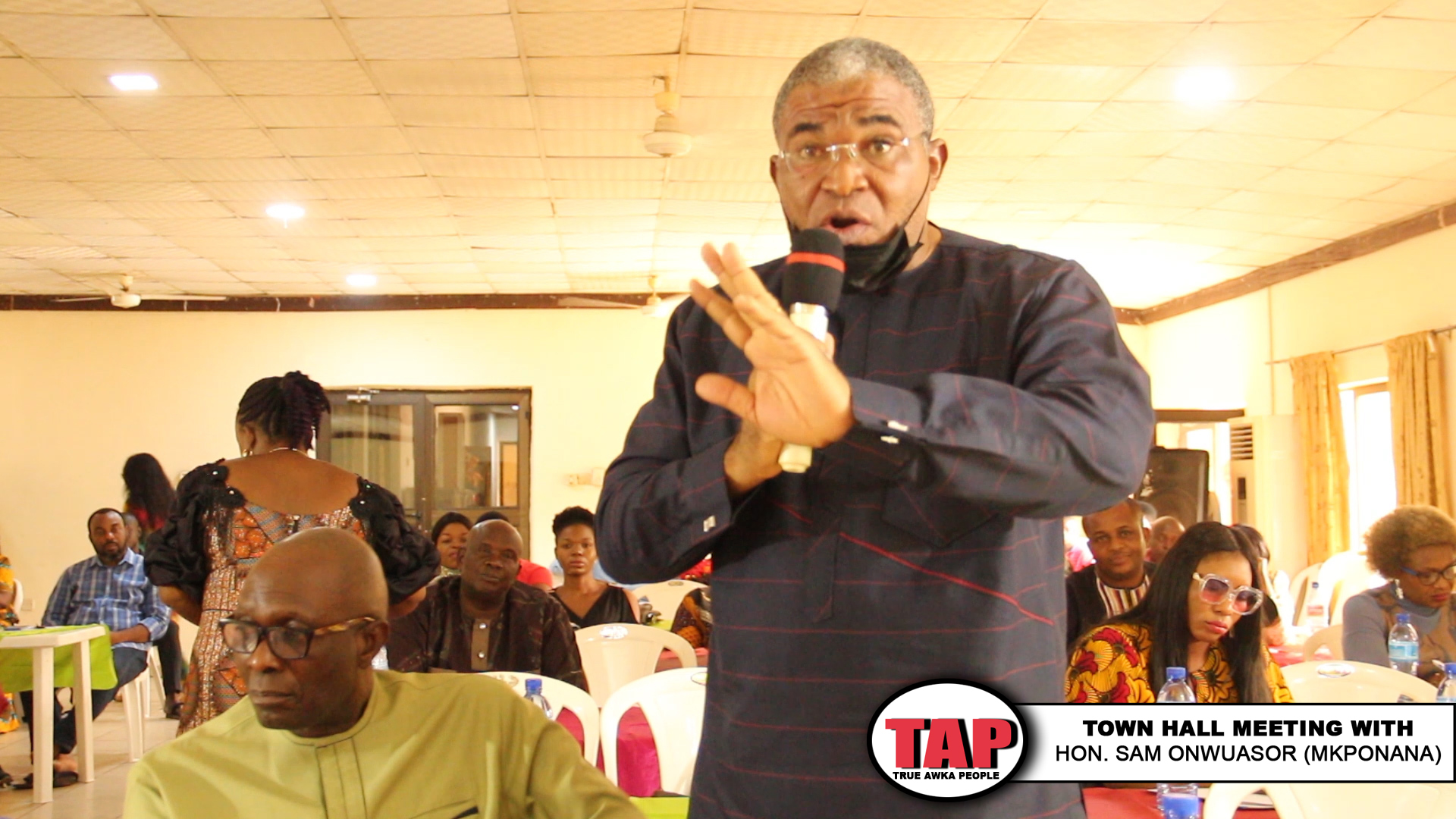
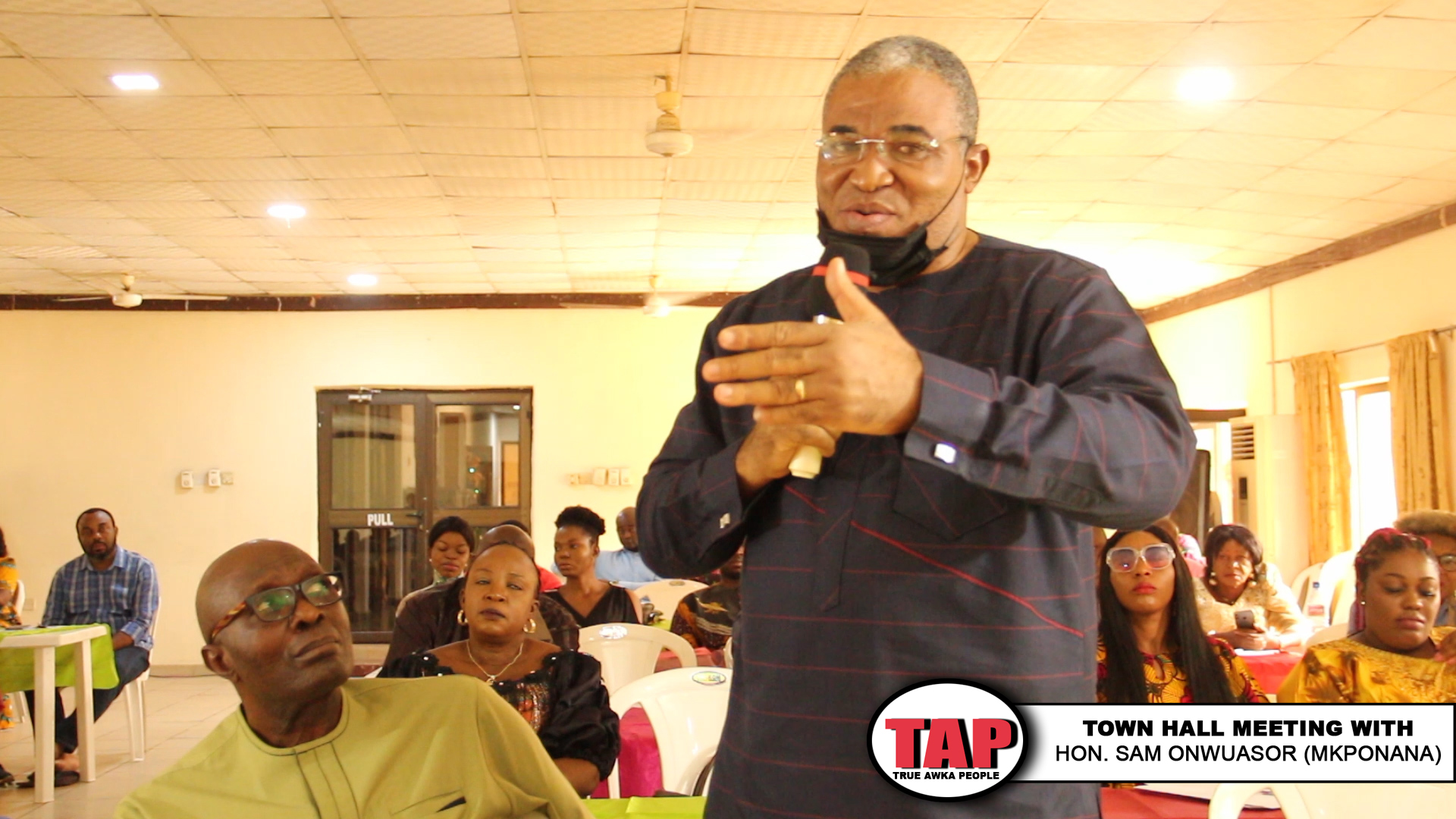
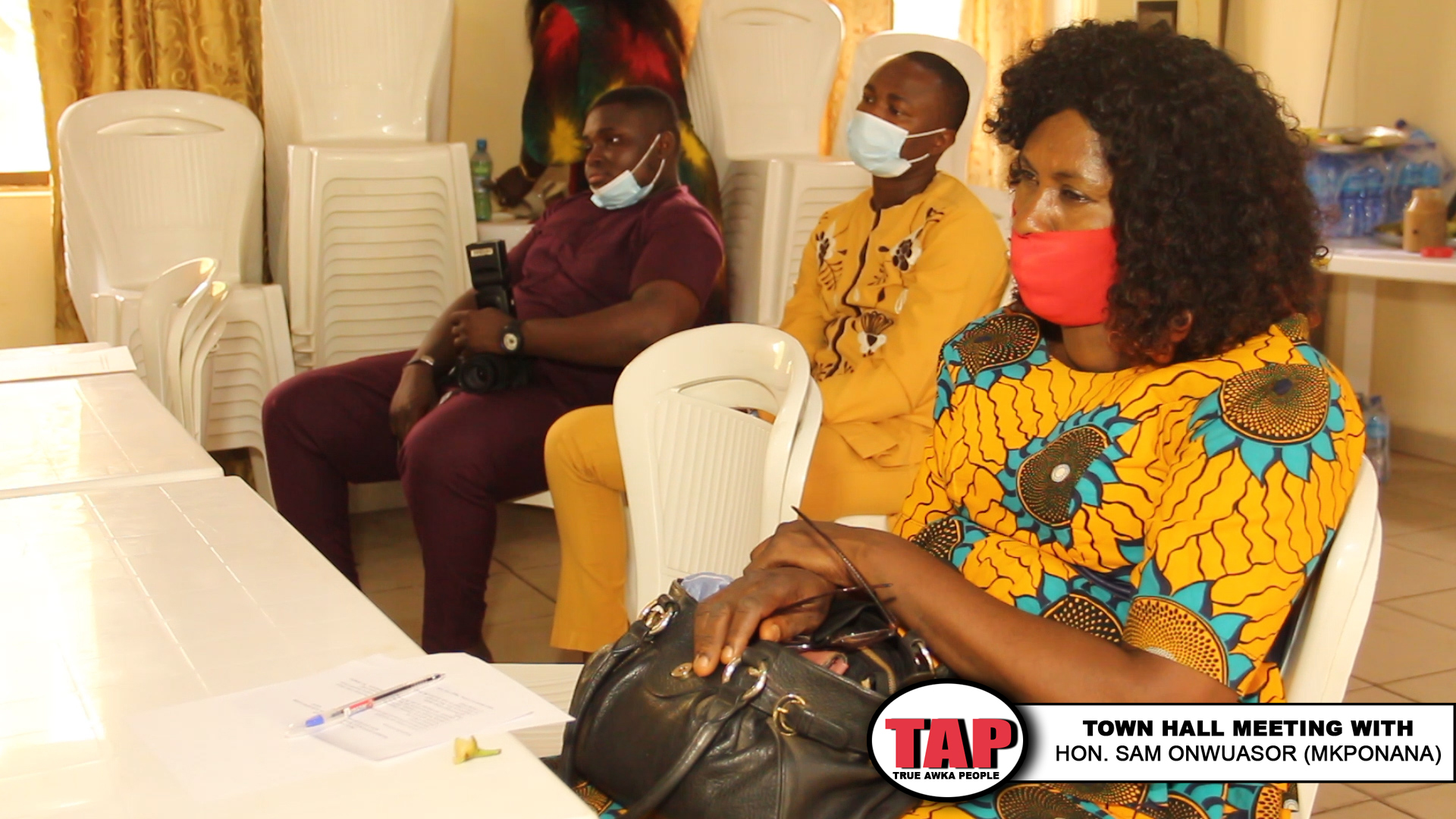
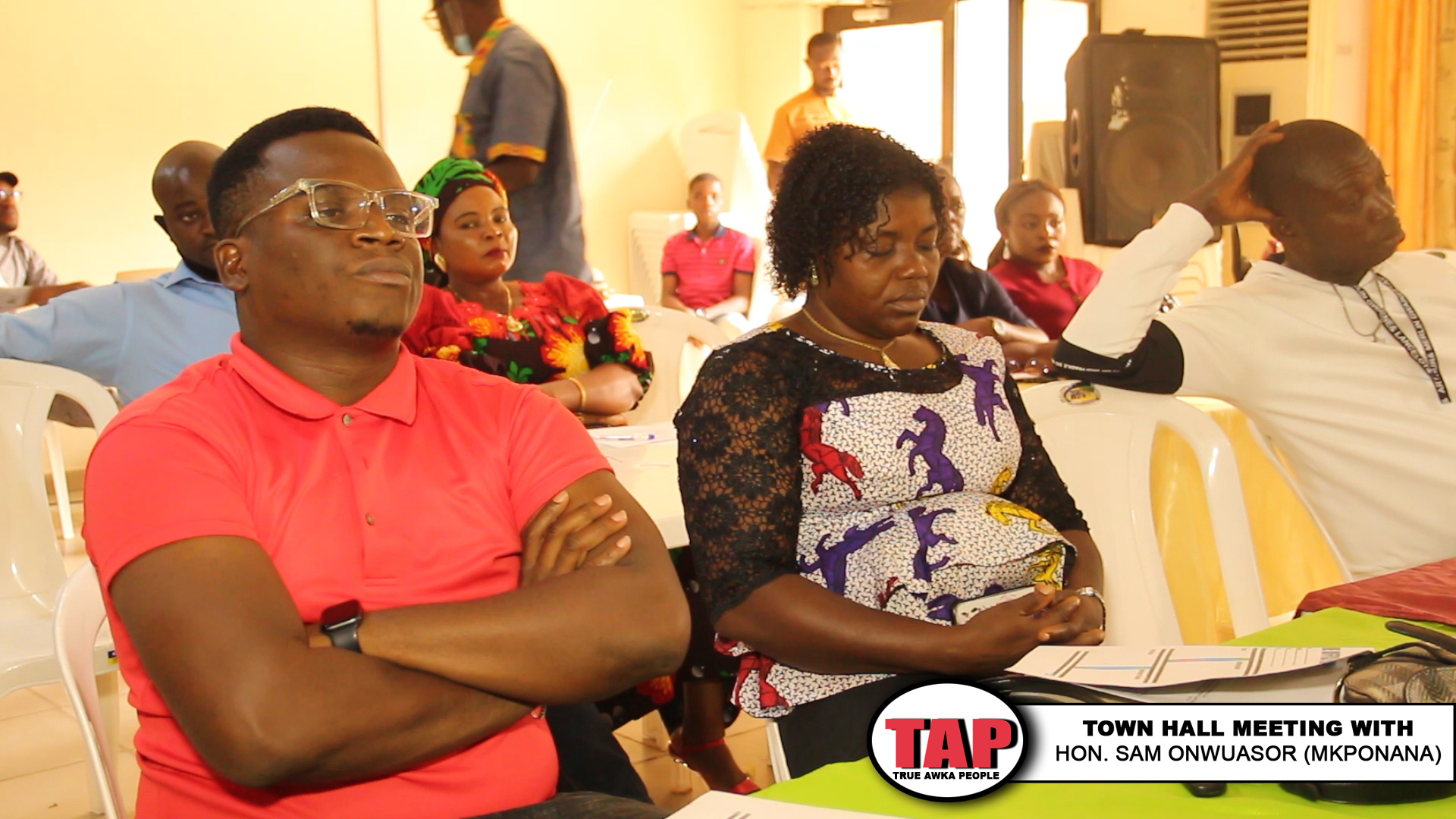
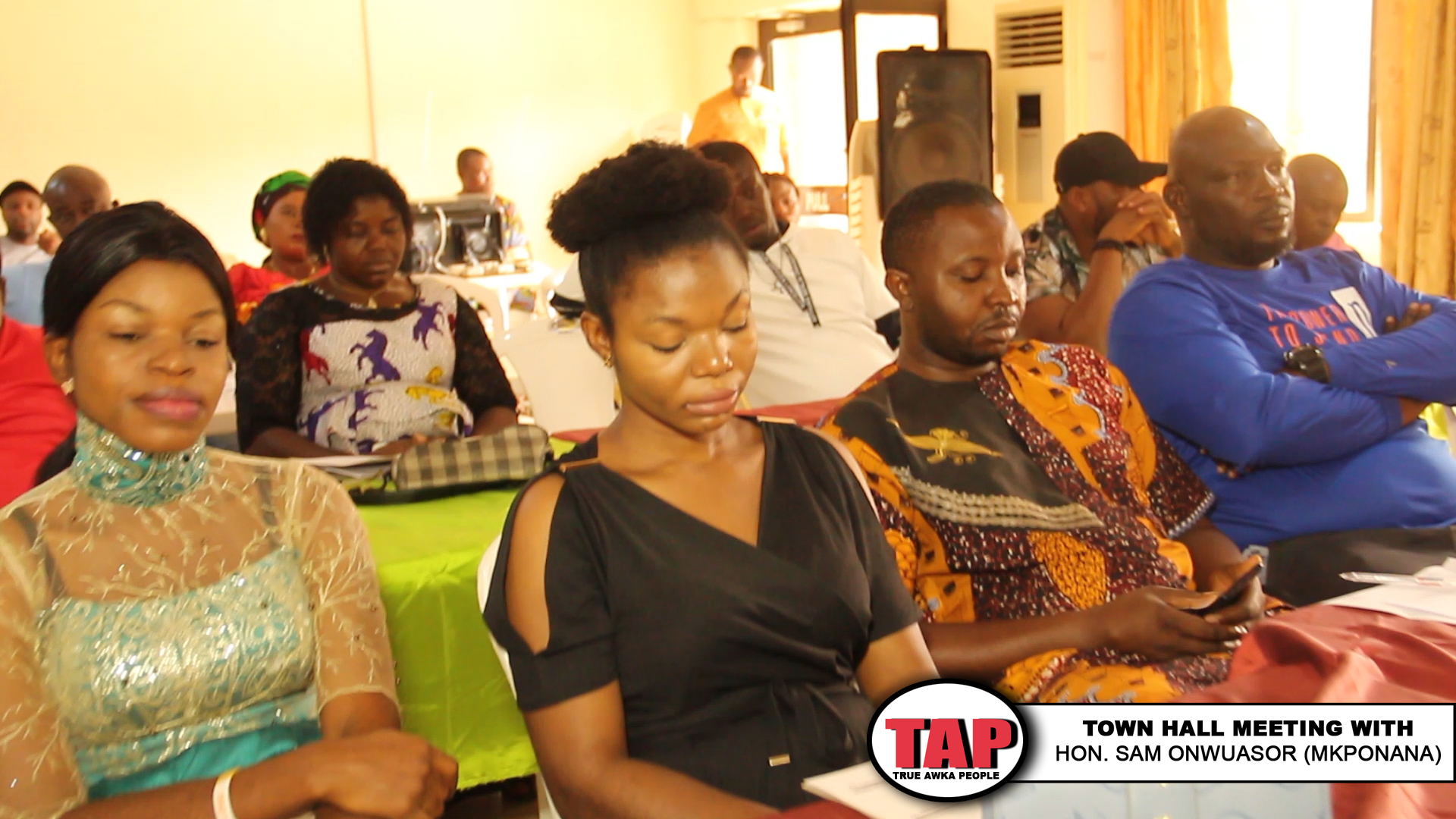
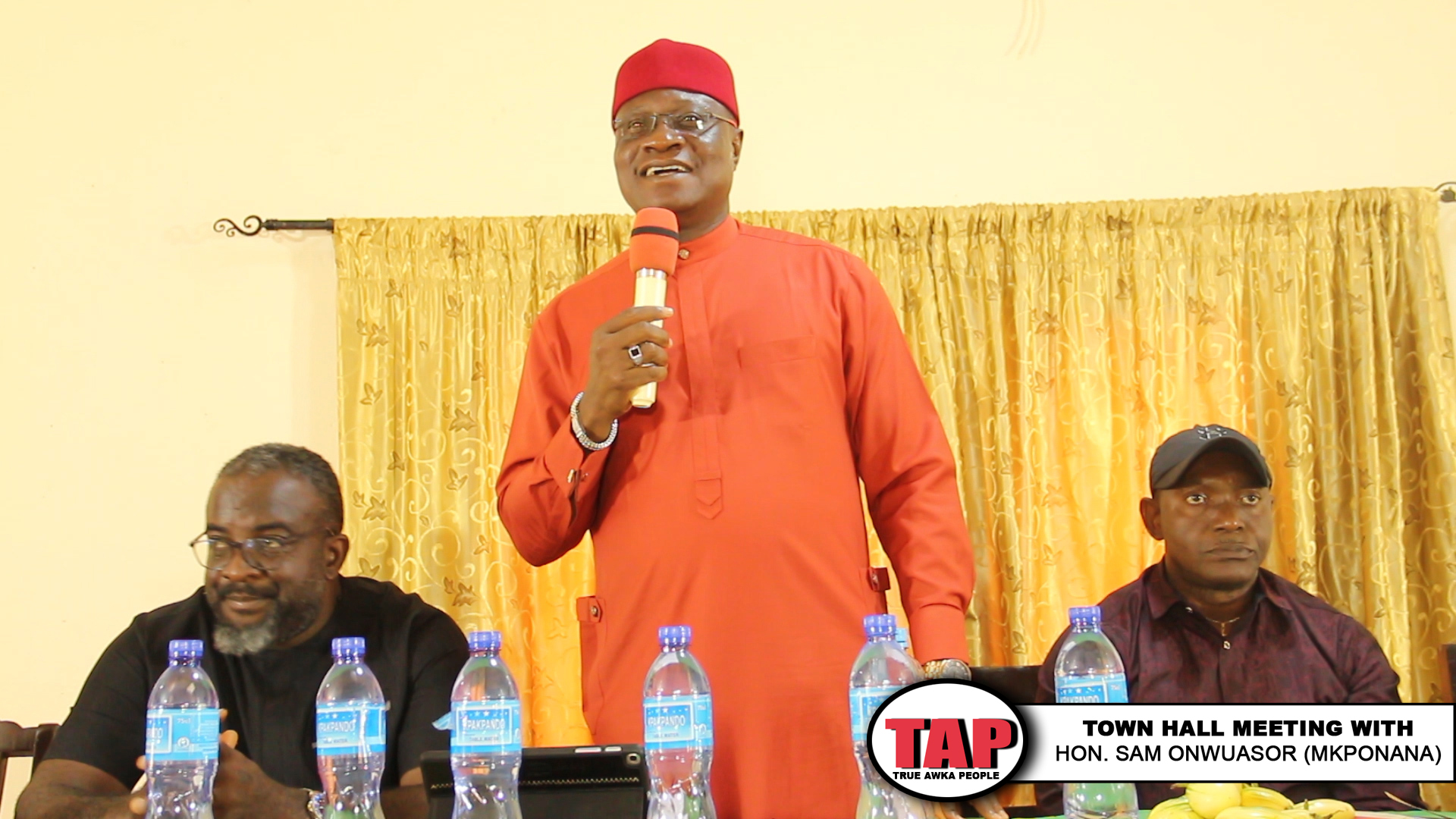
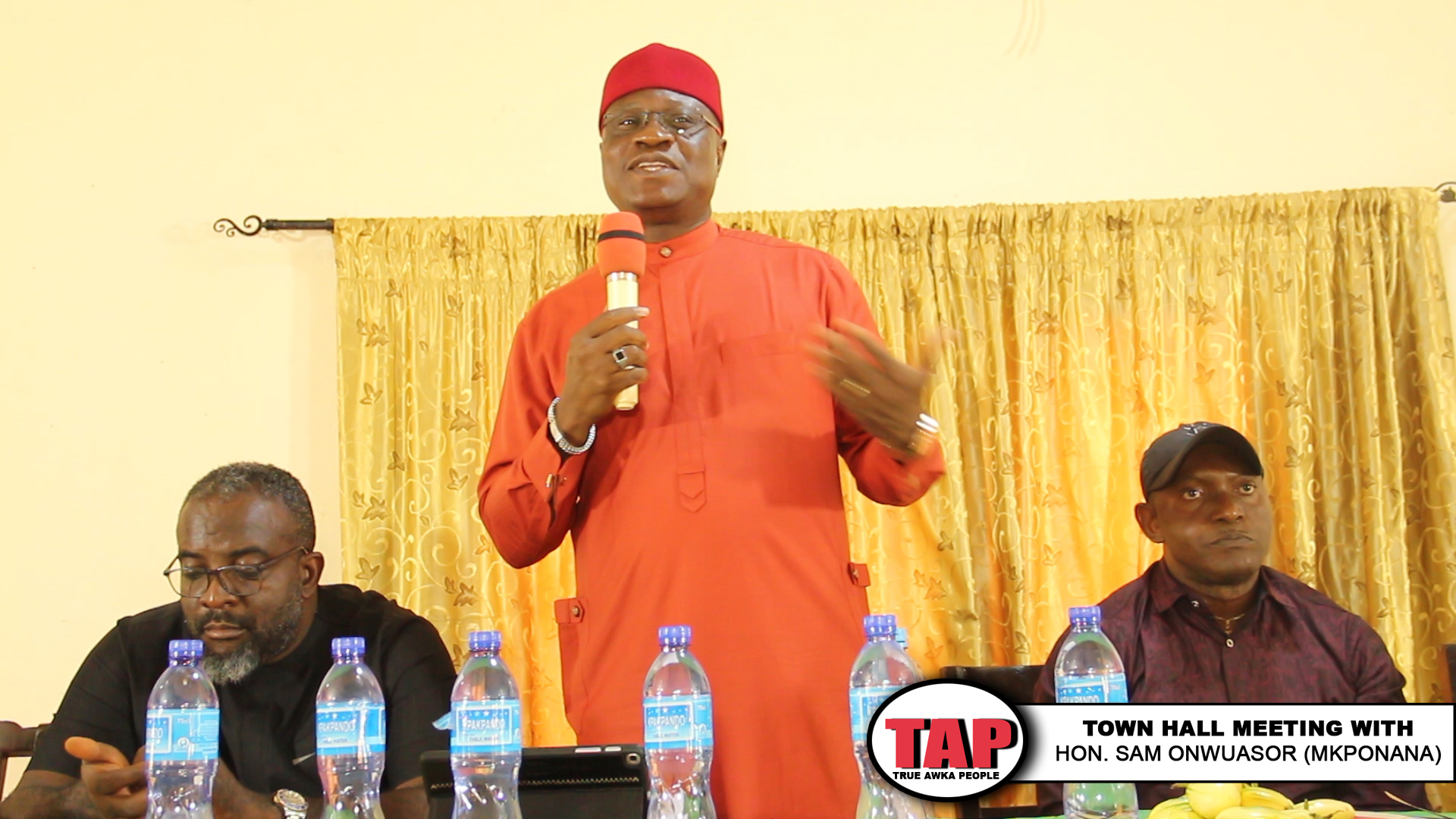
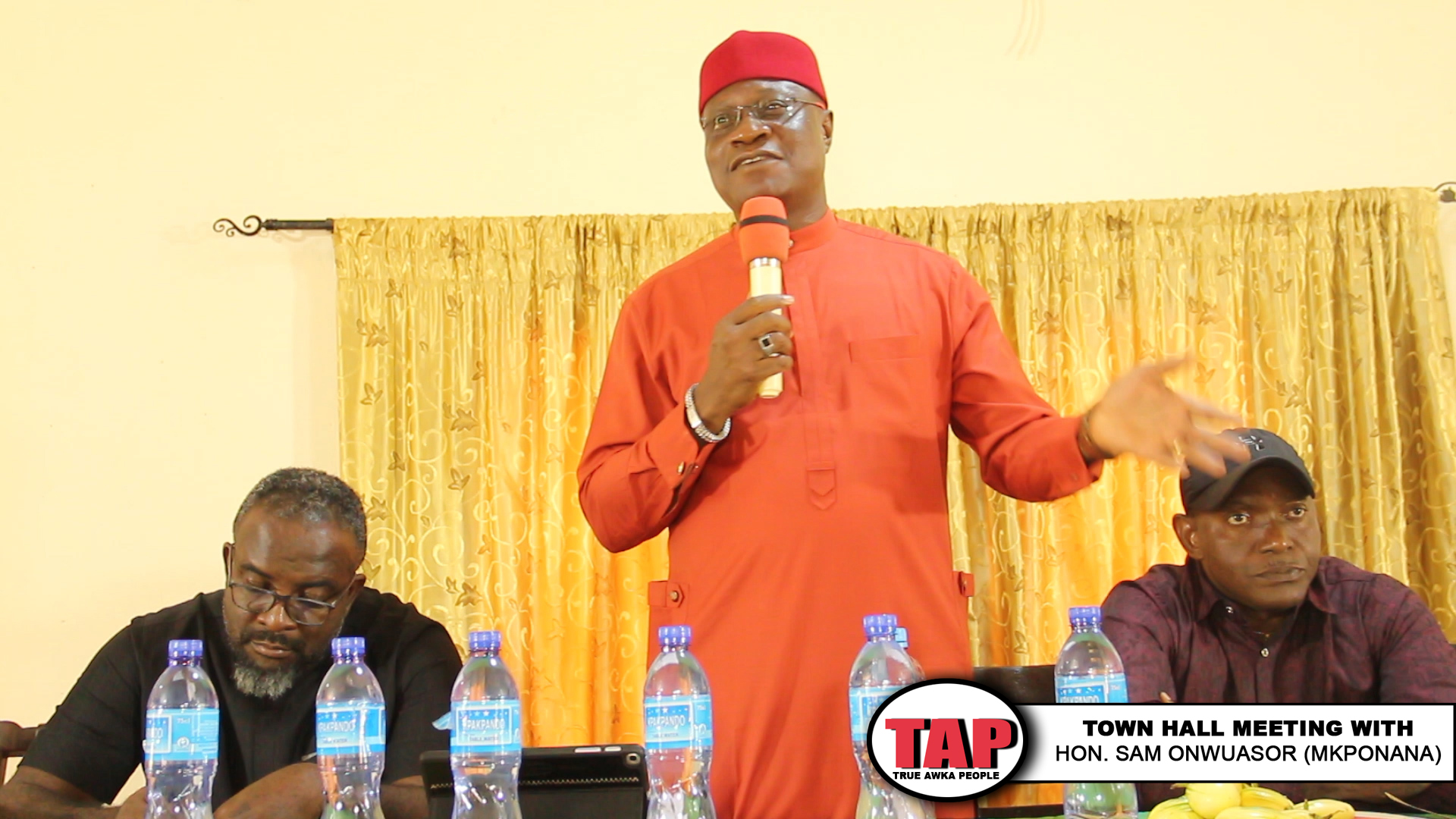
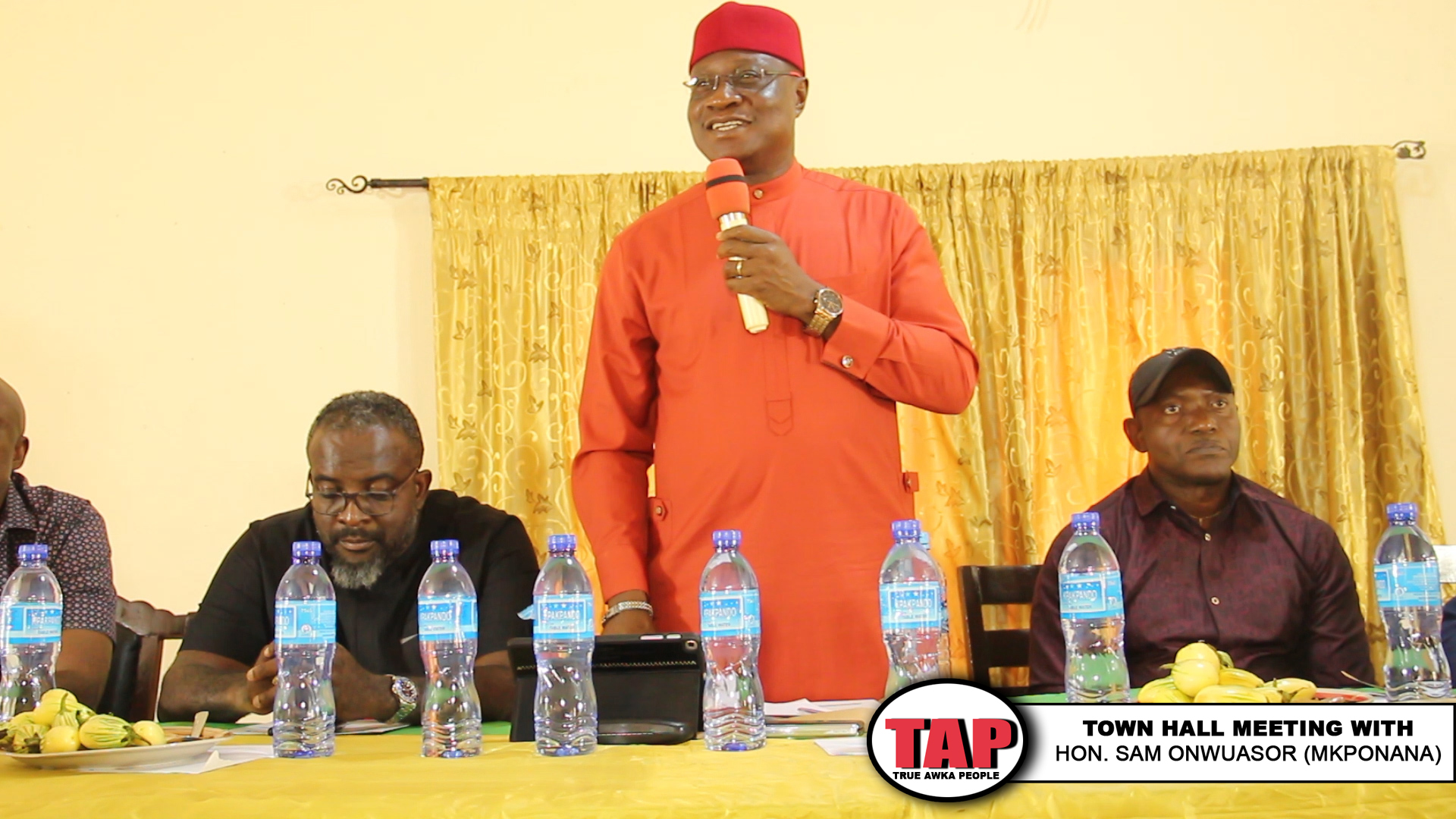
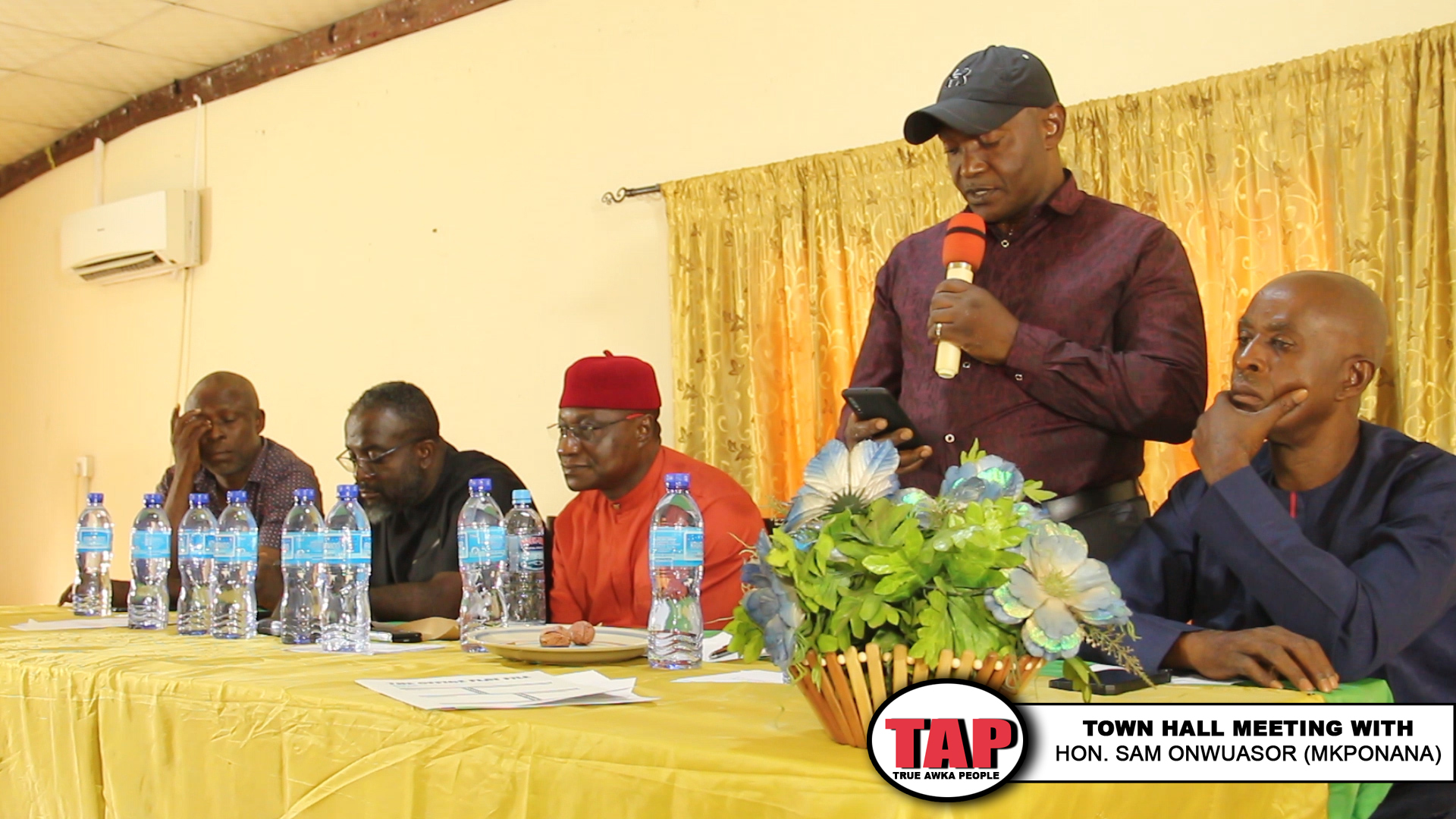
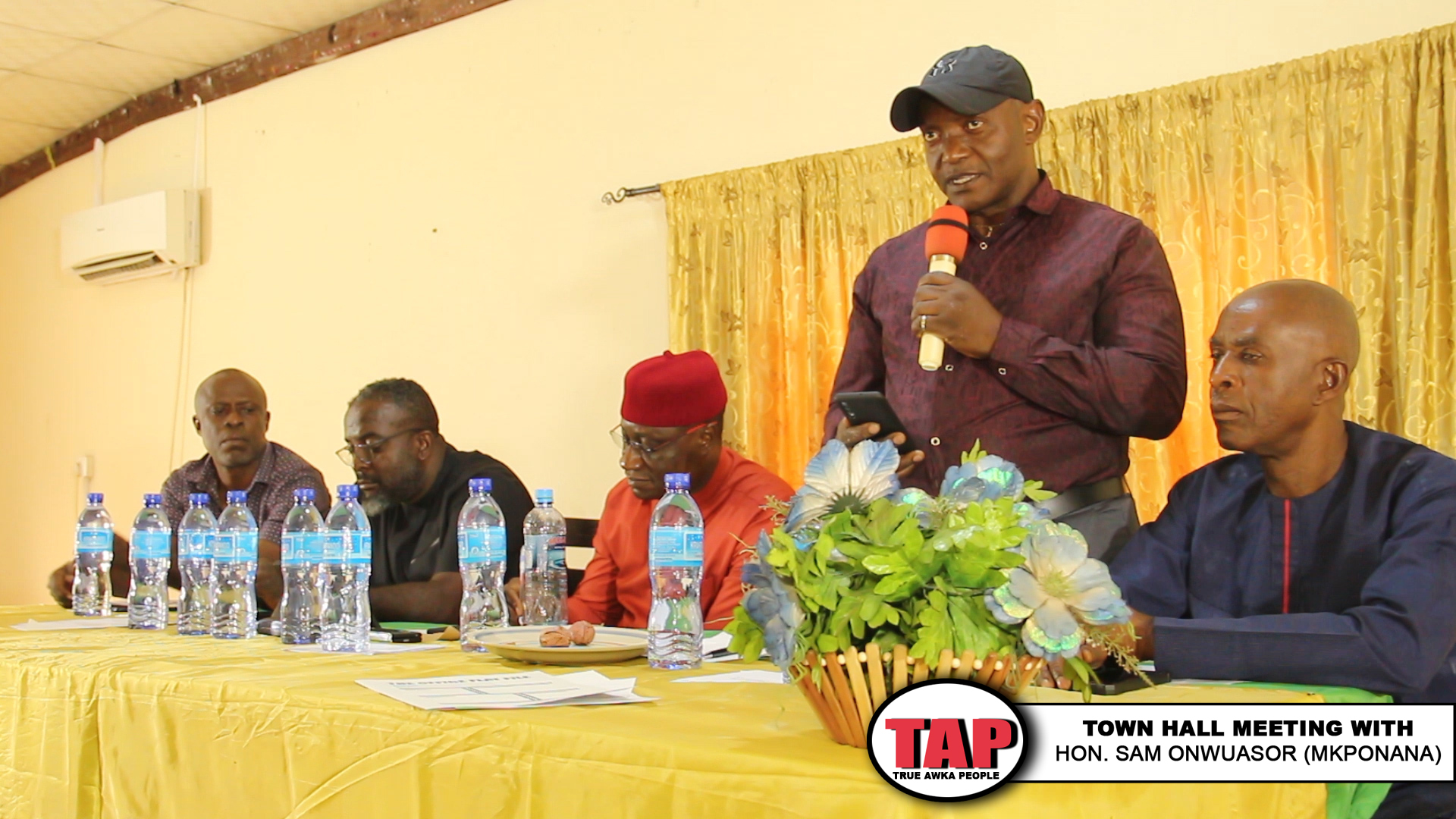
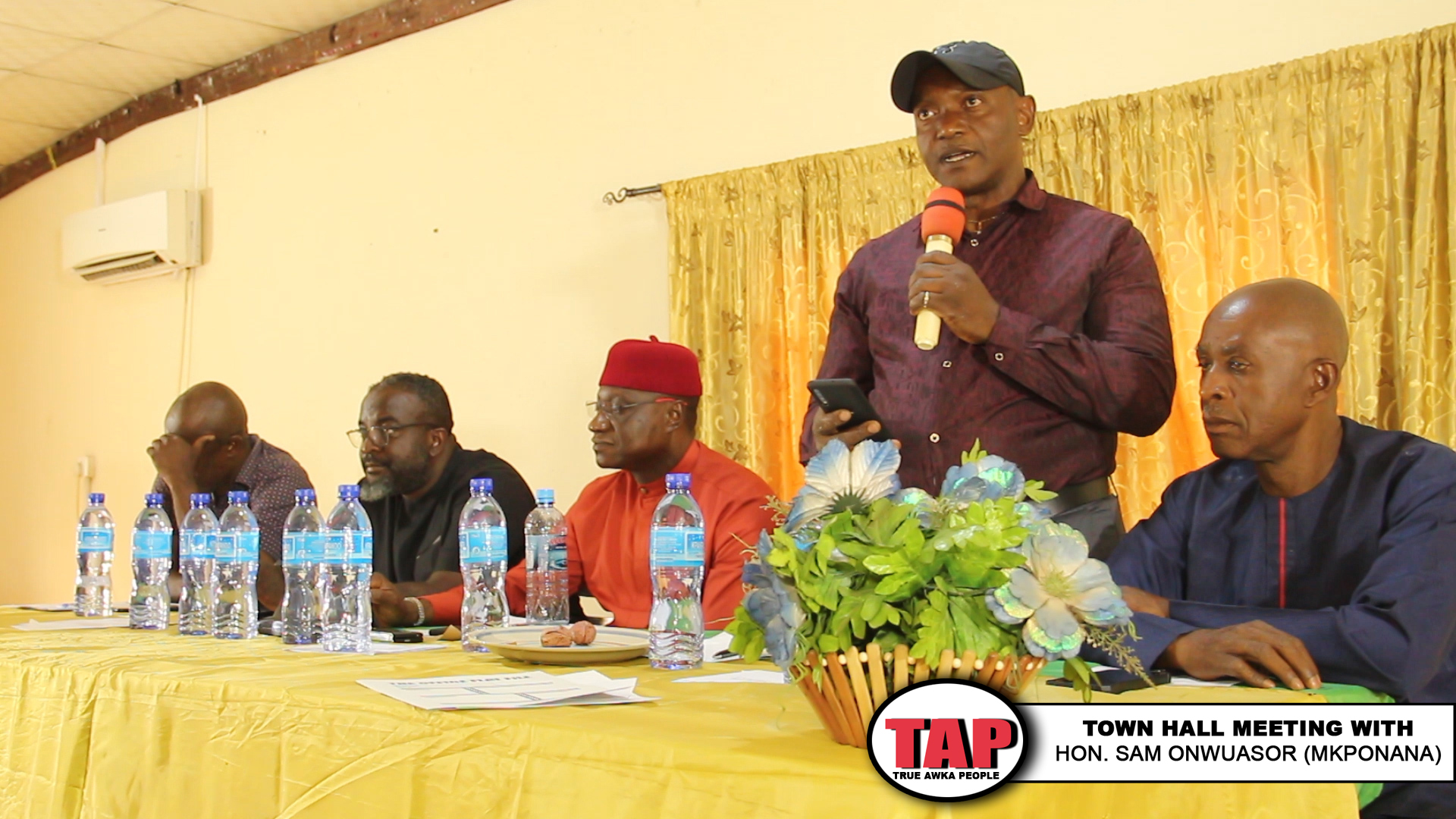
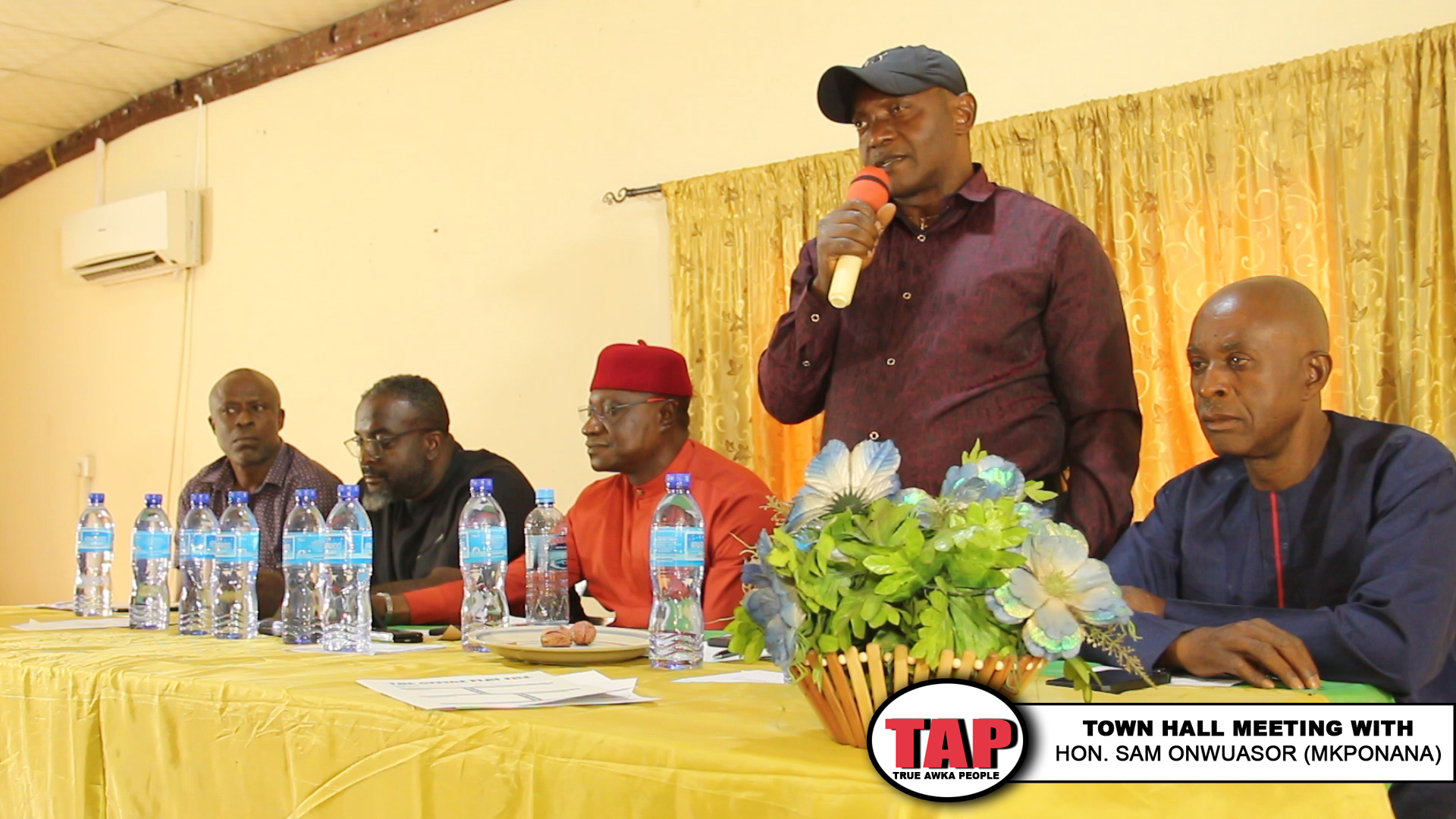
An Awka socio-political group, the True Awka People (TAP), held a town hall meeting on January 4, 2022, with Hon. Engr. Sam Chinedu Onwuasor, the House of Representatives member representing Awka North and South constituency, as Guest of Honor.
It was a pioneering effort at grassroots democratic engagement, designed to enable ordinary Awka constituents meet with their House representative in an uncontrived political forum.
The event lived up to its billing as a forum for robust democratic interaction. TAP leadership introduced the guest of honor, Hon. Onwuasor, and then after a brief opening statement by the guest quickly opened the floor for direct audience questions and comments.
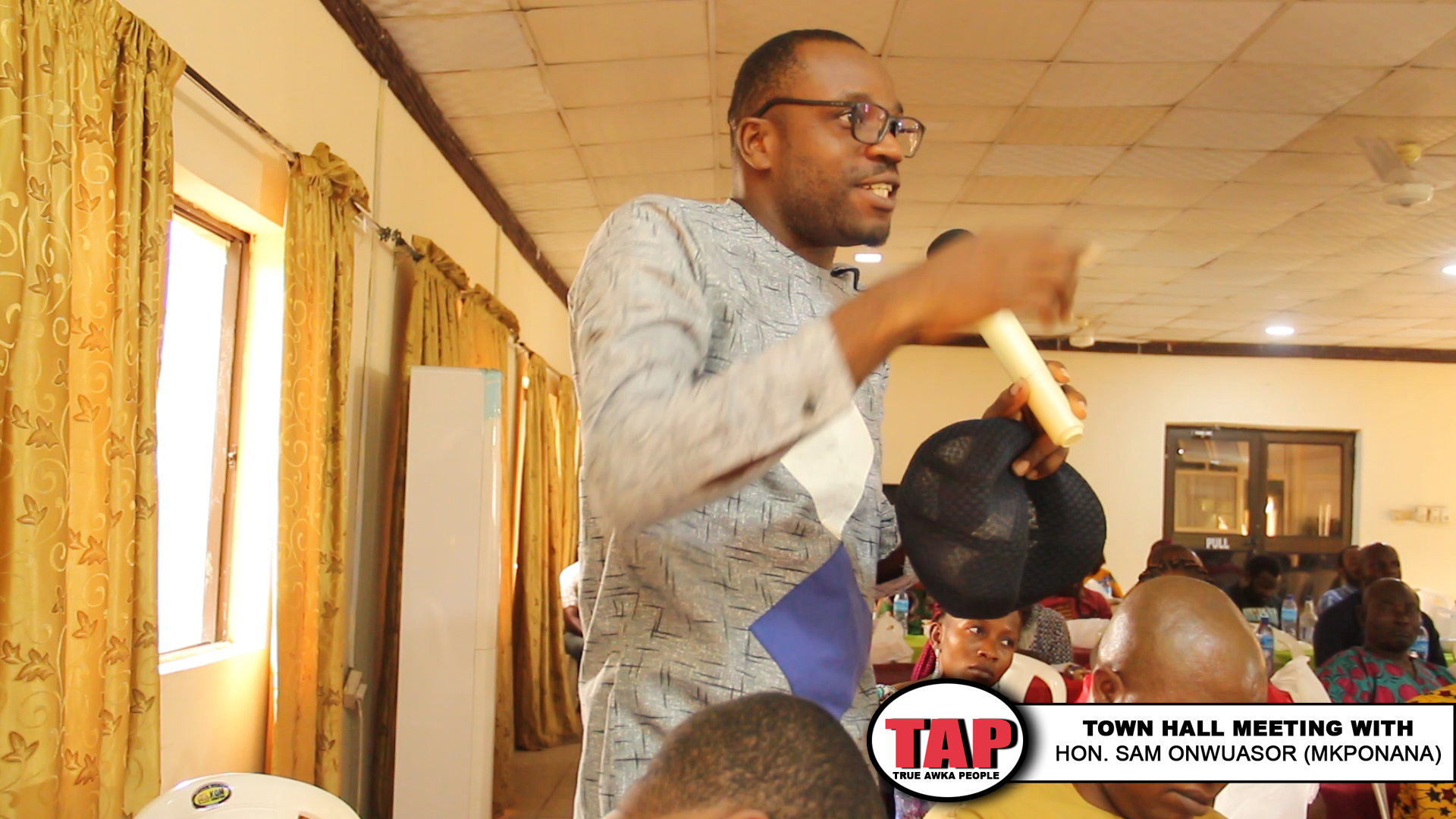
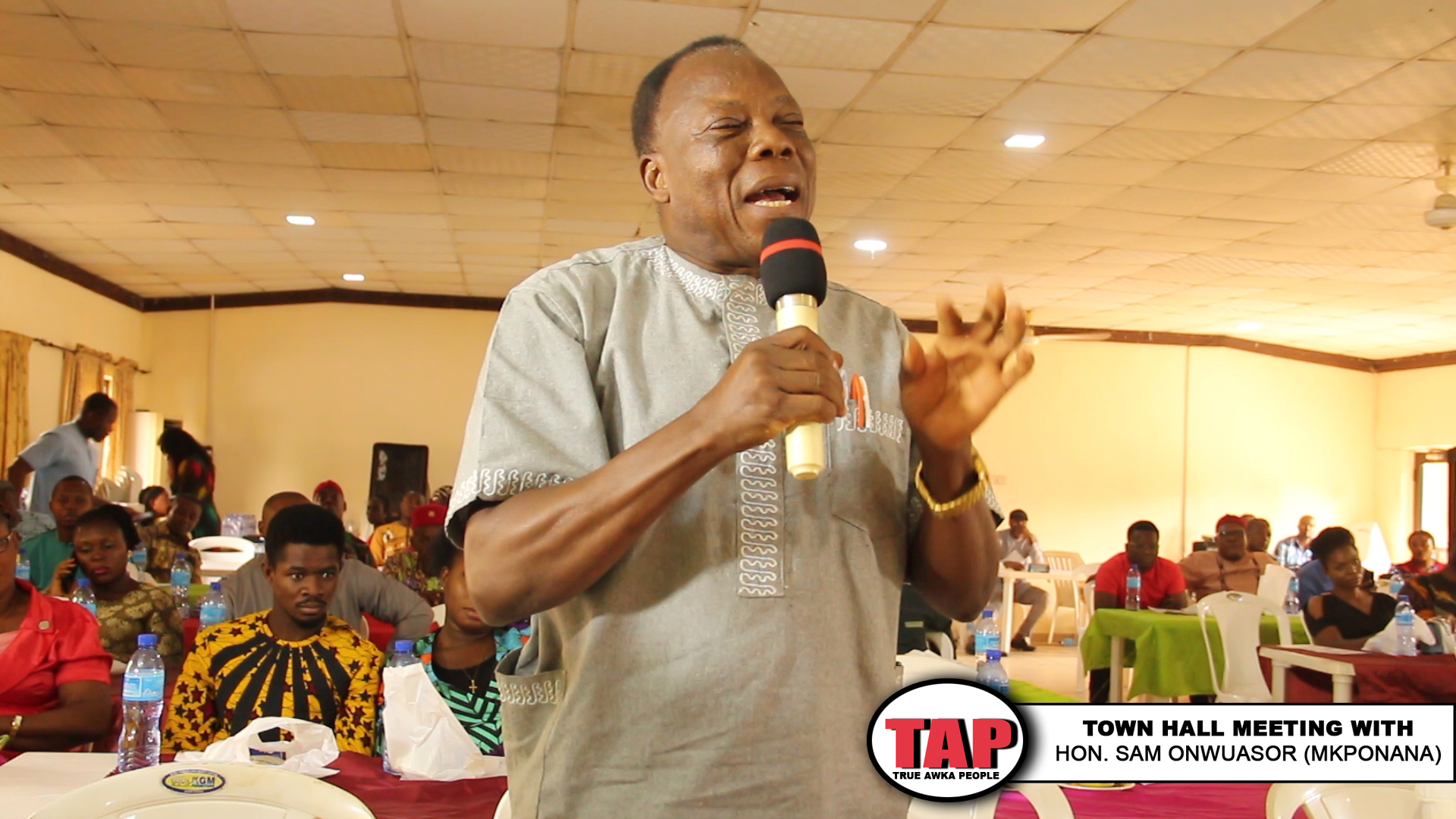
And what a robust session it was. During the six-hour event, the audience threw a vast array of questions at the representative, ranging from a sustained interrogation of his legislative record to impassioned questions about the paucity of government projects in Awka, including federal and state projects. There were questions too about the lingering community leadership crisis in Awka which has greatly undermined the political relevance of the capital city. The audience seemed most exercised by the collapse of public infrastructure in Awka, especially the dilapidated roads in the city. Attendees flung fiery questions at the House representative, demanding to know what he had been doing to alleviate the situation which greatly undermines the economy of Awka and environ.
Hon. Onwuasor took the questioning in his stride, acknowledging the relevance of the issues, providing answers where he could whilst stressing the limits of his legislative remit where he felt necessary.
In the end, guest, host and audience indicated that the event was worthwhile. Constituents hoped for a future town hall meeting to check in again with Hon. Onwuasor. The rep himself indicated his willingness to participate in future forums, but he also challenged the constituents to engage his office in an ongoing democratic dialogue.
TAP leadership informed Awka Times that they are hoping to set up a town hall franchise through which they hope to engage various leaders, in the government and community, in an ongoing democratic dialogue.
Below, we provide videos and photos from the Jan 4 event.
TAP Town Hall with Hon. Onwuasor
1 of 65
TAP Town Hall with Hon. Onwuasor
TAP Town Hall with Hon. Onwuasor
TAP Town Hall with Hon. Onwuasor
TAP Town Hall with Hon. Onwuasor
The True Awka People (TAP) was formed in 2017 with a goal to mobilize Awka people at home and abroad towards Awka development. It was borne out the festering political crisis in Awka which has seen ruptures in town union governance and the monarchy institution, and it hopes to facilitate political reconciliation and promote rapid development in Awka capital city.
The struggle may look like lunacy
To those seduced into vain ecstasy
By the Nigeria of their vast fantasy.
To them, the activists are arsonists
Who, in bouts of revolutionary fervor,
Treat the commoners as cannon fodder
Tipping their lives into needless bother
To rev their rabble of raucous ardor.
The rabble roils the genteel sensibilities
Of ‘patriots’ pumped by the possibilities
Of Nigeria, this giant dwarf of Africa;
It punctures the perfect illusions
Of those tortured romantics clutching
To the dream of a nation lurching
From zig to imponderable zag
Driven by demons deliberately divined
By a colonial creator seeking an afterlife
Of postcolonial sway in its African jewel.
But History will beam with benevolence
Upon the rabble if it curbs its excesses
And presses, thru curated conferences,
Its indictment of this monumental error
Striving, thru strident pain and horror
Until justice, now cowering in terror,
Emerges in towering form and splendor.
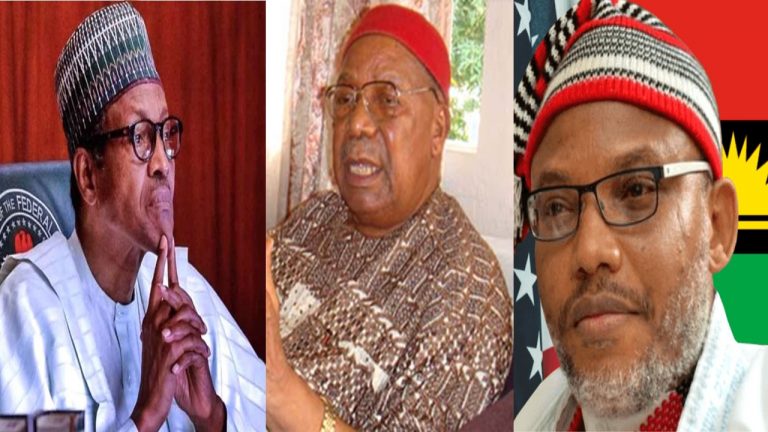
President Buhari, Chief Mbazulike Amaechi, Nnamdi Kanu
A recent meeting of Igbo Elders with President Muhammadu Buhari in Abuja during which they pleaded for an ‘unconditional’ release of Nnamdi Kanu, the incarcerated leader of the Indigenous People of Biafra (IPOB), has sparked differing reactions across the Igbo polity and beyond. Below, the Awka Times publisher takes on reactions by readers to his initial commentary on the Abuja conclave.
By Chudi Okoye
A few days ago, news broke that some “respected” Igbo elders had met with President Muhammadu Buhari in Abuja to plead for an unconditional release of Mr Nnamdi Kanu, the leader of the Indigenous People of Biafra (IPOB), currently incarcerated and indicted for treasonable felony and terrorism, among other charges. Merely hours after the news broke last week, I wrote an analysis here in Awka Times arguing that the Igbo elders’ intervention, couched as a plea in behalf of Kanu, had the potential to be interpreted as an “apology” and that it could create a set of cascading outcomes likely to undermine IPOB’s revolutionary project as well as, by implication, the broader political interests of Igbo people. I suggested that it might be better for IPOB’s revolutionary agenda for Kanu to tough it through the court trial, not minding the vagaries of the Nigerian legal system.
My suggestion that the legal process be exhausted is informed by an estimation that Nnamdi Kanu has a fair chance of beating the rap and reaping a rich reward in moral vindication and possibly even legal legitimation for his project. The charges against Kanu are ludicrous, to say the least, and the government’s ham-handed prosecutors are bungling the case big time. It is not surprising that a federal government which went to the ends of the earth seeking to re-apprehend Nnamdi Kanu (even resorting to extraordinary rendition which is repugnant to domestic and international law) has begun, through its hapless and poorly educated attorney general, Abubakar Malami, to drop hints that it would be amenable to a political solution in the Kanu case (and also in Sunday Igboho’s, concerned with Yoruba nationalism). Malami’s insinuation to a political solution might indicate the uncertainty of the government about its legal case against Nnamdi Kanu.
If the government is starting to worry about the winnability of its case, it stands to reason, doesn’t it, that Nnamdi Kanu’s lawyers should concentrate on defeating the government in its own courts. This, I argued, would strengthen the legal basis for IPOB’s operation, in addition to the moral dividend it could garner; and it would ultimately serve the larger political interest of Igbo people.
There were immediate (and not entirely unexpected) reactions to my piece. We published some of these reactions here in Awka Times, but some were also rendered in forums where my piece was re-posted. I had some personal interventions as well, from friends mainly. I was told that there were disconcerted reactions in some Igbo leadership circles, including by some of the very Igbo grandees involved in the Abuja outing. One highly-placed confidante told me that debate about the writeup was “storming on my side,” and that “two of the grandees have been on my case hurling abuses.” Another confidante sent me reactions from, as he put it, “a high-profile platform of past Governors, Senators, etc.” to which it seems he belongs.
On the whole, reaction to my writeup was mixed, as might be expected on such a polarizing matter. Several commenters aligned with my argument, some even extending its logic. Some emphasized the point that Nnamdi Kanu should have his day in court, and that the government should prove its charges against him if it has the evidence, or release him if it cannot substantiate the case. Others worried how the government could contain Kanu and IPOB radicalism if the legal process were aborted and Kanu liberated without legal disposition.
There are some, however, who disagreed with my argument, some rather strongly.
I decided that it might be worthwhile, in order to advance the debate, to address the issues raised in response to my view. I will summarize below the primary arguments opposing my stance:
• It is argued that the Igbo elders who went to Abuja might have decided to intervene in order to break an apparent stalemate and rising tension between, on the one hand, seemingly befuddled and frazzled Igbo political elites who have not been able, so far, to intervene in any meaningful manner in the drama of Kanu’s trial, and on the other, the Igbo public frustrated by the fecklessness of the Igbo political leaders. The Igbo elders should be commended, it is argued, and not criticized for seeking a political solution that will ease the current tension in Igboland.
• A political solution is possible and preferable to contentious litigation, and it could produce a win-win outcome for all parties involved in the current imbroglio. The argument goes that all sides have strong incentives to find a political solution. The government, it is suggested, has boxed itself into a corner bringing charges against Nnamdi Kanu that it cannot prove and is thus prosecuting a case that it cannot win. Meanwhile, the government is said to be attracting global opprobrium for harassing a group seeking self-determination under the auspices of a principle which is upheld by the African Charter and the UN Charter, instruments which the Nigerian government has ratified.
One of the proponents of this view, a barrister and long-time friend, even argued in private chats with me that the Nigerian government is squirming under pressure which it was presumably facing from global institutions, and that the government might itself have instigated the Abuja visit of the Igbo elders. The government is said to have done this, apparently, through a ‘coded’ message sent by the federal attorney general a couple of weeks ago to the effect that a political solution might be considered if one were presented to the government.
Meanwhile, since governments typically crave domestic tranquility, it can be expected, it is argued, that the Nigerian government must welcome any political solution to the Kanu case which helps to mitigate the ripples of instability felt across the South East. The governments and indigenes of the South East, where insecurity is rising and the economy is tanking, would desperately welcome respite from any political solution.
Even IPOB, my interlocutors argue, stands to gain: Kanu would be unshackled and his hassled group can return to operating within the norms of political protest permitted under universal conventions and international law. The group could be re-legitimated and de-proscribed.
• It is possible for the federal government, acting through the attorney general, to end the prosecution of Nnamdi Kanu, invoking the prerogative of nolle prosequi which will render the charges against Kanu nol prossed, that is, they will simply be vacated. The Nigerian Constitution imbues the attorney general of the federation and state attorneys general with power to do this respectively at Section 174(c) and 211(c), and they can exercise such prerogative at any point during a trial.
The above then is a summary of the objections to my stance against the Igbo elders’ Abuja excursion. I will attempt, in the remaining part of this essay, to respond to these objections, pointing out the logical fallacies in the critiques and why I reject them and insist on my previous position.
Igbo Elders Meeting with Buhari
Let us recall, again, the crux of my original argument. I had argued that although the Igbo elders’ plea for an unconditional release of Nnamdi Kanu was well-meaning (how can it be anything but?), it might in fact be construed as an “apology” for Kanu’s operation, as an implicit disavowal of his cause or at least a rejection of his tactics. Such a construction, I argued, could undermine IPOB’s revolutionary project, possibly resulting in a disorientation, deradicalization and demobilization of the group. And this, I further argued, would be detrimental to the larger political interest of the Igbos.
Several commenters said they failed to see how the release of Kanu could constrain IPOB operations, if it is unconditional as the Igbo elders pleaded. However, this objection fails to notice the nuance in the request presented by the leader of the Igbo delegation. Chief Mbazulike Amaechi, who led the group, requested that Nnamdi Kanu should be released to him personally, promising that “he (Kanu) would no longer say the things he has been saying.” As reported, the chief said he could control Kanu, “not because I have anything to do with them (IPOB), but I am highly respected in Igbo land today.” Chief Amaechi said he had interacted with Nnamdi Kanu twice in the past, following which the IPOB leader rescinded orders earlier given on civil disobedience.
Chief Amaechi concluded by telling Buhari: “I don’t want to leave this planet without peace returning to my country. I believe in one big, united Nigeria, a force in Africa. Mr. President, I want you to be remembered as a person who saw Nigeria burning, and quenched the fire.”
Although the news headlines stated that the Igbo elders pleaded for an unconditional release of Nnamdi Kanu, we can see in the way Chief Amaechi set up the request an opening for the Buhari government to come back with a set of prerequisites for terminating the prosecution and allowing the release of Kanu.
It is certainly correct, as the objectors argued, that Buhari could advise his attorney general to liquidate the prosecution of Nnamdi Kanu. But does anyone seriously think that he would do this without exacting serious concessions aimed at dismantling IPOB? One of my interlocutors argued that Buhari was seeking a face-saving exit from his government’s muddled prosecution of Kanu; that he has realized – apparently due to growing diplomatic pressure – that he was mistaken to have apprehended Kanu or banned his organization; and so he would be amenable to a political solution which re-legitimates IPOB, allowing it to operate as a nonviolent group seeking self-determination within the ambits of international law.
This argument ignores the fact that IPOB was operating as a nonviolent actor when it became classified as a terrorist organization (in 2017) and proscribed under the Nigerian Terrorism Act. It ignores the fact that the same government that chose to ban a nonviolent IPOB has exhibited no compunction in dealing with far more deadly bandits and terrorist groups marauding the northern territories of Nigeria, offering them amnesty, providing rewards and incentives and re-education in an attempt to bring the brigands back in.
You have to ask what would make Buhari’s government more apprehensive of a peaceful IPOB than the northern terrorist bands it has been willing to engage. Perhaps it considers the northern bandits a ‘mere’ security challenge but finds separatist IPOB more dangerous to the corporate existence of Nigeria. Or, maybe this is mere rationalizing: it is possible that Buhari is simply propelled by parochial motivations in his differential treatment of IPOB and the northern bandits.
I do not see Buhari willing to release Kanu except under the strictest conditions. The conditions of release would be set up as a stultifying dilemma for Kanu: if he accepts some squalid backroom deal in order to be released, his revolutionary project would be deeply damaged and his reputation would be in tatters; if he refuses, it would provide a plausible pretext for his prolonged incarceration. The Igbo elders, perhaps unwittingly, have created grounds for a Faustian bargain to be thrust upon their ‘son’, Nnamdi Kanu.
Misreading International Law
The argument is made that as long as IPOB commits to using nonviolent means, Buhari would have no choice but to give rein to its separatist agitation since the right to self-determination is guaranteed under international law.
There is something to this argument, but I think it relies too heavily on international conventions that are sometimes ambiguous and hard to enforce anyway.
Certainly, the right to self-determination is recognized under international conventions to which Nigeria is a signatory. For instance, Article 20 of the African Charter on Human and People’s Rights acknowledges that “All peoples shall have the right to existence. They shall have the unquestionable and inalienable right to self-determination. They shall freely determine their political status and shall pursue their economic and social development according to the policy they have freely chosen.” The convention also holds that “Colonized or oppressed peoples shall have the right to free themselves from the bonds of domination by resorting to any means recognized by the international community” (emphasis added).
Similarly, the United Nations International Covenant on Civil and Political Rights (ICCPR), in tandem with the UN’s International Covenant on Economic, Social and Cultural Rights (ICESR), also declares at Article 1 that: “All peoples have the right of self-determination. By virtue of that right they freely determine their political status and freely pursue their economic, social and cultural development.”
This principle has been reinforced by a UN General Assembly resolution adopted on 13th September 2007 which unequivocally affirmed the political and economic rights of indigenous peoples. According to the United Nations Declaration on the Rights of Indigenous Peoples, “Indigenous peoples, in exercising their right to self-determination, have the right to autonomy or self-government in matters relating to their internal and local affairs… [They] have the right to maintain and strengthen their distinct political, legal, economic, social and cultural institutions, while retaining their right to participate fully, if they so choose, in the political, economic, social and cultural life of the State.”
The right to self-determination is well-established, and it behooves the Buhari administration to respect any indigenous group, recognized as a ‘people’, seeking to exercise that right. But we should also not lose sight of certain loopholes inherent in these storied conventions. Take the case of the UN’s Declaration on the Granting of Independence to Colonial Countries and Peoples which was adopted in 1960. Whilst, on the one hand, the convention affirms at Article 2 that “All peoples have the right to self-determination; by virtue of that right they freely determine their political status and freely pursue their economic, social and cultural development”, it does however insist at Article 6 that “Any attempt aimed at the partial or total disruption of the national unity and the territorial integrity of a country is incompatible with the purposes and principles of the Charter of the United Nations.”
How do we reconcile these two articles? It would appear that the UN grants with one hand and takes away with another. It grants the right to self-determination, but denies the pursuit of it to the detriment of an extant state.
Some scholars have attempted to reconcile the two positions by arguing that while international law embraces the principle of ‘self-determination’, it does not affirm a right to ‘secession’ as a universal principle. Under international law, it is argued, secession is tolerated in instances where it is related to ‘external self-determination’ in which a people are colonized or oppressed by a foreign power. Even so, scholars point out, secession is unsupported if based on a violation of a fundamental norm of international law which prohibits the use of force. International law is also neutral on the question of secession where, as in the case of say Quebec and Scotland, a specific case of oppression cannot be established.
All of this dancing around in international law might be explained by the need to preserve the Westphalian principle of state sovereignty upon which international order is based. This principle is enshrined in the United Nations Charter which states at Article 2(7) that: “Nothing … shall authorize the United Nations to intervene in matters which are essentially within the domestic jurisdiction of any state.”
It is for this reason that positivists have long held that international and municipal laws are separate domains, and that where international law conflicts with domestic (municipal) law, the domestic law prevails. Certainly, it is established (for instance by Article 27 of the 1969 Vienna Convention on the Law of Treaties) that municipal rules cannot be used as justification to violate international law. But municipal authorities do proclaim the ultimate superiority of domestic law. For instance, although it is presumed in the United States that Congress will not legislate in a manner that is contrary to the country’s international obligations, it is nonetheless considered that US domestic legislation is supreme even if it breaches international law.
We find something similar even in Common Law countries which have a more benign (‘incorporationist’) view of international law, a view which presumes that municipal laws should not be inconsistent with international law. Even in these countries, it is often held that municipal laws take precedence over international law in cases of conflict.
This is certainly the case in Nigeria which proclaims that its 1999 Constitution is “Supreme” and that “If any other law is inconsistent with the provisions of this Constitution, this Constitution shall prevail, and that other law shall, to the extent of the inconsistency, be void.” This same Constitution proclaims the “sovereignty and territorial integrity of Nigeria”, declaring at Section 2(1) that “Nigeria is one indivisible and indissoluble sovereign state…” (emphasis added).
Misreading Buhari
I have made this long detour in order to confront the argument made by those cheering the Igbo grandees’ excursion to Abuja that the Buhari government can be persuaded to release Nnamdi Kanu and de-proscribe his group, IPOB, permitting it to continue with its secessionist agitation under some presumed norm of international law. I have shown that there are no firm principles in international law which would compel Buhari to give free rein to IPOB. The man is hardly a nationalist, let alone an internationalist.
Beyond this, we have also not seen in Buhari’s statements or “body language” (as we say in Nigeria) any indication that he is concerned with international conventions over and above the dictates of Nigeria’s domestic law.
At his meeting with the Igbo elders who came to plead for Kanu, Buhari made it clear that the elders were making a “difficult” request which has “serious implications” for the country. He invoked the principle of separation of powers, saying that since Kanu is already standing trial, a presidential intervention would go against the doctrine of separation of powers between the executive and judiciary. Buhari claimed that in his six years so far in office, “nobody would say [that] I have confronted or interfered in the work of the judiciary.” He even argued that the Nigerian government is doing Nnamdi Kanu “a favour” by putting him through legal prosecution. He allowed that when Kanu was re-arrested and brought back to Nigeria after jumping bail, he had felt that it was in Kanu’s interest: “I said the best thing was to subject him to the system,” Buhari told the South East delegation. “Let him make his case in court, instead of giving very negative impressions of the country from outside. I feel it’s even a favour to give him that opportunity.”
Think about the mindset behind these utterances. This is not the inclination of a man who has suddenly found religion; who has realized, as some argue, that it was wrong to have proscribed IPOB; and who supposedly feels embarrassed by international pressure (which I myself have not detected) and is seeking a face-saving exit through a negotiated political solution.
I insist, as I suggested in my original article, that what Buhari and his administration mean by “political solution” will not augur well for IPOB. It means a negotiated demobilization of IPOB and a resort to the institutional means of political protest. It means entrusting the fate of Igbo people entirely to the crop of politicians and associated persons currently representing them, a feckless group who absconded from their duty in the first place, making room for the emergence of a radical non-state actor like IPOB.
Little wonder these same actors have been all over the place hailing the excursion of the Igbo grandees. They are hailing the effort because it will lead in all likelihood to a defenestration of IPOB, and a return to the status quo ante.
It is nothing but ‘retrograde ejaculation’, as they say, this supposedly statesmanlike outing of the Igbo grandees. It is an option that all progressive forces of Igboland should reject.
Let Nnamdi Kanu have his day in court. In a way, it is a win-win situation for him. If Kanu trounces the Nigerian government in its own courts, he will emerge as an invincible hero, and some of his disagreeable behaviors will be forgotten. If he loses and then faces the blunt consequences of conviction, he will be seen as a persecuted Igbo freedom fighter and his suffering will likely rally the fissiparous forces of Igbo politics around a common cause, reaffirming the non-negotiable demand of Igbo people for equity in the Nigerian polity.
President Buhari with Igbo delegation, after meeting in Abuja on Nov 19, 2021
Igbo political emissaries met with President Buhari in Abuja to plead for the release of Nnamdi Kanu, the incarcerated leader of the Indigenous People of Biafra (IPOB). It is an unfortunate intervention that could undermine IPOB’s long-term revolutionary project and near-term Igbo political interest.
By Chudi Okoye
There was news reporting today that a group of Igbo grandees, billed as “Highly Respected Igbo Greats”, trundled themselves out to Abuja to meet with President Muhammadu Buhari to ask for an unconditional release of Mr Nnamdi Kanu, the incarcerated leader of the proscribed Igbo agitation group, Indigenous People of Biafra (IPOB).
The delegation included Chief Mbazulike Amaechi, a First Republic parliamentarian and Minister of Aviation, Dr Chukwuemeka Ezeife, former Governor of Anambra State, Bishop Sunday Onuoha of the Methodist Church, and Chief Barrister Goddy Uwazurike, former President of Igbo socio-cultural group, Aka Ikenga. Buhari received them well and promised to consider their request.
The opinion that follows below will probably sound insensitive coming from an Igbo man, but I think the Igbo grandees who went to plead with Buhari to release Kanu made a grievous mistake.
No doubt the Igbo grandees meant well. They probably felt compelled to act, likely for patriotic reasons but also on behalf of a scandalized Igbo political elite facing increasing pressure from a radicalized Igbo rank and file. But, in my opinion, their plea to President Buhari is constitutionally illiterate; it is politically inastute; and it is an ill-considered move that will likely hobble IPOB’s long-term revolutionary strategy.
Buhari was right to have stated – as reported, in response to the Igbo delegation – that its plea offends a fundamental tenet of the Nigerian constitution, which is the separation of powers. This constitutional principle was first fully articulated by Baron de Montesquieu, one of the great political philosophers of the Enlightenment, in his seminal work, The Spirit of the Laws, published in 1748. The principle was invoked by Montesquieu as a major critique of feudal absolutism in France and elsewhere in Europe, and it greatly influenced the constitutional ideals of both the American and the French revolutions. It has since become a cornerstone of modern constitutional government around the world.
In Nigeria, we have adopted and are deepening this constitutional principle as a revolutionary departure from the tripartite absolutisms of our history – first the feudal absolutism that flourished in several proto-Nigerian territories; then British imperialist absolutism; and finally, military absolutism.
The case against Nnamdi Kanu is now sub judice and is yet to be dispositioned; therefore, it is unclear if Buhari actually has proper legal power to intervene in the matter. Of course, the president has significant latitude under Section 175 of the 1999 Constitution which deals with the exercise of prerogative of mercy. The provision imbues a Nigerian president with the power to pardon “any person concerned with or convicted of any offence created by an Act of the National Assembly…, either free or subject to lawful conditions.” I doubt if this power can be exercised prior to the dispositioning of a case, but maybe our constitutional lawyers can weigh in with an interpretation.
Aside from the constitutional issue, there is also the political implication, for the Igbos, of its leaders, or purported leaders, going to Abuja to plead on behalf of Kanu. What is the object of their plea: are they asking for “forgiveness” – which would sound like a suggestion or an admission that Kanu and his IPOB are doing something wrong?
If so, the question arises as to what they think IPOB is getting wrong: is it the charge of Igbo marginalization and persecution which IPOB levies against the Nigerian state? Or is it the particular revolutionary tactics adopted by the group? What are the Igbo grandees pleading that Buhari should forgive – if indeed that is the thesis of their plea?
Even if the Igbo leaders did not mean to ask for “forgiveness”, it will certainly be construed as such by Buhari and his regime. They will read the intervention as an apology; they will construe it as Igbo leaders begging for forgiveness, which will be rather unfortunate.
There are at least two grievous implications from such an imputation by the Buhari regime. One pertains to near-term Igbo political interests, and the other to IPOB’s long-term revolutionary project.
If the Buhari regime reads the intercession of the Igbo grandees as a plea for forgiveness, Buhari could (over)leverage his powers under section 175 of the Constitution and “pardon” Kanu, but he will exact a heavy political price from the Igbos for the concession. For one thing, we can forget the idea of an Igbo president in 2023. The Nigerian state, or the dominant elite therein, already feels that conceding the presidency to the Igbos is a major concern, even a major risk. Buhari may be advised by his political strategists – and the wily president may accept the advice – to “free” Nnamdi Kanu as a substitute for conceding the presidency to the Igbos in the near term.
More than the presidency, Buhari and his anti-Igbo coterie could also leverage the “forgiveness” of Nnamdi Kanu to continue and even intensify federal disinvestment of Igboland.
Igboland has suffered from a systematic policy asphyxiation since the end of the Civil War, despite the ‘No Victor, No Vanquished’ nostrum enunciated after the war. We went from a hot, shooting war in 1967-70 to a cold war of policy neglect thereafter. This has resulted in de-industrialization and infrastructure disinvestment in Igbo territories, leading to a relentless economic decay.
The plea to pardon Nnamdi Kanu could become another chip to be used by the anti-Igbo forces in the Nigerian regime to further reduce federal investment in Igboland. It will be a heavy price to pay.
But it is not just the geopolitical implication for the Igbos that matters here. What would become of IPOB’s revolutionary strategy if its virulent leader were “pardoned”, with conditions, by the Nigerian state?
We know now, from the constant complaints of Nnamdi Kanu and his lawyers, that the guy is no Nelson Mandela who refused P. W. Botha’s offer in 1985 to release him from prison, subject to certain conditions. Rejecting the terms offered by the apartheid government for his release, Mandela had said to Botha:
I cannot sell my birthright, nor am I prepared to sell the birthright of the people to be free… I cannot and will not give any undertaking at a time when I and you, the people, are not free. Your freedom and mine cannot be separated.
This was 1985. Mandela was 66 years old at the time and had been in prison for about 23 years. Yet, he refused an offer to be freed from prison if it would hobble the revolutionary objectives of his party, the African National Congress (ANC), which was to overthrow the apartheid system under which South African Blacks had been suffering.
But we are seeing now that Nnamdi Kanu is no Mandela. Since his incarceration, his lawyers and associates have been howling about his suffering; he has used his IPOB to terrorize his own people, undermining Igbo economy, preventing school children from attending school, and generally imposing a reign of terror in Igboland.
Buhari and his gang will no doubt perceive that Kanu has little tolerance for the austerities of life under incarceration, this being the evident reason why he is sabotaging and terrorizing his own people and pressuring Igbo elites to plead for his release. So, it would stand to reason that Buhari will impose severe conditions against IPOB’s revolutionary quest in order to pardon Kanu.
Does anyone think that Buhari will pardon Kanu and yet give him free rein to continue his radical attack on the Nigerian state, or even to continue to press the Igbo case?
Not me!
So, whichever way one looks at it, this outing by the Igbo grandees, though well-meaning, is a major strategic error. It undermines not only IPOB’s revolutionary agenda but also the larger geopolitical interest of Igbo people.
It would be better for Kanu to go through the crucible of judicial trial and hopefully come out triumphant. That way, he and his IPOB will retain the moral and possibly legal right to continue their agitation, even if they have to amend their tactics.
And Igbo people will not have conceded anything in their demand for equal citizenship and equal opportunity in the firmament of Nigerian politics.
The IPOB leader, Nnamdi Kanu, elicits resentment and dread across the Nigerian polity, even among his own people. Many Igbos acknowledge the validity of Kanu’s critique of Nigeria, but there is significant apprehension about his adversarial approach which many fear offends Igbo strategic interest. But such apprehension represents a fundamental misunderstanding of Kanu and his revolutionary approach.
By Ikechukwu S. Onuora
Among the broad conglomeration of Igbo people of Nigeria, there are two categories of critics of Mazi Nnamdi Kanu, the leader of IPOB (Indigenous Peoples of Biafra). There are those who don’t want Biafra at all, and then those who want Biafra but not the way Kanu and his group are going about it. I would wager that the former are in the minority while the latter are quite a number.
The former are of the opinion that a pull-out from Nigeria will harm the Igbos adversely. While they admit that the Igbos are being marginalized, they argue that other ethnic groups also suffer from different kinds of marginalization. Therefore it’s not an excuse to demand secession. Again they posit that despite the Igbo marginalization, Igbos are economically better off than other ethnicities in Nigeria, therefore they should just be managing the situation while calling for a better deal instead of demanding for secession. To this group I say, each tribe has its own unique way of doing things. That we are both being oppressed and you chose to keep quiet doesn’t mean that I should also keep quiet. If other tribes feel they are also being marginalized in the country, it is up to them to decide also what to do about it. Again ascertaining the degree of marginalization of each group is crucial in appreciating their pain and reaction. I dare to say that no ethnic group is as marginalized as the Igbos.
But most importantly, those who tout the economic advantage of the Igbos over the other tribes in Nigeria should be made to know that we are not competing with other tribes in the country, we have passed that. We are fighting to compete with the rest of the world, we want to be the pride of Africa, we want to be at par with first world countries like America, Germany, Israel, etc., we want to achieve our full potential, and the country Nigeria is holding us down. If you don’t understand this, then you may never fully understand the nature of the struggle.
Why do you think our people in the first world countries of Europe and America are the most passionate about this Biafran issue? It’s not because they don’t know the danger the people at home face over the issue as some people have insinuated. It’s because they have seen and experienced the good life in first world countries but they know it’s not their home. They want to go home and replicate this good life at home but they can’t because of the situation at home. They watch their children becoming a lost generation, growing in a foreign country without strong roots in their culture. They want to take them home but they can’t because they know that there’s no guarantee of their safety, dignity, and success at home. It’s an agony that never ends. Indeed if you have not lived outside the country you may not fully appreciate this. They want a country, a home where they are valued, where their worth is recognized, where things are done on merit, where they can comfortably rear their children, where they can fully contribute their quota in raising it at par with the first world countries, a country they can be proud of. This is the major drive for Biafra abroad.
The same group that reject Biafra would argue that instead of blaming the federal government, we should rather blame more the state governments for not doing their elected duties, and we should vote out the bad ones. Of course their arguments have some merits. However with the present structure of the country, there’s a limit to what a good state governor can do. Bad roads, inaccessibility of clean water, lack of good hospitals, dirty environments, substandard schools, etc., these can be blamed on the state governments. But that’s where it ends. What of electricity generation, inter-state roads, functional seaports, security, etc. These are in the exclusive list of the inept and insensitive federal government. We have a sea port in Onitsha for instance, but an Onitsha importer will have to go to Lagos port to offload his goods. The governors are the chief security officers of their states but they are not in charge of the security agencies in their states. These are manned by foreigners to the region. The inter-states/federal roads are too bad yet the governor has no right to repair them. These are just few examples. We can’t continue like this.
Furthermore, how can you vote in the governor of your choice that will deliver good governance when your vote hardly counts, when the electoral body is controlled from Abuja and election results are decided by Abuja. We saw that play out in the last Imo state election. You only get your choice governor if Abuja has less interest in the contest as in the case of former governors Peter Obi and Chris Ngige, or you are ready to shed blood and die for your vote as in the case of Edo people in the Obaseki vs Ize-Iyamu battle (Pt. 2). This is exactly why KANU has always called for a boycott of elections in the Southeast; participation is always an indirect endorsement of the Abuja fraud. So you see, Nigeria has never and will never work for us Igbos.
Those of us who want Biafra but have issues with KANU’s method of pursuing it, accuse him of calling for war by his hardline utterances, by his formation of Eastern Security Network (ESN), and by his group’s attack on security formations in the Southeast. However let’s look closer at KANU’s utterances. It’s true that he is very aggressive towards both the Nigerian government, and also towards Southeast politicians who he believes are in bed with our northern oppressors. That is bad but does that translate into a call for war? Certainly not! Kanu said he formed the ESN to defend the East against the invading Fulani herdsmen that over the years have been killing, abducting and raping our women. Is that a call for war? Did he say he would go to the North and attack them? Did he say he would attack all the law abiding northerners living in the East? Of course not! Now, between the man who invades a home with arms and the one who defends his home with arms, who is the warmonger? Your guess is as good as mine.
As for the attack on security formations in the East by “unknown gunmen,” Kanu and his group have repeatedly denied having anything to do with that. Understandably many people don’t believe him because he surely has a grouse with the Nigerian security and has vowed to avenge the death of his followers in the hands of the Nigerian police and army. But is that enough to conclude that IPOB is behind these attacks? Certainly not! The police want us to believe that the ‘unknown gunmen’ are IPOB members. Indeed on few occasions they have arrested some young men and declared them to have confessed to be the “unknown gunmen” and also members of IPOB. However, experience has shown that the Nigerian police cannot be trusted to tell the truth in matters like this. To get to the truth, you have to dig deeper than what they say. And some digs deeper have revealed that many of the arrested and branded men were actually innocent.
Having said this, let us assume (without conceding) that IPOB is behind the attacks on security formations in the East. Now, that is very condemnable. I believe no reasonable person will wholly support that. However, we also need to ask the question, why would they be attacking the Nigerian police and army? You see, the French poet, Victor Hugo, made one of the greatest moral statements of all times. He said; if a soul is left in darkness, sins will be committed, but the greater culprit is not he who commits sins but he who causes the darkness (reflect more on this when you are less busy).
Over the years we are all witnesses to how the Nigerian police and army besieged the south-eastern Nigeria. How they mount illegal roadblocks at will and extort the people. How they extra-judicially arrest, jail, and kill our young men without any care in the world. How they massacred on various occasions unarmed youths of the East simply because they are IPOB members. Indeed the Nigerian security has treated the southeast like a conquered territory, they have committed countless atrocities in the East and the government who should call them to order cared less thereby creating the present darkness. So why we condemn the eastern youths (if indeed they are the culprits) for taking up arms now and call on them to drop them, we must not forget to make greater efforts to call on the government to restrain and discipline its erring security agents. Let them strictly follow the rules of engagement in carrying out their duties, otherwise the darkness will continue to exist and sins will continue to be committed and everyone loses.
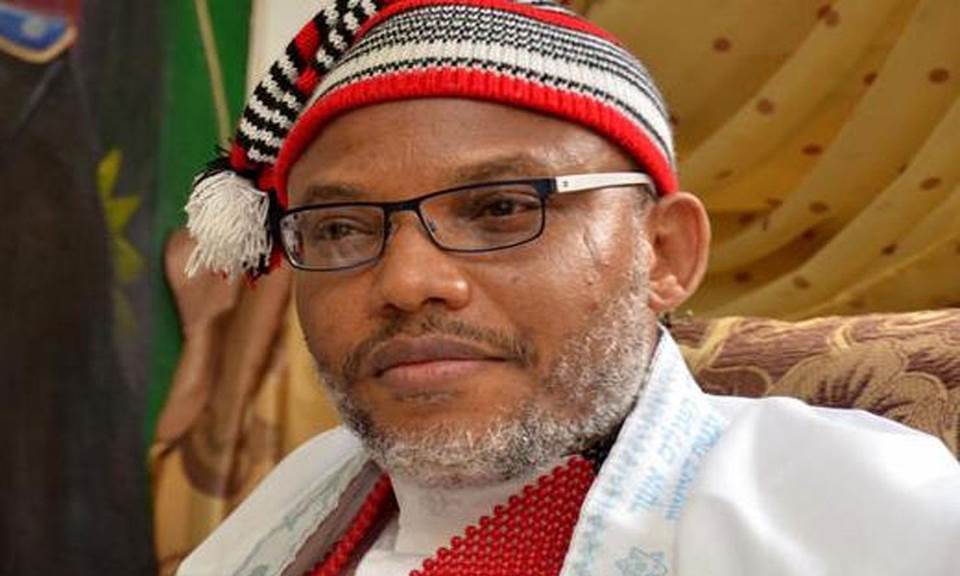
Mr. Nnamdi Kanu
It has also been argued that Kanu should not have formed the ESN because that has escalated the tension in the East. My question is, before the formation of the ESN, what was the situation in the East. Were there no killings by the Fulani herdsmen and the security agents? And in the absence of the ESN what exactly is our plan of defense against these beasts that are colonizing our forests and farms? Who are we looking up to defend our people? The police? The army? The vigilantes? Or the recently formed Eubeagu? Have you ever heard that the police or the army went into the bush to fish out killer herdsmen? The vigilantes and the Ebubeagu are poorly funded for it. Just about a week ago, the chairman of the Ebubeagu resigned citing lack of funds. And you want the only outfit standing as it were to disband? Probably our people being so religious are hoping for a miracle of deliverance from God as he did for the Israelites in Egypt. That’s laughable.
Look at what is happening in the Middle-belt region. I tell you, why the Fulani militia herdsmen are having a field day there is because there’s no militant leader in the mould of kANU there. Look at the Southwest, they were only checked with the rise of Sunday Igboho. Fortunately the governor of Benue state has realized albeit a bit late that the only language these beasts understand is militant language. Now he has told his people to take up arms and defend themselves. I guess he is also calling for war like Kanu.
What we need now is simply to support and harness the energy and influence of this young man Kanu. Castigating him will not achieve that; it will only worsen the divide. It’s true that he is “hard of hearing” but even the hard of hearing hears when the message is drummed loudly in their ears. The southeast state governments, the south east leaders, political, religious and otherwise, can create an alliance, a steady and cordial channel of communication with him at one end and with the federal government of the day at the other end, and impress on both sides of the need for restraint. That’s probably the only solution to the present crisis we are facing. To tell Kanu to back down without also talking to the FGN will likely be a waste of time.
It must be restated that what Kanu is calling for is not war but secession. I don’t know when a call for secession has suddenly meant a call for war. In many countries around the world like Spain, Russia, U.K, etc., there are calls by some groups for secession, but nobody has ever accused them of war mongering. Why then is our own different? Normally a call for secession is a call for referendum which is a peaceful process. Nnamdi Kanu has repeatedly said this. Let the people decide their fate. The problem comes when the government of the day not only refuses referendum but also criminalizes the call for it. Usually a responsible government, even if it refuses to organize referendum, will not repress the expression for it by the people. It’s only in rogue nations that this is done.
I fully agree with those who opine that restructuring of the country will be a better deal than secession. And I tell you that even Kanu will drop his call for secession if the country were to be restructured. That the talk of restructuring is even gaining ground now is mainly because of the activities of Kanu. But why he insists on secession is because he believes that restructuring is not possible. I’m inclined to agree with him on that too.
How do you achieve restructuring legally if not at the end of the day through the national assembly? The national assembly as presently constituted has the northerners in the majority, and they are the beneficiaries of the present structure of the country. How then do you think you can upstage them in a vote for restructuring or how do you believe they will agree to lessen their advantage and vote for restructuring?
The tie breaker in this struggle would have been the North-central or the middle belt who are actually the greatest victims of the murderous adventure of the Fulani militia. Unfortunately, the North-central despite its grudge against the rest of the North, would always choose them over the South. Despite their greater Christian religious affiliation with the South, they will always vote for a northern Muslim over a Christian southerner. That’s just the bitter reality. That’s what played out in 2015 election between Jonathan and Buhari. And when we thought they would correct their mistake in 2019 by voting for a detribalized Northerner in Atiku over the Fulani pro-extremist Buhari, we were yet again disappointed. And that leads us back to square one; referendum and secession as the way forward.
Worthy of mention here is a group led by Barr Tony Nnadi who claims to be the better alternative to Kanu’s group since they are pursuing the same aim legally. The group is called NINAS (Nigerian Indigenous Nationalities Alliance for Self-Determination). They claim to be presently in court (probably international court) with the federal government over the issue of referendum and possible secession. And they are almost certain they will win. This is certainly a good development because we need all the hands we can get in this struggle. How I wish both bodies can work hand in hand because we need them both.
When the case is won and the U.N gives the nod for referendum, and the Nigerian government predictably rejects it, the problem of enforcement comes in. The United Nations or United states cannot enforce it because Nigeria is a sovereign nation. The only thing the international bodies can do is to apply sanctions to the Nigerian government which we all know cannot deter the government. The big nations usually come in only if war happens to break out as seen in the case of South Sudan. In this case, because we have their legal approval ab initio, it’s possible that a number of them will support us even if only logistically. Now you see why we actually need a discipline armed group? However let’s pray it never gets to that.
Finally, a word for those who agitate that in the event of the creation of Biafra, the Igbos would lose their investments outside the Biafran land. And they have indeed invested heavily outside their territory. Well, that’s not completely true. A creation of a new nation doesn’t automatically mean that the members of the new nation are ejected from the old nation or lose whatever they have in the old nation or anywhere at all. Surely we cannot lose our investments in America, South Africa, Ghana, etc., simply because we now bear a new nationality. And this supposes to apply also to our investments in Nigeria. However it bears admitting that Nigeria is a country where anything goes, and given the hatred they have for the Igbos, the experience of abandoned property after the civil war may likely repeat itself. However, for me it is a worthy price to pay for a long term benefit.
The investments of the Igbos outside the Igbo land, especially in the North have never been really secure. The northern youths find it a pastime to loot and burn Igbo investments in their domain at any slightest excuse while the government looks the other way. But in the event of the creation of a new nation of Biafra, this cannot be business as usual because any tampering of our assets both human and material becomes an international issue that can generate international war. It will no longer be treated as internal Nigerian affair. And if God willing we are able to build our military to an advanced level as the Israelites did within a space of twenty years, then we can take the war directly into the Nigerian state and make them pay for all their atrocities against us. As an independent nation, we would have created military alliances with friendly nations such that in the event of such a war, we will have the backing and support of our allies. Today hardly do you see a nation going to war alone. There are always alliances that support them. My point then is that with the creation of Biafra, the security of our investments outside our country, in Nigeria precisely, will in the long run be more guaranteed than it is presently.
So, the way forward for us Igbos is Biafra. The earlier we realize and pursue it the better for us. It is my earnest prayer that this dream is realized in my lifetime.
– Disclaimer: The views and opinions expressed in this article are the author’s and do not necessarily reflect the editorial position of Awka Times.
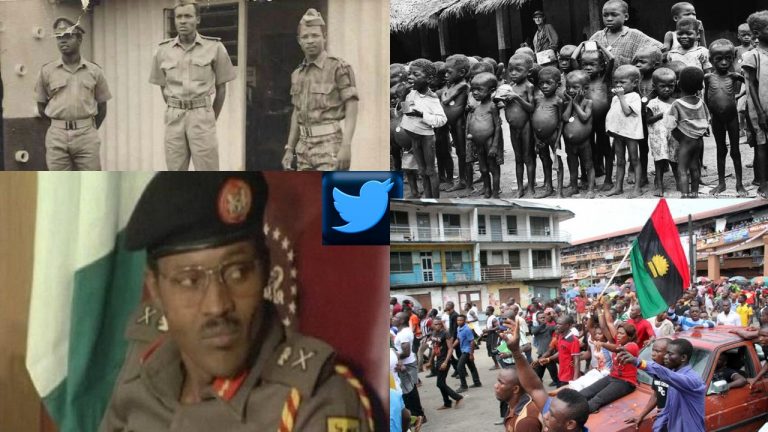
Buhari and the Igbos during the Civil War and since: Twitter now in the middle
President Muhammadu Buhari’s threat this week to deal severely with youths from a section of Nigeria demanding justice for their geopolitical zone is reminiscent of his efforts as a command combatant in the Nigerian Civil War and his repressive laws as a military head of state.
By Chudi Okoye
He may have become physically infirm and mentally debilitated, but Rtd. Maj. Gen. Muhammadu Buhari, even as the “democratically” elected president of Nigeria, seems to retain vestiges of the old habits which he displayed as Nigeria’s military head of state from December 31, 1983 to August 27, 1985. He remains today as grouchy as he was then, and much more parochial in temperament, it seems. Age has hardly mellowed the man.
This week, whilst addressing members of the Independent National Electoral Commission who had called on him in his Abuja lair in Nigeria’s capital city, Buhari, with a combustible demeanor and a bespectacled glint suggesting incandescent rage, seemingly went off script to inveigh against restive youths in a certain part of Nigeria who he said were destroying government property and creating general insecurity. Buhari invoked the ominous memory of the 1967-70 Nigerian Civil War, in which he had fought as a command combatant against the native region of those youths against whom he was fulminating, threatening to teach the froward youths a lesson they would understand.
The regional specificity of Buhari’s fulmination seems to be a clear indication that he is far more niggled or unsettled by the sporadic but growing outrages in the south-eastern part of Nigeria than he is by the rampant and arguably more sinister banditry, kidnapping and terrorism carried out by well-armed militias operating in his native northern Nigeria. He would cuddle the northern bandits wielding military-grade weapons, seeking to “rehabilitate” them, but he’s reading the riot act to an inchoate rabble of restive youths in the South East thought to be responsible for the flashes in the southern region.
In a Twitter posting on June 1, Buhari repeated the threat, saying those destroying “critical national infrastructure” and who wanted his “administration to fail” would “soon have the shock of their lives.” His Twitter posting was similar to what he said in his meeting with INEC:
“Many of those misbehaving today are too young to be aware of the destruction and loss of lives that occurred during the Nigerian Civil War. Those of us in the fields for 30 months, who went through the war, will treat them in the language they understand.”
Following a widespread condemnation of this overt threat and rather unpresidential vituperation, the administrators of the Twitter platform decided to remove President Buhari’s post. Predictably, only days after Twitter removed the offending presidential tweet, a twit representing the presidency, information minister Lai Mohammed, announced that the government of Nigeria would suspend Twitter operations in the country, citing as reason “the persistent use of the platform for activities… capable of undermining Nigeria’s corporate existence.” The statement either contradicted or indicted itself by being issued on the very Twitter platform it was condemning!
President Buhari and Information Minister Minister, Lai Mohammed
Twitter and the Nigerian government under Mohammadu Buhari had been at loggerheads for quite a while. As the BBC reports, there had been a latent desire to regulate Nigeria’s access to social media in general and to Twitter in particular ever since the administration’s inception in 2015. From the role played by Twitter in enabling the #EndSars anti-police brutality protests which roiled Nigeria in 2020, to Twitter’s apparent snub of Nigeria by choosing Ghana as the location for its African headquarters, the administration had been spoiling for a showdown with the social media giant. Deleting the president’s tweet was, presumably, the final straw.
As of Saturday June 5, just days after the outrage from Lai Mohammed, there was reported Twitter outage on the platforms of Nigeria’s largest mobile networks, MTN and Airtel, as well as others. Apparently the Nigerian authorities are following through on their threat. But it is uncertain if the government can sustain the proscription, not least given the potential for a workaround through a VPN (Virtual Private Network) access to the Twitter platform. Such alternatives are already circulating in social media among Nigerians intent on defying the government. A VPN connection would make it appear as if the user is accessing the Internet and Twitter from another country. It has been used by defiant citizens to get round similar bans in other countries.
All the same, the Nigerian authorities are now putting in place the legal instrument to criminalize Twitter usage in the country. On Saturday June 5, as Twitter outage began to be experienced on Nigeria’s mobile networks, the country’s attorney general and minister of justice, Abubakar Malami, issued a directive declaring that Twitter usage in Nigeria had become an offense punishable by law. A statement signed and released by the attorney general’s spokesman indicated that Nigeria’s top law officer had “directed the Director of Public Prosecution of the Federation (DPPF)…to swing into action and commence in earnest the process of prosecution of violators of the Federal Government De-activation of operations of Twitter in Nigeria.” The attorney general further instructed the country’s communications regulator (National Communications Commission) as well as the Ministry of Communication and Digital Economy to work with prosecutors “to ensure the speedy prosecution of offenders.”
The attorney general claimed that Nigeria’s laws do not guarantee absolute freedom of thought, expression, or privacy, a highly restrictive interpretation of the Nigerian constitution. “Every freedom has certain responsibilities,” he said. “No freedom is absolute. Those who are apprehended will get to know what sort of prosecution awaits them.” The attorney general amplified the theory, earlier advanced by the information minister, that Nigerians using Twitter to press for political reform are not law-abiding citizens. “How do you call them law-abiding when they violate laws… when they want to create havoc, create issues of sedition, felony and are inciting hatred among Nigerians?”
As the Twitter kerfuffle escalates, it evokes memories of Buhari’s role in the Nigerian Civil War and his effort, as a participant in the succession of military dictatorships that ruled Nigeria after the war, to stifle public opinion and political dissent.
Buhari’s Civil War Antecedents
The furious glint in Buhari’s eyes and the venom in his voice as he inveighed against the restive youths of the South East immediately recalled his role in the Nigerian Civil War. Lieutenant Buhari, as he was then, along with other young officers from northern Nigeria, played an active role in the July 1966 counter-coup which ousted Gen. Aguiyi Ironsi, the Igbo who had assumed power as military head of state after putting down the January 1966 coup. That earlier putsch sacked the First Republic government of Nigeria, and claimed the lives of the prime minister Sir Tafawa Balewa, a northerner, and Sir Ahmadu Bello, the Sardauna of Sokoto and powerful premier of the northern region.
As the Nigerian Civil War ensued, the 24-year old Buhari was assigned to the 1st Division under the command of Lt. Col Mohammed Shuwa, which was moved from Kaduna to be stationed for a while at Makurdi. Buhari was initially assigned to the role of Adjutant and Company Commander in the 2 battalion unit of the Second Sector Infantry of Shuwa’s 1st Division. Buhari’s 2 battalion was among the first units to see action in the war, setting off south through Gboko into the town of Gakem and moving towards Ogoja, with heavy artillery support from Gado Nasko and his squad. The troop captured Ogoja and prepared to advance towards Enugu, at the time the Biafran capital. For a while, Buhari was the Commander of the 2 battalion, pushing southwestwards through Abakaliki and Nkalagu to join other Nigerian forces in the bid to take Enugu.
There was much resistance on that flank, however. Before the push into Enugu, Buhari was re-posted to Nsukka as Brigade Major in the Nigerian Army’s 3rd Infantry Brigade, led for a while by Joshua Gin who was later replaced by Isa Bukar. Buhari stayed with this regiment for a few months. In 1968, he was re-assigned to the so-called Awka sector (4 Sector) which was later tasked with capturing Onitsha. This sector operated along the Awka-Abagana-Onitsha region, a critical Biafran axis for food supply. Buhari’s sector suffered a lot of casualties as it attempted to disrupt the Biafran food supply route along the Oji River and Abagana axis.
After the war, of course, Buhari went on to bigger and better things, notably helping to sack the regime of Gen. Yakubu Gowon in a 1975 coup, with Gen. Murtala Mohammed emerging as military head of state. He became military governor of North-Eastern State (and later of Borno State) following the coup. Buhari also acceded to the role of federal commissioner of petroleum and natural resources under the regime of Lt. Gen. Olusegun Obasanjo which emerged after the assassination of Murtala Mohammed in February 1976. He also assumed chairmanship of the Nigerian National Petroleum Commission (NNPC). He became Military Secretary at the Army Headquarters and a member of the Supreme Military Council from 1978 to 1979, and then later General Officer Commanding (GOC), Third Armoured Division of Jos, a position from which he helped to launch the New Year’s eve coup, in December 1983, which terminated Nigeria’s misbegotten 2nd Republic barely four years after it came into existence. He would become the menacing head of state who ruled Nigeria with iron fist from December 1983 until August 1985.
Brutal Decrees
In that 20-month reign of terror, Buhari gave Nigeria, among other things, the nefarious Decree No. 2 (1984) and Decree No. 4 (1984), two of the most repressive laws ever enacted in Nigeria.
Buhari’s Decree 2 gave the chief of staff, Supreme Headquarters (then the forbidding Brig. Gen. Tunde Idiagbon) the power to detain for up to six months without trial anyone considered to be a security risk to the Nigerian state. The law also gave the state security agency, the National Security Organization (NSO), unprecedented powers to detain, without charges, any individual considered to be a security risk. The agency used its enormous powers to crack down on public dissent – intimidating, harassing and jailing individuals who allegedly broke the law. Special military tribunals were set up to try any breaches, with the tribunals increasingly replacing law courts in the administration of law. The decree imposed a ban on strikes and demonstrations of any sort. Hundreds of politicians, officials and businessmen were rounded up and thrown into jail for corruption. Some of these apprehensions were deserved, no question, given the excesses of the 2nd Republic politicians. But others – like the internment of the musician and activist Fela Kuti along with other government critics – were questionable. In any case, due process of law was completely abandoned.
There is an echo of Decree 2 of 1984 in Buhari’s recent threat to deal severely with Igbo youths. These youths might be merely acting out in frustration against the evident marginalization and persecution of their region by a seemingly vindictive old warrior who vowed to penalize a geopolitical zone that dared to deny him its majority vote in his civilian bid for power. To Buhari, as indicated by his information minister, this constitutes a threat to the Nigerian state. It is not the perceived injustice but the reaction to it that is deemed threatful to Nigeria’s corporate existence. Talk about the inversion of logic.
On the other hand, Buhari’s attempt to muscle Twitter is reminiscent of his Decree 4, issued on April 17, 1984 – that is, just over three months after sacking the civilian administration of President Shehu Shagari. Decree 4 was nothing short of a cynical and draconian clampdown on free speech. The decree forbade journalists from reporting any information whatsoever that was deemed by government to be “false” or which, even if true, brought government officials into ridicule or disrepute. According to Section 1 of Decree 4, “Any person who publishes in any form, whether written or otherwise, any message, rumour, report or statement […] which is false in any material particular or which brings or is calculated to bring the Federal Military Government or the Government of a state or public officer to ridicule or disrepute, shall be guilty of an offense under this Decree.” What is more, Decree 4 was made retroactive, which meant that journalists would be liable for whatever they had written or broadcast even before the decree was issued, as well of course as after it was.
The law also stated that journalists and publishers who were found to be in breach would be tried by a military tribunal whose ruling would be final and could not be appealed. Penalty was a jail sentence of up to two years and a fine not less than ₦10,000 (consider that in 1984, ₦1 was $0.765, meaning, by my rough calculation, that the fine was the equivalent of ₦6.5m today).
We all probably remember the case of the two journalists, Tunde Thompson and Nduka Irabor, who were jailed under Decree 4. They were working for The Guardian newspaper which had been established only the year before. Tunde Thompson, the newspaper’s diplomatic correspondent, was detained after the paper published his story providing an outline of the government’s plan to overhaul the Foreign Service. Several of the changes reported by Mr. Thompson were later introduced by the government which nonetheless persecuted the reporter and his newspaper.
Several other journalists were also caught in the wide net cast by the nefarious decree. For instance, over at The Statesman, a newspaper based in Imo state, an article was published asking why the Buhari regime would imprison former Vice President Alex Ekwueme, an Igbo, a man who was not known for personal corruption, while his president, Shehu Shagari, the northerner who presided over the rogue 2nd Republic, was allowed to remain under house arrest. The Statesman article hinted at a possible tribal discrimination. For the affront, The Statesman was shuttered for two months (at a huge economic loss for any print newspaper), while its editor and the two reporters who wrote the article were dismissed.
There were many others that fell prey to Buhari’s media restriction law. Ultimately, the draconian law proved to be one of the reasons why the Buhari regime itself was overthrown in a palace coup led by Gen. Ibrahim Babangida and others, in August 1985.
By his actions this week, threatening Igbo youths who are merely agitating for justice, and suspending Twitter for daring to expunge his malicious message from its platform, a rattled and seemingly embittered Buhari, contemplating the utter shambles and the reign of error that is his presidency, may be reviving his old draconian habits.
He may not get federal lawmakers to enact any repressive laws, although who can say with the ineffectual and inattentive posse of legislative grabbers milling around the seedy labyrinths of the presidency seeking personal favors. But certainly Buhari has enough latitude of power, or at least he can lay claim to such, to undertake a chilling regime of repressive action to quell an increasingly restive republic. It will be up to us as vigilant citizens, jealous of our rights, to stand up to potential tyranny, whatever our station, vocation or location.
This article was updated on Sunday June 6, following news about the Nigerian government’s criminalization of Twitter usage.
Long long ago, in our mass hysteria
We felt elated, as with keen mysteria
Simply to be citizens of One Nigeria
We grew up knowing a Fun Nigeria
We had our fill of her, like Bun Nigeria
And played mild games of Pun Nigeria
Yes, we sweated so much in Sun Nigeria
So hot was this place, our Own Nigeria
But we felt proud to be Sons of Nigeria
As if we had all, all of us, Won Nigeria
Alas, today we are wasted in Worn Nigeria
All around abound signs of Torn Nigeria
Some of us, mild ones, feel it’s Yawn Nigeria
And these types just want to Shun Nigeria
Others, dispirited, think it is Done Nigeria
They too are minded to Scorn Nigeria
Many even say it is truly Gone Nigeria
And these have decided to Spurn Nigeria
Some folks, in fact, want to Stun Nigeria
Or, maddened, are moved to Burn Nigeria
Maybe that’s why everywhere it’s Gun Nigeria
Day after day there’s news to Mourn Nigeria
So much death, it’s a macabre Porn Nigeria
Even now, bandits who are Non-Nigerians
Are riding sullen citizens to Churn Nigeria
Since we elected their own to Run Nigeria
So now, patriots of this fallen phenom
Join me to sing in notional tandem
The lyrics of a new national anthem
Dirge for a country created at random
By imperialists who cared not an atom:
Abide, O Cowed Patriots
Nigeria’s call delay
We’ve lost our fatherland
Thru fear and greed and vice
The labors of our heroes past
Have so far been in vain
We create with heart and spite
A nation lacking freedom, peace and unity
There are divergent political tendencies in Igboland regarding how to engage the Nigerian hegemonic powers. These divergences centre on differing views about the nature and value of Man, economic vs. political; and they dissipate Igbo political energy. It is only through a radical convergence that the progressive forces can hope to bring about meaningful change to Nigeria’s political system.
By Chudi Okoye
“Seek ye first the kingdom of God,” Jesus enjoined the multitudes, “and all [else] shall be added unto you.” Kwame Nkrumah, the late Ghanaian statesman, had no truck with that stock Biblical injunction. In a 1963 speech in Addis Ababa, the iconic pan-Africanist urged Africans to seek first the “political kingdom” and socio-economic development would follow. Osagyefo Nkrumah’s rallying cry roused many in the heady days of African decolonization, with keen debate about which path was proper as primary concern for a newly independent continent – economic cooperation or political integration.
We find a hint of such infernal debate in the mental dispositions of the Igbo people of Nigeria.
There is an unspoken but deep divergence among Igbo people on what constitutes the nature of Man and the value of a human being. We don’t always think of it in these terms, but the tension in Igbo philosophy of Man (and in Nkrumah’s exhortation) relates to an ancient debate about Homo Economicus (Economic Man), as conceived by the English philosopher and political economist John Stuart Mill, versus the idea of Homo Politicus (Political Man) as originally conceptualized by Aristotle. Some Igbos think the paramount goal of life is to maximize economic utility, and so they lean toward the conception of Man as an economic animal. On the other hand, some Igbos conceive of Man mainly as a political animal imbued with certain natural rights which must be valued above all else and protected by all means.
Igbo culture is associated with two fundamental dispositions: an instinct to materialism, and an instinct to democracy. These innate dispositions, I argue, to a great extent explain the dichotomy in Igbo thinking as to their place in, and expectation from, Nigeria; and thus the divergences in their political tendencies.
The foregoing may sound all highbrow and theoretical. Well, to some extent, they are. But I am sure that you have encountered the jesting stereotypes about the ethnic majorities of Nigeria: the insinuation, often, being that the Hausa/Fulani are motivated by religion, the Yoruba by politics, and the Igbo by money.
At the risk of offending the squeamish, let us take a few of these hilarious nuggets:
• An Igbo man, a Yoruba man, and a Chinese were having a group discussion. A big housefly flew into the room. The fly flew past the Yoruba man and the Igbo man, but just as it was about to fly by the Chinese, he caught it and put it in his mouth. Although they were astounded, both the Igbo man and the Yoruba man said nothing. A few minutes later, another housefly buzzed joyfully into the room. It went past the Yoruba man, but just as it was about to pass the Igbo man, he caught it. Then turning to the Chinese man he asked: “How much will you pay for it?”
• An Igbo man fell into a well and was screaming for help. His wife came with a rope to drag him out. The drowning man took one look at the rope and yelled: “Nwanyi, how much did you pay for that rope?” The wife said she paid ₦1,000. Horrified, the man screamed: “What! Return it right now! Go to Papa Emeka’s shop, he sells his rope for ₦300. Hurry up before I die here!”
• An Igbo man bought a new car and wanted to show it off to his friends. So he drove it to a popular watering hole. As he parked the car and opened the door to alight, in his excitement he failed to check for traffic. A lorry speeding down the road barreled into the car’s door, knocking it off the hinges. The horrified Igbo man jumped out of the car and screamed at the lorry driver: “Look at what you have done, you idiot! Do you know how much this car cost me? This is a brand new car and it cost more than you can make in a decade!” The lorry driver looked at the Igbo man in astonishment. “Sir,” he began to say, “you are shouting about your car. Haven’t you noticed that your arm came off with the car door?” The Igbo man stared at his arm in horror and disbelief, and then as loudly as he could muster his voice, he said: “Chineke nna! My Rolex! I was wearing my Rolex on that arm!”
Without question these stereotypes are simplistic and even offensive. Folks often go for the jugular with the jocular. But stereotypes are usually not without a hint of truth to them. It doesn’t matter anyway. I’m not here to moralize on such characterization, merely to use them to show that the hypothetical points I am making have echoes in popular consciousness.
If Igbo worldview bends toward the material, which some may find either appalling or enthralling, the Igbos do have a supremely redeeming quality, a deep democratic intuition. Much unlike the other major ethnic nationalities in Nigeria, and despite the absurdity of monarchism now creeping across Igboland, traditional Igbo society has an egalitarian DNA.
Most ancient Igbo societies were an acephalous republic with a segmentary social structure. They had a lineage-based leadership system with autonomous constituent villages and weak central institutions. It is widely attested in the anthropology of Igbo societies that they were, up until the arrival of colonialism, largely stateless societies, having few central governing institutions with power diffused to village structures. Community life was based on a kinship rather than a kingship norm. Moreover, leadership was based on an achievement ethos rather than ascription. Anyone with means and motivation could make their way into leadership positions. Communal laws were binding and sacrosanct, but at the same time there was a strong sense of individual self-determination. Chinua Achebe, in his essay “Chi in Igbo Cosmology”, argues that Igbo political individualism emanates from Igbo ontological beliefs:
The idea of individualism is sometimes traced to the Christian principle that God created all men and consequently every one of them is presumed worthy in His sight. The Igbo do better than that. They postulate the concept of every man as both a unique creation and the work of a unique creator. Which is as far as individualism and uniqueness can possibly go! And we should naturally expect such a cosmogony to have far-reaching consequences in the psychology and institutions of the people… [W]e should… notice… the fierce egalitarianism… which was such a marked feature of Igbo political organization, and may justifiably speculate on its possible derivation from this concept of every man’s original and absolute uniqueness.
Ancient Igbo communities had a fierce disdain for monarchic or oligarchic rule. All on their own, not being familiar with the Athenian notions of democracy and completely unaware of the revolutionary upheavals that had led to the establishment of the English Magna Carta (1215) and Bill of Rights (1689), French Declaration of the Rights of Man and of the Citizen (1789) and United States’ Bill of Rights (1789), Igbo antiquity autochthonously developed a culture that upheld the values of individual liberty and political democracy. These values were not codified in any written document resembling the classical documents of Europe and the United States. But they were deeply embedded in Igbo cultural precepts and unwritten laws. They were embedded in the hearts of the people and evinced in the confidence and assertiveness of a proud people who did not accept the superiority of other cultures or communities.
That was who the Igbos were. This is, even today, who the Igbos are. They believe in embracing the material abundance of nature, and they believe in unfettered freedoms to pursue their destiny. To a considerable extent it is these two innate compulsions, materialism and liberty, that shape Igbo political character. We must consider these fundamental facts in order to understand the current political divergences among the Igbo.
The materialist instinct of the Igbo propels them to adopt a transactional relationship with the broader Nigerian formation, with a willingness, it seems, to tolerate political marginalization in so far as there is opportunity for individual economic advancement. This instinct can often induce a consciousness that Igbo identity is subordinate to Nigerian citizenship. Or it may be based on a belief that the Igbos should seek economic ascendancy first, which then provides a pedestal for future political ascendancy. Whatever the thinking, there is a willingness here to subordinate the political to the economic, at least as a short- to medium-range strategy.
Conversely, the Igbo libertarian cum democratic instinct does drive a yearning for self-government, for the repatriation of power to the primal ethnic community, to institutions that will be regulated by Igbo native norms in addition to the constitutional norms. The desire for regional autonomy finds expression in varying forms and tendencies, as I argued in a recent Awka Times piece, including: (1) the moderate types whom I called “dauntless devolutionists”, seeking the transfer of more powers to states, the current federating units of Nigeria; (2) a more radical cohort of “Restructurists” which wants a reconfiguration of Nigerian federalism towards regionalism; and (3) a revolutionary fringe which wants nothing short of total separation from Nigeria. All these tendencies stand in contradistinction to the politically conservative types prioritizing economic prosperity.
The question now is what to do about these deep divergences in Igbo political outlook.
I think the immediate task for all who seek political justice for the Igbos is to work towards fusing these disparate views. There will be no victory without such political and intellectual fusion. None of these varying tendencies – on their own, vitiated by internal contradictions in Igboland – can take on Nigeria’s hegemonic juggernaut. It is only by recognizing the common desire for radical political change, and then ironing out the tactical differences so they can work together, that the progressive forces in Igboland can achieve their goal.
There is no need in the interim to engage the conservative Igbos who, for various reasons, seem to be willing to play second fiddle in the firmament of Nigerian politics. They will most likely come around when the Igbo political project overcomes frictional force and gathers momentum. So, for now, let’s focus on the crucial task of strategic consolidation.
There are many, especially Igbo intellectuals and political leaders, who are privately enraged by Igbo political marginalization and are even disposed to its confrontation but who despair at what they consider the crude extremism and exhibitionism of Nnamdi Kanu and the rest of the revolutionary separatists. They tend therefore to recoil from the political arena.
I think this attitude is unfortunate and, in fact, historically illiterate. History shows that whatever the level of revolutionary fervor manifesting in the arena of political struggle, it is not the revolutionary fringe but informed statesmen and intellectuals who in the end are called upon to articulate an enduring political settlement. The revolutionaries serve a purpose in galvanizing the legions, but it is usually cooler heads who attend the constitutional conferences where ultimate political settlement is hammered out. Nnamdi Kanu and his kind will have their well-deserved place in history, but they will not be in the halls of power where constitutions are designed.
Let us therefore not despair. Eventually, I believe, the various political tendencies in Igboland will gravitate towards the radical centre which demands, with insistence, the political restructuring of Nigeria.
As the commemoration of Biafra Day begins to become a unifying event for the Igbos, it is apt to contemplate ways to reconcile the divergent tendencies in Igbo politics and find a central tendency that assuages Igbo yearning for self-determination with minimal political risks. The approach that best recommends itself is that of radical restructuring within the context of Nigeria.
By Chudi Okoye
It is May 30th today, and it is a day for Biafra invocations. This date, May 30th, is beginning to become something of a calendar shrine, an uninstitutionalized day of commemoration for politically conscious Igbo people, at home or in the diaspora. The leading Igbo emancipation groups – the assertedly non-violent MASSOB (Movement for the Actualization of the Sovereign State of Biafra) and the more militant IPOB (Indigenous People of Biafra), among others – are willing it into reality as a commemorative day for the Igbo race.
It was on this day, 54 years ago, that Lt. Colonel Chukwuemeka Odumegwu Ojukwu, aged just 33 and at the time in his fifteenth month as the military governor of Eastern Nigeria, proclaimed into existence the sovereign Republic of Biafra. The hastily announced nation-state would subsist for a little over two-and-a-half years, hanging on by grit and sheer force of will, despite facing near isolation and unimaginable war hardships.
Ojukwu breathed Biafra into being with this bracing excerpt of words:
Fellow countrymen and women, you, the people of Eastern Nigeria:
Conscious of the supreme authority of Almighty God over all mankind, of your duty to yourselves and posterity;
Aware that you can no longer be protected in your lives and in your property by any Government based outside Eastern Nigeria; ………
Determined to dissolve all political and other ties between you and the former Federal Republic of Nigeria; ………..
Affirming your trust and confidence in me;
Having mandated me to proclaim on your behalf, and in your name, that Eastern Nigeria be a sovereign independent Republic,
Now, therefore, I, Lieutenant-Colonel Chukwuemeka Odumegwu Ojukwu, Military Governor of Eastern Nigeria, by virtue of the authority and pursuant to the principles recited above, do hereby solemnly proclaim that the territory and region known as and called Eastern Nigeria together with her continental shelf and territorial waters shall henceforth be an independent sovereign state of the name and title of “The Republic of Biafra”.
Ojukwu’s ostensibly confident tone as he proclaimed Biafra belied the utter improbability of the new state. The crisis that culminated in Biafran secession had been brewing for months, following the military coup of January 1966; the installation of a new military government under the politically maladroit Igbo, Major General Johnson Aguiyi-Ironsi; the brutal Northern counter-coup that took place in July, six tumultuous months after the first coup; the purging of Igbos in the military high command; and the pogrom of Igbo people mainly in northern parts of Nigeria. Biafran secession was an ineluctable consequence of an insurmountable pressure piled upon the Igbos as postcolonial Nigeria disintegrated. What were a persecuted people to do? What options did a hounded horde have in the haze of anomie?
But secession would produce extremely devastating consequences for the Igbos who had made great advances from colonial times under the enlightened leadership of Nnamdi Azikiwe and other luminaries, and ultimately for Nigeria as well.
Consequent upon the proclamation of Biafra, war was declared by Nigeria. The war was prosecuted by an over-matching Nigeria, supported with cool calculation by some of the world’s leading military powers including the United Kingdom, Russia, China and others. For its part, the ill-prepared and impecunious Biafra managed to scoop up diplomatic recognition and meagre support from some emergent, low-tier countries including Gabon, Haiti, Ivory Coast, Tanzania, and Zambia. Moral support and varied levels of assistance – though not diplomatic recognition – also trickled in from other countries including France, Spain, Portugal, Norway, South Africa, and even Vatican City. As war wore on, there was also spirited assistance from non-state actors like Médecins Sans Frontières, U.S. Catholic Relief Services, Holy Ghost Fathers of Ireland and a few others horrified by the level of Biafran suffering.
It was an unsuggestable match-up. Biafra collapsed after thirty agonizing months under the weight of its own improbability. Outnumbered, out-provisioned, out-gunned, the Biafran side threw in the towel in January 1970, after their brave war leader, Emeka Ojukwu, took an inevitable flight into exile.
By most estimates Biafra lost close to three million lives, mostly civilian lives. Lives that had not perished were malnourished, victims of a deliberate, internationally orchestrated program of economic sabotage prosecuted by a side which believed that starvation of children was a legitimate tool of war. The war engendered a massive destruction of physical and social infrastructure in Igboland, a complete devastation of the regional economy, and a massive moral dislocation. There is not as yet a proper historicization of that war, no proper delineation of the atrocities inflicted upon the Igbo people.
Still, the most surprising curve in the accounting of that cataclysmic conflict is not the ultimate victory of an imperialist-backed behemoth, Nigeria. Not in the least! Rather, it is the inventiveness of an inchoate Biafran force, which for the most comprised an amorphous rabble of untrained kids only a few months before the outbreak of war in elementary and secondary schools. It is in the grit and plucky fortitude of a persecuted population, blockaded towards oblivion by a brutal behemoth, so that necessary supplies and supply routes were wantonly destroyed. It is in the relatively rapid recovery of a pulverized Igbo people who shook off post-conflict traumatizations such as the confiscation of their properties through the abandoned property policy; the sequestration of their bank deposits, allowing every Igbo depositor only a 20-pound credit whatever their prewar balance; a devious policy of indigenization which parceled off state assets into private hands at a time most Igbos had little bidding potential; and various forms of victimization visited upon them even as the Nigerian government smilingly declared a bogus policy of ‘No Victor, No Vanquished’.
These are the inimitable graphs of that devastating war. They are a monument to the resilience of the Igbo race. But they are also a reason for persistent disarticulation in the practice of Igbo politics.
Biafra and Igbo Political Divergence
The speed of Igbo recovery from the traumas of a crushing civil war can be termed nothing but a miracle of modern history. From the pit of post-war despondency through a plethora of punishing policy promulgations, the Igbos have picked themselves up and are, without doubt, holding their own in diverse spheres of social life in Nigeria, from commerce and industry to finance to entertainment, academia and beyond.
And yet, even with the indubitable evidence of Igbo resurgence in the social spheres, there is little doubt that Igbos have been politically marginalized, unable yet to persuade a fretful Nigeria to trust them with real powers. Although Igbos are among the three largest ethnic groups in Nigeria, no one from the core Igbo territory, since Nigeria’s independence in 1960, has managed to make it to the position of head of federal government. None, except for Aguiyi-Ironsi’s chaotic 194-day stint as military head of state which ended in his ignominious murder by northern soldiers. (Nnamdi Azikiwe was only a ceremonial president in the First Republic). There was the four-year stint of Alex Ekwueme as Shehu Shagari’s vice-president in the Second Republic; but that’s just it: he was VP. There has been a string of Senate presidencies, although not since 2007. And Edwin Ume-Ezeoke was Speaker of the Federal House of Reps between 1979 and 1983. That’s it really. Other than being bequeathed the barest minimum of constitutionally stipulated roles, the Igbos are in the main locked out of power at the federal level, often passed over in strategic federal appointments, or occasionally plucked up to serve in some plum role at the pleasure of the hegemonic North.
Those who have ruled Nigeria: Near exclusion of Igbos
This blatant marginalization has left the Igbos politically befuddled, their politics muddled by bouts of desperation, indecision, bad calculations and sheer chicanery. At the national level, Igbo politics lacks gravitational force, resulting in the relegation of Igbo strategic interest by a magnitude equal to the square of the distance of Igboland from the center of political gravity. The material consequences of Igbo political marginalization are evident in the paucity of federal investment in Igboland, in the inequitable allocation of resources and political goods to the Igbo area. But there are also impalpable consequences, seen in the beggaring of Igbo political psyche and the vulgarization of Igbo political character. Worse, there is a sense of siege with heavy military presence and the ubiquity of police checkpoints in Igboland, one study by Intersociety finding that Nigerian security forces extort as much as $100 million per annum from the rash of illegal roadblocks mounted in Igboland.
Among the politically conscious Igbo there is a pervading sense of subjugation and persecution which feels not unlike a low-intensity continuation of the civil war. But although this perception is pervasive, it has produced differing shades of political sensibility among the Igbos, and thus a dizzying kaleidoscope of political praxis.
I would wager that most Igbos celebrate the idea of Biafranism, or at least they recognize its utility as an ontological concept, as a code for the spiritual unification of the highly itinerant Igbo people. Biafranism serves, or could serve, as an organizing principle for Igboness.
However, it is in the operationalization of Biafra as a political project that Igbo consensus disintegrates. As far as I can make out (see my conceptual sketch) there are five discrete political tendencies in Igboland today. There are, first, some extremely conservative Igbo types who want to remain in Nigeria under the present constitutional structure. These types believe that the Igbos could yet become ascendant in Nigeria, due in part to their national dispersion and also their rising economic prosperity. There are others, not unlike folks from some other Nigerian ethnic groups, who want significant devolution of powers to the states. They point out constitutional incongruities such as state governors being considered the chief security officers of their states but having no control of the security forces. The recent call by southern governors for devolution of more powers to the states, as we earlier reported in Awka Times, probably falls under this category. But then there are others, thirdly, who seek not just devolution of powers but actual change of the federal structure, from the present 36 states to a regional structure, perhaps based on the six geopolitical zones or some re-aggregation of the zones. And then there are the separatists who want nothing other than ‘Biafran’ excision from Nigeria. Even among these separatists, there is a divergence between the ethnic minimalists who simply want self-determination for the core Igbo states, and the regional maximalists dreaming of a pan-Igbo sovereign state which will encompass the Igbo-speaking parts of the South South geopolitical zone and even some parts of the southern fringe of the North Central zone.
These divergent mental models and political tendencies are at the root of Igbo political disorientation. It is not clear which of these tendencies will prevail in the end. However, we might learn some lessons from the history of the ancient Israelites who faced similar political rupture, and who are a culture often associated with the Igbos.
Jewish Parallels
Roman imperialism arrived in Judea with Roman conquest of the independent Hasmonean monarchy and the capture of Jerusalem in 63 BC by the Roman general, Pompey. There were three strands of Jewish response to Roman imperialism: (1) sacerdotal and elite retainership, seen with the acquiescence of Temple leadership (scribes and priests) and the role of Herod as a vassal (client) king; (2) the stance of the revolutionary zealots who mounted a radical opposition to imperialism, their actions in the end leading to Roman destruction of the Second Temple in 70 AD (the Babylonians had destroyed the First Temple in 586 BC) and the massacre of the Sicarii rebels at Masada three years later in 73 AD; and then (3), an insidious peasant-focused communalist apocalypticism, preached by Jesus the Nazarene, which anticipated the eventual destruction of Roman imperialism along with the dispossession of the compromised Jewish aristocracy, and the elevation of the downtrodden under a new Heavenly authority, with Jesus himself at the helm. Some historians argue that it was the Jesus sect and its pacifist approach that ultimately prevailed.
In the narrow sense of Jewish history, this claim is technically incorrect. The Jews remained in bondage long after the death of Jesus whom they never fully embraced as Messiah anyway. They remained under Roman colonialism until 313 AD, then came under Byzantine rule (313-636 AD), Arab rule (636-1099 AD), Crusader domination (1099-1291 AD), Mamluk rule (1291-1516 AD), Ottoman rule (1517-1917 AD), and British rule (1918-48 AD). In other words, the Jewish people remained under foreign domination for about 1,915 years after the death of Jesus! Even now, 73 years after the establishment of the independent state of Israel in 1948, you could make a case that the Jewish state is propped up, if not quite by American imperialism, but at least by the protections of Pax Americana.
Still, one could say that in some sense the Jesus sect did ‘win’ in the end – not in Israel itself but out there in the gentile world. This was achieved through a reverse assimilation and conscription of imperial power starting with Emperor Constantine the Great. As some scholars have argued, Christ may have founded the religious sect that later became Christianity, but it was primarily Paul that turned it into a transnational movement and Emperor Constantine that laid the foundation for the emergence of Christendom. From the Edict of Milan in 313 AD which decreed tolerance for Christianity, to the Council of Nicea in 325 AD which established the Christian canon and the orthodoxy of Christ’s divinity (thus rejecting the claim of the Arians to the contrary), to the inauguration of Christendom with the Edict of Thessalonica in 380 AD which made Nicene Christianity the state religion of the Roman Empire, producing a succession of Christian emperors in Europe. Even now, 1,640 years on, you could argue that although the fortunes of Christendom ebbed and flowed in the intervening period, it retains a hold on the world’s pre-eminent powers.
Lesson for the Igbos
There is a poignant lesson for the Igbos in the Jewish experience, as the Igbos themselves confront the specter of pseudo-imperialist rule in the Nigerian political formation. The triumphant Jesus sect was a sort of central tendency betwixt the conservative and the radical extremes of Jewish politics. There is also such a central tendency in the spectrum of Igbo political sentiment today, as I have outlined here. That central tendency consists in a rejection of the conformist and gradualist approach of what I call the “Ardent Nigerianistas” and the “Dauntless Devolutionists”. It also implies a rejection of the radical “Ethnic Separatists” and “Linguistic Separatists” with their uncompromising “Biafrexit” agenda.
There is only one workable approach for the Igbos in the current conjuncture, an approach that could assuage the yearning for self-determination but avoids the potential disruptions likely to attend insurgent separatism. This is the approach of cautious radicalism, offering the Igbos regional autonomy but also the bounties of belonging in a bigger political tent. Biafra agitation is not just a yearning for self-determination. It is also a critique of Nigerian stagnation, an expression of disgust at the failure of Nigeria which was once considered the beacon of the Black Diaspora. The only approach that affords the Igbos an opportunity to pull Nigeria up to its potential is that which allows the Igbos to develop at their own pace. The recommended approach, superior to all other Igbo political tendencies, is that of the “Radical Restructurists”.
The Igbos would best serve themselves, Nigeria and the Black world by gravitating towards the central tendency of radical restructuring.
A radical awakening among the southern peoples of Nigeria, further intimated by recent statements from the Southern Governors’ Forum, could offer a path to political order in Nigeria based on restructuring of constitutional powers
By Chudi Okoye
It was Pentecost this past Sunday in Christendom. And, following that gnostic event, it may be time to seek new insights regarding the state of Nigerian federalism.
We are faced daily in Nigeria with so much motion and commotion, our senses ceaselessly assailed by cyclonic blasts of events, that we often ignore, or insufficiently explore, fundamental issues concerning the Nigerian state – the ‘state’ being the Nigerian polity and its governing institutions.
One issue which we frequently discuss but not always at proper depth is the balance of power between tiers of government and among the federating regions of Nigeria. There is a lot of focus in our discourse on power distribution between the federal and state governments, and also among the geopolitical zones. Part of the conventional wisdom is that the North has a strong purchase on federal power, and that this has intensified under the current president, Maj. Gen. Muhammadu Buhari, who has completely ignored the fabled norms of federal character in making critical appointments.
In conventional discourse, we often argue that the North maintains power in part by co-opting leaders from the South through a combination of ensnarement and inducement.
If this claim is correct, then it would appear that an even more cynical type of Dual Mandate may be at play in contemporary Nigeria than was the case in colonial times. Let me explain.
Dual Mandate in the classical Lugardian sense was a deliberate plan to pursue the strategic and economic interests of the colonial metropole whilst yet striving to ‘civilize’ or ‘pacify’ the colonized ‘savages’. Imperial Europe could exploit African resources in so far as it committed to developing the peripheral colonies. We have something of that hue too in postcolonial Nigeria, a localized version of Dual Mandate. An aggressive local hegemon has captured the Nigerian state, bending it towards its own parochial interests, whilst also using diverse means to pacify the re-subjugated sections of the country.
But things are no longer as they were. That Dual Mandate play book is confronting an uncompromising new consciousness – what we might call a Duel Mandate – in the South. There is, it seems, a new radical awakening which is rising in the southern region, threatening the norms of Nigerian politics. And, if not assuaged, it will cause unimaginable turbulence in the lead-up to the presidential election of 2023.
Fundamental Flaws
When we properly contemplate the unfurling phenomena of contemporary Nigerian politics, we find that prospects for the polity are indeed dismal, far dimmer than we deem in our more sanguine moments. This dismal prognosis for Nigeria comes from parsing the pronouncements and behaviors of its principal political actors, but such behaviors are themselves driven by certain underlying characteristics of Nigerian society which are often insufficiently examined.
Specifically, there are two mutually incompatible phenomena (or ‘antinomies’, to borrow a Kantian concept) inherent in Nigeria which are sometimes missed by those attempting to theorize the Nigerian state. These antinomies, I believe, are among the key reasons for the persistent instability of the state in Nigeria.
The first of these contradictions relates to what we might call the ontogenetic (meaning, roughly, the ‘developmental’) gaps between the state and various domains of civil society in Nigeria – ‘civil society’ being the private spheres of community and associational life occurring outside of the state but impacting it. If one can imagine a spectrum of developmental or evolutionary levels, it is possible to situate the Nigerian state and its governing institutions, as currently constituted, somewhere between the primitive domains of the Nigerian civil society which are entrenched in the rural hinterlands, and the arguably more enlightened domains represented by the country’s urban cultures.
In other words, the Nigerian state is much like the musician Fela’s freakish Beast of No Nation, a blundering Leviathan sandwiched between two heteromorphic cultural domains: between two civilizations if you like, the one primitive and the other fairly enlightened. At a conceptual level, the Nigerian state is tied to the enlightenment ethos of Nigeria’s modernizing civil society – characterized by moderately high levels of formal education, social mobility, secularism, low incidence of primordial attachment, predominance of horizontal affinities, outward orientation, popular and high culture, advanced social and productive technologies, etc.
Yet, in practice the Nigerian state – though institutionally modern – seeks its own legitimation primarily by attending to the primordial demands of traditional society which is insular, benighted and stagnant.
The state is thus in tension with civil society in Nigeria.
Part of the reason for this is the fact that the ascendant forces in Nigeria’s political society, the Hausa-Fulani oligarchy and its local appendages in other geopolitical zones, do not seem to comprehend or at least share the enlightenment conception of the Nigerian state. That is, the forces which dominate the Nigerian state – the powers at the apex of the polity – are largely attached to atavistic norms which are at odds with the modernistic – especially the secularist – aspirations of the state. Put another way, the Nigerian state is rooted in modernity, but its dominant forces are rooted in backward tradition.
Here is the highest expression of this contradiction: that Nigerian politics is dominated by a reactionary, warlike sect beholden to norms of nomadism, which has little understanding of, or indeed respect for, the principles of Westphalian sovereignty or Jeffersonian democracy upon which the Nigerian constitution is based. This sect is extremely adept at capturing political power, but it has little idea how to govern through the modern democratic institutions over which it presides. Worse, this sect, as we are now realizing, denies the legitimacy of those institutions, and even does not seem to respect the sovereign integrity of the Nigerian state – only in so far as the state serves its parochial interest.
This is at the core of Nigeria’s political instability: those who control the commanding institutions of state do not know how to govern through those institutions; nor, due largely to their own civilizational outlook, do they wholly accept the modernist ethos of the institutions they control.
We have all become quite familiar with the supposed agenda of Nigeria’s north, often figuratively expressed as a desire to ‘dip the Quran in the sea’. This goal originated from no less a historical personage than Shehu Usman dan Fodio (1754-1817), the powerful Islamic scholar and icon of Islamic expansionism who led Fulani conquest of many territories that eventually became parts of modern northern Nigeria. This goal is often interpreted in a literal sense as the extension of Islamic conquest to southern Nigeria, all the way to the country’s Atlantic coast, the assumption being of a desire to convert all the southern peoples of Nigeria to Islam.
In the context of Nigeria’s contemporary politics, this might be a simplistic reading, a view that might be held only by an inattentive student of Nigerian history. A more sophisticated interpretation conceives of this putative goal more in terms of Fulani – or, broadly, Islamic – capture of the Nigerian state and its institutions, and the cooptation of southern political leaders to this purpose, or at least a weakening of their resolve against it.
That is the political meaning of the metaphor of dipping the Quran in the sea. It is an undeviating, long-term agenda emanating from the pre-colonial and colonial eras, to maintain northern dominance of the political sphere in Nigeria and to use its power to dispense the Nigerian political economy in favor of the North’s ruling elites. In order words, it is a metaphor for entrenching northern political hegemony.
Any time there’s an intimation of a threat to the North’s hegemonic agenda, we see an instant reaction from the region. Such is the case with the recent gathering of the southern governors in Asaba, and the uproar seemingly provoked by their pronouncements after the parley.
Southern Governors Awakened?
Following a rising number of clashes, often fatal, between communities in southern Nigeria and nomadic cattle herdsmen from the North, the Forum of Southern Governors on May 11 gathered in Asaba, capital of Delta State, to discuss the issue of grazing rights, herdsman menace, community clashes and rising insecurity in their states, among other issues. The governors rose from their meeting to announce a ban on open grazing in all the 17 southern states. They also indicated that state governments have power to regulate grazing rights; and they urged the federal government of Nigeria to work with willing states to develop alternative, modern systems of livestock management.
Edo State Governor, Godwin Obaseki (left); Dapo Abiodun of Ogun; Akwa Ibom Deputy Governor, Moses Ekpo; Governor Willie Obiano of Anambra; Douye Diri of Bayelsa, Ebonyi counterpart David Omahi; Dr. Kayode Fayemi of Ekiti; Chairman, Southern Governors Forum and Governor of Ondo, Rotimi Akeredolu; Dr. Ifeanyi Okowa of Delta; Nyesom Wike of Rivers; Babajide Sanwo-Olu of Lagos; Enugu State Governor Ifeanyi Ugwanyi; Imo Deputy Governor, Placid Njoku; Oyo State Governor, Seyi Makinde and Okezie Ikpeazu of Abia after Southern Governors’ meeting at Government House, Asaba…May 11, 2021 (The Guardian).
The southern governors’ forum did not stop there. The forum, years in limbo after it was founded and only this month reconvened, dabbled into other critical geopolitical issues. It touched on the urgent need to restructure the Nigerian federation, pointing in particular to the evolution of state police, a review of revenue allocation formula in a way that favors the sub-national governments in Nigeria. The southern governors acknowledged the popular discontent growing in the South over the tribal tilt of Buhari’s administration, and argued that “there is need to review appointments into Federal Government agencies (including security agencies) to reflect [the] federal character [of Nigeria].”
The governors’ pronouncements, proper if pointed, predictably caused an uproar in the North and even drew something of a rebuke from the federal government through the Attorney-General of the Federation, Abubakar Malami. The reactions ranged from criticism of the southern governors for not consulting with their northern counterparts before announcing the open grazing ban, to a claim that the governors lacked powers to ban open grazing since such a ban infringed the cattle herdsmen’s constitutional rights to freedom of movement (it is unclear if the critics meant that freedom of movement implies freedom to trespass, and if they meant that the constitution also grants cattle freedom of movement). There was also a claim, pushed by Miyetti Allah, the cattle breeders’ pressure group, that the southern governors’ pronouncements amounted to a call for secession.
Such was the outcry!
More charmingly, the southern governors’ stance drew a resounding approval in the South, and seems to have ignited something of a rising revolution of expectations across the region. A lot of politically engaged southerners, strained to breaking point by the arrogance of Fulani imperialism, have been hailing the southern governors for their determination.
Southerners are celebrating the seeming radicalism of the southern governors, thrilled that the meridional meeting seems to have unsettled the northern elites, including Buhari’s tribally tendentious presidency.
The reason for southern excitement is clear. It is not merely the governors’ audacious ban of open grazing which might be difficult to enforce and could be rested in court. It is also their willingness to pronounce on the issue of restructuring, even though such was certain to niggle the North and its ethno-military complex. It is the hope that the southern governors’ meeting might become the beginning of an institutional legitimation of the revolutionary pressures observably building up in a politically awakened South.
The revolutionary pressures in the South had been spreading horizontally, but now they appear to be becoming vertical with the seeming radicalization of the southern governors.
The cheer in the South and the fear in the North arise from the radical portents of the parley. The focus may be on ‘open grazing’ today, but could there be a sustained radical convergence in the South that will engender fundamental shifts in Nigerian politics? Will the governors now be driven by radical pressure to seek other concessions, maybe follow through on their call for a re-arrangement of power relations and the political economy of Nigeria?
That is what the disquiet in the North is about, and it becomes clearer as we mull the meaning of Pentecost in the context of Nigerian politics, along with another Biblical myth, the Tower of Babel.
Pentecost, Tower of Babel and Political Restructuring
The Tower of Babel myth is recounted at Genesis 11:1–9. It tells of how a once united human race, which spoke one language, was fleeing after the Great Flood and had decided, when they reached the land of Shinar in the southern region of Mesopotamia, to build a city and a tower to reach into the heavens, as a monument to their unity and an escape from a future flood. However, God disapproved of the project and decided to give the humans different languages to confound them.
The myth of Pentecost is rendered at Acts 2:1–31. It commemorates the descent of the Holy Spirit upon the Apostles and other followers of Jesus Christ gathered in Jerusalem to celebrate the Feast of Weeks, making it possible for their sermons, rendered in Galilean vernacular, to be deciphered by the pilgrims from diverse nations.
What do these two Biblical myths tell us? The classical interpretation of the Tower of Babel story is that God confounded the people because He considered their tower project to be hubristic. It was being erected, as it were, as a monument to man and a (jealous) God would not allow it. However, a more contemporary interpretation explains God’s action, not as a punishment for human pride, but instead as evidence that God wanted to create cultural heterogeneity among humans, as a way to promote inter-cultural competition which will drive human progress. Babel is thus presented as an etiology for cultural dispersion and the cradle of civilization.
Although Babel and Pentecost are mythical accounts, they offer meaning for multi-ethnic politics in Nigeria. Cultural and linguistic diversity has divine origin, but it is possible for the constituents of a polylingual polity to understand one another given the proper context of power relations.
This is simply what the demand for restructuring in Nigeria is about. Diversity in Unity. If you impose artificial unity through a flawed federal constitution that builds a Babel of powers for a center dominated by one parochial group, you will meet the fate of the Tower of Babel. However, if we convene a sovereign conference that truly and meaningfully devolves powers to the constituent entities, then we will find a common language among our many tongues; we will finally, hopefully, begin to understand one another.
What this means is that the southern peoples of Nigeria have to keep up pressure on their governors who have made a definitive radical move. It is uncertain if the governors will hold their resolve. Many of them are compromised by their own malfeasance, and some may be constrained by calculations about their future political career – at the federal level. The governors are therefore, in the main, purchasable and may wobble at some point.
The southern peoples of Nigeria must maintain pressure on their governors, if they hope to sustain this revolutionary moment. The power blocs of the North may pursue their Dual Mandate, but the southern peoples must focus on their Duel Mandate and fight for a restructuring of power relations in Nigeria.