28 C
Awka
Tuesday, March 31, 2026

Trumpet With Certain Sound

Home Blog Page 8

Presidential ‘Face-off’: How Leading 2023 Candidates Outperformed their 1979 Counterparts

0
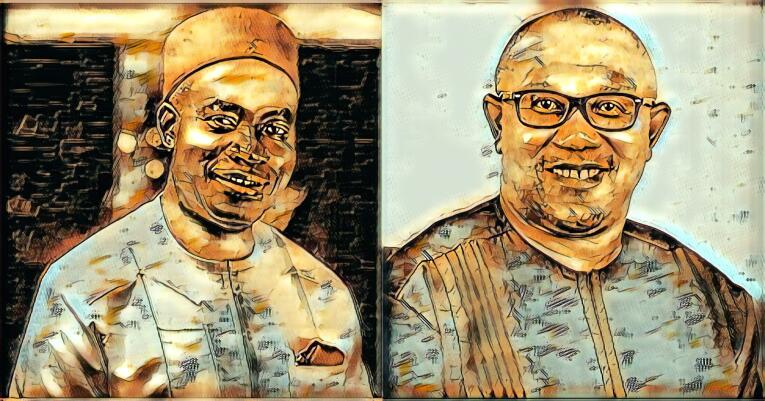
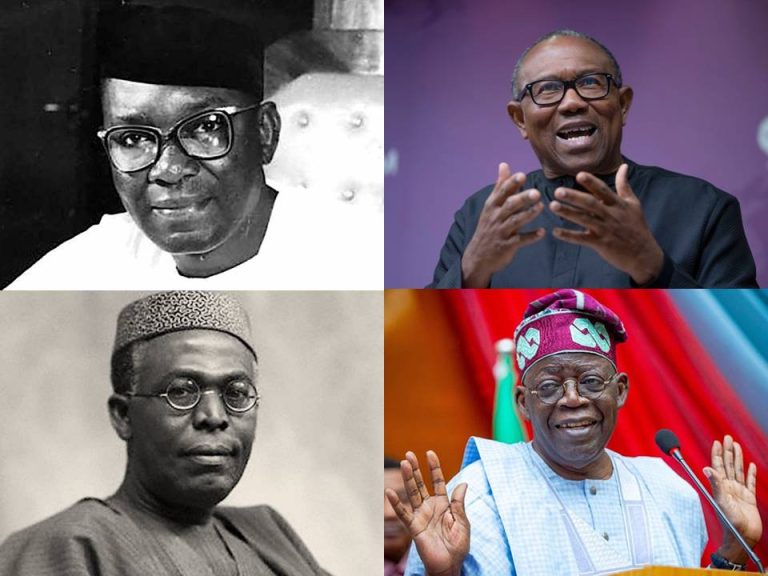
Zik, Obi, Awo and Tinubu

The leading candidates in the 2023 presidential election in Nigeria achieved a regional ballot sweep that their illustrious predecessors only dreamed of – an outcome that may signify the changing sociology of Nigerian politics.

By Chudi Okoye

This certainly isn’t Zik’s and Awo’s Nigeria. No, it’s not. The country over which these political colossi and their contemporaries bestrode seems to have gone, or at least to be rapidly disappearing. And this may be the reason – the fundamental reason – why their formidable but comparatively less accomplished latter-day incarnations have achieved what they could not bring off in their penultimate political outing, or even at the height of their illustrious political careers: win significant votes across the rigid walls of regional constituencies in Nigeria.

One interesting aspect of the 2023 presidential contest in Nigeria is that its frontline reflected to some extent the geopolitical constellation that participated in the Second Republic presidential elections. For instance, for the South East geopolitical zone we might pose the great Dr. Nnamdi Azikiwe of the Nigerian People’s Party (NPP) against Mr. Peter Obi of the Labor Party (LP); for the South West there’s the revered Chief Obafemi Awolowo of the Unity Party of Nigeria (UPN) against Mr. Bola Tinubu of the All Progressives Congress (APC); for the North East we could put up Alhaji Waziri Ibrahim of the Great Nigeria People’s Party (GNPP) against Waziri Atiku Abubakar of the People’s Democratic Party (PDP); and for the North West there’s hallowed Mallam Aminu Kano of the People’s Redemption Party (PRP) against Alhaji Rabiu Kwankwaso of the New Nigerian Peoples Party (NNPP).

Notwithstanding these semblant overlaps, the results achieved by the flag-bearers in the 2023 presidential election were far different – for the most part – from those achieved by their arguably more illustrious geopolitical predecessors. Let’s take Zik versus Obi. In the 1979 election, Nigeria’s foremost statesman secured 16.8% of the national votes, placing third in the national ranking. He secured 82.9% of the votes in Anambra and 84.7% of those in Imo, the two states that made up what we now call the South East geopolitical zone. But, except for Plateau State where NPP co-founder, Solomon Lar, held sway, the political colossus Zik did not get near the 25% mark (originally established by Section 34 A(i)(c)(ii) of the Electoral Decree No 73 of 1977) in any other state of the country. The closest Zik came to that was in Rivers State where he notched up 14.4%. He barely scratched up a vote in Niger State where he had been born (1.1%); and he came nowhere near the mark in Lagos State where he had lived and spent a significant part of his illustrious career (9.6%).

Compare that to Peter Obi’s performance in 2023. Like Zik, Obi also placed third in the national ranking but with a much higher share, 25.4%, according to the currently contested results announced by the Independent National Electoral Commission (INEC). Obi achieved a similar sweep of the South East as Zik had done in 1979, nabbing a whopping 87.8% of the pan-zonal votes. But Obi went way further in other constituencies than Zik had managed. Obi won a commanding vote in Abuja, the federal capital (61.2%). He secured a winning vote in Plateau State, just as Zik had done in what constituted the same state in 1979: 42.9% to Zik’s 49.7%; and he either carried or won significant votes in various other surrounding states: Benue (40%); Nasarawa (35.4%); and Taraba (29.3%). Overall, Obi attained the 25% threshold in 16 states and also in Abuja, carrying 11 of those states plus Abuja. At the zonal level, outside of the South East Peter Obi won 42.4% in South South; 31% in North Central; and 19.9% in South West, even carrying Lagos State, a supposed stronghold of APC’s Bola Tinubu. It was only in the North West and North East that Obi underperformed, scoring 5.2% and 9.2% respectively in those zones.

I should perhaps mention in passing that Obi’s performance simply eclipses that of the other giant of the South East, Ikemba Odumegwu Ojukwu, who only managed an embarrassing 3.3% national share when he contested the presidency in 2003 under the banner of All Progressives Grand Alliance (APGA). Ojukwu fared even worse, with a 0.44% share, when he contested again in 2007. In both elections, the great Ikemba was trounced even in the core Igbo states, a zone he had led to war.

Results of the 2023 Nigerian Presidential Election by Geopolitical Zone

Turning to another giant of Nigerian history, Chief Obafemi Awolowo, we see a similar pattern as the great sage is also outperformed by his 2023 incarnation in Bola Tinubu in the South West. Where Obi was able to duplicate Zik’s sweep of the South East, Tinubu could not quite match Awo’s command of the South West, with the latter ranging from 82.3% to 94.5% across the four states that made up the zone in his day: Lagos, Oyo, Ogun and Ondo States. In the 2023 election, Tinubu did carry the South West, but with a comparatively smaller share of 53.6%. Whereas other parties were unable to make an inroad in the South West zone in 1979, 2023 saw some notable incursions, with PDP nabbing 22.2% share and LP, as we saw, picking up 19.9%.

However, while Tinubu could not repeat Awo’s command of the South West in 1979, he was able to forge cross-cutting regional alliances which enabled him to outperform Awo in other territories. Other than then Kwara State where Awo had scored 37.5% and erstwhile Bendel State where he secured a winning 53.2%, Awo did not attain the required 25% in any other state (he came close in Gongola with 21.7%), though he ended the race in second place nationally with 29.2%. It seems Bola Tinubu has achieved what the incomparable Awo could not, which is the Nigerian presidency, if INEC’s results are ultimately affirmed by the courts. He did that by winning 36.6% of the national votes and scoring the requisite 25% in 29 states, 12 of which he carried. Across the geopolitical zones, Tinubu took sizeable shares everywhere outside the South West: 39.6% in the North West; 38.6% in North Central; 34.5% in the North East and 28% in South South. It was only in the South East that Tinubu’s sun failed to rise, with a pitiful 5.7% share.

As to the ‘face-off’ between North East’s Waziri Ibrahim and Atiku Abubakar, on the one hand, and North West’s Aminu Kano and Rabiu Kwankwaso, on the other, we see the exact same pattern we found earlier – of the newbie achieving a better spread than the grandees of the earlier generation. Where Waziri Ibrahim with his GNPP placed bottom rank with 10% overall in the 1979 election, attaining 25% or higher in just three states (Borno 54%; Gongola 34.1%; and Sokoto 26.6%), Atiku Abubakar, on the platform of PDP, came away in 2023 second-placed with 29.1%, achieving the required 25% in 21 states, 12 of which he carried. Also, while in 1979 Waziri Ibrahim did perform strongly in the North East and did a little well in the North West, he was virtually inconspicuous in any other geopolitical zone. In contrast, Abubakar made substantial inroads in most every zone: 50.6% in the North East; 34.8% in the North West; 25.5% in North Central; 25.1% in South South; and 22.2% (as we saw) in the South West. Once again, it was only in the South East that Abubakar tanked, with just 4.1% share – a humiliating reversal from his party’s previous track record in the zone.

We need not detain ourselves with Aminu Kano versus Rabiu Kwankwaso. With these two, 2023 was basically a repeat of 1979: each carried only Kano State, Mallam Kano with 76.4% and Kwankwaso with 58.6%. Aminu Kano secured 10.3% of the national vote in 1979; Kwankwaso got 6.2% in 2023.

This foregoing analysis raises a question as to why the 2023 presidential frontliners, though arguably far less politically accomplished, nonetheless for the most part far outperformed the more illustrious earlier generation. Obi may have grown in political stature, as I argued in a recent Awka Times piece, but he is no ‘Zik of Africa’. Tinubu is perhaps deservingly acclaimed as a formidable political tactician, but he has nothing of Awo’s personal charm or political magnetism, or Awo’s famed intellectualism. Kwankwaso may be a formidable grass roots politician and may have achieved a comparable result to Aminu Kano’s, but he lacks the latter’s ideological clarity and perhaps his social influence.

What these results show is not necessarily that the newbies are more effective political operators than had been the grandees of the earlier generation. Rather they point to what might be a natural attenuation of primordial politics in Nigeria, arising from factors such as increased urbanization and social integration; improved communication and transportation, enabling greater social migrations; demographic changes, especially with a youth bulge in the population; rising educational levels, as well as other indices of modernization. These factors engender an increasing shift in the Nigerian zeitgeist from Gemeinschaft to Gesellschaft: from a mindset or mental model that focuses on tribal ties and an affectual ‘natural will’ to one increasingly motivated by an effectual ‘rational will’ which stresses ‘society’ and associational relationships. Such a shift avoids the ‘atavistic regression’ – a tendency to revert to ancestral impulses – that likely encumbered the old warriors of Nigerian politics in the Second Republic election. The underlying sociology of the Nigerian political system is changing, and the political newbies are clearly benefiting from it.

I hasten to stress, in conclusion, that this isn’t a claim that primordial sentiments are on irreversible retreat in Nigeria. Politicians will always seek what they consider the least costly and most efficacious path to power, and this may include, when they’re in trouble, whipping up primordial sentiments. We did see something of that even in the 2023 election. But we cannot ignore the fundamental changes that are taking place in Nigerian society, and how these societal changes seem to be scrambling the ancient logics of Nigerian politics.

In a forthcoming article, I hope to examine the case of a particular geopolitical zone (one yet again seemingly short-changed in the 2023 presidential election) and how it might adapt its politics and political strategy in light of this changing social milieu.
Black Swan and Tocqueville Effect: Peter Obi and the ‘Revolutionary Moment’ in Nigeria

0
Peter Obi: The Phenom of the 2023 Presidential Election in Nigeria

Peter Obi won the Nigerian presidential election of February 2023. Probably not so in the statistical sense of ballot share, a matter which is being litigated, but with regard to the quotient of gained prestige and political stature. When assessed against other candidates in the election, Obi is the undisputed ‘Man of the Match’. This final part of a trilogy on the presidential election (see Pt. 1 and Pt. 2) examines the Obi phenomenon and what it might portend for Nigerian politics if consolidated.

By Chudi Okoye

I know – yes, I do! – that right now in Nigeria we are in a season of hyperboles and high-octane emotions. So, dear reader, I will understand if you espied the title of this essay and instinctively sneered at it. ‘Black Swan’ and ‘Tocqueville Effect’? What the heck are those?, you might have asked. ‘Revolutionary moment’ in Nigeria? Give me a break!, you might have gasped. Well, before you contemn or condemn the title, come along let’s unpack the phenomenon to which it alludes.

First, to ensure we are all on the same page, let’s start with concept definitions. If you aren’t familiar with what’s known as ‘Black Swan Theory’, it’s a concept – popularized by Nassim Taleb, a Lebanese-American writer and risk statistician – which explores the logic of random, unexpected or highly improbable events with high-impact outcomes. Mr. Taleb – a former options trader who has taught the Science of Uncertainty and also Risk Engineering at several universities – codified this theory across several books, the best-known of which are: Fooled by Randomness (2005); The Black Swan: The Impact of the Highly Improbable (2007); and Antifragile: Things That Gain from Disorder (2012).

Fascinating titles, right? You bet! The British Sunday Times once described Taleb’s Black Swan as one of the twelve most influential books since World War 2. The guy’s got game!

I have provided details of Mr. Taleb’s titles as an early hint of where I am taking this essay on the Peter Obi phenomenon.

Now, let’s turn to the ‘Tocqueville Effect’, or what’s sometimes called the ‘Tocqueville Paradox’. In my most recent Awka Times article on the outcome of the February 2023 presidential election in Nigeria, I coined the phrase “revolution of rising palpitations” to depict the roiling reactions attending the Independent National Electoral Commission’s management of the election and its now controverted results. I’d coined this phrase as a play on the well-known expression, revolution of rising expectations, invented (back in 1949) by the American diplomat, Harlan Cleveland.

Cleveland formulated this phrase to describe what had come to be known in Social Science as the Tocqueville Paradox which holds that social revolutions are born, often not out of deteriorating conditions and extreme immiseration of the lower classes – as Karl Marx and his followers have argued, but rather from growing frustrations in society caused by rising expectations of improved living conditions and upward mobility, themselves triggered by initial incidences of social progress. In other words, the more social conditions improve the greater the expectation from benefiting classes and the more intolerant they are of any reversal of social change.

This theory of revolution derives from the work of Marx’s contemporary, the 19th century French aristocrat and diplomat, Alexis de Tocqueville, who had studied the social conditions and revolutionary upheavals in America and France and published his findings in books that are now classics of Social Science: Democracy in America (1835, 1840) and The Old Regime and the Revolution (1856). From Tocqueville’s sociology of revolution has emerged a theory that stands Marxism on its head: the claim that revolutionary impulse is driven not so much by the deterioration of social conditions but by the initial improvement of them (which raises standards and expectations) and subsequent reversals (which breed widespread frustration).

With the foregoing, let’s now delve into the Obi phenomenon.

Obi vs. the Big Two
As soon as political party primaries commenced in this electoral cycle, I – like some other analysts – began to write about the Obi phenomenon. Though not awestruck like his fervent followers (yeah, a la Rudyard Kipling, some of us kept our heads while others seemed to be losing theirs!), I have written several articles in this magazine graphing Obi’s political ascent, describing what I called “the Peter Obi Insurgency” in one early piece and, onomatopoeically, “the Pitter-Patter of Petermentum” in another.

Although some newspaper columnists came late to the realization (one once portrayed a presidential field led by “two and a half” candidates, Obi being the “half”), Obi’s campaign did take off with an early tailwind and, showing remarkable agility, he kept building momentum right up to the eve of polling day. I wrote in my recent essay that “Peter Obi is the undisputed star of the 2023 general elections.” Indeed he is. I would add even, without equivocation, that he is the ultimate ‘winner’ of the presidential election, the ‘Man of the Match’.

I don’t mean by this that he polled the highest statistical votes. Obi claims of course that he did, and there’s not an iota of doubt about it among his posse of peppy supporters. But the matter is now being litigated. We will see where empirical evidence leads.

I mean instead that Obi won the election in terms of the quotient of gained prestige and political stature. I argue that Obi garnered the most and grew the mostest among all candidates in this presidential election cycle. I will discuss the details. But let’s look first, as baseline, at how the two other leading candidates tracked in this election, ignoring the rump (the other 15 contestants) in the long-tailed lineup.

Bola Tinubu: Putative Winner of the 2023 Presidential Election (Awka Times reproduction)

Take the putative winner of the election, Bola Tinubu of the ruling party, All Progressives Congress (APC). The dude may have won, as INEC claims, but he comes away from this shoddy affair utterly discredited. For a start, his party APC lost a whopping 6.4m votes and dropped 19 percentage points in 2023 versus its vote share in 2019. Tinubu depleted his party and he will govern, if the courts confirm his ‘victory’, with a truly questionable mandate. Of the 93.5m registered voters and 87.2m of them who collected their PVCs, only about 24m assumedly voted, of whom just over a third, 36.6%, cast their votes for the ruling party’s candidate. As an even grimmer statistic, the 8.8m that voted for Tinubu represent only 9.4% of registered voters and something like 4.1% of the total population. This would be about the most impaired mandate of any president since the Second Republic. It trumps only by a few percentage points the 33.7% of votes garnered by Alhaji Shehu Shagari in the 1979 presidential election in which the latter, anyway, had to face some juggernauts of Nigerian politics, including Dr Nnamdi Azikiwe, Chief Obafemi Awolowo, Malam Aminu Kano and Alhaji Waziri Ibrahim. Every other winning ticket since then outperformed Mr. Tinubu’s squeaker in this election.

But it isn’t only the stats that startle about Mr. Tinubu. There’s also the image thing; the character thing; the reputation factor. It’s not just the niggling concern about Tinubu’s health, which is no mean matter by itself: look how sick Nigeria became under a sickly Muhammadu Buhari. It’s also the unshakable stench that pervades this man’s personal reputation. There’s financial scandal, with no one really certain about the source of Tinubu’s stupendous wealth. There’s drug scandal, which now has the world sniggering about a Nigeria soon to be ruled by a shady fellow implicated in drug trafficking. With his antecedents and the manner of his emergence as president, Tinubu will confirm the worst stereotypes about Sleazy Nigeria. He will sweep into Aso Rock trailing a cloud of moral turpitude which may not lift until he leaves office. Tinubu may be reputed as a political tactician but there’s just a foulness of form and fame that follows him which even the presidency cannot deodorize. It seeps through his allegedly porous pants into his political base and carries into all the crannies of his political universe. Tinubu, alas, will represent the ultimate cartoonification of the Nigerian presidency.

Atiku Abubakar: Key Loser in the 2023 Presidential Election (Awka Times reproduction)

Turning to Mr. Atiku Abubakar, there’s nothing after this election but a flotsam, the wreckage of a once promising political career tarnished by repeated defeats, corruption scandals and the stigma of betrayal. He’ll be remembered not just as the man who made it impossible to evict a hollowed ruling party but also someone whose ambition filibustered the possibility of a president of Igbo extraction and, thus, a chance finally to exorcize the demons of the Civil War. Abubakar’s political denouement is both sad and sickening. He leaves the stage with his party, the People’s Democratic Party (PDP) – under which he served as VP and whose ticket he has led in two elections – hugely shrunken and deeply fractured. It is a most unedifying legacy.

And so we arrive at Peter Obi.

The Obi Phenomenon
I am on record for questioning the exorbitant claims about Obi’s record as governor of Anambra State. I am from the state, so I know the truth and have not swallowed some of the fictions peddled by some of Obi’s supporters – and sometimes by Obi himself. This is not to say that Obi didn’t perform well as governor. He did. It just isn’t as outstanding a record as is often portrayed.

Obi also earns a slap on the wrist for his rapid flight from PDP when, it seems, he sensed some force fields against his prospects in the party’s primary. Obi’s exit certainly contributed to the fragmentation of PDP, an unfortunate reality which redounded to APC’s electoral advantage, as I argue in an earlier piece.

Obi might share in the blame for the consequence of PDP fragmentation, but, unlike Atiku Abubakar, he has a redeeming card in what he accomplished in this election from the platform of his destination party.

There are two ways to calibrate what Obi has accomplished – one, by the numbers; the other, normative.

The numbers are just staggering. Let’s recall where the Labor Party stood at the time Obi decided to join it after decamping from PDP. The party was nothing and it was nowhere. It had not a single seat anywhere, not at national or sub-national level. It did once boast a governorship and a House of Reps seat, but at the onset of the 2023 election cycle the party had nothing and it existed only on paper. The status of Labor as an electoral force is best depicted by its performance in the 2019 presidential election: of the 27.3m valid votes cast in that election, Labor scooped up all of 5,074 votes; that is, 0.02% of the total.

Yet, within just one election cycle, with Peter Obi’s diligent electioneering – and without merging with any other party – Labor went from that incredible state of absolute nothingness to being, now, a notable ‘Third Force’ in Nigerian politics. In the 2023 presidential election, Labor scooped up 6.1m votes, representing 25.4% of total valid votes cast in the election (PDP – a previous 16-year incumbent which fielded a veteran of five earlier presidential elections as its flag-bearer and which still controlled many governing and legislative seats – secured only an equivalent 6.98m votes or 29.1%). Labor carried the federal capital Abuja (where Buhari resides!), winning a whopping 61.2% of the votes there, which meant no other party approached the 25% threshold in the FCT (an achievement which might be critical in the ensuing election litigation). Labor also carried 11 states, and won 25% in a total of 16 states (APC and PDP carried 12 states apiece). The states carried by Labor included Lagos, a state Tinubu had governed for two terms and which he supposedly still controlled as political godfather. Furthermore, on current tally of the National Assembly elections, Labor has won seven Senate and 34 House of Representatives seats. And permutations are that the party is poised for significant wins in the upcoming state assembly and governorship elections.

There is no other way to put it: this is a monumental change in political fortunes for the Labor Party. And it’s down, simply, to a single factor: the capture of the party by Peter Obi.

The achievement is even more compelling when you consider other fallouts from these electoral facts. Obi has now emerged, indisputably, as a national political figure – from just four years ago when he was merely Atiku Abubakar’s nondescript running mate who barely registered on the Richter scale of national politics. He now has a fervent political following: a discrete, trans-regional, supra-generational, multi-demographic following with a strong affinitive identity and intense loyalty attaching exclusively to the person of Obi, not necessarily to his party. The remarkable thing is that although Obi is in his 60s, he has emerged as the avatar of generational change and symbol of post-primordial politics in Nigeria. There are still some sentiments attaching to Peter Obi as perhaps the embodiment of the hope for a geopolitical correction which will see a person of South East extraction catapulted to the apex of power in Nigeria. But this sentiment is not at all primordial in its aspiration; it is merely a yearning by South-easterners for re-integration into the grand diagram of power in Nigeria. Nigeria itself needs this correction, perhaps more so than its seekers!

This is a truly remarkable achievement, the more so – going back to our opening theoretical metaphor – for its Black Swan effect. The story of black swans is that no one believed they existed; it had been thought, in the West at least, that all swans were white. All that changed in 1697 when the Dutch explorer, Willem de Vlamingh, discovered black swans in Australia. This is the story of Peter Obi and the Labor Party. The party was totally inconspicuous in the arena of politics. And its nouveau venu, Obi, though better-known than the party, had been merely governor of a mid-sized state in the smallest geopolitical enclave in the country, one described as a “dot” by a certain dolt in Aso Rock. Sure, Obi occasionally popped up in national consciousness as something of a public intellectual grappling with sundry national issues. But he was just that, an occasional public intellectual without a discernible power base. Until Obi’s campaign took flight, few could have anticipated his incarnation as a canny political operator now with a proto-movement which could, if nurtured, disrupt the fundamentals of Nigerian politics.

Up until this election cycle, it had been believed – and our election statistics affirmed it – that fringe parties were merely an accounting fiction in Nigerian politics, without electoral force or efficacy. Though we had 18 registered political parties, Nigeria was really a de facto two-party state dominated by shifting coalitions of the political elites. Now, this election has started what could upend such presumption about Nigerian politics.

It might be thought that the Third-Force breakthrough engendered in this year’s elections is ephemeral; that it is merely a temporary aberration and that soon – perhaps by the next election cycle – we will witness a ‘regression to the mean’, as we say in my analytics profession: a reversion to the rigid orthodoxies of Nigerian politics. Perhaps. But this is where our second theoretical reference kicks in: the thing about the Tocqueville Effect. Hitherto, the rigidities of Nigerian politics discountenanced the deep currents of social change taking place in the country. There’s a youth bulge in Nigeria’s demographic structure which creates a peculiar impulse to change and a Weltanschauung totally unaccommodated in the insular praxis of our politics. Now, with Obi’s ascendancy, this impulse and its worldview may finally have found a mainstream political outlet and, if nurtured may compel its ethic of progressive change upon our politics.

Much depends on what Obi decides to make of his political career from here on out. If he settles in his mind that his departure from PDP constituted a revolutionary break with establishmentarian politics, and if he feels he has the stamina for it, he might want to nurture his proto-movement into a permanent force in Nigerian politics. Sometime last year, I wrote a poem titled “Rise Up!” to celebrate Obi’s exit from PDP and the dawn of his new mission. In it, I wrote:

The old party’s primary was his epiphany
To stop palling around with men of infamy
He felt a great vocation newly beckoning
Which he must give the fullest reckoning

I hope Peter Obi fixates on that mission, and that he can enlarge his vision to embrace its full revolutionary potential. Modifying the old, well-known Edmund Burke saw about good and evil, I’d say the only thing necessary for evil to triumph is not merely that good men do nothing, as the Irish statesman and philosopher said, but that they bungle what good they get to do. St. Augustine said to build a tower that will pierce the clouds, one has first to lay a foundation of humility. Obi is humility personified, at least going by his public image; a Black Swan that may become a real force in Nigerian politics.

As a social scientist and journalist, I can’t be partial to any partisan tendency. But, for the sake of our much-abused country, I will be rooting for Obi, if he pursues a revolutionary agenda.

Nigeria’s 2023 Presidential Election Outcome: Pre-Mortem on the Opposition’s Legal Recourse

0
INEC's Mahmood and APC's Tinubu

There may be a prima facie case of aggravated infractions in the just concluded presidential election in Nigeria. However, it might be challenging to meet the high burden of proof the courts would require to overcome the need for system preservation and vacate an officially declared presidential election result.

By Chudi Okoye

Even in the separate ‘world’ press conferences they held to oppose the controversial presidential election result that INEC had just announced, the two main opposition parties could still not agree. The events were intended to showcase the opposition’s grievances and their plans to recover a supposedly stolen mandate. But even in this, the parties presented conflicting claims.

At his press event held on March 2nd, the day after the final results were announced by the electoral umpire, INEC, Peter Obi of the Labor Party (LP) – looking sombre and emotionally exhausted – declared that he had won the election and that he was heading to court to prove it. Soon after that event, the media team of the putative winning party, All Progressives Congress (APC), issued a caustic riposte – which was part dare and part prebuttal – taunting Mr. Obi and saying they would meet him in court. The complainant seemed more complaisant than the accused, though each played to their usual style: Mr. Obi understated; Tinubu’s attack dogs bristling with bravura.

For his part, the flag-bearer of the People’s Democratic Party (PDP), Atiku Abubakar, whilst not at the point avouching his victory, was nonetheless hailed by his boisterous party entourage as the winner of the election. Atiku would not say affirmatively that he was headed for the courts, only that his legal team was studying the facts and that he awaited its advice.

These two candidates, PDP’s Abubakar and LP’s Obi, came the closest as first and second runners-up to Bola Tinubu, presumptive winner of the presidential election in Nigeria, which held on February 25 2023. Their parties have been the loudest in alleging irregularities in the election process, while other opposition parties have offered only murmurs of disapproval or absolute silence.

Incompetence and Alleged Collusion
The management of the 2023 presidential election was by no means a model of excellence. The easiest case that can be made against INEC (Independent National Electoral Commission) is one of gargantuan incompetence. This was seen the most in its clumsy management of techinal operations, especially in troubleshooting the glitches and snarls in its blockchain technology set up for election data storage and transmission of results. It was also revealed in the commission’s cack-handed and insensitive manner of responding to complaints from voters and opposition parties. The impassive disposition of Professor Mahmood Yakubu, INEC Chairman, amid a din of public and partisan denunciations, only added to the mounting frustration. It seemed at times as though a placid academic was leading a flaccid organization. Professor Yakubu’s deportment mirrored the notoriously blasé attitude of President Muhammadu Buhari in his current round of ruining (sorry, running) Nigeria’s affairs.

INEC’s evident incompetence and the indifference of its leadership gave vent to a vexed accusation of collusion with the ruling party, including allegations of vote suppression, voter intimidation and misallocation of ballots. These all need to be tested through an election tribunal and eventually the courts, as provided by law.

Election results are always vigorously contested in Nigeria. The First Republic saw a plethora of post-election litigation, most notably suits and countersuits involving Chief Obafemi Awolowo and Chief Samuel Akintola in the Western Region. All presidential elections since 1979, except for the 2015 election, ended up in legal contestation. Post-election litigation in Nigeria might appear reflexive but perhaps they are unavoidable in a contentious democracy where political power intersects with economic and social status, such that most elections become but an existential struggle.

The history of presidential election litigation in Nigeria is daunting, though, for any hope of easily petitioning the 2023 shambles. No presidential election petition has ever been decided in favor of a petitioner, and none has led to election annulment (except in one case, by the military). Even so, there seems to be a strong prima facie case of actionable infractions in the 2023 election praxis. At the very least, there may be a meritable case with regard to vote suppression or voter intimidation; or one based on the legal theory that the incompetence of INEC might have upended the natural outcome of the election.

The headline data pertaining to the election are quite disturbing, and they suggest a need to dig deeper to find out what happened. In the 2019 presidential election, Nigeria had a total of 82.3m registered voters and 27.3m valid votes, indicating a valid voter turnout of 33.2%. By 2023, the registered voter base had increased by a net of 11.1m (or 13.5%) to 93.5m. Still, in spite of this notable increase, valid votes in the 2023 election supposedly dropped 12.1% to 24m, giving a voter turnout of 25.7% in the election. In other words, these headline figures would have us believe that the country registered a lot more voters in 2023 but far fewer of them turned up to vote, compared to the previous election. It just doesn’t make sense, except of course if it is thought that the currency change initiative and fuel scarcity, occurring in the lead-up to the election, had a vote-depressing effect.

There’s certainly something pointing to likely misfeasance or even outright voter disenfranchisement in the management of the election. And these are litigable.

Election Litigation
As at the time of this writing, the wheels of election litigation are just beginning to turn. On March 3rd, Peter Obi of the Labor Party filed an ex parte application at the Court of Appeal sitting in the federal capital Abuja seeking access to all the sensitive materials that INEC deployed for the conduct of the February 25 presidential election. The appellate court, with Justice Joseph Ikyegh presiding, granted the application for both Obi and the PDP candidate, Atiku Abubakar, who had filed a similar application. This court will eventually sit as the Presidential Election Petition Tribunal.

We will see how the cases evolve. Awka Times contacted some legal experts to assess the chance of the election being nullified, either by the Election Appeal Tribunal or the Supreme Court. None of the lawyers would speculate on the likely outcome at this point, since no substantive case has been filed by the aggrieved parties. One lawyer, Barrister Eustace Odunze, told Awka Times: “There are a lot of video recordings showing likely infractions during the recent elections, but they have to be packaged as credible and admissible evidence in a substantive court case, and one needs to study them to be able to offer an informed opinion on the possible outcome.”

So we have to wait.

As the parties and their candidates began to prepare their petition, there was an unexpected case filed at the Supreme Court by six PDP-controlled states – namely Adamawa, Akwa-Ibom, Bayelsa, Delta, Edo and Sokoto – seeking a cancellation of the February 25 election and a nullification of Mr. Tinubu’s declaration as president-elect. The states had initiated their case on grounds of gross irregularities pertaining especially to the transmission of results. It had seemed like a deliberate legal strategy to have the states file a possibly expedited case at the apex court while the aggrieved candidates begin their own challenge with an election tribunal, as required by law (Section 132 of the Electoral Act 2022). Indeed a legal expert, Barrister (Dr.) Peter Ntephe, contacted by Awka Times, argued that this was an “interesting and novel strategy.” But he said he doubted if the states’ case would be “taken to conclusion.”

Similarly, Barrister Odunze, citing Section 232(1) of the 1999 Constitution, told Awka Times that he was unsure of the efficacy of the states approach. “I do not understand why the states have decided to go straight to the Supreme Court on a matter that should go to the election tribunals,” Odunze said. “If the Supreme Court assumes original jurisdiction and rules on this matter brought by the states against the FG, then it has effectively ousted the powers of the election tribunals.”

Shortly after these chats with Awka Times’ legal experts, news broke that the case instituted by the PDP governors had been withdrawn. Awka Times reached out to the lead counsel for the plaintiffs, Chief Mike Ozekhome SAN, to verify the news and ascertain the reasons for discontinuance. Ozekhome confirmed the discontinuance, and told Awka Times it was “because [the petition] has been overtaken by events.”

It would seem that the case was withdrawn because the actual aggrieved parties – the presidential candidates and their parties – are making headway in their own legal foray. A substantive case by the PDP governors might have complicated or even confused the legal strategy. It’s also far from certain, anyhow, that the Supreme Court would have taken up this particular case.

Prospects for Election Petition
The opposition parties may yet succeed in their election petition, but they have been far from sprightly in pursuing a legal recourse. The parties had been on the back foot throughout the crucial stage of national results tabulation. Their representatives huffed and puffed, stomping around at the national collation centre in Abuja as results were released, simultaneously complaining about the slow transmission of results from the outposts and then the over-hasty announcement of results. They also raised issues about discrepancies between the nationally declared results and field tabulations which were supposedly in their possession. Saying the process was like a “garrison operation” for a pre-determined outcome, they called for a cancellation of the whole election and demanded a do-over. They asked for INEC chairman to step aside because they’ve lost confidence in him. In all of this, however, the opposition parties appeared at that point to rely more on moral suasion to make their case than seek a forceful legal recourse. None of the parties took a purposive legal step to stop the announcement of results, even when it seemed there was reasonable ground to do so.

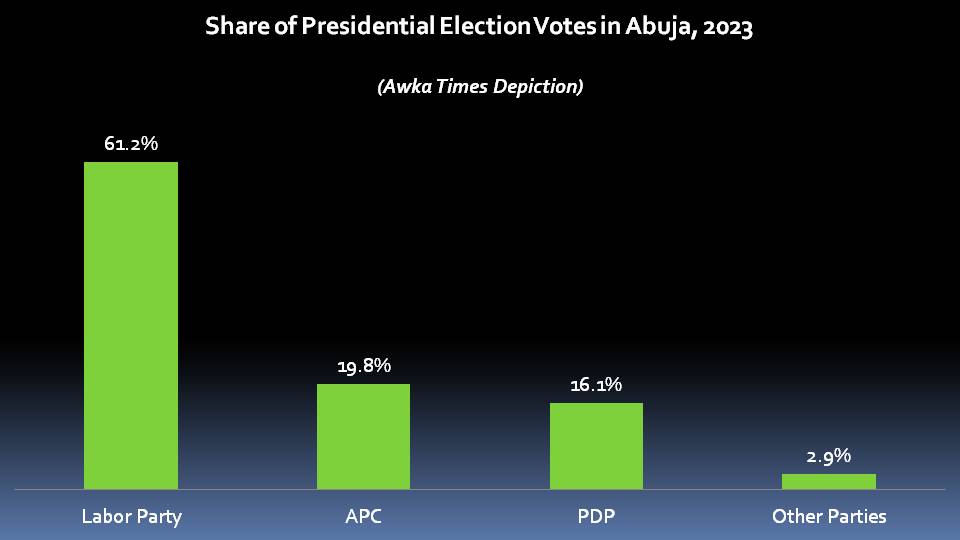
Consider, for instance, the controversy surrounding the status of Abuja, and the results for the federal capital in the 2023 election. Of the 460,071 valid votes cast in the FCT, Labor secured a commanding 61.2%; APC 19.8%; PDP 16.1%; and other parties 2.9%.

Share of Presidential Election Votes in Abuja, 2023

As INEC neared the end of its announcement of results at the national collation centre and it appeared that APC might have an edge, the issue of Abuja erupted. The issue centers on whether a winning party specifically requires a minimum of 25% share of votes in the federal capital, or whether the constitution construes Abuja merely as another state. Section 134(2) declares that:

“A candidate for an election to the office of President shall be deemed to have been duly elected where, there being more than two candidates for the election, he has the majority of votes cast at the election; and he has not less than one-quarter of the votes cast at the election in each of at least two-thirds of all the States in the Federation and the Federal Capital Territory, Abuja.”

One interpretation of the above provision may be that Abuja is a unique constituency and that a minimum of 25% share of FCT votes is required for a winning ticket. Yet, on a different interpretation Abuja may be construed merely as another state and not as a special case. This interpretation would seem to be supported by Section 299 which states that “the provisions of this Constitution shall apply to the Federal Capital Territory, Abuja as if it were one of the States of the Federation.” Yet, the matter is complicated by the fact that in several other regards (for instance the requirement at Section 147(3) that each state must provide a federal minister), the constitution does not accord Abuja the status of a state. There is therefore some ambiguity as to whether Abuja is a special case for the purposes of federal election.

The issue is pivotal since we’ve seen that none of the political parties, except Labor, attained the threshold of 25% in Abuja in the 2023 presidential election. As the announcement of results neared an end, APC spokespeople, showing remarkable nimbleness, suffused media outlets with a narrative that a 25% threshold in Abuja was not required. In one instance on Channels TV, a pro-APC attorney cited the petition brought by then challenger Muhammadu Buhari against President Olusegun Obasanjo in the 2003 presidential election. The attorney claimed that the issue of the status of Abuja was dispositioned in that case, and that a separate 25% threshold was not required for the FCT. But a reading of the judgment in that case by Awka Times does not indicate the issue was specifically addressed, let alone settled.

As the APC spokespeople propagated their own interpretation, clearly intending to influence both public opinion and even INEC view, I barely espied any opposition lawyer picking up the matter. The opposition parties should probably have sought a court order preventing INEC from announcing the winner of the election, pending a proper interpretation by a competent court. But, here again, they dropped the ball.

Perhaps, the opposition parties stayed their hands out of patriotic concern, mindful of the historical instance when the late Arthur Nzeribe’s Association for Better Nigeria (ABN) attempted through a court process to prevent the June 12 1993 election from holding. Failing to stop the election, ABN later secured a court order commanding the National Electoral Commission to suspend the announcement of election results. The great uncertainties attending ABN’s legal forays at the time had plunged the nation into a deep trauma of political instability and resulted, by design, in an extension of military rule. While it is commendable that the opposition may have stayed their hand out of patriotic concern, the parties might still have found a redeeming legal recourse to suspend the announcement of results without necessarily plunging the country into political chaos. After all, such concern did not stop the ruling party, APC, from taking legal action to stop the opposition parties from interfering with the announcement of results!

The same nimbleness has seen the ruling party moving fast, since INEC concluded its announcement of results and certification, to consolidate its candidate’s ‘victory’. Mindful of the logic of ‘adverse possession’, the ruling party has been busy creating “facts on the ground,” lining up stakeholders (Dangote, IBB, various constituencies, foreign governments, etc.) to show growing acceptance of Mr. Tinubu’s ‘victory’. The party is cleverly and deliberately raising the cost of any idea of nullifying the election, knowing that a conservative apex court would err on the side of system preservation, rather than hand down a ruling capable of heating up the polity. APC clearly has a nuanced understanding of game theory, more so it seems than the opposition had initially revealed.

To be fair, the opposition parties may now be becoming more planful and surefooted in their search for legal redress. I am becoming a little impressed with their approach. I still, however, detect a kink.

All through this post-election drama, I have wondered despairingly how to reconcile the Labor Party’s spectacular wins in these recent elections and the party’s demand for a cancellation of same elections based on allegations of ‘widespread fraud’. APC operatives appear as well to have alighted on this apparent contradiction. In its statement welcoming Mr. Obi’s legal challenge, the party insisted that “the 2023 election [was] one of the most transparent and peaceful elections in the history of Nigeria,” and that it was “because the process was credible [that] Mr. Obi’s Labor Party [was able] to record the over six million votes it got, contrary to pre-election forecast.”

The ruling party further asserted, in an inspired piece of prebuttal, that:

“Mr. Obi surprised bookmakers by winning in Lagos State, Nasarawa, Plateau, Delta and Edo where there are sitting governors of either the All Progressives Congress or the Peoples Democratic Party. Those governors have entrenched political machinery. That Obi won attests to the credibility of the election process. In those states, most of the sitting governors contested election to go to the Senate and lost to little known candidates of the Labor Party. The Labor Party also swept the entire five South East states under the control of either APGA, PDP or APC. We believe that the Labor Party presidential candidate contradicted himself… by suggesting that the election was only credible in states and places his party won.”

APC operatives also zeroed in on what could be a vulnerability, if ignored, in building Obi’s legal case. We know that the Labor Party had been able only to submit names of polling agents in 134,874 of the 176,606 polling units, and that it had only 4,859 collection agents which amounted to half the number for each of the major parties. It would be tough for Labor, which is now supposedly crowd-sourcing polling data, to aggregate credible and admissible evidence from polling units where it had had no official representation. APC’s spokespeople had picked up on this seeming deficiency, arguing that Mr. Obi “will have to convince the court with his allegation of rigging in over 40,000 polling units across the country, especially in North West and North East, where his party had no party agents and did not sign result sheets as required by law.”

It is a strong argument, no question. But this is not to say that APC itself is in an unassailable position. The party has gone on record with its own allegations of fraud and other malpractices in the 2023 election, just as the opposition parties have claimed. Whilst proclaiming on the one hand that the 2023 election was properly conducted, the party also claims on the other hand to have “evidence of voters suppression, intimidation and harassment in South East, especially of those who came out to vote for our party.”

This claim has prompted a reaction from the opposition PDP. A statement by the office of the PDP presidential candidate argues that APC’s “claim that there was massive rigging in the southeast and that the APC will be challenging the votes in that region validates our position that this election was fraught with irregularities. This is the reason we are seeking the cancellation of the results.”

We are thus in a somewhat unpredictable situation. The ruling party seems to be agreeing with the opposition parties’ assertion that the presidential election of February 25 2023 was deeply flawed. Yet, proving the allegations on either side might be a huge challenge, especially to the degree of clarity that would be required to overcome the residual need for political stability and system preservation.

All told, there would seem to be only a slight chance, though it is not improbable, that the election tribunal or the Supreme Court will cancel the election and order a re-run.


Nigeria’s 2023 Presidential Election Outcome: Post-Mortem on the Opposition’s Tactical Moves

0
Main Opposition Candidates, Peter Obi and Atiku Abubakar

The fragmentation of opposition forces and their tactical blunders may have been the decisive factor that shaped the outcome of the 2023 presidential election in Nigeria.

By Chudi Okoye

In the immediate aftermath of the 2023 presidential election in Nigeria, conventional wisdom both within the opposition parties’ high command and among their ranks seems to be that the ruling party, All Progressives Congress (APC), finagled a victory through concerted collusions with the electoral umpire, the Independent National Electoral Commission (INEC). This belief is deeply held and it animates a continuing agitation, within Nigeria and beyond, against the results announced by INEC on March 2nd. It also informs the legal effort now forging in opposition circles to challenge INEC’s official election results.

In our febrile post-election environment, marked by what I might sympathetically call a revolution of rising palpitations, there has been much abounding ‘evidence’ floating in social media and elsewhere seemingly supporting the clamored allegation of an electoral heist. I examine the case and prospects for the emerging legal challenge in another Awka Times piece. Here, I plan to focus on a different issue which quite possibly impacted the election outcome in an even more decisive way.

Divided Opposition
Whatever might be said about the actions of the umpire, perhaps the more poignant story of the 2023 presidential election is the spectacular failure of the opposition to take advantage of the ambient conditions. This election should have been a cinch, an easy clinch for a united and focused opposition. The ruling party, APC, has thoroughly mismanaged the country, with an economy that is teetering and a society sundered to a level far worse than what the party inherited on assuming power in 2015. By any measure we can imagine, the ruling party has been an unmitigated failure, and it should have been handily defeated in the 2023 election.

And, in a way, it was. Except that the losses incurred by the ruling party, rather than accrue to a unified opposition, dissipated across three presidential candidates who once all belonged to the main opposition party, People’s Democratic Party (PDP).

Let’s look at the numbers. The ruling party, APC, had won the last presidential election (in 2019) with 15.2m votes (a 55.6% vote share). In 2023, the party ‘won’ again – according to the currently disputed official results, but with 8.8m votes (36.6%), suffering a 42% vote loss. In contrast, the main opposition party, PDP, had a haul of 11.3m votes (41.2% vote share) in the 2019 election which it lost. In the 2023 election, however, the three PDP and offshoot opposition candidates – PDP’s Atiku Abubakar and two decamped stalwarts of the party: Peter Obi in the Labor Party (LP) and Rabiu Kwankwaso in the New Nigeria Peoples Party (NNPP) – together polled a total of 14.6m votes, amounting to a combined share of 60.7%. In other words, compared to 2019, the PDP splinter tickets had increased their combined votes by 29%. It would have been enough to easily dislodge the ruling party, had the PDP stalwarts remained united.

It cannot be gainsaid that the opposition parties’ strategic blunder was the primary reason for their electoral misfortune in 2023. This fact gets forgotten in the fevered aftermath of the election, with the opposition parties and their enraged supporters focusing only on the possible collusion between the electoral umpire and the ruling party. In 2013, in order to take on then incumbent PDP, various political formations had come together – including Action Congress of Nigeria (ACN), Congress for Progressive Change (CPC), All Nigeria Peoples Party (ANPP), a breakaway faction of the All Progressives Grand Alliance (APGA) and a faction of PDP (nPDP) – and formed APC. The new party would win power in the 2015 election, toppling a 16-year incumbent. By contrast, in 2022, rather than join forces to face a fumbling incumbent, leading aspirants in the opposition PDP – uncertain about their prospects in a deeply machinated PDP primary process which was unfolding – fled to fringe parties where they could easily snag presidential nominations. Kwankwaso decamped to NNPP in March 2022; Obi left two months later, as we reported in Awka Times, just before the PDP primary election got underway. He promptly snagged the Labor Party’s nomination.

These departures clearly wounded PDP, as the 2023 election results reveal. Consider, for instance, how PDP collapsed in 2023 versus 2019 in the five states in Obi’s South East geopolitical zone, as we show in the chart below. The most precipitous drop was in Anambra and Enugu, from 86.6% to just 1.5% and from 84.5% to 3.5% respectively. Zone-wide in the South East, PDP’s vote share tumbled from 76% in 2019 to just 4% in 2023. It was, to tell it as it is, a complete rout.

PDP Share of Presidential Election Votes in the South-Eastern States: 2019 vs. 2023

Compared to PDP’s annihilation in the South-eastern states, there was a milder yet noticeable slide in support for the party in Kano State, Kwankwaso’s stronghold. There, the party’s vote share dropped from 20.7% in 2019 to 7.7% in 2023. The major loss in the state was for APC, which saw its share tumble from 77.5% to 30.4%. Kwankwaso’s NNPP mopped up a 58.6% share in the state, hauling the highest state vote of any party in the entire election.

PDP also suffered significant losses in the states controlled by the so-called ‘G5 Governors’. These are a dissident cohort of PDP governors – in Abia, Benue, Enugu, Oyo and Rivers States – stirred by the seeming northern domination of PDP high command. The group was particularly critical of the violation of the party’s zoning arrangement which should have seen the presidential ticket go to the South in this election cycle. The G5 Governors tried without success to have other key party positions, specifically the chairmanship, ceded to the South, once northerner Atiku Abubakar had emerged as party flag-bearer. For this reason, the governors took it upon themselves to frustrate the party’s campaign in their respective states. Some flirted with the competition or surreptitiously worked against their party’s ticket. The effect is clear in the election results. We’ve already seen the heavy erosion in the two South-eastern states in the G5 cohort: Abia and particularly Enugu. In Benue State, PDP share dropped from 48.9% in 2019 to 16.9% in 2023; in Oyo State, from 43.8% to 22.6%; and in Rivers State, where gang leader Nyesom Wike holds sway, from 73.8% all the way to 16.9%.

The internal combustion of PDP this election cycle has seen the party shrink even further from its formerly formidable size. In the 1999 presidential election, the first in the Fourth Republic, PDP ramped up 62.8% of the total votes with Olusegun Obasanjo leading its ticket. In subsequent elections in 2003, 2007 and 2011 which the party won, it secured respectively: 61.9%, 69.6%and 58.9%. In the two previous elections that the party lost, it saw its share of vote somewhat denuded, but nothing as precipitous as the loss in 2023. In 2015, PDP secured 44.9%, and in 2019 it garnered 41.2%. In 2023, the party’s share of votes slumped to 29.1%.

To be sure, the other wing of Nigeria’s erstwhile governing duopoly, APC, also took a beating this cycle. A party that commanded 53.9% of votes to win power in 2015 and 55.6% to retain it in 2019, managed to eke out a disputed victory in 2023 with a mere 36.6%. Whereas APC had won with a handy majority in the past, it only squeezed through this cycle – to an extent because the party had managed to contain its own internal crises, but certainly because of the folly of a hubristic opposition that could not join forces against a bumbling incumbent.

Inflated Expectations
When you think about it, the saga of the main opposition’s strategic failure seems almost Shakespearean. At the beginning of this election cycle, particularly at the onset of party primaries, there had been calls – including by me in a June 2022 piece – for electoral alliance between the main opposition parties. This would have required of course that some aspirants step down for a unified candidate. However, blinded by their burning ambitions, none of the contenders would budge. They all decided to fight the election from separate party platforms.

Why any of the dispersed opposition candidates thought they could win the election on their own, with dissipated forces, remains a mystery. What in the world, for instance, made Kano strongman, Kwankwaso, think he could win the presidency, being a completely unknown quantity in most parts of the country?

What made Atiku Abubakar think he could overcome a predictable erosion of support in former PDP strongholds now controlled by his estranged affiliates, Messrs. Obi and Kwankwaso? Or indeed that he could overcome the hostility of the G5 governors in their respective states?

Come to think of it, what made Peter Obi, a virtual upstart in the national arena, think he could romp to victory on the flank of a fringe party with not a single seat at any level of government? I had warned about this in a June 2022 piece for Awka Times in which I expressed skepticism that Obi’s “flight to the fringe will foster the presidential quest of the South East geopolitical zone, [or] prove a successful strategy for him personally.” Whilst acknowledging Obi’s insurgent promise, I wrote that “it is doubtful if any politician, not even one as fortunate and formidable as Peter Obi, can win the presidency from the periphery of Nigerian politics.”

In yet another piece in 2022, I wrote as follows: “The political ascent of Peter Obi is evident; some even think his presidential quest is providential. Does Obi have a date with destiny, or will ‘Obistructionist’ forces rise up to impede his progress? The wind may be in Obi’s sails, but there may be ‘Obistacles’ ahead [that] he and his supporters should prepare to confront.”

A few days to the presidential election, I returned to the same theme, writing that:

“The unspoken issue in Nigeria’s impending presidential election is the tension between who ought to win and who might actually win the election.”

I pointed out again that there could be resistance to the change momentum embodied in Obi’s political surge, and that field manipulation tactics could be employed to prevent what ‘ought to be’ from actually ‘becoming’. This appears to have played out in the unfolding reality of the election.

Peter Obi deserves enormous credit for what he has accomplished for Labor, a party one couldn’t find hitherto in a haystack. With Obi’s star power and unquestioned diligence, Labor chalked up a string of National Assembly seats in the just concluded elections (seven Senate and 34 House of Representatives seats), and it seems to be poised for a winning streak in the upcoming state elections. Obi may have broken – for now at least – the dominance of the governing duopoly; and with his populist appeal and post-primordial rhetoric, animated previously politically inert sections of the population, particularly the youths. In my opinion, Peter Obi is the undisputed star of the 2023 general elections.

Even so, however, there are structural constraints which, as dazzling as he is, Obi could not overcome in one election cycle. By moving away from PDP, Obi abandoned the norm in Nigeria of a path to power based on elite negotiation and chose instead a populist approach. Nigeria has never tolerated a populist path to power, whether under colonial rule or military regime, and not even in civilian dispensations. That move, thus, signaled danger to the ruling elites, which must be stopped by all means necessary. The electoral frauds allegedly perpetrated in this past election were undertaken in service of that objective, as I had predicted.

Epilogue
Though the outcome of this election was somewhat predictable given the main opposition’s tactical choices, it is to be regretted that the challengers could not have worked together to preempt the logic of that outcome. Consider, if you will, what might have happened had the PDP got its act together and stayed intact as one party, avoiding the egofest that led to ticket fragmentation and self-sabotage. Had the party managed to contain its fissiparous forces, Nigeria might today be celebrating a second instance of a ruling party losing to the opposition – an advance in our democratic journey – rather than the spectacle of an underperforming incumbent party retaining power through what seems like grubby electoral machination.

The evidence is clear and the conclusion inescapable: it is not so much that the ruling party, APC, ‘won’ the 2023 presidential election; it is rather that the main opposition parties may have lost it. These parties saw electoral victory looming, but they reached in and pulled out an ostensible defeat. Sad.

And The Voters Went Out To Vote

0
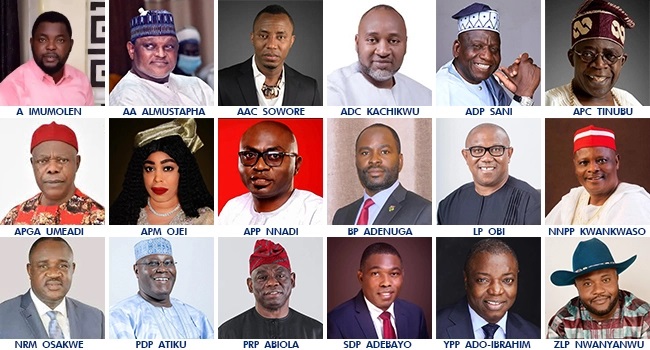
Nigeria:2023 Presidential Contenders

And The Voters Went Out To Vote
(Lament for the 2023 Nigerian election)

By Chudi Okoye
(First Draft: Feb 27, 2023)

Oh hear now all ye here gathered
Words akin to ones once rendered
By the Lord in his Parable of the Soils
Here recast as a parable about spoils

The voters recently went out to vote
In yet another quadrennial civic float
To rekindle hopes for a better existence
In this land mired in manifold pestilence

As they voted for varied political herds
Some votes scattered as wayside stray
Trampled ‘n devoured by political birds
Which yapped ‘n flapped ‘n flew away

Some votes were a fetish of foolish hope
On the stony promises of carpetbaggers
Who offered little else but foxy swagger
So they withered as their casters groped

Other votes, propelled by political gust
Landed on thorny grounds full of dust
Where they were choked by the greed
Of grasping politicos of their own creed

Alas, as the last votes were being counted
It appeared not enough had been planted
In soils fertilized by the real patriotic desire
That our country’s recovery would require

Thus, while we surge in our present battle
To confront elites who are clearly rattled
We’ll prepare for another tetradic pageant
To vote for a dream that’s now emergent!

Moment of Truth: Who Should Win vs. Who Might Win Nigeria’s 2023 Presidential Election

0
Nigeria Decides: Obi and the 2023 Election

The unspoken issue in Nigeria’s impending presidential election is the tension between who ought to win and who might actually win the election. If fate would favor this forlorn country, what ought to be will become fact in the Feb. 25 poll. But it is not at all clear that Nigerians – despite the current hardships – will call the winds and summon the rain to change their fate in this particular election.

By Chudi Okoye

The moment is nearly upon us: merely a matter of days before Nigeria decides in a critical election that will reveal, perhaps more poignantly than previously, the political character of this country. The dreamers and their drummers have had their say. It is now time to explore the lay and see who might actually win the day. I propose to provide insights to that hereunder.

The 18th century Scottish philosopher, David Hume, provides a useful conceptual framework we might use for our task. In his highly acclaimed Treatise of Human Nature (1739), Hume tackled what is termed the ‘is-ought’ problem, criticizing the moral philosophers of his day for deriving normative conclusions from positive or empirical reality. His critique of moral philosophy is encapsulated, in part, in what is often called ‘Hume’s Guillotine’ (a.k.a. Hume’s Law) which posits that it is impossible to derive an ‘ought’ from an ‘is’ where there is no logical link between the realm of value and the realm of fact.

Much the same can be said, despite fervent conjectures, about the conjuncture of factors in the Nigerian presidential election due to hold, all things being equal, on February 25.

Polls and the ‘Ought’ Argument
There has been much postulation and much polling, even beyond our shores, about the likely outcome of the election. Nigeria being a country sized for significance but punching well below its weight, the impending election has attracted much global attention. This is in part – to borrow from Einsteinian physics – because it is thought that the gravitational fields of Nigerian politics could warp time and speed up the deepening of democracy in wider Africa. At least that is the impression usually given by giddy global observers.

The polls have been clear, as I myself observed back in June 2022 shortly after the party primaries, that the 2023 presidential election, notwithstanding the crowded field, is essentially a three-way contest which could go into a runoff. Some of the polls – like that by SBM Intelligence for the Enough is Enough Nigeria group – seem reluctant to predict a likely winner in the election, merely indicating plausible paths to victory for the three leading candidates: Atiku Abubakar of the Peoples Democratic Party (PDP), Bola Tinubu of the All Progressives Congress (APC), and Peter Obi of the Labor Party (LP). One of the polls, by POLAF, tips Atiku Abubakar to win what it expects – as do other pollsters – to be a close race. A few other polls, specifically those by Fitch and Dataphyte Research, predict a win for Bola Tinubu. But many more of the polls posit Peter Obi as the presumptive frontrunner, including those by Stears, Nextier, Bloomberg/Premise, ANAP/NOI and Redfield & Wilton.

Perhaps tilted (or titillated) by this tally of polling and the apparent zeitgeist, the London Economist, in a lead editorial that probably reflects global sentiment, came out with a strong endorsement of Peter Obi. The magazine was pretty contemptuous of Atiku and Tinubu, saying that “Nigeria desperately needs a new kind of leadership” and that “Peter Obi offers the best hope of it.”

The Economist’s opinion aligns very much with mine. Going back to David Hume’s ‘is-ought’ dichotomy, there’s no doubt in my mind who ought to win this election. Peter Obi is the outstanding candidate of the entire field and, without putting too fine a point on it, ought to carry the day. I have argued this point in several writings from the very beginning of this election cycle. I argue this case not because I am persuaded by the padded resume of Obi’s governing record often put about by his supporters and the candidate himself. Nor am I impressed by the sheer exaltation and lionization of Peter Obi by his overzealous supporters – a fluid mass of idealistic meritocrats, urban professionals, rural primordialists and frenzied youths – some of who all but equate Obi to Jesus the Christ and Obi’s hopeful victory to the Second Coming. In one pro-Obi WhatsApp forum I’m familiar with, members once recounted, with unending glee, a story told about some woman at some event who supposedly spread her wrapper on the floor for Obi to walk on, not unlike the biblical account of cloaks and palm fronds laid out by Jesus’ followers for his triumphal entry into Jerusalem. When I protested such unseemly Jesusification of Obi, one forum member, a brilliant and well-travelled petroleum engineer, justified it on the ground that the Scriptures also mention a woman (named as Mary of Bethany in John) who anointed the feet of Jesus with expensive oil. I kid you not!

With such unbridled zeal, and maybe because Jesus reportedly said his true followers must forsake friends and even family, it is not surprising to find that the more ardent ‘Obidients’ have been willing to forsake their friends and even family to follow Obi. Because they’ve become so emotionally invested in the candidate, some supporters cannot countenance even the slightest likelihood of Obi losing the election. So Obi’s victory has become religion, assuredly invoked in his adherents’ frenzied glossolalia. And from this follows a disturbing level of impatience and intolerance – what seems really like a dictatorship of the faithful, reminiscent of Russia’s dictatorship of the proletariat – with terrifying portents of what might follow if Obi wins the election.

None of this, however, subtracts from the compelling case for Peter Obi. Despite the worrying cult of personality and the frenzy at the core and fringes of Obiworld, no cool-headed analysis, if fair, would deny that Obi is the best of the contesting bunch. Obi offers as deep a diagnosis of Nigeria’s problems and as creative a remedy as any on the table in this cycle. But that is not where he earns distinction. What Obi seems to have that eludes the establishment candidates is a relatively unspotted (granted, not superseding) record of governance; his unpretentious charisma and apparent authenticity; a spontaneous and energetic followership resulting from his relatability and facility with popular engagement; and an accessible vernacular of politics laced with the idiom of social contract far removed from the current patronage system and the clientelist approach of establishment politics. All of this lends freshness and even a revolutionary veneer to Obi’s political project, an antithesis to the current praxis which may be what Nigeria needs for a post-Buhari recovery. Under Obi, based at least on the tenor of his campaign, Nigeria’s current ersatz democracy would likely improve and become more people-centered.

Added to all this, there’s a geopolitical imperative powering Obi’s candidacy, given that it represents an affirmative correction for his native South East region which has long been locked out of real power in Nigeria’s post-independence dispensation. Obi himself affects a disavowal of this imperative, but it is part of the calculus of much support he has attracted, both inside and outside his native region. Such a correction might bring equity and needed tranquility to the polity.

All of the above represents the ‘ought’ argument in our discourse, making a normative case for an Obi win. But the question is: even though Obi ought to be elected the next president of Nigeria, can he in fact win the election?

Alas, despite the promising predictions of many polls presented above, it is not at all certain that he can.

Structure and Resistance
Obi deserves great credit for propelling himself to the frontline in this election, in a rather short span of time and on the platform of a once inconsequential fringe party. But whilst he has created a credible political vehicle, it is unclear that he has had the time to build a formidable movement with elaborate structures that may assure him victory in this election. According to the latest data from the Independent National Electoral Commission (INEC), there are about 176,606 polling units for the 2023 election. Obi’s Labor Party submitted a total of 134,874 polling unit agents (PUAs) to INEC, covering about 76.37% of the total polling units, and 4,859 collection agents (CAs). These compare with 176,223 PUAs (99.78%) and 9,581 CAs for APC; and 176,558 PUAs (99.97%) and 9,539 CAs for PDP. Even Rabiu Kwankwaso’s New Nigeria Peoples Party, which is scarcely within polling radar, has submitted 176,200 PUAs and 9,604 CAs, far higher than Labor’s. By these numbers, it would seem that Obi’s Labor Party has a deficit in excess of 40,000 polling agents to the establishment parties, APC and PDP, and about half their collection agents. The party is also not fielding any (or strong) candidates in many of the federal and state elections that will hold on the same day as the presidential election and subsequently in March, the consequence being that Obi, even were he even to win, would rule Nigeria as a minority president.

It is impressive how Obi’s Labor Party has ramped up in the past few months. But its deficit to the main parties in terms of political structure cannot be ignored.

Electoral Monetization: There is also an issue as to the funding of field operations, including the unfortunate reality of voter mobilization and inducement, a constant in Nigerian elections. Recent improvements in INEC’s election management technology and the heavy messaging against vote buying should help to mitigate this factor. But the situation is complicated by human factors which we must consider. For one thing, there’s the evident desperation of the two ambitious septuagenarians running on the platforms of the main parties: this being their last opportunity for a presidential run, they can be expected to pull out all the stops to achieve their dream in this election cycle. This plays into the exigent conditions in Nigeria today marked by continuing terror and insecurity, fuel scarcity and a recent currency change which has severely curtailed money flows in the economy. The combined effect of these challenges is that electoral monetization may again play a decisive role in the outcome of the election, regardless of relentless messaging to the contrary.

Without question, many amongst the increasingly fretful and financially stranded electorate will be well disposed to inducements from our practiced politicians and their agents. The major parties are poised to take advantage of the current situation, with their elaborate resources and control of incumbent governing structures.

Many commentators have praised President Muhammadu Buhari for initiating the currency change, arguing that it will limit the opportunity for election monetization. However, the opposite may well be the outcome, with cash-strapped and desperate voters more easily induced by politicians and their agents. I’m not at all certain that the authorities are well prepared for such an outcome.

Resistance to Change: There’s yet another angle to this besides the current national exigencies which offer desperate politicians an opportunity for dirty tricks. We must consider too the many force fields of the Nigerian formation that may likely negate the momentum of change in this election cycle (a subject about which I have written several recent essays). There is, no doubt, a great desire for change in the country, in part inspired by Peter Obi’s rhetoric, which changed the dynamics of the election and helped to propel his political ascendancy. Obi came along and electrified what might well have been a run-of-the-mill election, exerting a force that has changed the usual inertia of the political public. His forceful momentum, built largely on his personal celebrity, has altered the mechanics of presidential election contest, eroding some of the structural advantages enjoyed by his establishment opponents. However, whereas we may be seeing in political play something of Newton’s First Law of Motion (F∆t = m∆v), classical physics also tells us, in the Third Law of Motion, that when an object exerts a force on another object, it receives an equal and opposite reaction (F1 = -F2).

Obi’s populism and politics of change, seemingly unthreatening because of his mild and self-effacing manner, might nonetheless be considered a threat to the hegemonic forces of Nigerian politics and the prevailing modes of accumulation in the country. Obi has done the utmost in his campaign peregrinations to reassure the entrenched powers, even whilst virtue-signaling and promising populist changes. But it is unclear the extent to which he might have succeeded with his reassurances. All things being equal, we must expect a strong resistance – along class, geopolitical and generational lines – to any kind of power shift or a reconstitution of the political economy entailed in Obi’s politics of change. Nigeria’s history is replete with reactionary responses to radical change: from the gradualist negotiation of self-rule to an anti-secessionist civil war; from the tradition of reactionary military coups to the outright annulment of a democratic election victory secured by a progressive coalition.

Granted, much of Nigeria’s reactionary history is associated with a once dominant military institution which seems now somewhat vitiated. More so with Major-Gen. Buhari’s dismal presidency which likely has significantly weakened the political potency of the military brass and its hegemonic civilian allies. But the power of hegemony, as we learn from Gramsci, is that it isn’t only the ruling elites but even sections of the masses that may resist change and want to maintain the status quo.

A vocal section of the Nigerian populace is supporting Obi, believing perhaps that the dream of a ‘New Nigeria’ after Buhari would require a non-establishment change agent like the Labor candidate, a new ‘kid’ on the federal block, to bring it about. The Bible tells us after all to pour new wine, not into old wineskins, but instead into new ones to avoid a rupturing of the container (Matt. 9:17, Mk. 2:22, Lk. 5:37). Obi may be embraced by some in the population as new wine in the new wineskin of a post-Buhari Nigeria. Unfortunately, however, his very ‘newness’ may constitute a problem for some sections of the population. The same biblical parable concerning new wine warns us about reactionary instincts in broader society, saying “no one after drinking old wine wants new wine, because he says, ‘The old wine is better’” (Lk. 5:39).

This is part of the paradox of the masses: though the yearning for change is palpabe, it is possible that a significant portion of the populace, particularly amid the current exigencies, may end up voting for the status quo, against their own interest. We’ve seen this in many other places, even in advanced democracies. Can we forget, for instance, how the Nigerian Labor Party’s namesake in the United Kingdom ended up losing the 1992 general election, which it had been widely expected to win after years of torrid Tory rule? Labor lost that election primarily because British voters had been cleverly nurtured by right-wing media into fearing the changes a Labor government might introduce.

Destiny Awaits
I hasten to say that nothing in my foregoing comment rules out a possible upset by Peter Obi in this week’s election. What this man has accomplished in a relatively short time, rising to political stardom on the platform of a fringe party, is nothing short of astounding. Clearly Obi’s rhetoric resonated because of the disaffection in society which has long sought a political expression. It is to Obi’s credit that he has been able to channel this deep discontent and its latent energy, which had been a blind spot for the stodgy and unimaginative politicians in the incumbent parties. In the process Obi has turned himself into a political star, far outshining his own party. Perhaps Obi has been able to project himself precisely because the party itself is not a competing celebrity, and perhaps because there are no entrenched coalitions within the party that are powerful enough to constrain his rhetoric or political strategy.

Whatever it is, Obi deftly created a political space for himself after the short shrift he received in his previous party, and he has greatly maximized that opportunity. We will see if the party from which he exited, PDP, wracked by the exit of another stalwart, Kwankwaso, and the dissent of the G-5 governors, will rally to a victory nonetheless. Or if the ruling party, APC, will overcome the burden of its abysmal record and its own internal fissures to retain power, even with a singularly distasteful standard-bearer and the disagreeable single-faith ticket it has chosen. Even if Obi loses to either of the establishment candidates this time around, he will be able to bid for power in subsequent elections – if he can stick around to build a lasting political movement from the political vehicle he is currently riding. He could also use his new political stature to attempt a capture of any of the dominant parties so as to re-align it to a radicalist reform agenda. We will see if Obi has the temperament and talent for this, and if in fact his current following, a fluid and possibly ephemeral base, might stay with him even through electoral misfortune, were that unfortunately to happen.

The woman who reportedly laid out her wrapper for Peter Obi to walk on, a la Jesus’ triumphal entry into Jerusalem, might be more prescient than we know. The biblical event presaged Jesus’ passion: his trial and subsequent crucifixion by the entrenched authorities. But that suffering mediated the ‘resurrection’ and the eventual theosis of Jesus Christ.

Peter Obi could yet pull off a surprise win in this coming election, and in doing so transform the physics of political contest in Nigeria. He could indeed surprise the pollsters by realizing their prediction. But even if he falls short this time, there is an opportunity to build his incipient movement so Nigeria can eventually witness the convergence of what ought to be and what finally becomes.

Spit-At-Home Day

0
SE Terrorists and Biafra Flag

By Chudi Okoye
December 14, 2022

It is sit-at-home day in the South East
One fiercely enforced by local bandits
Who have caused a split in our homes
And cut a reddened slit in our hopes

Today they killed a pregnant woman
One among many harmless humans
Wasted at will on this prohibited day
Merely fending for those in their lay

How wrathful they have now become
The cads to whom we oddly succumb
Hoodlums from our illed hood slums
Who beat their own infernal drums
Hijacking our dream of a new Orient
For a future they seek to our lament

Alas, freedom is being inflicted on us
Like pestilence and rank catastrophe
By this set of self-acclaimed toughies
Who play a vile spit-at-home game
Called sit-at-home by another name

They fly fearfully from feisty Fulanis
Fell freebooters from the boreal land
Fleeing their own desolate wasteland
Who now freely roam our hinterland
Which these gangs pretend to defend

Unable to fight in the northern parch
Or indeed halt Islam’s southly march
They turn furiously on us local folk
On whom they impose a severe yoke
Terrorizing all who resist their vision
Or dare to confront their proposition
That we the people must be violated
In order – eventually – to be liberated

We stand firm in rejecting this deceit!
We reject abuse as freedom’s conceit
Self-flagellation as self-determination
We stand firm against those blighters
Passing off as our freedom’s fighters
What is freedom if not for the living?
Or its virtue, fixed on forced believing?

Rise Up and Walk!

0
Rise Up and Walk

By Chudi Okoye
November 25, 2022

Apostle Peter looked upon the lame
Squatted by the gate called Beautiful
Fractured and forlorn, with no name
His arm stretched out seeking alms
And Peter said: Silver or gold, I’ve no stock
But in the name of Jesus, the ever dutiful
Who has your destiny in His palms
Rise up and walk!

Aspirant Peter looked at the huddled masses
Seeing them now without muddled glasses
Fractured and forlorn, much like the lame
Needing aid as leaders play their game
And Peter said: Dollar or Naira, I’ve no stock
I have no shi shi, not any to give
But we can do that by which to live
Let us rise up and move our bulk!

The old party’s primary was his epiphany
To stop palling around with men of infamy
He felt a great vocation newly beckoning
Which he must give the fullest reckoning
Like the great Apostle, his pious eponym
Who had faced down Rome’s great power
And built a temple for Galilee’s Sower
He has erected a citadel of hope
Urging voters and all in scope
To rise up and retake Aso Rock!

The ‘Dot’ and the Sloth

0

By Chudi Okoye
November 21, 2022

The big shot who called us a ‘dot’
From his spot in blighted Aso Rot
Is now caught in a demeaning squat
Wasted and become but a naught.

In our history he’ll be seen as a blot
A sloth who, with his vile Fulani stunt,
Left the nation cleft and distraught
Fraught, taut and in a debted knot.

He leaves with our realm in real brunt
A hobbled giant with a deep grunt
Needing one to heal it that is hot
Who may well emerge from the ‘dot’.

Oh, how great the day if the ‘dot’
Comes in to clean up after the sloth.
If, we pray, such a deed is wrought
The sloth will, finally, connect the dot!

A Path to Positive Outcomes in the Battle of the Professor and the Trader

1
The Professor and the Trader

The two men said: “Let there be battle!” At first some were rattled. But then there was much good that came from the fray. And so, after a short period, seeing that their exertion was good, the two men rested, with neither one bested.

By Chudi Okoye

How fortunate for us that the two firm friends are feuding! How fortunate indeed. When you think of it, this makes a kind of metaphoric sense. A major feud brews over a brewery investment. It’s between the professor and the trader, the two respectively current and former governors of the same state. Many of those behind the principals are belching as if they’ve had a surfeit of the brew from the brewery. They go at it with unconstrained logic and unrestrained fervor. But like most sodden folks, they will hopefully shamble their way home to deep slumber and wake up to sobriety the morning after the night of heavy bingeing. Then, as they amble out of bed, they will realize how fortunate it’s been that their principals had this feud.

It is all so Shakespearean. And even Biblical. In a lyrical passage at Psalm 8:2, the Psalter declares: “Out of the mouth of babes and sucklings hast thou ordained strength.” In just the same manner we might declare: “Out of the mouths of the professor and the trader has thou divined renewed purpose.” It is compelling, though this is not as yet obvious to the warring parties.

The partisans have retreated to their corners and are hurling brickbats at one another. The anger is deep, on both sides. The professor’s side feels he’s misunderstood and unfairly vilified for making an innocuous comment about what he perceives as the trader’s shrinking brewery investment. The trader’s side is seething, seeing nothing but mischief and envy in the professor’s levy of criticism which it considers a deliberate attempt to bring down its principal. The exchange has become rather rebarbative and prickly.

The acrimony is intensified because it has a class dimension which isn’t obvious to many observers. The professor wrote in a haughty manner. The wily trader justifiably exploits this to feign the underdog: in his response, he affects the part of a plain-speaking trader who is younger and not as educated as the professor. He doesn’t dispute the professor’s grading of his governing record in the state, saying instead, meekly, that he tried his very best. He then says the professor should do better with his world-acclaimed education and connections. Well played.

But this seemingly inoffensive response only partially pacifies the partisans. There are booby-traps despite the excited claps elicited by the measured response. The quarrel has become a class war: the traders in the community are up in arms because they feel one of their own has been slighted. So are the young who have long co-opted the sexagenarian trader into their millennial cohort. And so are the not-so-educated. Never mind that the trader who calls the professor “my senior brother” is less than a year the younger. And never mind that the trader is a savant who has taken business and leadership courses at some of the world’s most prestigious colleges. But all is fair in warfare.

So it has become a revel of deprecations. But it’s not just that. There’s as well an orgy of imprecations. The jabs seem straight out of the Bible’s ‘Imprecatory Psalms’ – you know, those like Psalms 69 and 109 (and many others) that rain curses and abuses, invoking judgment and calamity upon one’s enemies or those perceived as enemies of God. You think I’m kidding? Check this out. Amid the slanging match, a hitherto somnambulant Ohanaeze Ndigbo suddenly bestirred itself to invoke the retribution of Igbo deities upon the professor for daring the trader. The pan-Igbo body panned the professor with cant and impolitic viciousness. But the apex group’s vexed reaction ended up a negative. For, it prompted a loquacious spokesman for one of the major political parties to unleash a long-rehearsed attack line, asking if the trader, who has carefully nurtured a national profile in his presidential quest, is now merely an Igbo candidate! So who now is hurting the trader’s quest? This is what happens when emotive men with mixed motives enter the fray. Perhaps they should just stay away!

Thank goodness for the trader’s measured and emollient intervention. Amid a simmering kettle of churlishness, he showed his mettle. It might have been self-serving (it’s allowed: he’s a politician!), but in time it could help pull the partisans back from the brink. Thank goodness too for the professor. He had promised a further intervention after his first, but he seems to be staying his hand, despite bristling provocation from partisans who cannot see the risk of baiting him. The restraint of both principals should enable us now to take stock, as we recover from our shock. It should help us to see what we’ve missed amid all the bashing and clashing and frenzy of emotions. Which is that there’s a packet of benefits we can pocket from the current racket. There’s some goodness in the rudeness!

For one thing, there’s now an implicit wager between the professor and the trader. In his smacking earlier piece the professor had said the trader’s presidential quest is going nowhere, as he is unlikely to win the coming election. For his part, the trader has dared the professor, with all his erudition, to do better at governing their native state. Hmmm. Can you now see? Neither man can afford to fail. For they would have proved the other right. The trader must pull out all the stops to win the presidential election, duly picking through all the weaknesses outlined by the professor in order to correct them. And the professor must now govern the state far better than any predecessor had done. A Pascal’s Wager of sorts, benefitting both the state and the nation if both wagerers win. A feud that seems like a syndrome of MAD (Mutually Assured Destruction) could indeed produce, for both protagonists, another kind of MAD: Mutually Assured Delight.

There’s also this: the feud, despite the fears of a few, shows the professor’s and the trader’s geopolitical zone in a good light. What some rue as roiling cantankerousness rather shows the range in the zone. It’s not strange; it is democracy at work. This is particularly welcome because the trader’s tumultuous rise to national prominence has proved rather head-spinning for some of his supporters, so much so that something like a cult of personality has built up around him. It is understandable. Decades of misrule in our nation has produced a lumpen mass of hungered citizens long yearning for redemption. The trader’s populist message seems to have caught on with many among the huddled masses. And they have become attached to him in a way only occasionally seen in our national politics. They have become quite protective of him, as an embodiment of their long-strangled dreams, to the point of becoming intolerant of any criticism directed at the trader. It is undemocratic and it is unhelpful. It is this intolerance and over-protectiveness that the professor punctured with his piercing piece on the trader. It may hurt the trader’s flanks for a while but it sends a reverberating message: our democratic tradition is alive and well, despite the mob instinct. The professor deserves praise for his bravery. The trader deserves praise for his equanimity.

This should be reassuring to those in other geopolitical zones worried about the instinct of the trader. Is he truly a nationalist as he projects, or is he dancing to some hidden ethnic agenda? Mischief makers had been hinting at the latter, though there’s scant evidence of a primordial bone in the body of the super-cordial trader. The professor did all a huge service by puncturing that presumption. No one from any other geopolitical zone has given the trader as close a tackle as he got from the professor. It shows the nation that there’s a diversity of interest within the trader’s zone as there is elsewhere, perhaps even more so. And there’s a yearning for alliances across the nation to attain both regional and national goals. That is as it should be. This fracas should help to allay any paranoia about an ethnic agenda. The credit for this goes to the two men in the arena. The professor had the instinct for a close-marking critique, while the trader understood and took it well. The two displayed temperaments that should reassure the nation at large.

So all in all, though it has been a heady few days for the professor, the trader and their phalanxes, it has been rather beneficial for our democracy. There has been, we can say again with boldness, some goodness in the rudeness.

Hurray for democracy!