28 C
Awka
Tuesday, April 7, 2026

Trumpet With Certain Sound

Home Blog Page 16

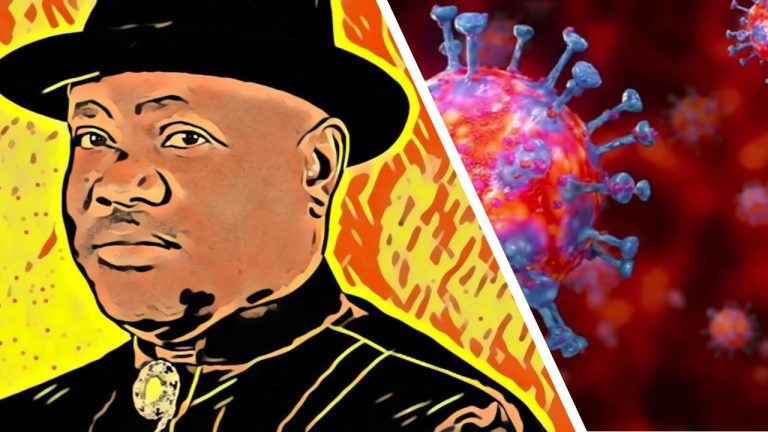
Rivers Raises the Bar: Closes All State Borders to Combat COVID-19

0
Governor Wike in new measure to shut out coronavirus
Raises constitutional issues relating to inter-state freedom of movement

By Chudi Okoye

In a dramatic new measure to check the spread of coronavirus within its administrative territory, the government of Rivers State in Nigeria has announced that air, sea and land routes into the state will be closed to traffic starting from 6 p.m. local time on Thursday, March 26, 2020. The governor of Rivers State, Nyesom Wike, announced the new measure in a broadcast on Wednesday, March 25, 2020.

This appears to be the first of such move towards sequestration by a state government in Nigeria. In a country where state governments cannot raise a police force, it is unclear what instrument of states’ rights in Nigeria’s constitutional order enables such a measure.

Section 41 (1) of the Nigerian Constitution (1999) provides that “Every citizen of Nigeria is entitled to move freely throughout Nigeria and to reside in any part thereof, and no citizen of Nigeria shall be expelled from Nigeria or refused entry thereby or exit therefrom.”

The Constitution also states, at Section 41(2) that “Nothing in subsection (1) of this section shall invalidate any law that is reasonably justifiable in a democratic society,” but it is not clear if the power to enact such law vests in a state government.

Already, however, state governments in Nigeria, in response to the treat of COVID-19, are imposing social distancing rules which impinge on the rights to free assembly and movement, as enshrined in the Constitution.

In announcing the new measure, Governor Wike, himself a lawyer with a wife on the bench, said that this became necessary in view of recent developments.

The move seemed to have been precipitated by a specific incident raising the scare of coronavirus contagion. In his broadcast on March 25, Governor Wike alluded to the incident:

“It is with gratitude to God that I announce to you that our State would have been infected with coronavirus yesterday,  but for the vigilance of security agents who, acting on a tip-off, prevented an infected person from boarding a flight from Abuja to Port Harcourt.”

He said that “the infected person beat all security measures that were put in place at the Nnamdi Azikiwe International Airport, Abuja and was to sneak into Port Harcourt before security agents stopped her.”

It seemed that the decision to close the state’s border’s arose from this incident. Wike confirmed this trigger in his broadcast:

“Based on this alarming Information, the State Security Council met yesterday and reviewed measures already put in place and decided that there was urgent need to adopt stringent measures to protect those living and doing business in the state from the virus.”

He said the State Security Council made the following decision which he said were “painful”:

“1. With effect from 6 p.m. on Thursday, March 26, 2020 , the Port Harcourt International Airport,  Omagwa will not be open to air traffic. While we may not have the right to stop flights from entering Port Harcourt, we cannot allow anybody coming from the airport to enter our State. We are confident that the Federal Airports Authority of Nigeria (FAAN) and other federal agencies will cooperate with us.

“2. All Land and Sea Borders will be closed.

“3. Vehicular movements in an out of the state have been banned. In essence no vehicle will leave Rivers State for any other State and no vehicle will be allowed to enter the state.”

The Rivers State governor said that the new measures will remain in force “till further notice”.

He further noted:  “Let me reiterate that the situation we are facing requires drastic measures because coronavirus has ravaged many countries.

“Security Agencies have been empowered to strictly enforce this directive. There will be no room for sacred cows because the virus is no respecter of persons.

“May I once again call for the support and understanding of everyone living and doing business in Rivers State to help the relevant Government Agencies implement these measures to check the spread of coronavirus to the state.”

Further appealing for public understanding of the drastic new measure, Governor Wike said: “At this time in our national life, we must shun primordial sentiments and face the reality on ground.

“I am confident that God being on our side, the temporary hardship we are facing today will come to an end very soon.”

Earlier, in a statement issued on Monday March 23, Governor Wike had announced the measures his government was putting in place to combat the COVID-19 menace. These included:

Setting up border surveillance  posts

Setting up local government monitoring teams

Banning of public burials and weddings

Injunction against open religious worship

These measures were to take effect from March 24, 2020.

The governor also announced the closure of academic institutions and markets in the state

Most states in Nigeria, similar to the federal government, are introducing their own package of measures to combat the potential spread of coronavirus. Rivers State may be the first state, however, to shut down its borders. Other states may likely follow suit, raising legal questions about the constitutional order in Nigeria at a time of pandemic crisis.

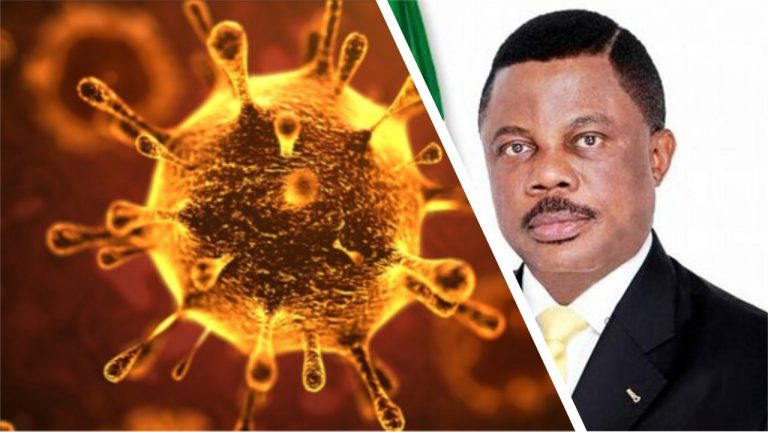
Anambra State Government Takes Critical Steps To Contain COVID-19

0
Anambra State Gov., Willie Obiano with new coronavirus guidance

… Inaugurates Ad-hoc Committee with Professor Iwu as member

… Directs civil servants to proceed on 14 day leave

… Suspends all public gatherings

By Ndu Chris Nwannah, ATM Guest Writer

Governor Willie Obiano of Anambra State has announced new measures aimed at controlling the spread of the COVID-19 in the area. Since the outbreak of the virus in Wuhan, China, its ripple has been felt in numerous countries of the world, including Nigeria. Hundreds of thousands have contracted the virus, which had also resulted in the deaths of thousands of people across the continents of the globe.

The worst hit nations are China, Italy, Spain, USA, Germany, Netherlands, France, UK among others. Coronavirus has brought with it huge economic challenges with the shutting down of businesses, borders, citizen movements, leading to complete lockdown in many nations. International flights have been put on hold as countries announced measures to reduce importation of new cases into their territories.

Nigeria was one of the countries that recently announced the closure of its international airports to forestall movement of people from the hard hit nations into the country. Federal institutions had recently been directed by the National Universities Commission to close offices for one to help mitigate the spread of the virus.

At a media briefing in Awka on Monday 23 March 2020, Governor Willie Obiano directed all civil servants in the state to proceed on a 14 day work-from-home leave starting from Tuesday March 24, 2020. He said the directive excludes health workers and others on essential service.

“Civil servants in the state are hereby directed to proceed on a 14-day work-from-home with effect from Tuesday, March 24, 2020. However, any civil servant may be called upon at any given time to handle an urgent assignment as the case arises. This directive excludes all staff of Anambra State Ministry of Health workers and officers on essential duty.”

The Governor further announced the suspension of public gatherings having more than 30 guests indefinitely.

“All public gatherings are hereby suspended in Anambra State till further notice with effect from today, March 23, 2020. This includes traditional marriage ceremonies, community festivals, ofala festivals, masquerade festivals, Igbankwu nwanyi, funeral ceremonies, baby christening, new yam festivals, title-taking ceremonies and any meeting of more than 30 participants. Traditional rulers and President General of Communities must ensure full compliance or be held responsible.”

Academic institutions were also affected, as Governor Obiano noted that, “all nursery, primary, secondary, vocational and tertiary schools are hereby closed with immediate effect. All academic and extra-curricular activities are hereby suspended.”

The transport sector was also affected in the new measures as all operators were asked to maintain effective manifest system.

“All public transport operators are directed to submit the manifest of all passengers coming into Anambra State to the appropriate authorities with their names, phone numbers, residential addresses and final destination.”

“The general public is mandated to maintain a habit of frequent hand-washing with soap and water as well as use alcohol based hand sanitizers.

“No Keke or tricycle rider should carry more than two passengers at a time.

“Drivers of shuttle buses must not carry more than 3 passengers at a time.

“Drivers of township and mini buses must not carry more than 5 passengers at a time.”

He urged citizens to only visit markets to purchase essential items. The Governor further announced the closure of all night clubs till further notice. The Governor said that “people should endeavor to sit at home.”

The Governor also stipulated that “operators of bars and restaurants should not admit more than 30 customers at a time and must adhere strictly to the basic standards of social distancing. They must also provide hand-washing points and hand sanitizers for their customers. Any violation will attract immediate closure of the premises.”

He directed “all persons returning to Anambra State from all countries of the world and states that have Covid-19 cases to go into self-isolation for 14 days and report.”

In addition, Governor Obiano said that “Security Agencies have been directed to ensure full compliance” with all the directives.

Governor Obiano also constituted an Action Committee on Covid-19 headed by himself to ensure the effective plans to contain the situation. The members of the committee, as announced by the Governor are: Dr. Vincent Okpala, Commissioner for Health, Mr. C Don Adinub, Dr Simeon Onyemaechi, Professor Igwegbe Anthony, Professor Oby Emelummadu, Dr. Simon Ushie, Dr. Basil Nwankwo, Dr. Emmanuel Azuike, Dr. Ifeoma Njelita, Dr. Uche Onyejimbe, Dr. Chijioke Obagha and Professor Maurice Iwu.

Others are Dr. Joe Akabuike, Dr. Ifeanyi Okoye, Dr. Ernest Ifebi, Dr. Chioma Ezenyimulu, Dr. Onyeka Ibezim, Chidi Kanu, Rt. Hon Uche Okafor, Speaker Anambra State House of Assembly, Professor Solo Chukwulobelu, Chief Primus Odili, Sir Uzu Okagbue and  Chinedu Aniagboso.

He said “all calls related to suspected Covid-19 should be routed to Anambra Public Health Emergency Operation Center on 08030953771 and 08117567363,” and assure that “we are determined to do our best to preserve life and restore normalcy within the shortest possible time.”

For the most part, the new measures provide more stringent guidance than those earlier announced by the governor on March 19th, suggesting ongoing recalibration of the state’s public guidance.

One Week After Lagos Explosion: New Fatalities Reported, Occupancy Rights Distorted, and Community Life Utterly Contorted

0
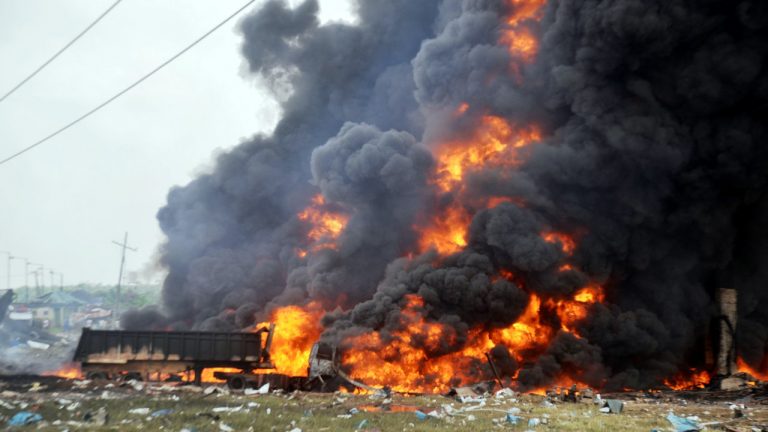
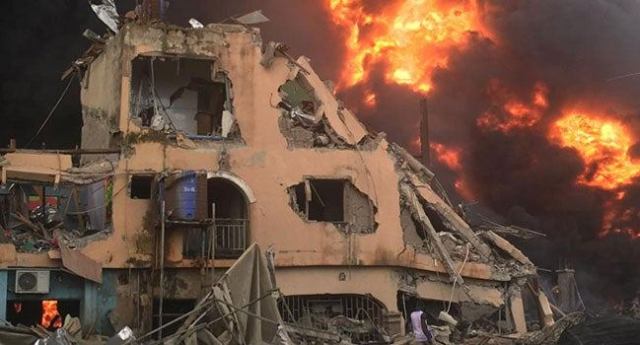
Thick billowing smoke after the devastating Lagos explosion, Mar 15, '20

… New fatalities reported in past few days, bringing total body count so far to 23 and about 500 displaced

… Salvage work and clearance underway, but massive destruction defies easy solution

… State government sets up relief fund, but reconstruction may be hampered by conflict over occupancy rights

By Chudi Okoye with Philip Nwosu and Stella Nzekwe contributing field reports

They are still counting the bodies in Abule Ado even one week after the devastating explosion. Every so often another unforeseen fatality would be reported, adding to the body count from the bolt of explosion that jolted Abule Ado, a community in Amuwo-Odofin Local Government Area of Lagos State, Nigeria.

On the day of the incident, Sunday March 15th, 2020, an Awka Times reporter who was at the scene had counted no fewer than 17 corpses being evacuated from the rubble. In the succeeding days, the body count had gradually increased, rising to 22 by Friday March 20th when the Director-General of Lagos State Emergency Management Agency (LASEMA), Dr. Olufemi Oke-Osanyintolu, disclosed that another body had been recovered from the rubble.

And then on Saturday March 21st, there was yet another fatality. LASEMA’s Dr. Oke-Osanyintolu, in a press statement said that the latest casualty, a female victim, had died at the National Orthopedic Hospital, Igbobi, Lagos, where she had been receiving treatment. The latest fallen victim brought the total figure of fatalities to 23. It is unclear if this will be the final tally in the morbid arithmetic of death from the Sunday morning explosion seven days ago.

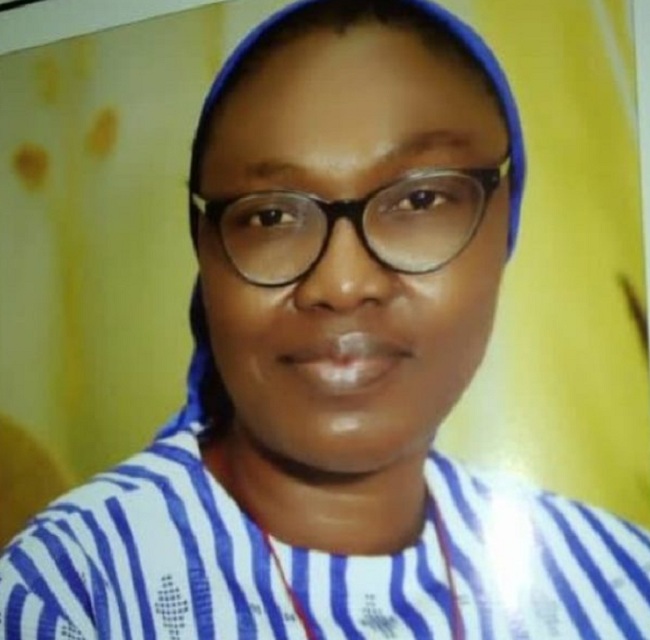
The circumstances surrounding some of the casualties are particularly depressing. There is the story of the well-loved administrator of Bethlehem Girls College, Rev. Sister Henrietta Alokha SSH, who died along with a female security staff, in the midst of a heroic effort, as the first casualties in the school. The school is considered one of the worst hit establishments in the blast. The reverend sister had died having plunged back into a collapsing building to find a couple of students who were missing from the crush she had rounded up in her rescue effort.

Late Rev. Sister Henrietta Alokha, SSH

The explosion had occurred with the students gathered in the school refectory for the 9 a.m. mass which had just started. A witness told Awka Times that shortly after service had started a deafening explosion rent through the refectory which sent the students scampering, in dazed confusion. However, according to the witness, the school principal, the late Rev. Sister Henrietta Alokha, was able to rally about 300 students and shepherded them towards a school fence where they used an improvised ladder to climb over to safety. The students were shaken up but safe, thanks to the selfless reverend sister who lost her life trying to save the children.

Late Rev. Sister Henrietta Alokha was a native of Agenebode in Etsako East Local Government Area of Edo State, Catholic Diocese of Auchi. Born on May 11th, 1967, she made her First Religious Profession of Vows on August 23rd, 1987 and her Perpetual Profession of Vows on November 12th, 1995.  She celebrated her Silver Jubilee on November 3, 2014. Arrangements are being finalized for her funeral on March 25th and 26th.

Three other school staff were later reported dead, trapped in the school’s staff quarters that lay in ruins, according to the Director of Education of the Catholic Archdiocese of Lagos, Monsignor Jerome Odutan.

Apart from the school casualties, Awka Times also learned of a family of three – a couple and their son – driving to church whose car was blown apart in the explosion. All three were killed in the instant.

There is also the story of another victim, a man who according to witnesses usually attended mid-morning mass but who decided on that fateful day to switch to the early morning service. He had just returned from service with his wife and was settling down at home when the blast occurred. It is reported that the foundation of the man’s building shook so violently that the walls started to cave in. As the man tried to run out of the building with his wife a wall collapsed on them, killing them instantly. The deadly blast occurred at a time, by his usual routine, that the victim would have been at his church.

Meanwhile, emergency workers are still searching for a man, declared missing by family members three days after the massive explosion. He is now presumed dead and a search is on for his body.

Trail of Destruction

A week out from the day of the catastrophic explosion, the scene of wreckage remains mind-numbing. Even as dust from the rubble settles, one can still hear anguished cries with some confused residents returning to the wreckage and picking through the rubble to see what they can salvage. But there is hardly any silver lining, hardly much to recover from such gruesome damage.

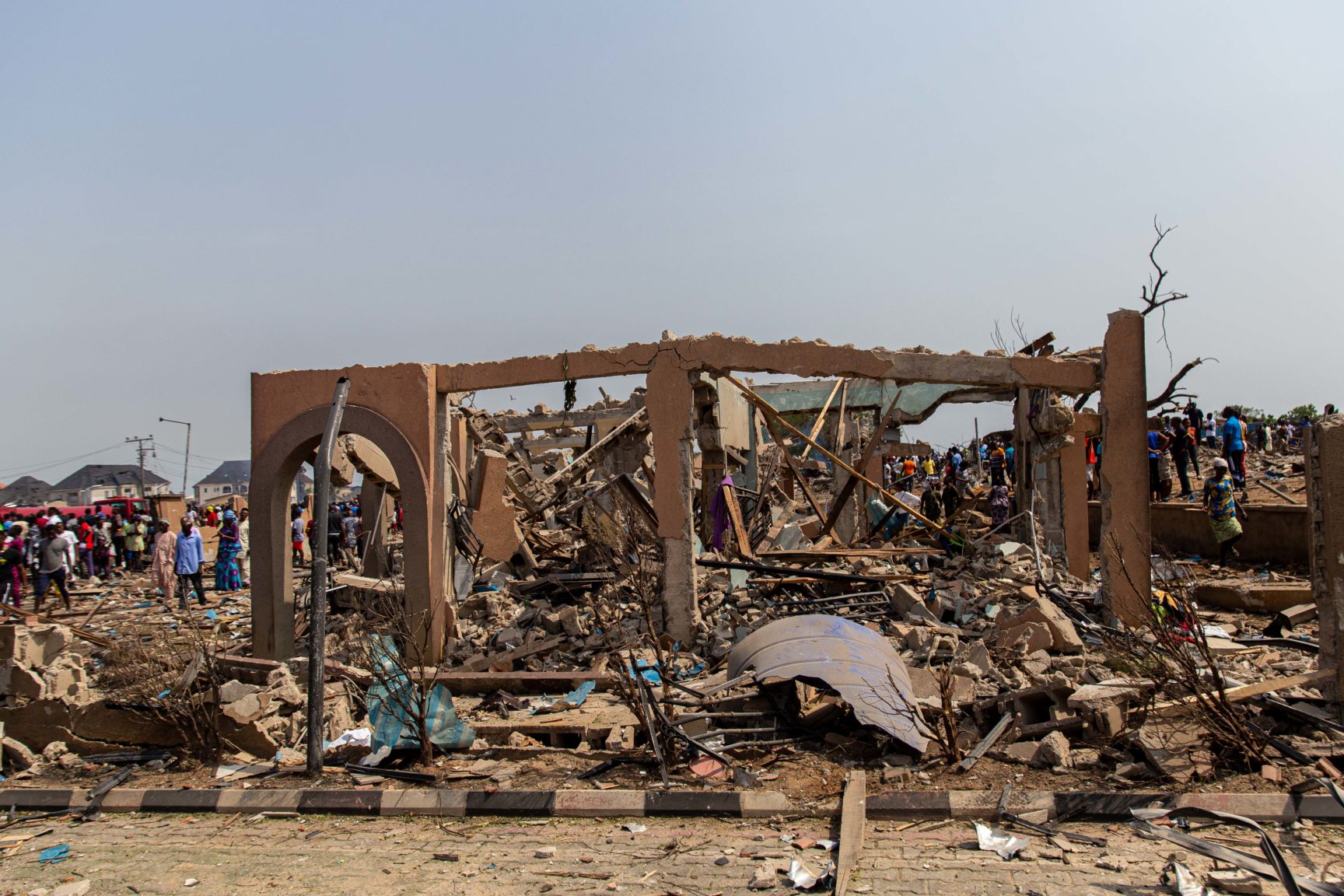
Littered everywhere are personal belongings, mementos of personal lives lying in tatters. All around there is debris from collapsed buildings and other structures, blown rooftops, mangled vehicles, cratered pavements etc. It looks for all the world like the site of a bomb explosion – a massive detonation at that. And this is precisely what informal local opinion insists on: that this was unquestionably a bomb explosion, and not devastation from gas depot explosion or an oil pipeline explosion, as other official and unofficial explanations would have it.

Wreckage from the Lagos explosion

The precise nature and cause of the explosion is still being investigated. But the result is all too real.

At what was said to be the epicenter of the incident, fire was still smouldering several days after the explosion, with isolated tongues of flame glowing at the scene and palls of thick smoke billowing into the sky. No fewer than 10 fire trucks had been seen at the scene by 7 p.m. on that fateful Sunday, but several days afterwards, they were still struggling to overmaster the flare and the air pollution.

A week on from the massive explosion, the grim physics of the damage remains very much in evidence. Debris from physical damage are still piled high, a forbidding heap still undented even with determined effort. It is estimated that over 50 buildings collapsed in the explosion. Among the worst-hit were the buildings in Bethlehem Girls College, a school owned by the Catholic Archdiocese of Lagos.

Even survivors of the explosion have a grim story to tell about their experience on that ill-fated day. One such victim, Mr. Caleb Nwachukwu, a resident of Abule Ado, recounts his experience: “It was like the beginning of the end, as I sat in my living room watching television with my family. We [had] just returned from 6 a.m. mass, then suddenly there was a blast that threw all of us off balance and relocated us to different places. But thank God Almighty we only sustained minor injuries.”

Mr. Nwachukwu said that all his properties were destroyed, including television and furniture, as the impact of the explosion went through their apartment like a hurricane, smashing windows, doors, iron railings and even burglar bars.

Caleb Nwachukwu’s experience, frightful and traumatic as it must have been, pales in comparison to the devastation at Bethlehem Girls College. The explosion had torn through several of the school’s structures, leaving a trail of destruction. The administrative block, the chapel which was still under construction, the staff residence, the dormitory and the grotto – all ripped apart in the fiery devastation. A tally of the destruction at the school is only just beginning to be carried out.

Apart from institutional losses, individual residents incurred unimaginable losses as well. One affected landlord, Chief Emmanuel Ume, said that he had lost two duplexes, a luxury hair salon and a sewing factory in the conflagration.

Narrating how he escaped death, Ume said: “I had gone to church with my family that Sunday morning and that was what saved me. When we got back, we discovered that we had lost everything. What I and my family are left with are the clothes we wore to church. We want the government to come to our aid.”

State Government Rescue Effort

The Lagos State government is working frantically to salvage the situation. Briefing journalists on rescue efforts a few days after the explosion, LASEMA Director-General, Dr. Oke-Osanyintolu, had said there was a total of 276 persons displaced as a result of the explosion. But as of Saturday March 21st, the number of displaced persons had risen to 500, according to Dr. Oke-Osanyintolu. The LASEMA DG disclosed that about 100 of the displaced persons were being accommodated in the LASEMA relief camp at Igando, in Alimosho Local Government Area of Lagos State.

LASEMA Director-General, Dr. Oke-Osanyintolu

In his press briefing days before, Dr. Oke-Osanyintolu had said that 57 of the victims who were trapped under the rubble had been rescued, 47 of whom were assessed at various hospitals and discharged. Ten of the rescued victims were said at the time to be receiving treatment for minor and major injuries. Among the three with severe injuries, Dr. Oke-Osanyintolu said, “one is on admission at the Lagos State University Teaching Hospital, another is being treated at the Nigerian Navy Reference Hospital Ojo, and the third is at Gold Treat Hospital.”

Dr. Oke-Osanyintolu also gave the tally of damaged properties.

“A total of… 93 houses were damaged out of which 44 were mildly damaged, [while] 49 were severely damaged. 40 cars and three articulated vehicles were destroyed, seven schools were destroyed, three churches, one hotel, and one shopping complex were also destroyed.”

Dr. Oke-Osanyintolu disclosed that a committee had been set up by the governor of Lagos State, headed by the state deputy governor, to coordinate rescue and relief efforts. He also announced that a relief camp had been established.

The Lagos State governor himself, Babajide Sanwo-Olu, announced later that a relief fund of ₦2 billion had been set up and that the state government was depositing ₦200 million immediately into the account. He said that he was also reaching out to other state governors and the private sector to assist.

Federal Complication

Meanwhile, there appears to be an emerging controversy over the ownership of land in the affected area. The acting Managing Director/Chief Executive Officer of Federal Housing Authority (FHA), Umar Saliu Buntu, who visited to inspect the site of the explosion and to commiserate with the victims, took the time to warn that the federal government had long acquired much of the area, saying that many of the residents might be illegal occupants encroaching into federal government land. H said that the federal government would initiate plans to retake the area in question.

However, in a riposte to the FHA’s claim, a traditional ruler in the area, the Baale of Soba, Chief Raheem Agbebeji, insisted that the portions of land in question were community-owned. The traditional ruler first sough to clarify media reporting that the March 15th explosion occurred in Abule Ado. He said that the explosion actually occurred in Soba town and not in Abule Ado. “Soba Community is a distinct and different community from Abule Ado, though they share a common boundary,” the traditional ruler noted.

In a press statement issued by his spokesman in response to the FHA’s claim of federal ownership, the monarch said that “Soba is not an illegal community.” He said archival documents would show that the community had been in existence for over 300 years, and insisted that the community would assert its right of ownership.

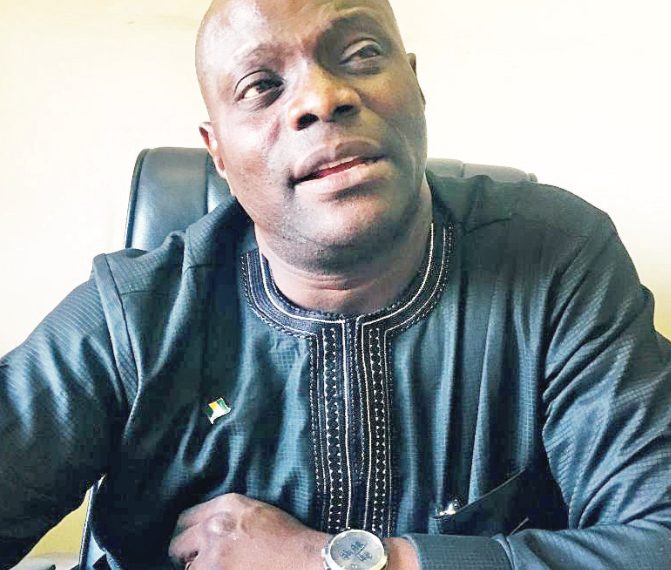
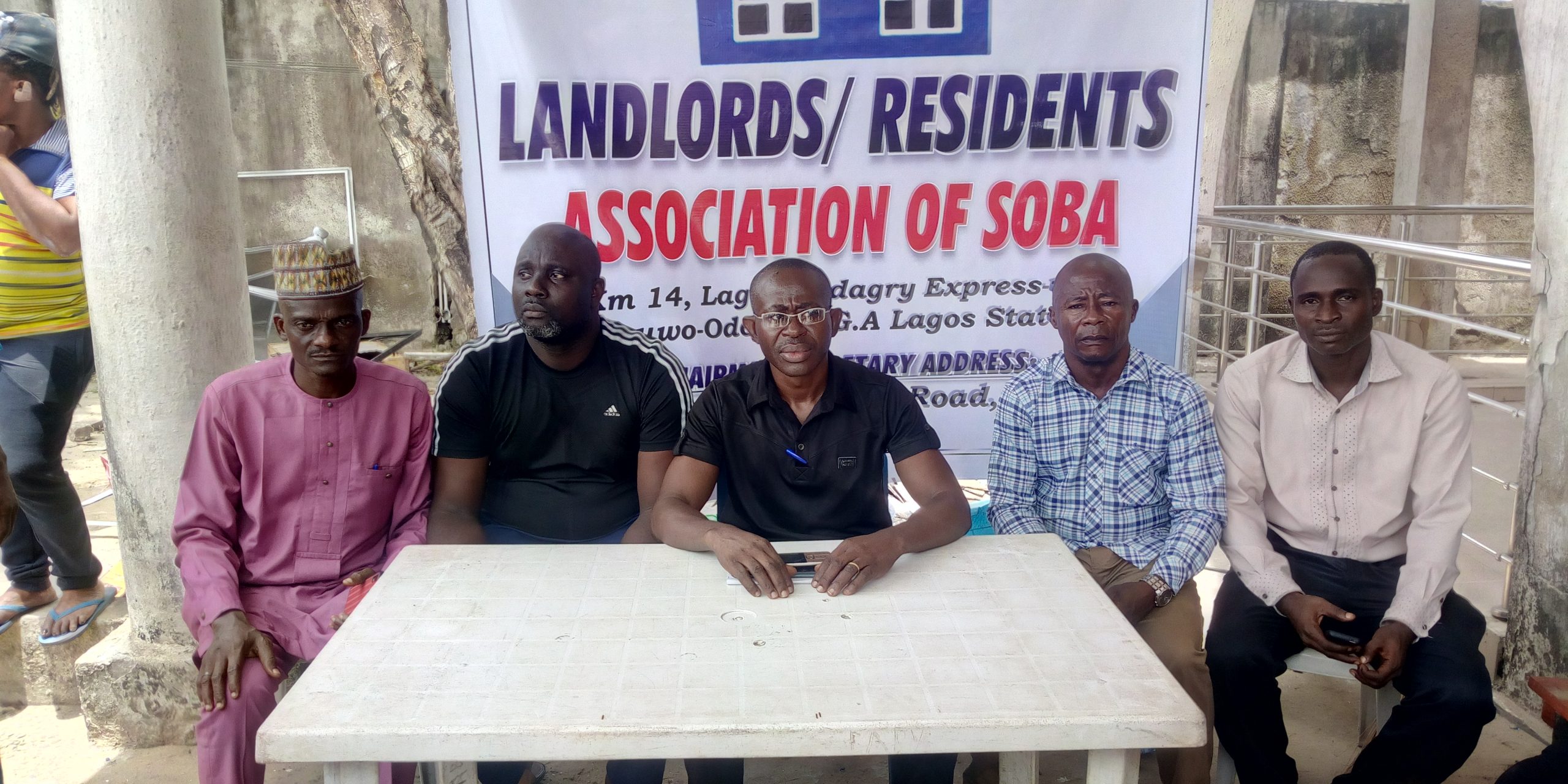
Landlords and residents in the area are backing up the Baale’s stance. The chairman of Landlords/Residents Association of Soba, Chief Gani Adams, told newsmen recently that the landlords of Soba had legal documents and that even before the incident the landlords had been communicating with the FHA to secure certificates of occupancy in the area.

Representatives of Landlords/Residents Association of Soba, Lagos 

Speaking through a representative, the leader of the landlords said: “Some of us have been here for over two or three decades, and we have met FHA on several occasions. They have our master plan and survey plan, and they know we are living here. We are not aliens and we have been working hand in hand with them. We are not illegal occupants. Our documents are intact. They even delineated this place to us. They know we are here.”

It seems the land ownership issue is quite confused. But the FHA boss, Umar Buntu, whilst insisting that “the [federal] government is coming back to take charge”, also indicated that the state and federal authorities would work together “to sanitize this place”, with proper investigations carried out before decisions are taken. Chief Emmanuel Ume, one of the residents who said he lost a lot of property in the area, advised the federal government to tread with caution as a takeover of the affected areas may do more harm to victims.

Amid the daunting task of rescue and rehabilitation, a disagreement over land ownership is emerging. Added to all this is a severe disagreement over just what happened on the morning of March 15th, 2020. The Nigerian National Petroleum Corporation (NNPC), through its Group Managing Director of NNPC Mr. Mele Kyari, claims that the blast was caused by some gas depots operating close to the pipeline right of way. But some residents blame the NNPC which they say did not lay its pipes deep enough into the ground. Other residents assert a more dramatic explanation, insisting that the explosion was a bomb blast. The chairman of the Soba landlords association, Chief Gani Adams, said that his group was “convinced that it was a bomb detonated on the pipeline which caused the unprecedented blast and damage to lives and properties.”

With disagreement over the cause of the explosion, with a massive rehabilitation and reconstruction work ahead, and with dispute over land ownership in the area, it may be a long time before any semblance of normalcy is restored to these devastated lives and these devastated areas of Lagos State.

Biafra Mourns Nigeria

2

By Chudi Okoye                                                                                   

Part I
They took us back with noble lies brandished
Insisting there was no victor and no vanquished
But here we are, alas, lost and languished
We the defeated, lorn, perennially anguished
What once we owned now owed or relinquished
Assets claimed by compatriots, simply vanished.

But no longer shall we, the defeated, be ambushed
By a history, a victor’s knittery, cynically garnished
With splendid lies, our bondage gloriously lavished.
Now, to us, their promises stand bald and tarnished
Our lingering credulity completely banished
As we rise to render our truths, unvarnished.

Part II
As the bite of Biafra stiffened, they spawned a song:
“To keep Nigeria one is a task that must be done!”
They yelped, prompting one poet’s practiced pun:
“To keep Nigeria one, justice must be done!”
Just so. But how, pray, can we expect such a turn,
Seeing Nigeria dying slowly from a war it won?

To keep Nigeria as one could yet be done
If no region is reviled, and none left to burn
If all peoples, to a one, can have their turn
But if we merely Grind On With Odd Nigeria
Whereupon the country rocks in mass hysteria
Then surely we cannot Go On With One Nigeria.

Part III
The bodies of Biafra’s fallen may be interred
In shallow graves left unmarked or now marred
And their survivors may be sullen, deeply scarred
But their spirit is yet abroad, righteous and restless
Awaiting, from aggressors still rigid and remorseless
Atonement for atrocities levied on Biafra’s defenseless.

Until Nigeria repents and faithfully propitiates
Biafra’s helpless hordes hideously annihilated
In a war, chroniclers recall, it brutishly instigated
It will remain a voided victor, a vaunted vagabond
A predator pinioned by prey, morbid and moribund
Unless it concedes Biafra or conceives a fairfull bond.

March 20, 2020

Nigeria Shuts Out Travellers From 13 Countries As Domestic Coronavirus Cases Increase

0
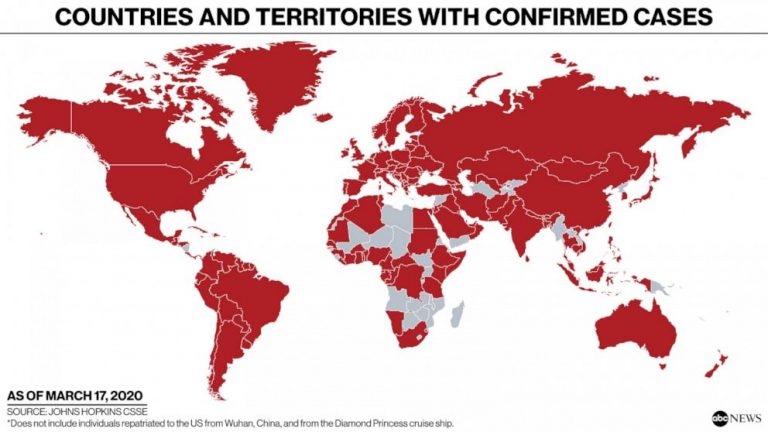
Global coronavirus spread as of March 17, 2020 (Johns Hopkins)

… Follows example of other African countries

… Schools, public events and gatherings begin to be shuttered

… ANSG launches sensitization, bans public assembly from 23rd March

… CBN cuts interest rate and will inject ₦1 trillion into economy

By Chudi Okoye and Stella Nzekwe

Out of an abundance of caution, Nigeria is placing travel restrictions, starting Saturday 21 March 2020, on travellers from 13 countries with high incidence of coronavirus afflictions.

The restricted originations include some of the world’s largest economies which are currently clobbered by high levels of coronavirus exposure: United States, China, Iran, South Korea, Germany, Italy, United Kingdom, Switzerland, Norway, Netherlands, Spain, France and Japan.

Nigeria also announced a temporary suspension of its visa-on-arrival policy.

These decisions came as Nigeria announced five new cases of coronavirus as of 18th March which brought the official total to eight. The latest announced cases include a 30 year-old female that flew back from the United Kingdom on 13th March who observed self-isolation when she tested positive. She is now receiving treatment at Mainland General Hospital, Yaba, Lagos.

Africa Responds

With its announced travel restrictions, Nigeria is following the precedence of some other African countries which had earlier imposed inbound restrictions against the countries most exposed to the coronavirus disease. Although the African incidence level is beginning to rise, the continent seems so far spared the most pernicious scourge of the strange virus. A few reasons have been adduced for the seeming low incidence of coronavirus in Africa and elsewhere. These include weak travel connections to the originating centres of the virus and local climate conditions. There has been some skepticism about the quality of screening and even the authenticity of reporting coming out of Africa and other areas with low incidence of local transmissions. But it is unclear if this is genuine scientific concern or merely prejudiced bafflement. Be that as it may, continental officials are beginning to ramp up on containment measures to prevent an insidious spread, including the imposition of travel restrictions and other stringent measures.

From Tunisia to Sudan to Egypt in North Africa all the way down to South Africa, African countries are taking any combination of the following measures: suspension of some or all international flights, closure of territorial borders, social distancing including closure of public institutions, restriction of public gatherings, and even night-time curfew.

Countries like Kenya have banned inbound travellers from countries reporting any case of coronavirus, not just travellers from high-risk origins. Some African countries have already declared a national emergency, similar to the steps taken in some high-risk countries outside the African continent.

On Sunday, 15th March, the South African head of state, Cyril Ramaphosa, projecting poise and presidential aplomb, addressed his country for about 20 minutes on the pandemic, announcing that his government was declaring a “national state of disaster”. He laid out the steps his government was taking to contain the spread of the virus in his country.

South African president, Cyril Ramaphosa

Nigeria Follows Suit

The president of Nigeria, Major-General Muhammadu Buhari, has yet to address the country on the scare of coronavirus. The Nigerian head of state has however set up a Presidential Task Force (PTF), inaugurated on 17th March, to manage government response. The PTF immediately announced a ban on all forms of travels by public officers and civil servants until further notice. The next day, 18th March, saying that it had further assessed the global situation, the PTF announced the following measures:

  • “The Federal Government of Nigeria is restricting entry into the country for travellers from the following thirteen (13) countries; China, Italy, Iran, South Korea, Spain, Japan, France, Germany, Norway, the United States of America, the United Kingdom, Netherlands and Switzerland. These are all countries with over 1,000 [coronavirus] case domestically;”
  • “All persons arriving in Nigeria who might have visited these countries, often days prior to such arrival, will be subjected to supervised self-isolation and testing for 14 days;”
  • “The Federal Government is temporarily suspending the issuance of all visas on arrival;”
  • “The Federal Government is also counseling all Nigerians to cancel or postpone all non-essential travels to these countries; and”
  • “The Federal Government urges Public Health Authorities of countries with high burden to conduct diligent departure screening of passengers and also endorses this travel advisories to their nationals to postpone travels to Nigeria.”

These restrictions will be in force for four weeks beginning 21st March, subject to review, the PTF assured.

The measures so far floated by Nigeria appear less emphatic than what obtains in some other African countries. Djibouti, with no reported coronavirus case so far, has suspended all international flights to the country, according to its US embassy. Morocco too has suspended all international flights “until further notice”; while Ghana, according to the country’s Information Minister, Kojo Oppong Nkrumah, has said that all travel into the country “is strongly discouraged at this point in time.”

WHO’s Assessment and Pandemic History

Nigeria’s cautiousness might not be unconnected with the advice given by the World Health Organization (WHO) which is urging countries not to apply impulsive travel restrictions in a way that would impact trade and travel.

It will be recalled that WHO had on 11th March declared coronavirus (COVID-19) a global pandemic which, unlike an outbreak or an epidemic, means that the virus is spreading across countries and continents and affects large chunks of transnational populations. In the realm of infectious diseases, a pandemic is the worst case scenario.

According to Dr. Tedros Adhanom Ghebreyesus, the 55 year-old Ethiopian academic who heads WHO as Director General, “we have rung the alarm bell loud and clear.” The director called on countries to act together to combat a common threat and to learn from one another’s containment and attenuation successes. He urged countries to “find, isolate, test and treat every case and trace every contact.” Dr. Tedros added: “Ready your hospitals. Protect and train your health workers. Let’s all look out for each other because we are in this together to do the right thing with calm and to protect the citizens of the world.”

The WHO director noted that “although this is the first pandemic caused by coronavirus, we also believe that this is the first pandemic that is able to be controlled.”

World history is dotted with pandemic outbreaks. According to the website of the TV network, History, the earliest recorded pandemic happened during the Peloponnesian War (431-404 BC) between Athens and Sparta, with an outbreak of typhoid fever which had spread from Libya, Ethiopia and Egypt into Athens around 430 BC.

According to the public health resource, MHP Online and also the US Centre for Disease Control (CDC), the pandemics in world history with the greatest fatalities include: the bubonic plague of 541-542 with a death toll of 25 million; another bubonic plague, the Black Death, occurring in 1346-1353 which originated in Asia but reached Europe and Africa, killing about 75 to 200 million people (wiping out, according to some estimates, as much as one-third of the world population); the 1918 pandemic (H1N1 virus) known as Spanish Flu, theorized to have originated from China (like the current coronavirus), which ultimately claimed an estimated 50 million lives; and HIV/AIDS, first observed in American gay communities in 1981, which to date has claimed an estimated 36 million lives.

There have been several other pandemics, among them: the Antonine Plague of 165 AD bearing what was thought to be smallpox or measles; the leprosy outbreak that grew into a pandemic in Europe in 11th century; the Russian Flu of 1889-1890; the Indian cholera pandemics of 1852–1860 and later 1910-1911; the Asian Flu of 1956-1958; and the Hong Kong Flu of 1968.

The above shows that coronavirus does have a long line of preceding pandemics. The world’s last known pandemic broke out in June 2009 when WHO declared H1N1 (swine flu) a pandemic. That case lasted for over a year, with a “post-pandemic period” announced by August 2010.

Specific Adjustments

The trajectory for the current pandemic, coronavirus, is still steeply upward. WHO warns that “in the days and weeks ahead, we expect to see many cases, many deaths and the number of affected countries climb even higher.” WHO’s director, Tedros, says the organization is “deeply concerned… by the alarming levels of spread and severity…” In response, perhaps, to WHO’s warning, across nations furious efforts are underway to “flatten the curve” of escalation. In Africa too, where it seems the curve of escalation is less steep, containment measures are being mounted in addition to the travel restrictions.

In Nigeria, social distancing measures, already widespread in more afflicted environs, are slowly being put into place. A growing number of public events are being cancelled. For instance, the management of the National Youth Service Corps (NYSC) has cancelled the Batch A orientation programme for students across the country. The camps which started on 10th March were supposed to last for 21 days. Corps members in the camps were, however, informed on 18th March that the camps were being closed and that they would receive posting letters to proceed to their places of primary assignment. The corps members said they were told this was due to the coronavirus crisis.

Earlier, the Nigerian federal government had approved the postponement of the 20th National Sports Festival which had been due to start this weekend in Benin City, Edo State. The Minister for Youth and Sports, Mr. Sunday Dare, made the announcement on Tuesday 17 March 2020.

Several other public institutions may become candidates of social distancing measures.

The Nigerian Centre for Disease Control (NCDC) offers guidelines for self-isolation and preventive measures which consist largely in practicing personal hygiene. The Presidential Task Force (PTF), in its public briefing, also issued a practical advisory with a To-Do list for Nigerians:

  • Stock up on essentials  – food , water, tissues, fruits, sanitizers, handwash, disinfectant
  • Avoid frivolous spending
  • Practice good personal hygiene and avoid crowded areas
  • Where possible limit physical meetings: use virtual meeting tools (email, Skype or phone)
  • Drink plenty of fluids, get a lot of rest and sleep as much as possible
  • Make sure surfaces (e.g. desks and tables) and objects (e.g. telephones, keyboards) are regularly wiped with disinfectant
  • Wash hands with soap and running water when hands are visibly dirty
  • Boost immune system: Take vitamin C –  particularly oranges.

Sensitization in Anambra State

At a local level, the Anambra State Ministry of Information and Public Enlightenment has embarked on an enlightenment campaign taken to public places to provide awareness about coronavirus as well as the lassa fever pandemic.

Earlier, on Friday, 6th March, the Anambra State Commissioner for Information and Public Enlightenment, Mr. C. Don Adinuba, led a sensitization campaign team to New Tyre Market, Nkpor in Idemili North Local Government Area. The commissioner said that the enlightenment campaign was part of the state government’s concern to protect the health of its people. He stressed that although Anambra State remained free of lassa virus and coronavirus, “we are [working] with development partners to strengthen proactive measures against the two viruses in the state. As such, we are here to sensitize traders and tyre vendors on precautionary measures in order to avoid the risk of the diseases in the state.”

The state government plans to carry that message across communities in Anambra State.

Anambra State Gov., Willie Obiano

In a statement issued on 19 March 2020, the governor of Anambra State, Willie Obiano, provided the following public health advisory on coronavirus Ndi Anambra:

  • Assembly: All public gathering is banned ‪from 23rd March 2020 until further notice
  • Markets: Traders and market goers should wash their hands frequently, use sanitizers, avoid handshaking and hugging, keep 6ft distance between customers and traders. Market leaders to buy infrared thermometer to test suspect cases
  • Education: Students of Anambra tertiary institutions must proceed on vacation effective 20th of March 2020 until further notice. All primary and secondary schools in Anambra State must go on indefinite vacation effective 27th March 2020. Until then, all inter-house sports competitions are by suspended until further notice. School management to implement strict hand washing policy. Schools management should take the temperature of their day and boarding students at least once every day. Temperatures above 37.9 degrees Celsius must be reported to the nearest hospital.
  • Residents: All residents in Anambra State advised to avoid handshaking, hugging and all other forms of contact salutation. Avoid unnecessary travels. Keep reasonable social distance. All residents returning from countries and states with active COVID-19 cases must self-isolate for 14-days, taking temperatures twice daily, and contact the Anambra state Public Health Emergency Operation Center immediately (PHEOC numbers are ‪080309531; 08145434416; 0810446408).
  • Hotels, eateries and nightclubs: All hotels must provide a handwash station and sanitizers. Guests are encouraged to wash their hands with soap and running water for at least 20 seconds. Hotel management to take temperature of guests and visitors with a non-contact infra-red thermometer. Temperatures over 37.9 degrees Centigrade must be reported to the PHEOC. Hotels, restaurants and nightclubs to check temperature of all their staff on daily basis, with those exceeding 37.9 degrees Centigrade taken to hospital. Restaurants must avoid overcrowding patrons at the table. Hotels are encouraged to maintain a database of their guests.
  • Buses: Owners and operators of long-distance luxurious buses and intrastate buses to maintain inbound and outbound travel manifest, provide hand wash stations and provide hand sanitizers in their buses for passengers who must wash hands regularly.

As World Markets Tumble, CBN Reacts

Whilst healthcare measures are slowly being rolled out at national and subnational levels to mitigate the impact of coronavirus, policy measures are also being introduced to mitigate the economic impact. The economic consequences of coronavirus are already manifesting across the world. Business contraction is leading to widespread layoffs. Major global stock markets are tumbling. For instance, amid wild swings in recent trading, the United States Dow Jones Industrial Average has dropped a whopping 32%, from 29,343 as at 19 February 2020 to 19,898 by 17 March 2020. On a number of occasions during this wild trading period, the automatic circuit breaker was triggered causing regulators to stop trading to avert the dangerous trends. A deep recession is now widely expected, and authorities are scrambling to design alleviative measures, including bail-out for companies and cash payments to stricken families.

Regulatory intervention is also afoot in Nigeria. On Wednesday, 18th March, the governor of the Central Bank of Nigeria (CBN), Mr. Godwin Emefiele, announced at a press briefing in Abuja that CBN will inject ₦1 trillion into critical sectors of the Nigerian economy. The package will include ₦100 billion in loan facility to support health authorities, helping to ensure laboratories, researchers and innovators are able to work with global scientists to patent and produce vaccines and test kits in Nigeria to prepare for any major crises ahead.

CBN governor, Godwin Emefiele

The CBN had earlier, on 16th March, announced the slashing of interests rate on its intervention loans from 9% to 5%, as well as an extension of moratorium from one to two years, to buffer the Nigerian economy. The apex bank had said that the measures were the first set of its elaborate responses to combat the coronavirus crisis.

In his briefing on CBN plans, the governor, Mr. Emefiele, had said:

“The Coronavirus pandemic is having consequences for both the global and the Nigerian economies. It has already led to unprecedented disruptions in global supply chains, sharp reduction in crude oil prices, turmoil in the global stock and financial markets, wide spread cancellations in sporting, entertainment and business events, lockdown of large source of movement of persons, in many countries and intercontinental travel restrictions across critical air routes across the world.

“These outcomes have had adverse effects for key sector including oil and gas, airlines, manufacturing, trade and consumer markets.

“In furtherance of its financial systems stability mandate, the CBN is committed to providing support for affected households, businesses, regulated financial institutions and other stakeholders in order to cushion the adverse economic consequences of this pandemic on our people.”

From its healthcare providers and researchers to government agencies, corporate entities, civic groups and families, Nigeria – though yet to be formally addressed by its seemingly hebetudinous president – is slowly joining a world frantically groping for solutions to combat an insidious pandemic. The current outbreak, like its historical predecessors, is certain to cause long-term changes in society and economy. How much pain these changes induce, and how fast the pain will reduce, remains to be seen.

Awka Times guest reporter, Pamela Henry-Igwe, contributed to this story

Foreign Loan for ‘Nigeria’; Sullen Groan in the South East

2
Saga of President Buhari and the South East geopolitical zone

The federal government of Nigeria under Major-General Muhammadu Buhari is seeking a jumbo foreign loan to finance infrastructure development and other projects in the country. The $22.7 billion loan, already approved by the Senate and now awaiting debate in the House of Reps, is planned for projects in all geopolitical zones of Nigeria with the brazen exception of the South East. Senators from the zone were almost entirely absent from the chamber during a Senate debate on the loan, but they reportedly voted afterwards to approve it. However, forced by growing discontent over the exclusion of their zone from loan disbursements that carry a sovereign repayment burden, South East senators have begun to pipe up, trying – so far haltingly, even diffidently – to address the distress of their zone and to seek redress.

By Chudi Okoye

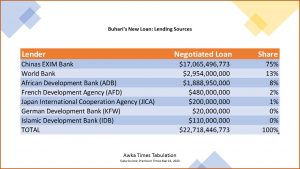
It is, by historical standards, among the largest sovereign borrowings ever canvassed by the country of Nigeria. The loan amount being sought, $22.72 billion, is equivalent to 84.3% of Nigeria’s current external debt stock of $26.94 billion. If successfully secured, the new loan would nearly double Nigeria’s foreign debt stock. It would also push the country’s total public debt portfolio (foreign and domestic), at $85.39 billion as of Q3 2019, to $108.11 billion. This would significantly increase Nigeria’s debt-to-GDP ratio and, concomitantly, increase the country’s already high debt servicing costs.

Nigeria’s external debt has ballooned since President Muhammadu Buhari assumed office in 2015. After the historic debt relief achieved under President Olusegun Obasanjo which had enabled Nigeria to zero out its debt exposure to the Paris Club by 2006, Nigeria’s external debt profile had crept up again under subsequent administrations, according to data harnessed by Awka Times from the Debt Management Office’s website. The external debt reached $9.46 billion as at the time of Buhari’s fourth presidential election attempt which he won, defeating the incumbent Goodluck Jonathan to assume office in May 2015. In the four years of Buhari’s presidency to September 2019, Nigeria’s external debt had jumped a whopping 185% (from $9.46 billion to $26.94 billion), according to Awka Times analysis.

And it is now set to rise even further.

Twice since assuming office the Buhari government had asked the Nigerian National Assembly to approve a massive foreign loan facility which the government is seeking to finance infrastructure development and related projects. In 2016, Buhari asked the Assembly to approve a jumbo loan package of $30 billion for these purposes. However, the 8th National Assembly, partially controlled by Buhari’s political party, the All Progressives Congress (APC), had rejected the package, approving only a draw-down of $6 billion.

Since winning a re-election in 2019, and with a seemingly more amenable National Assembly, Buhari had re-introduced his mega foreign loan request. On 5 March 2020, the Senate signed off on the package of $22.72 billion, after a brief but reportedly heated deliberation. The loan request is currently on rotation in the lower chamber of the Assembly, the House of Representatives, where it has run into some delay but will likely be approved.

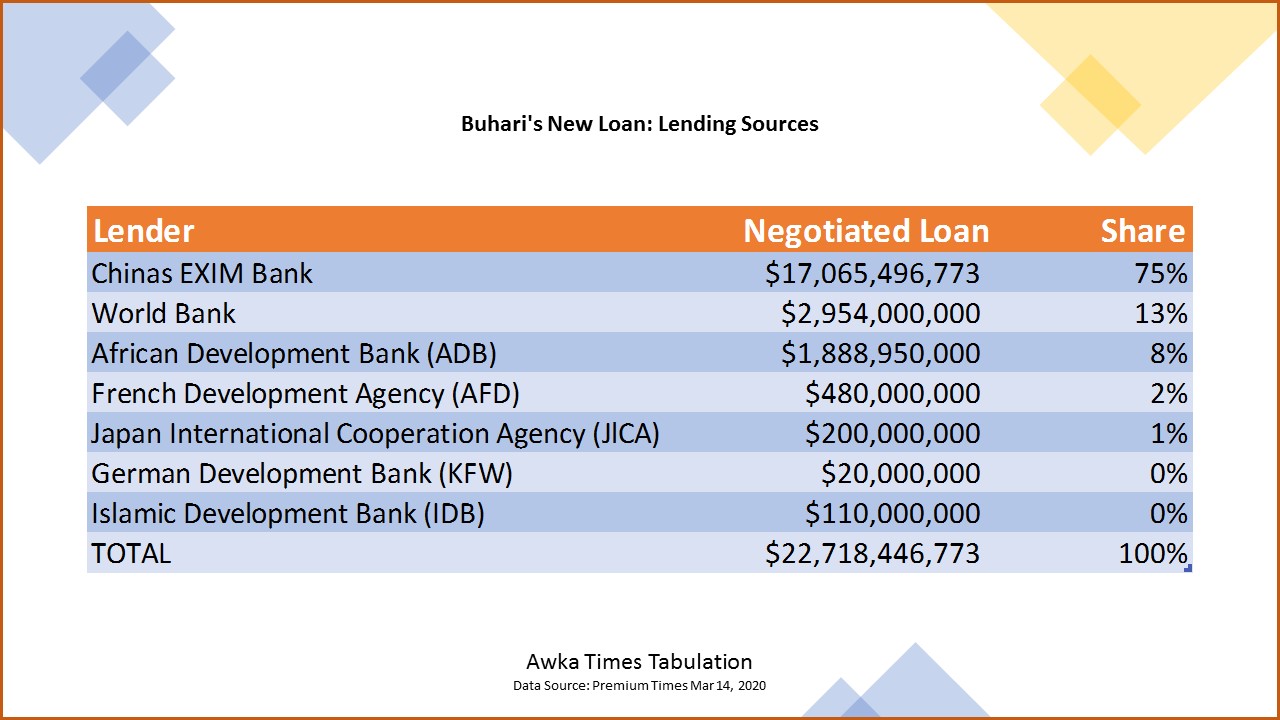
The Buhari administration is seeking the new loan from multiple sources, as shown in the table below:
(Click above insert to view table in full mode)

The foreign borrowings are tied to infrastructure and other projects approved by the lenders. Much of the lending will reportedly not be disbursed into the Nigerian treasury but will instead be released by lenders as direct project payments.

If the loan request is eventually approved by the lower house at its current level, it would occasion a vast inflation of Nigeria’s external debt stock, raising it to about $49.66 billion, an explosive 425% spike from the external loan outlay when Buhari first acceded to the presidency in 2015. This would return Nigeria to the level of loan profligacy seen under the ill-fated Second Republic, under President Shehu Shagari, when Nigeria’s external debt jumped 434% in just four years, from the $3.74 billion inherited from the military under General Olusegun Obasanjo in 1979 to about $20 billion when the Shagari government fell in December 1983.

Shared Burden, Discrepant Benefits

Astonishing as the loan expansion itself is, it is rather the plan for its deployment that is raising political hackles in parts of Nigeria. A national debt being sought ostensibly for infrastructure development has a disbursement scheme which – rather brazen for its political insensitivity – completely leaves out the South East geopolitical zone, a zone riddled with blighted or non-existent infrastructure. It is hard to understand the technocratic assessment or political calculation behind such brazen neglect.

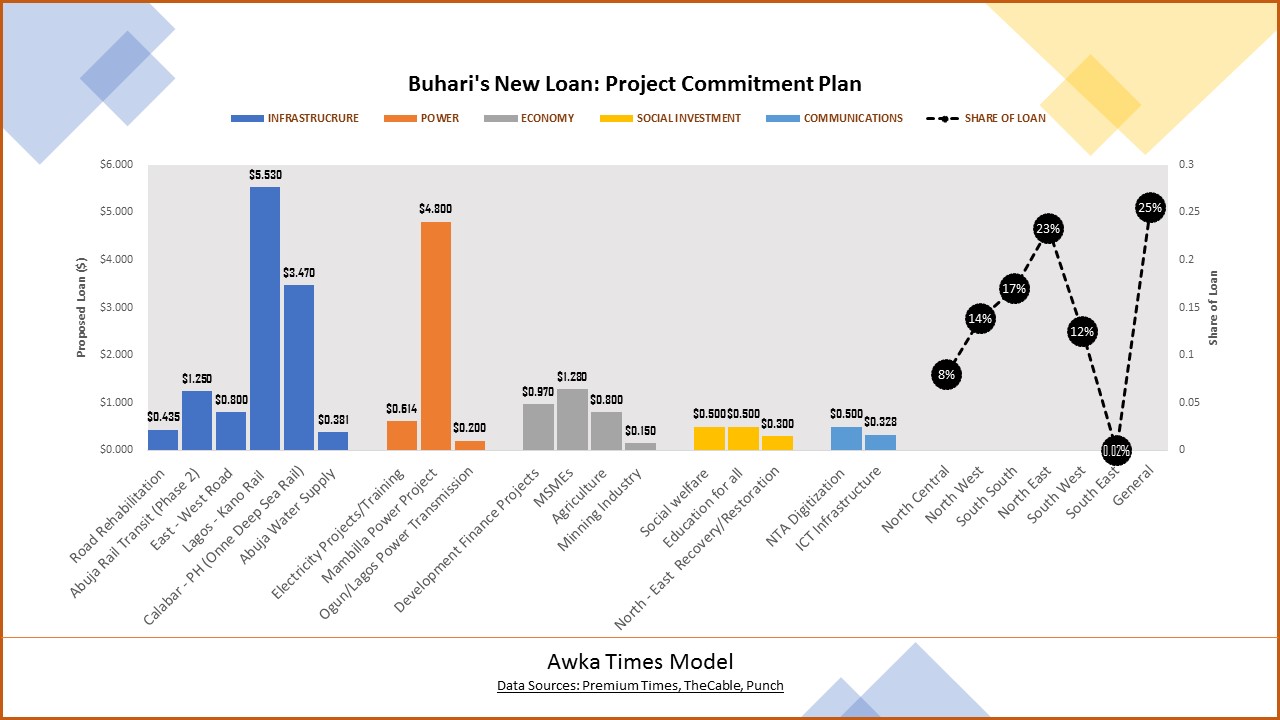
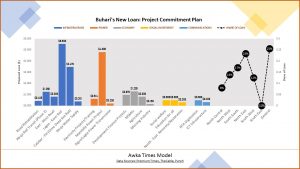
The federal government’s plan envisages five different areas of utilization for the new loan, the major ones being infrastructure, power generation, economy, communication, social investment, and others. The largest of the proposed outlays are: the Lagos-Kano railway modernization project, spanning the South West and Northern geopolitical zones, for which $5.53 billion is earmarked; the coastal railway modernization project covering the Calabar-Port Harcourt-Onne deep sea port segment in the South South, for which $3.47 billion is being set aside; the Mambilla hydro-electric power project in Taraba State of the North East zone, assigned $4.8 billion; the nationwide support project for Micro, Small and Medium Enterprises, allocated $1.28 billion; the Abuja mass rail transit project allocated $1.25 billion; and a plethora of other proposed allocations.

The bulk of the canvassed foreign loan goes to projects in other geopolitical zones except the South East, and to nationwide projects hardly any of which impacts the neglected hinterland. Awka Times’ detailed checks show that the only mention of a specific South East disbursement relates to a paltry $50 million, accounting for 0.2% of the anticipated loan, earmarked for “vocational training in the power sector”. But this amount is to be split between Enugu and seven other states (Lagos, Ogun. Kano, Plateau, Niger, Kaduna and Cross River) as well as Abuja FCT. If, to keep it simple, we assume that the $50 million will be split evenly between the nine destinations, then, in the end, the only specific earmark for the South East zone from the jumbo loan of $22.72 billion is a laughable $5.6 million.

This means that specific South East earmark from a loan that would be repaid by all of Nigeria as a sovereign entity is only 0.02%!

Contrast the abject disregard of the South East with the following zonal allocations: North East 23%, South South 17%, North West 14%, South West 12%, North Central 8%, and Nation 25%.
(Click above insert to view chart in full mode)

Electoral Loss, ‘Resentful’ Boss

There is speculation that this apparent discrimination against the South East is likely the result of a promise Buhari himself made after the 2015 presidential election when he stated at a Washington DC forum that states which gave him only 5% of their votes could not expect to be treated as those that gave him 97%.

Buhari, in 2015, explaining his ‘5%/97%’ rule

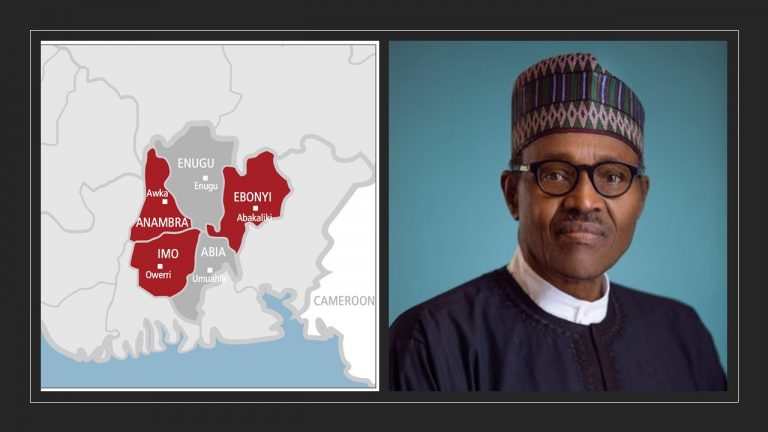
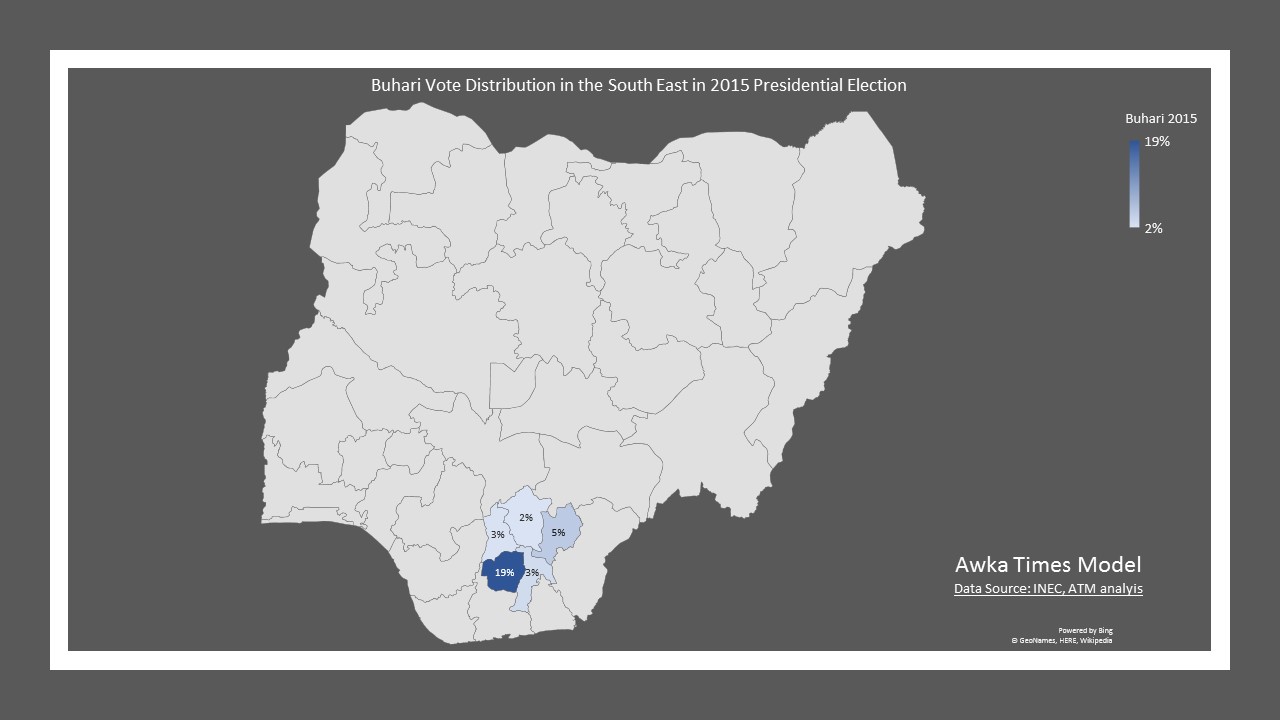
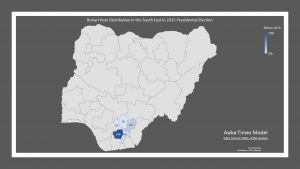
As the map below shows, in the 2015 presidential election Buhari polled at 5% or less in all the states of the South East zone barring Imo where he notched up 19%. His principal opponent in that election – the southerner and then incumbent president Goodwill Jonathan who was running on the People’s Democratic Party (PDP) ticket – mopped up the bulk of the votes in the South East.
(Click above insert to view map in full mode)

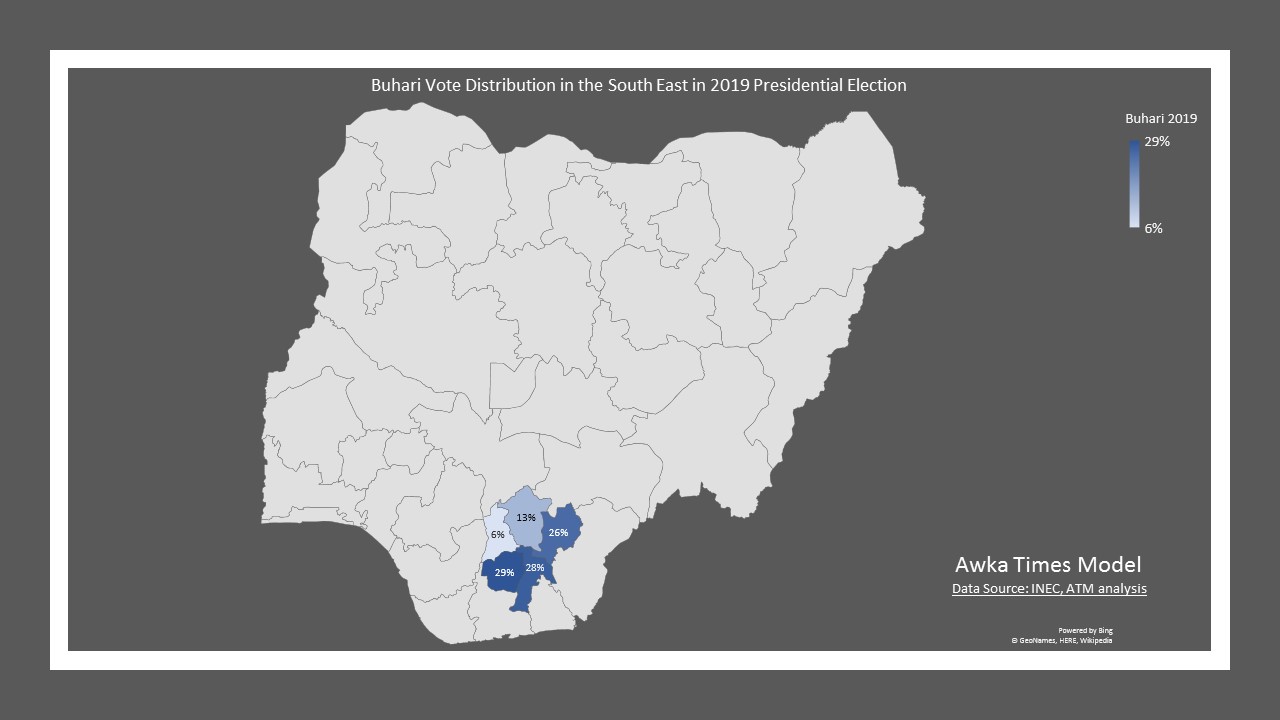
In 2019 when President Buhari was seeking re-election, the competitive field had changed somewhat. This time, the PDP fielded a flagbearer considered a formidable candidate: former vice-president Atiku Abubakar who was a Northerner like Buhari. This material fact, that the two major parties both fielded Northern flagbearers, coupled with a natural political pragmatism that pulled some influential South East politicians into the ruling APC in the intervening years, led Buhari to perform much better in the South East in the 2019 presidential election. This time, he polled in the high 20s in three of the five South Eastern states (Imo, Abia and Ebony); he scored 13% in one (Enugu); and he managed to eke out 6% in the remaining state (Anambra).
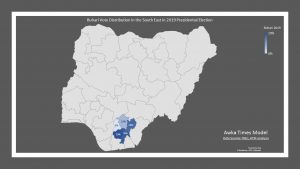
(Click above insert to view map in full mode)

The result of the 2019 presidential poll showed that although Buhari’s favorability in the South East had noticeably improved, he was still disfavored in the geopolitical zone. He still underperformed the competing ticket even when his opponent was another Northerner, albeit one with a popular Igbo ex-governor, Peter Obi, as his running mate.

Given the above, there may be some justification to the claim that the apparent marginalization of the South East, vivified in the proposed loan issue, is evidence of political retribution being exacted by a politician against a zone that has never favored him.

Hallowed Roles, Mellowed Voices

It is unclear if this stark political reality influenced the thinking of the South East caucus in the National Assembly. Because that would be the only charitable way to explain the initial behavior of senators from this zone in the loan saga. When the loan petition was tabled for deliberation in the Senate chambers, all but a few of the 14 South East senators were reportedly absent (the 15th South East senator, Orji Uzor Kalu representing Abia North, has been incarcerated since December after he was convicted in a fraud case). As reported, there had been a heated though relatively short debate among the senators over the loan request. Apparently only a few of the South East senators who were present had contributed to the loan debate. When they did, there seemed to be some sort of psychological distancing from their constituency concerns, as in the submission by Sen. Rochas Okorocha (Imo West), who rose to speak on a different but related bill to set up a South East Development Commission:

“When we talk about the unity of Nigeria, Igbos contribute 75% on the unity of this country. But yet they are the most misunderstood people. Let me also speak with passion and appeal on THEIR behalf for the first time… I’ve risen here to speak on behalf of North Central, North West, South West and others. First time I’m speaking on behalf of the Igbos. That this feeling of neglect and marginalization by the South East needs to be corrected SOMEHOW. Of recent is a $22.7 billion that came to this nation as loan, and nothing is being traced to the South East. It’s painful. And the Igbos are BEGINNING to feel rejected, neglected in a nation THEY think they are part of. I think this great chamber should assuage THEIR fear and concern.”

Sen. Rochas Okorocha speaking during a Senate debate (OakTV)

In contradistinction to Sen. Okorocha’s oddly dissociative advocacy, it was most notably Sen. Enyinnaya Abaribe (Abia South) who spoke with passion, laying out a cogent case for distrbutive equity with regard to the project funding from the loan. Sen. Abaribe not only demanded more details on the geopolitical distribution of the loan, he also questioned the economic value of several line items in the borrowing plan.

However, despite Sen. Abaribe’s spirited remonstration, the loan petition still got a unanimous assent in the Senate, with reports that the South East senators joined their colleagues to approve the loan, after a closed-door session of the Senate.

It is therefore a little perplexing that the same South East senators showed up at a press conference, one week after the Senate vote approving the loan, to announce that they were “concerned” about the exclusion of the South East from loan disbursements! Presumably this new realization came about in the wake of negative media reporting and commentary after Senate approval of the request was announced.

Looking somewhat flummoxed at the press briefing that he gave with a handful of his caucus colleagues on March 12th, group leader and former deputy Senate President, Ike Ekweremadu (Enugu West), said that the South East caucus was protesting the exclusion of the region in the distribution of infrastructure projects funding from the new federal government loan. He said that the caucus had taken its protest to the Senate President, Ahmed Lawan, and the Speaker of the House, Femi Gbajabiamila.

Sen. Ekweremadu with SE caucus members, Mar 12, 2020 (Viable TV)

Sen. Ekweremadu told reporters that the loan request was approved by the Senate because many South East senators were out of the chamber during the debate, “attend[ing] to other important things.” He said:

“Regrettably last Thursday, the Senate passed a borrowing plan which excluded the whole of South East. We like to use this opportunity to thank some of our colleagues who were at the chamber like Enyinnaya Abaribe who made spirited efforts to get the matter addressed to see that there is equity distribution.

“Most of us were not in the chamber. I was at an INEC retreat so we want to commend [Abaribe] for what he did and those of our colleagues who were there during the conversation. We met as a caucus of legislators of the South East last night after consulting with our people and getting their feelings regarding this issue.

“If we are going to be part and parcel of the payment, it makes every sense that we are going to benefit from the utilization of those funds. Our concerns about certain facilities within the eastern corridor railway of Port Harcourt to Maiduguri, we are also concerned about the access to the sea for people of the South East to open seaports in our area. We hope by the time the matter is addressed, the fears of the people will be allayed.”

Sen. Ekweremadu said that the South East caucus “felt that the best approach was for a constructive engagement with the National Assembly leadership. So this afternoon, we had a very good conversation with both the Senate President and the Speaker of the House of Representatives.”

He said the caucus believed that the matter would be revisited because the National Assembly leadership had shown not just “concern” but “commitment”, assuring the caucus that the situation would be redressed in a way that includes the South East in loan projects.

Sen. Ekweremadu took the time to thank the Assembly leadership for its assurances. He also hoped that what was presented by the federal government “was just a plan and [that] there’s still an opportunity to look at distribution.”

Ekweremadu was asked why his caucus was acting so belatedly when the group should have been aware of the content of the federal government’s proposals before the vote. He was reminded in fact that the government’s proposals had long been in rotation since they were first presented in the Eighth Assembly in which many of the current caucus members served. The implication was that members of the South East caucus had had plenty of time to seek a recalibration of the loan disbursement plan before it was approved by the Senate, but they apparently did not.

The senator parried the question but stated that the South East still had a window through legislative processes which would be exploited to address the issue. He said since the loan request had not been approved in the House of Representatives, “the appropriate thing will be done and our people’s fears will be allayed.”

It seems possible that the evident inequity in the planned distribution of the loan would be addressed, especially with a presumably chastened caucus responding to constituency pressure. Since the issue of the loan entered the public domain, agitation has been rising among South East communities.

Beyond adverse media commentary, some individuals are taking practical steps to redress the situation. For instance, a group that goes by the name “Igbo Board of Deputies”, apparently a non-profit outfit, has been circulating material purporting to show that it had engaged attorneys to act for it on the loan issue. A letter seen by Awka Times appears to have been drafted by attorneys retained by this group and addressed to China EXIM Bank which is providing over 70% of the new loan. In the letter, the group offered data (with some inaccuracies) making the case that the South East was not benefiting from the loan. As such, the letter said, it was serving legal notice to China EXIM Bank to desist from disbursing the loan, or risk being joined in a planned suit against the federal government of Nigeria over its discrimination against the Igbos on this loan and related issues.

It is unclear what the threatened suit will accomplish, or if indeed it would be brought. But such civic society initiative is evidence of disgruntlement in the South East over its flagrant mistreatment on this loan issue. It also defies political logic that the APC government would be so cavalier and insensitive towards the South East, in the face of rising agitation, even as it is striving for further electoral inroad to the geopolitical zone. Perhaps this is the reason for the South East caucus’ optimism about the “assurances” offered by the National Assembly leadership.

Be that as it may, we cannot be entirely certain if the “assurances” are well-intended or merely communicated to mollify a disgruntled constituency. It is also uncertain what form “redress” will take: whether the South East will receive meaningful project allocation from the loan, or merely allocated a token to placate the rising discontent.

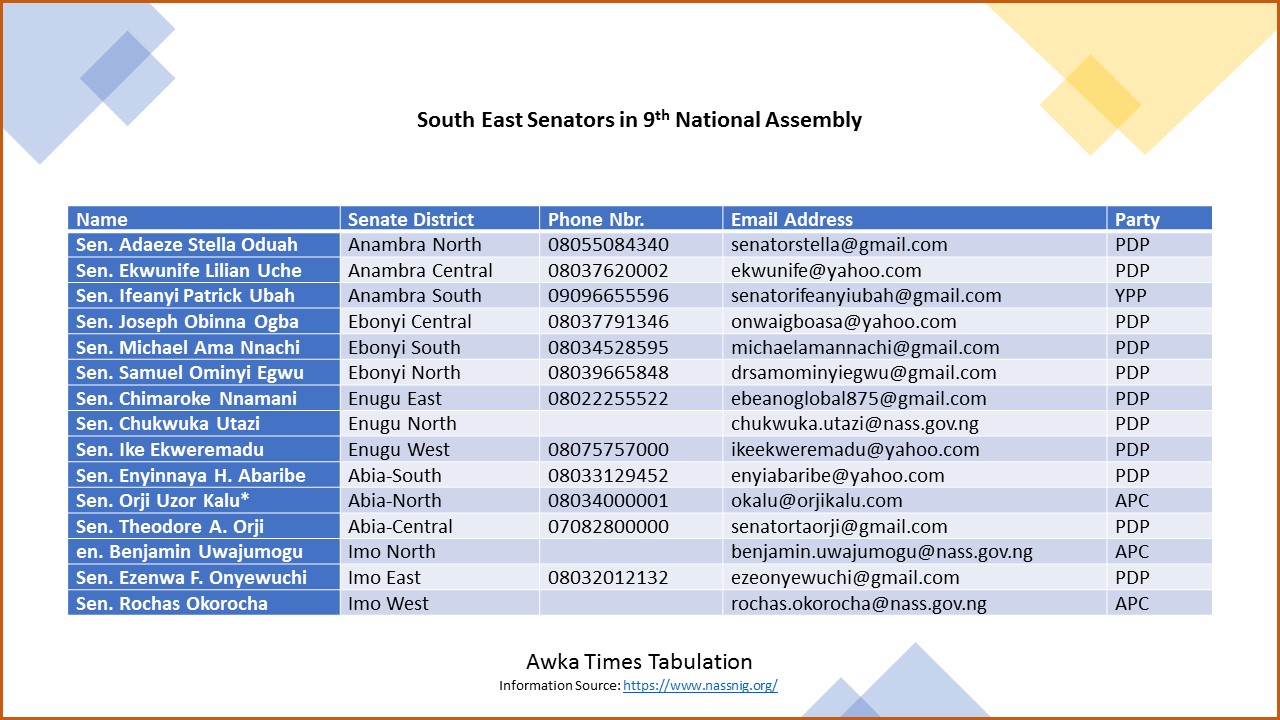
Given the uncertainty, Awka Times, in the spirit of patriotic journalism, is joining efforts aimed at redressing a situation that could further fray the fragile cohesion of Nigeria. We have put together a list of the South East members of the Nigerian Senate, publishing their phone and email information so that constituency members could contact their senators demanding that they stay the course to ensure that a meaningful and adequate solution is devised. It is necessary to redress the gratuitous discrimination against the South East zone in the utilization of a loan ostensibly secured under the sovereign remit of Nigeria.
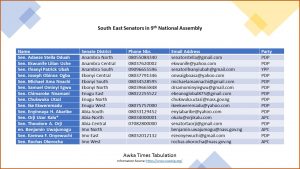
(Click above insert to view table in full mode)

* Note: Sen. Orji Uzoh Kalu is currently incarcerated following conviction in a fraud case, so he may not be easily reachable at this time.

Awka Times reporter, Stella Nzekwe, assisted with this report.

ANSG Congratulates Mr. Chudi Offodile On Appointment As NIMASA Director

1
Mr. Chudi Offordile, Executive Director, NIMASA

By Ndu Chris Nwannah, ATM Guest Writer

The Anambra State Government has issued a statement congratulating Honourable Chudi Offodile on his appointment by President Muhammadu Buhari as an Executive Director in the Nigerian Maritime Administration and Safety Agency (NIMASA). Offodile was on Wednesday, March 11th, announced as the new NIMASA Executive Director in charge of Finance & Administration following the reorganization of the agency’s top management team by the federal government.

NIMASA is a federal agency focusing on aspects of maritime regulation, including: safety administration,  labour, pollution prevention and control, search and rescue, cabotage enforcement, shipping development and ship registration, training and certification of seafarers, and maritime capacity development.

In a statement issued in Awka by the Commissioner for Information and Public Enlightenment, Mr. C. Don Adinuba, the Anambra State government said that “Offodile is eminently deserving of the appointment. He is, in fact, worth everything in gold.”

Chudi Offodile, a lawyer, politician and author, represented the Awka North/South federal constituency in the National Assembly from 1999 to 2005. In the House of Representatives he was both Chairman of the Sub Committee on Gas and Chairman of the Special Committee on Joint Venture Oil Operations. He later headed the Committee on Public Petitions.

Following his career in the federal House, Mr. Offodile re-engaged his private legal practice in Abuja as the managing partner of Chudi Offodile & Co. The practice specialized in oil and gas, finance, regulatory compliance and international trade. He also served as a Director of the Abuja Infrastructure Investment Centre (AIIC) from 2001 to 2015.

Earlier in his career, Mr. Offodile had served a full term in the West African Regional Parliament and the ECOWAS Parliament (2000–2005) where he chaired the Energy, Science and Technology Committee.

In its congratulatory message to Offodile on his latest appointment, the Anambra State government stated: “Although he left the legislature 15 years ago, his colleagues and officials of the National Assembly speak nostalgically about him on account of the brilliance, commitment and vibrancy he displayed.”

“Having discharged his duties with aplomb, he set a standard by which a lot of his colleagues are still judged in matters of transparency, probity and commitment to the common good as well as legislative delivery,” the statement further affirmed.

According to Commissioner Adinuba, “Offodile was one of the first major investors in the state following the restoration of democratic rule in Nigeria in 1999 and encouraged many people from Anambra State to follow his bold example of Think Home.”

The Commissioner also stated that Offodile’s “impressive record made Governor Willie Obiano [to] appoint him last December [as] a member of the Anambra State Vision 2070 Committee, a group drawing up a strategic plan to make the state attain the status of a fully developed entity in the next 50 years. The committee is headed by former Central Bank Governor, Chukwuma Soludo, a distinguished Economics professor.”

Mr. Adinuba also noted that Governor Obiano has expressed “the gratitude of the people and government of Anambra State for [Offodile’s new] appointment.”

Continuing, the statement stressed that “Honorable Offodile’s appointment into the leadership of NIMASA, a key parastatal, is obviously in line with President Muhammadu Buhari’s promise during the 2019 electioneering to appoint persons from Anambra State and the Southeast geopolitical zone into strategic positions.

“We still expect more key appointments because all the people the president has appointed from our state and the Southeast geopolitical zone always display outstanding competence, integrity and loyalty,” Mr. Adinuba concluded.

Free Digital Flipbook Version of Awka Times – Limited Time Only!

0

Greetings, dear readers!

As previously announced, we have now completed the production of the print edition of Awka Times, and we are shipping bundles into selected markets in Nigeria. Please bear with the slight delay. Whilst regrettable, this is not unusual for a first edition.

As the print edition wends its way into the market, we have also produced, as previously announced, a digital facsimile in flipbook format. Ideally, this digital flipbook copy will be available with subscription. However, given that this format is not common in most media markets including Nigeria, we have decided to make the flipbook version freely accessible, for a period of time, to allow readers unfamiliar with the format to try it out.

To get the digital flipbook version, please click here.

Once in, you’ll see the tools to navigate through the pages.

Flipbook offers an immersive reading experience which you’ll enjoy.

Cheers!

Chudi Okoye

Publisher/Editor-in-Chief, Awka Times

At 14th UNIZIK Convocation, Youths Charged to Take Advantage of African Free Trade Agreement

0
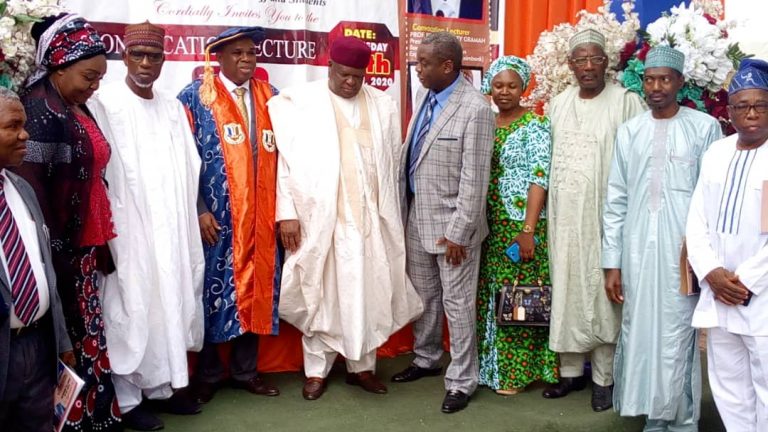
Afreximbank boss, Prof. Oramah (4th left), NUC Exec. Sec, Prof. Abubakar, and VC Prof. Esimone (in plaid suit) at UNIZIK for Convocation Lecture, Mar 11, '20

… African Export-Import Bank boss, Professor Oramah, urges youths to harness African Continental Free Trade Agreement which takes effect by July 1, 2020

By Ndu Chris Nwannah, ATM Guest Writer, and Chudi Okoye

It had taken an immense amount of gritty work to bring it into being. A generation of African statesmen dreaming about it and years of insistent, bareknuckle diplomacy finally produced the African Continental Free Trade Agreement (AfCFTA). To date, 54 of the 55 sovereign states of the African Union (AU) – successor to the fabled OAU (Organization of African Unity) – have signed up and 29 have ratified the protocol, kicking the agreement into effect on 30 May 2019. With this, free regional trading under the agreement is set to start on 1 July 2020 – in just over three months.

With this remarkable milestone, Africa has set up – in terms of numbers of participating countries – the world’s largest free-trade area since the establishment of the World Trade Organization (WTO) in 1994. The AfCFTA protocol covers a market of more than 1.3 billion people, representing about 17% of the world population. It also covers a continental market with a combined current gross domestic product (GDP) of US$3.4 trillion, representing a miniscule 3% of global GDP, but which is predicted to grow to about US$5.6 trillion in 2025, five years hence.

Broadly, the African Continental Free Trade Agreement aims to eradicate tariffs, liberalize trade and create a single market in the continent of Africa. This will mean progressively free movement of people, capital, goods and services across the continent. This presents a massive opportunity for the more competitive African countries, but especially the youths who predominate in the continent’s population. Africa is the youngest continent in the world, with 60% of its population less than 25 years old. Nigeria, as a country, has an exceeding youth proportion, with 62% of its population younger than 25.

With the commencement of the African free trade revolution only three months away, and with many global development organizations from World Bank to One saying that African youths are best positioned to take advantage of the emergent market, it was quite fitting that the commencement speech at the ongoing convocation ceremony of Nnamdi Azikiwe University (UNIZIK), Awka, should centre on the matter of youth sensitization and development.

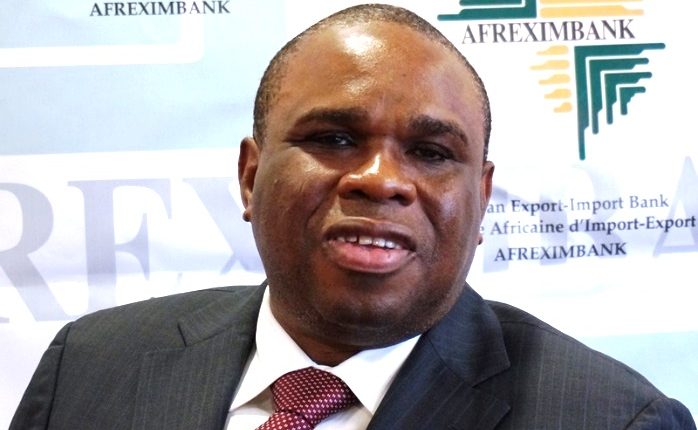
Professor Oramah, UNIZIK Convention Lecturer, 2020

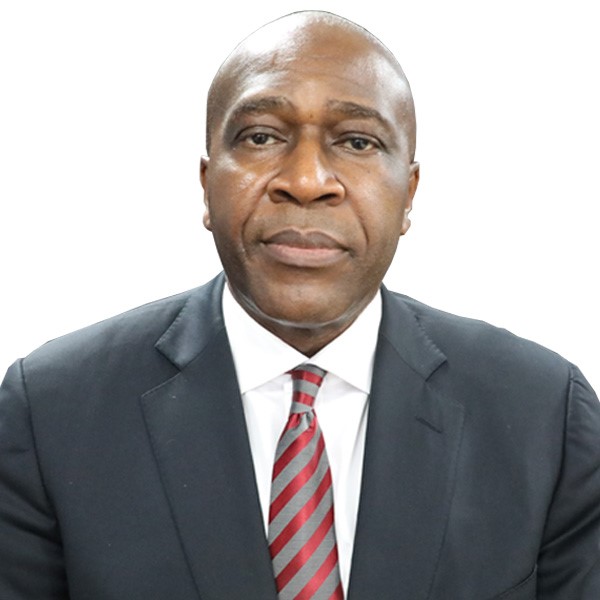
For its 14th convocation ceremony, UNIZIK invited the President and Chairman, Board of Directors, African Export-Import Bank, Professor Benedict Okey Oramah, to deliver the Convocation Lecture. The professor obliged and turned up with an eager message. In a paper titled “Unleashing the Power of the Youth” delivered on March 11th in the institution’s auditorium, Professor Oramah, himself a 59 year-old with a PhD in agricultural economics, charged the graduating youths to make effective use of the African free trade agreement to unleash their untapped potentials. Professor Oramah reminded the audience about AfCFTA kick-off date and the opportunity it presents.

“On July 1, 2020,” he began, “trading under the African Continental Free Trade Agreement (AfCFTA) will commence. The AfCFTA, which is aimed at doubling the share of intra-African trade in Africa’s trade within a 10 year period, is also expected to transform the continent’s manufacturing  sector, formalize and strengthen the SME sector and ultimately accelerate economic growth and development.”

The President of Afreximbank said AfCFTA would definitely unleash the abundance of the African youth, as it would break the barriers of 84,000 kilometres of borders over 55 countries. He said that the policy would reduce the about 54 visas needed to travel across Africa, create regional supply chains, foster manufacturing and expand the creative sector of Africa.

“Today, the visas are gradually disappearing. The AfCFTA will create regional supply chains, foster manufacturing and expand the creative sector of Africa. It is the AfCFTA that will unleash the creative and innovative power of the African youth. The struggle for economic emancipation cannot be easier for the African youth.”

He said that “the emergence of light manufactures, regional and continental supply chains and a strong creative industry will depend on how the youth is able to harness the opportunities offered by the AfCFTA.”

Professor Oramah argued that in historical and contemporary history youths have been the catalyst to economic transformation. He cited the instance of ‘Asian Miracle’, arguing that youths were instrumental in uplifting South East Asian economies from poverty to prosperity during the 1970s to the 1990s. The professor cited youths as Africa’s greatest resource, much more valuable than oil and solid minerals, and argued that in the face of high youth employment, rising crime rates and dangerous emigration practices, there is imminent need to channel youthful energy to useful engagements.

Professor Oramah charged youths to be prepared to take full advantage of any emerging opportunities to exhibit their talents. He noted that Afreximbank had launched some initiatives and programmes to support African economies and the youth to maximize benefits of the AfCFTA. Professor Oramah further stressed that the bank was committed to disbursing US$25 billion revolving loan during a five year period 2017-2021 to support cross-border trade and SMEs in regional supply chains. Out of this figure, he affirmed that the bank had disbursed about US$15 billion.

He emphasized that governments across Africa had a huge role to play by “supporting the growing and innovative youth entrepreneurs with leadership development opportunities, finance and links to wider markets.”

Professor Oramah said it was imperative that governments support the emergence of Export Trading Companies by promoting the emergence of an innovation ecosystem like Silicon Valley. This idea, which he teasingly branded NILICON Valley, is already taking root with innovation centres sprouting in places like Lagos, Port Harcourt and Abuja, in areas run by foresighted ministries of youth. Professor Oramah called for the inclusion of leadership, soft and digital skills in training and educational programmes as well as encouraging links between the private sector and training institutions. The President of Afreximbank noted, however, that youths must work hard to acquire the skills necessary for the emerging opportunities.

The Chairman of the Convocation Lecture, Professor Rasheed Abubakar, who is the Executive Secretary, National Universities Commission (NUC), said in his closing remarks that Professor Oramah had captured the current innovative challenges in the country and Africa and also showed how to overcome them. He described the lecture as a message of hope to youths. He challenged the Afreximbank to consider Nigerian universities, especially Nnamdi Azikiwe University, in the establishment of its Innovation Technology Laboratories. This, he noted, would help in building the capacity of students, lecturers, entrepreneurs and industrial clusters in Nnewi, Onitsha and neighbouring areas to grow.

The Convocation Lecture was graced by the Vice Chancellor of UNIZIK, Professor Charles Esimone, the Chancellor of the university, members of the Senate of the university, management, staff and students as well as the graduands.

UNIZIK Honours Deposed Emir Sanusi, Others, During 14th Convocation Ceremony

0

… University confers doctorate degrees on deposed Emir of Kano, along with MDs of Innoson Motors and Dozzy Group

… Graduates 49 First Class materials, 339 doctorate degree holders

… Tackles infrastructure decay, staff, students’ indiscipline

… Orders Confucius Institute officials in China to be quarantined

By Ndu Chris Nwannah, ATM Guest Writer

The Nnamdi Azikiwe University, Awka, Anambra State, will confer an honorary doctorate degree to the recently deposed and exiled Emir of Kano, Alhaji Sanusi Lamido Sanusi, as part of the university’s 14th convocation ceremony taking place from March 9th to 13th.

The vice-chancellor of the university, Charles Esimone, a Professor of Biopharmaceutics and Pharmaceutical Microbiology, disclosed this during a pre-convocation media briefing held at the university on Monday, March 9, 2020, the day news broke of Emir Mohammad Sanusi II’s dethronement. The emir had been dethroned due to alleged “insubordination” and “disrespect” shown towards the governor of Kano State and “other lawful authorities”, according to a statement signed by the secretary to the Kano State government, Alhaji Usman Alhaji.

Professor Esimone disclosed that Alhaji Lamido Sanusi was among three eminent Nigerians to be conferred with the prestigious honorary degree of the university. He said the honorees were “agents of change” and were being conferred with doctorate degrees for contributing “enormously” to the transformation of the university through infrastructure development. The other honorary doctorate awardees, according to the vice-chancellor, include Chief Innocent Chukwuma, the founder and managing director of Innoson Vehicle Manufacturing, and Chief Daniel Chukwudozie, founder and managing director of Dozzy Group, a conglomerate operating in oil and gas, manufacturing and other industries.

According to UNIZIK vice-chancellor, Alhaji Sanusi had donated a ₦500 million hostel building located at the Okofia Nnewi campus of the university when he was the Governor of Central Bank of Nigeria (CBN), a post in which Sanusi served between 2009 and 2014.

Professor Esimobe also disclosed that Chief Innocent Chukwuma, the auto assembly magnate, had helped in tackling transportation difficulties in the institution. He noted that Chief Chukwuma had built an auto diagnostic centre at the Nnewi Campus of the university, and was also building one such centre in Awka. He noted that students would be trained in vehicle repairs and maintenance at these auto diagnostic centres. The vice-chancellor announced that Chief Chukwuma was also establishing other ventures that would benefit the local economy in terms of skills acquisition and employment generation.

As for Chief Daniel Chukwudozie of Dozzy Group, Professor Esimone stated that he had funded the establishment of a paint factory in the university, and also made commitments to erect more buildings in the university. The VC noted that UNIZIK uses Dozzy Group’s paint products for its building projects.

UNIZIK honorary doctoral awardees: Sanusi, Chukwudozie and Chukwuma

The doctoral honorees are part of the 9,571 graduands being awarded undergraduate and postgraduate degrees during the 14th convocation ceremony of Nnamdi Azikiwe University going on all week. Of the total graduands, the university would be graduating 2,821 postgraduate and 6,750 undergraduate students, according to Professor Esimone. This year’s graduands at UNIZIK include 339 doctorate degree holders and 49 first class graduates. Mr. Ezeh Gabriel Chukwubuikem from the Department of Cooperative Economics and Management, with a CGPA of 4.83, emerged the Overall Best Graduating Student for the 2018/2019 academic session.

UNIZIK VC, Prof. Esimone, with the Overall Best Graduating Student, Ezeh

Professor Esimone said that the institution would continue to uphold quality academic ideals. He assured that the first class graduates would be offered automatic employment after their  NYSC scheme, as part of the measures to promote sound academic programmes. Professor Esimone also promised that there will be postgraduate training for them to further enhance their capacity, enabling them to add value to the system as well as help to train and nurture students under their watch.

Professor Esimone, who became vice-chancellor of the institution in May 2019, maintained that UNIZIK would continue to uphold zero tolerance for indiscipline among staff and students by applying necessary sanctions against culprits. According to him, staff must operate professionally, while students should guard against indulging in examination malpractices and results forgery.

The vice-chancellor stated that the management was seriously working on a project aimed at positioning the university to be among the top 200 globally, best 10 in Africa and the best in Nigeria. He stressed that the effort was already yielding fruits as the university’s ranking had tremendously improved in recent time. Professor Esimone noted with satisfaction that the ranking of the institution had improved significantly from lower than #2500 to about #1000 currently. He noted that the improvement project was rooted in the ‘ACADA’ model which stands for Academic Excellence, Community Service, Administrative Reforms, Discipline and Advancement in human capacity and infrastructure development. He explained that the recent recruitment process in the institution was approved by its Senate to meet special needs of accreditation and staff deficiencies.

The vice-chancellor debunked insinuations that the institution had increased its school fees. He said what the management did was to consolidate all fees payable by students, helping to improve fees transparency through the removal of illegal payments.

Professor Esimone stressed however that the institution was having funding challenges as most of its projects were executed through Internally Generated Revenue, while it was still battling with hostel, staff quarter, standard auditorium, students’ centre, ICT and recreational facility deficiencies.

The vice-chancellor affirmed that the institution had got some funding from the Tertiary Education Trust Fund (TETFUND). He announced that the university last month secured five TETFUND research grants amounting to over ₦100 million.

He said that TETFUND was helping it to overcome some infrastructure deficiencies. Professor Esimone noted that take-off grant was important to the development of any university, but said that UNIZIK did not get one and has relied heavily on Internally Generated Revenue and private grants. He said the university needs a senate building, staff quarters, standard auditorium, students’ centre, ICT equipment and recreational facilities.

The vice-chancellor affirmed that in a bid to combat open defecation and improve campus hygiene, the institution had embarked on the conversion of hostels to self-contained rooms.

Answering questions on the coronavirus disease (COVID-19) currently menacing the global community, Professor Esimone said that staff of the university’s Confucius Institute (set up to promote language and culture interchange between China and Nigeria) who went to China for a training programme had been asked to stay back, quarantined on location, pending the resolution of the COVID-19 issue.

For this year’s convocation event, the Research Fair keynote address was delivered by Special Guest of Honour, the Executive Secretary of TETFUND, Professor Elias Suleiman Bogoro. Professor Benedict Okey Oramah, President and Chairman, Board of Directors African Export-Import Bank (Afreximbank), was selected as the Convocation Lecturer; while Professor Abubakar Rasheed, Executive Secretary of the National Universities Commission (NUC), was chosen to chair the Convocation Lecture. The 14th convocation includes an interdenominational service which was held on Monday, March 9, the opening day of the convocation programme.

At the press briefing, Professor Esimone stressed that he would be writing to the Senate of Nnamdi Azikiwe University asking it to make convocation a regular event with specific dates attached to it. The vice-chancellor said that he appreciated the Visitor to the University, President Muhammadu Buhari, for approving its 14th convocation ceremony.