28 C
Awka
Friday, April 3, 2026

Trumpet With Certain Sound

Home Blog Page 13

Awka Main Market Reopens After Two-Week Covid-19 Closure by ANSG

0
Eke Awka market roundabout - usually a rowdy arena

Market reopened at the culmination of the initial closure period, following observable efforts by market stakeholders to comply with official Covid-19 protocols.

By Chudi Okoye

Eke Awka market, the main trading centre in the Anambra State capital, reopened today, 29th June 2020, after a two-week closure imposed by the Anambra State government. The market closure was occasioned by what the government said were observed violations of its Covid-19 containment guidelines by market stakeholders and participants.

The market closure had been announced by the Secretary to the State Government (SSG), Professor Solo Chukwulobelu, in a statement issued on Thursday, 11th June 2020.

On the Monday that Eke market reopened, there was an instantaneous return to the sizzle and crush for which the market – the largest in the Awka conurbation and one of the busiest in Anambra State – is known. There was a splurge of commerce, with boisterous transactions going on everywhere as needy patrons and eager traders tried to make up for lost time. It was as if the market had been in suspended animation.

Right from the early hours of the morning, shop owners were seen busily cleaning up their surroundings and setting up their wares, in eager readiness to resume trading. The market closure had clearly strained business and family finances, and market operators were desperate to re-engage their livelihoods.

The reopening of Eke Awka market came about after the two weeks of closure imposed by the authorities had fully elapsed. The government stuck rigidly to its two-week imposition despite initial entreaties by community stakeholders, clearly with the objective of modifying Covid-19 compliance behaviors in Awka town and environ.

The state government’s rigid imposition appeared to have chastened the Awka community, compelling an immediate response among local residents. Right after the government’s announcement of its plan but even before the market closure came into enforcement, Awka residents had begun to display a new level of Covid-19 sensitivity, many consciously observing the rules. People were seen studiously – some even ostentatiously – wearing masks, observing physical distancing rules, tidying up their environments, washing their hands, wiping with sanitizers, etc.

The public’s behavior modification was encouraged by sensitization measures put in place by the market administration and other stakeholders. National Youth Corps members were enlisted in the sensitization effort. Community information services were employed to drive higher consciousness about Covid-19 and to broadcast the need for improved compliance. For instance the popular community stentor, Mr. Issa Nwosu, was pressed into service making days-long announcements through the length and breadth of Awka town to drive awareness and compliance.

Bystanders around shuttered Eke Awka market spotting protective masks

Apart from the gentle suasion, there was also a show of force by the government to compel compliance. Apparently working with Eke Awka market administration, the state government deployed contingents of enforcement task force to Eke Awka market and elsewhere around Awka town to monitor compliance, with the mandate to sanction defaulters. There were reported cases of instant sanction for defaulters, some fined, some whipped, others forced to perform some prescribed community service – for example by sweeping the streets and pavements – all carried out in open view to maximize the public shaming of culprits.

As all these measures took effect and Covid-19 compliance level observably improved, Eke Awka market stakeholders issued a statement pleading with the government to reopen the market. In the statement released on 23rd June 2020 at Eke Awka Administrative Hall, the market leaders rather cloyingly pleaded with the state government to “temper Justice with mercy.” The chairman of Eke-Awka Market Association, Mr. Emeka Jude Agumadu, who issued the statement admitted that there had been some traders and buyers who did not appear to believe the menace of the coronavirus, saying that partly for this reason earlier efforts to enforce compliance measures were unsuccessful. He acknowledged that this was the reason for the market closure by the government.

Mr. Agumadu said however that more stringent measures were now in place to ensure strict compliance with Covid-19 containment guidelines as laid out by the state government following standards prescribed by the World Health Organization (WHO) and the Nigerian Centre for Disease Control (NCDC).

“We the management of the market are doing all we can to ensure 100% compliance, and we have also re-energised our Covid-19 Task Force to stand at every point of the market to ensure that both traders and visitors comply to the guidelines,” Mr. Agumadu said.

“I am also using this opportunity to warn everybody that all protocols must be observed when coming to Eke Awka market,” he continued. “If you have any intention of coming to the market, whether you’re a trader or a customer, be ready to comply or forget about coming close to the market or its environs.”

He also added that arrangements has been made to provide water and soap as well as hand sanitizers at every gate or entrance for people to use before they could enter the market. Agumadu disclosed that all the market lines and women leaders had been directed to ensure that adequate measures were put in place in their various lines to avoid a repeat of what led to the market closure.

Mr. Agumadu spoke to the confusion of Eke Awka market and street shops, noting that Eke Awka was on total shutdown while the street shops that were far removed from the Eke Awka environ had been open since they were not under the supervision of Eke Awka Market Association.

The market leader appealed to the governor of Anambra State, Chief Willie Obiano, to consider reopening the market to alleviate the suffering of the traders, particularly those plying perishable goods who only recently emerged from the nationwide lockdown in Nigeria and had re-stocked just before the closure. While the main market was closed, some frustrated food sellers desperately sought other makeshift outlets to sell their perishable goods, including Sammy Sparkle Lane and Umukwa village square. This was a significant inconvenience.

A representative of the market traders, Mr. Eugene Okeke, also pleaded with the state governor to reopen the market because of the economic challenges faced by traders.

Presumably in response to the pleas of the market stakeholders, but also following the culmination of its two-week timeframe, the Anambra State government on Friday, 26th June, announced that it would suspend the closure and reopen Eke Awka market on 29th June. A statement issued by the Anambra State SSG, Professor Solo Chukwulobelu, noted that the decision was made by the state governor, Willie Obiano, having “considered the various pleas by Eke Awka market traders and other stakeholders, and following assurances by the traders that going forward they will strictly abide by, and enforce the state government’s Covid-19 law and other directives on stopping the spread of the virus in the state.”

The SSG also indicated that “the [Eke Awka market] traders have signed an undertaking with the state government in that regard, hence His Excellency, on compassionate grounds, has directed that the directive to close Eke Awka market, which came into effect on Monday, 15th June 2020, be suspended.”

Professor Chukwulobelu said that Eke Awka market would reopen along with surrounding markets such as Oderah market, Uwakwe Ukaegbu market, Author Eze Avenue market and Zik Avenue.

Anambra State SSG, Prof. Chukwulobelu, announced the reopening of Eke Awka market

He urged all market leaders in the state to enforce the terms of the undertaking signed with the state government relating to the implementation of Covid-19 safety protocols in their various markets.

“We are entering a new phase of engagement with market leaders in the state whose support is critical to stopping the spread of Covid-19 in Anambra State. The market leaders now know that sanctions more stringent than the almost 2-weeks closure of Eke Awka market will apply if they fail to enforce Covid-19 safety protocols in their various markets including wearing of protective face masks, maintaining of social distancing in the markets, provision of buckets and water for washing of hands etc.,” Professor Chukwulobelu concluded.

There is no knowing the full cost of the market closure to the Awka economy. There were concerns that government might have been a bit heavy-handed in selecting only Eke Awka market for closure. But the government’s decision was probably driven by data indicating that Awka South Local Government Area had the highest number of coronavirus cases among the 21 LGAs in Anambra State, representing about 34% of the cases as at the time of market closure on 15th June.

There had not been much public outrage against the market closure despite the strictures and privations arising from it. There seemed to be a strong consensus on the need to tighten compliance enforcement.

Public acceptance of the closure was also strengthened by several high profile deaths that occurred in the past few days in Awka, although it is not clear that all or even more than a few of the fatalities were connected with coronavirus infection.

As Eke Awka and surrounding markets reopen, it will be important for market participants to remain compliant and for the government to maintain a monitoring regime, to prevent another instinctive closure order with all the attendant costs for the market economy.

 Awka Times reporters Stella Nzekwe and Pamela Henry-Igwe contributed to this story
Dr. Aneze Chinwuba (1944-2020): An Obituary

28
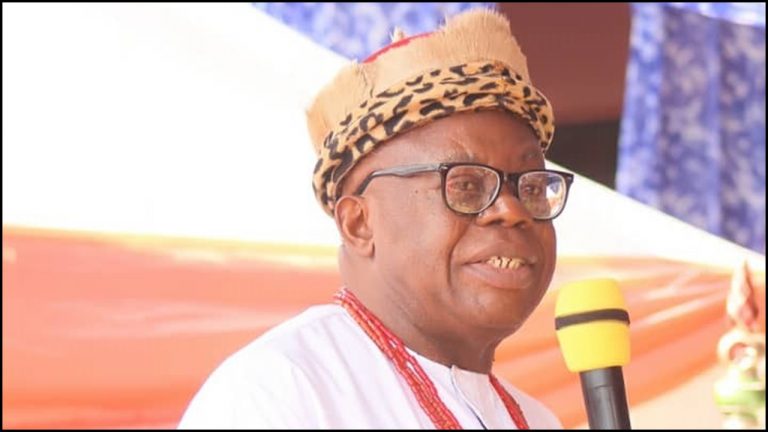
Dr. Aneze Felix Chinwuba (1944-2020)/Awka Times

Awka town loses a natal intellectual and controversial septuagenarian considered patriotic by those who favored his politics and opportunistic by those who disapproved of him.

By Chudi Okoye with Stella Nzekwe

He was steeped in the esoterica of Awka politics and society. At his brightest, he was considered the authoritative intellectual providing a priori justification for the presumptions of, and the choices made by, his factional cohort in Awka domestic politics. He wrote a master’s degree dissertation and also a doctoral thesis on the heady subject of consociationalism (the idea of equitable power sharing among the constituent units of a democratic society), arguing that this was essential to promote political stability in a pluralistic society.

He had argued this point in his 1980 PhD thesis at Tulane University, USA, focusing on Nigeria as a case study (his thesis was titled: Consociationalism as an Approach to Political Integration: The Case of the Federal Republic of Nigeria); but there is little doubt that he held a similar view with regard to his home town Awka, which would later become the capital of Anambra State, Nigeria. Despite the emergence of monarchy as a latter-day formation atop the hierarchy of Awka political institutions, he believed in the democratic essence of Awka polity and thought that power must be shared among the governing institutions of the town. His voice was sometimes lost in the mêlée of Awka politics, and his ideals were probably contaminated by the sordid struggle for ascendancy among Awka political elites. But he died fighting for those very ideals.

Dr. Aneze Chinwuba (Ọzọ Ọkpala, a.k.a. Mgbọlọgwu Awka), a towering political figure in Awka, died on June 23, 2020 in his hometown, after a brief illness and treatment at the Odumegwu Ojukwu Teaching Hospital (formerly Amaku General Hospital), Awka.

He had been active to the very end. He was visible during the recently concluded Egwu Imoka festival, the flagship cultural event in Awka, as he had been in previous years’ editions of the event. He had participated robustly in the roiling debate as to whether the event should hold this year in the era of Covid-19, insisting on the sanctity of the Awka hallowday and the need for it to proceed – with all due precautions for coronavirus containment maintained.

Dr. Aneze Chinwuba was actively engaged in the affairs of Awka Historical Society, a nascent foundation set up to promote the documentation of Awka history. He was equally engaged with Awka Times Magazine; as a source he was especially receptive of our reporters’ many calls. He was in constant contact, by telephone and WhatsApp, with our publisher, with whom he shared an unspoken but scholarly experience as political scientist. Despite the token of academic comradeship and the basic similarity of intellectual outlook, there was an occasional tension between the partisan intellectual and the independent-minded magazine publisher, perhaps inevitably so. But Dr. Chinwuba was always congenial even in testy disputations, pressing his points in his dignified drawl, with a canny combination of ponderousness and playfulness.

He was a bundle of knowledge, and would often trail off on a long historical excursion during interviews, making him at once a delightful tutor but also a profoundly undisciplined interview subject.

Academic and Other Career

Dr. Aneze Chinwuba’s instinct to explore and to explain was not surprising for an academic. He had attended Government Secondary School Owerri, the current Imo State capital. After the Nigerian Civil War which broke out around his freshman age, he proceeded to the United States of America for further studies. In 1975, he obtained a BA (hons.) in International Relations at Knox College, a liberal arts academy in Galesburg, Illinois, USA. He later enrolled to study Political Science and International Politics at Tulane University where he would obtain his master’s and doctoral degrees.

After his return to Nigeria he took up teaching appointments, at various times, at the University of Nigeria, Nsukka (UNN), and at the Anambra State University of Technology (ASUTECH), established in 1980 (the same year of his doctoral graduation) with campuses in Abakiliki, Enugu, Awka and Nnewi. It is said that Dr. Chinwuba had helped to lobby for the creation of Nnamdi Azikiwe University (UNIZIK) in 1991, following the split of the old Anambra State into Anambra and Enugu States. UNIZIK was created  as an amalgam of the Awka and Nnewi campuses of ASUTECH, and was later in 1992 taken over by the Nigerian government as a federal university. The university now flourishes on four campuses; it is a major employer at its various locations; and Dr. Chinwuba is said to have helped several Awka indigenes gain employment and admission into the university.

He was at various times chairman, the Presidential Visitation Panel to the University of Ibadan. He was also, on secondment from the Federal Republic of Nigeria, a Visiting Professor and Director/Coordinator of the Ibrahim Badamasi Babangida School of International Studies, University of Liberia, Monrovia (where, as he once informed Awka Times, he had taught the late Liberian dictator, Samuel Kanyon Doe).

Dr. Aneze Chinwuba also took up other distinguished roles. He was at one point chairman of the now defunct Nigerian Telecommunications Limited (NITEL). He served two consequential governors of Anambra State – as a Special Adviser (Political) to Chief Jim Nwobodo and also as a Special Adviser (Political and General Duties) to Dr. Chukwuemeka Ezeife. He had a foray himself as a governorship aspirant, emerging as the first runner-up in the 1999 gubernatorial primaries of the People’s Democratic Party, PDP. (Recalling the event 21 years later, barely a month before he died, Dr. Chinwuba ruefully told our publisher in a WhatsApp chat that “they gave it [the nomination] to Dr. C. C. Mbadinuju” who served as Anambra State governor between 1999 and 2003).

Awka Politics

Whilst soaring to heights in academics and state politics, it was perhaps in matters pertaining to local Awka politics that Dr. Aneze Chinwuba had his most consequential impact. Awka town has labored for long under the weight of its schizophrenic political arrangements. A rustic democracy of the Athenian hue with a gerontocratic decision making structure, ancient Awka had a hierarchy of governance institutions at the top of which were perched the powerful Ọzọ Awka society and the oldest man in the town, the Otochal Awka. In contemporary Nigeria, the traditional governance institutions of Awka have appeared obsolescent, imbued with no statutory roles of any consequence but retaining great cultural salience. In contradistinction to the ancient governance institutions of Awka, two other institutions became prominent in the postcolonial era, namely the traditional ruler (first named Ichie of Awka and later Eze Uzu) and the president-general of Awka Development Union Nigeria (ADUN). Much of the dynamics of contemporary Awka politics centers on the struggle for relevance between the ancient governance institutions, particularly Ọzọ Awka society, and the emergent governance entities.

Dr. Aneze Chinwuba straddled both worlds with aplomb, unique as a cultivated academic steeped in tradition. He once served as secretary of Ọzọ Awka society, having taken the highest traditional title in Awka land. At one point he wrote a book (Ọzọ Awka in History, FutureTech Publishers, 2014; 356 pages) which sought to document the origin of the institution and quite consciously to assert its continuing relevance in contemporary Awka political affairs. Perhaps as part of his fierce advocacy for the relevance of Ọzọ Awka society, he became a committed protagonist in an insurgent claim against the government-recognized traditional ruler of Awka, an incumbent who had unending run-ins with Ọzọ Awka, owing in part to divergent views on the proper role of the society in modern Awka polity. Chinwuba would emerge as the ‘traditional prime minister’ of the insurgent faction.

He was unquestionably a central figure of the kingship rivalry in Awka, possibly propelled by personal ambition as his critics alleged but probably also driven by ideological conviction, by the consociational notion of elite power sharing in a pluralistic society which he had begun to explore more than forty years earlier in his graduate work at Tulane.

Aneze Chinwuba was saddled with a huge responsibility as the intellectual, institutional and even inter-generational guarantor of the monarchic insurgency in Awka. He seemed sometimes addled by the impossible role, and oftentimes raddled by the inflexibilities of the power struggle, but he was never rattled: through it all he maintained a calm equanimity and a friendly disposition that probably belied his deep convictions about the need for elite power sharing in Awka pluralistic society.

Those who came close found him emotionally supple, easily sharing his joys and enthusiasms but also quick to disparage what he considered nettlesome or inappropriate. For a man at the fulcrum of Awka political controversies, he seemed at times almost unflustered, joyous and rebellious at the same time, seeking yet seemingly contented. He once told Awka Times that the life he was living was the result of “good planning, patience and contentment.” He was hospitable to all unthreatening callers, insisting in his chats with Awka Times that any Awka person was welcome any day to his home to engage any topic of discussion they fancied.

Dr. Aneze Felix Chinwuba was born nearly 76 years ago to the Okpala Chinwuba family in Umubele, in the Agulu quarter of Ezinato section, Awka town. He married Mrs. Chinenye Chinwuba (Ugodie), and they were blessed with four children: Adannia, Junior, Onyebuchi and Chibuzo. He was said to be a striver who loved his family, and a reportedly conscientious father and grandfather right to the end.

Awka Times was told that his beloved ones had gathered around on June 22nd anticipating his recovery from the brief illness, reportedly singing and dancing after he had eaten a fine meal prepared by his daughter, Onyebuchi, all receiving paternal blessings from him with assurances that things would turn out fine.

The day after the joyous family gathering, however, Dr. Aneze Chinwuba’s condition deteriorated and, amid intensive care, he gave up the ghost, reportedly smiling before his light finally dimmed.

Igbo Followership is the Problem!

2
South East Governors

Ineffective political leadership in Igboland is a concomitant of the weakness and inefficacy of Igbo political society.

By Anonymous

THE TIME IS NOW! The fight is for all Igbos, not for the leaders alone.

Let me complicate this a bit. All we hear is the tiresome refrain: Igbo leaders have done this; Igbo leaders have not done that. But what about Oha Ndi Igbo, we the Igbo mass citizenry? What have we done to deserve good leadership and effective  representation?

Let me get a little personal, if I may. Do you attend the meetings of your town union? Do you pay dues and levies to your town union? Do you in fact have an organized town union? If you do, does it have a political committee? Does your town have a political action fund by which you could raise money to support a candidate of its choosing? How many times have you volunteered hours to organize on Igbo issues? How effective is your organizing? Do you make out time, at least once every month, to host a small dinner in your house aimed at galvanizing an Igbo issue? Will you come out to protest in Owerri or Enugu or Umuahia or Abakiliki if either Nnia Nwodo or Senator Enyinnaya Abaribe is shot by “unknown gun men”?

We expect much from Igbo leadership, but we have no hand in the choice of who makes that leadership. Now take this example: when the Supreme Court sacked Emeka Ihedioha as governor of Imo State, you would have expected that a mass protest would erupt in the state, with support action in all of Igbo land and the Igbo diaspora. But what did the Igbo people do? They talked the moon to sleep. Unfortunately, critics arose in support of a 419, certificate-forging, cream-bleaching governor to rule Imo State.

If it were the Irish, say, they would send a quiet and effective message in the night to the judges ‘encouraging’ them to do the right thing. But the Igbo? They pray and wait for God, and act surprised at the very obvious political turn.

When, in 1983, then head of state, Maj. Gen. Muhammadu Buhari, hauled Imo State governor Chief Sam Mbakwe and his wife into jail, did the masses of Imo and Igbo people get out of their homes in great numbers with their own guns slung across their shoulders to say to those who took Mbakwe: “you dare not!” Hell no!

How about when former head f state, Gen. Ibrahim Babangida, tested water with his sacking of Commodore Okoh Ebitu Ukiwe as Chief of General Staff, did Igbo people rise in protest? Heck no!

It was after the Ukiwe summary dismissal, without very strong response from the Igbo, that the power wielders in Nigeria began the strategic marginalization of the Igbo. They concluded that the Igbo were no longer politically relevant or effective. The current Igbo sons and daughters have not shown the kind of fidelity the older Igbo showed to each other. If it were in 1965 that Mr. Emeka Ofor donated a whopping ₦460 million to the Ahmadu Bello University, Zaria, for research, while leading institutions in Igboland – the University of Nigeria Nsukka, Nnamdi Azikiwe University, Awka, Federal University of Technology, Owerri and others – lacked funds for their researches, the Igbo would have sent a quiet emissary to Mr. Ofor to say: “Don’t you ever return to Igbo land until you have given some money to Nsukka and others, too”. In fact, Emeka Ofor would not have even dared.

Leadership draws strength from the community. If a people are without consequence, their leadership will be without consequence. In fact, how can you send men and women on an errand without making certain that they will return in one piece?

All the people guarding your so-called Igbo leaders are sent to them from Abuja, the federal capital of Nigeria. They are surrounded by military barracks whose provenances they cannot determine. So, you’re an Igbo leader, and you are stubborn like Mbakwe, and one day they take you out and say you had an accident. Guess what the current Igbo would do because they have not organized for effect? They will write letters to the United Nations and call all the forces in the world to bear witness to how we suffer in Nigeria. The world, if they pay attention at all, will nod their head in sympathy and say, “indeed, you suffer” and continue on their merry way.

But if the Igbo provide very sophisticated protection for their leaders irrespective of what the federal government says, you’d have effective leadership because the Igbo too could bury you if you let them down. Think about the Irish or the Palestinians. They don’t accept rubbish. And if any one who leads them messes up, they have people to answer to. But not Igbo leaders. You know why? Because just as Igbo leadership is absent, Igbo people themselves are half awake since they can’t seem to organize themselves.

A people are always greater than their leaders. But today, the Igbo want leaders who are bigger than they from whom their destiny must be shaped. No! We must make the leaders we want. Recruit them. Train them. Support them and protect them. If they depend on us for their survival, they will give us sterling service. But if they depend on forces outside Igbo land for their political and economic survival, as well indeed as for their lives, you cannot expect their loyalty to be with the Igbo.  So, let’s take some responsibility. The leaders we get reflect us too. To paraphrase Joseph de Maistre, in a democracy,  people get the leadership they deserve.

We the Igbos must somehow find the means to rebuild fidelity between us and those that we select to lead the way.

DISCLAIMER : Opinion articles are solely the responsibility of the author and does not necessarily reflect the editorial position of Awka Times.

ANSG Announces Plan to Close Eke Awka Market Following Covid-19 Violations

0
Anambra State SSG, Prof. Chukwulobelu, announced the reopening of Eke Awka market

… Anambra State government plans to close Eke Awka market for a period of two weeks

 … Proposed market closure allegedly due to egregious violation of Covid-19 regulations

 … Government also claims Awka South LGA has the highest number of Covid-19 cases in the state

 … Authorities say they are monitoring other markets in Anambra State for compliance

By Chudi Okoye

The Anambra State government has announced its plan to close Eke Awka market, the major market in the state capital, effective Monday, 15th June 2020. The government’s plan is to close down the market for a period of two weeks. According to the government, it was “constrained to close down Eke Awka [market] in the overriding public interest.”

In an initial statement attributed to the Secretary to State Government (SSG), Professor Solo Chukwulobelu, released to the press on Thursday, 11th June 2020, the government suggested that the proposed closure was due to observed neglect of laid-down coronavirus guidelines.

“This is as a result of non-compliance by the market traders and customers with Covid-19 protocols including wearing of protective face masks, provision of running water and soap for washing of hands, keeping of physical distancing etc.,” according to Professor Chukwulobelu.

The initial announcement by the government did not clearly explain if Eke Awka was the only culprit market in Anambra State, justifying the specific marking of the market. To clarify the situation, Awka Times reached out to senior officials of the government. The SSG, Professor Chukwulobelu, explained to Awka Times that the government’s decision was based on monitoring and detailed data collection results showing persistent violations of government Covid-19 guidelines.

The Anambra State Commissioner for Information and Public Enlightenment, Mr. C. Don Adinuba, also contacted by Awka Times, provided more details regarding the government’s plan. According to him, the decision to close Eke Awka market was made “following widespread violations of the protocols in the fight against the coronavirus pandemic…” He explained that “the violations are carried out by traders and buyers as well as suppliers in the market.”

Commissioner for Information, Mr. C. Don Adinuba

Commissioner Adinuba stated that the government had reopened markets in Anambra State on 4th May 2020, after five weeks of closure, on the expectation that “all stakeholders in the markets” would follow the specific protocols and guidelines laid down by the government to contain the spread of coronavirus.

“It is regrettable that these precautionary measures meant to protect the lives of millions of our people have flagrantly been violated habitually, especially in Awka Market. The result is the recent spike in the number of confirmed Covid-19 cases and even fatalities in our dear state. Awka South Local Government Area, where Eke Awka is located, has recorded the highest number of Covid-19 cases of all LGAs in the state.”

Although Eke Awka market is the only market scheduled for closure, the government stated that it is monitoring other markets for Covid-19 compliance. According to the initial statement from Professor Chukwulobelu,

“The government is also putting other market leaders and local government councils in the state on notice that… markets in the local government [would be] closed down if it is observed that such markets do not observe Covid-19 protocols.”

Mr. Adinuba, the information commissioner, also confirmed this position to Awka Times. According to him,

“The government is closely monitoring the level of compliance with the [laid-down] protocols in the battle against Covid-19 in other markets. Any market found to have a low compliance level will be shut down immediately and indefinitely.”

The government’s statement also indicated that effective Monday, 15th June 2020, a daily curfew would be enforced throughout Awka South local government area, starting from 8pm and lasting until to 6am. The curfew would remain in force “until further notice”, according to Professor Chukwulobelu. Other areas would also face a “similar curfew action”, the government warned, if rule compliance slackened.

The public health justification for the government’s decision seems unassailable, if, that is, the government’s allegation of egregious violations in Awka is substantiated. However, the economic implication of the proposed market closure, along with the hardship factor, will be severe, especially with the simultaneous curfew regime planned by the government. A combination of market closure and curfew will likely lead to an asphyxiation of Awka commercial economy.

Awka Times reached out to various community leaders in Awka to get their perspectives on the development, without much success.

All efforts to reach the Eke Awka market manager, Mr. Jude Agummadu, proved abortive.

Awka Times also contacted the government-recognized traditional ruler of Awka, Eze Uzu II Gibson Nwosu, currently away in the United States for his annual medical check-up. Nwosu, who had not heard of the proposed market closure, referred all questions to his traditional prime minister, Chief Benjamin Okoye, presumably in a position to contact relevant stakeholders. However, Chief Okoye was not able to provide a clear statement when contacted by Awka Times.

Similarly, all attempts to reach the government-recognized president-general of Awka Development Union, Engr. Tony Okechukwu, proved unsuccessful.

It is unclear if Awka community leaders could have worked out a more nuanced arrangement with the state government, instead of an outright market closure – similar to what obtains in other domains where markets are allowed to open for shorter time windows or on staggered days in the week.

It is also possible that Awka stakeholders could have opted for a more stringent enforcement of Covid-19 protocols during market operations, and might have prevented an outright market closure with all the economic implications.

Furthermore, Awka leaders might have been able to negotiate a far shorter period of market closure to minimize the impact of the measure on the municipal economy.

Without a response from community leaders, it is unclear what interventions, if any, they envisage.

The state government’s plan to close Eke Awka market comes in the wake of the recent Egwu Imoka festival, the major cultural event in the Awka, which the government had attempted without success to suspend. It will be recalled that on 10th May 2020, the Anambra State government had issued an order suspending Egwu Imoka, arguing that the event could not be allowed to hold due to the risk of Covid-19 contagion. The government had issued that order without community consultation, custodians and organizers of the event said in interviews with Awka Times. The Egwu Imoka event was held nonetheless, amid heavy security surveillance, without much regard for the state government’s Covid-19 protocols.

Since that Egwu Imoka event which wound up on 30th May, Anambra State has witnessed a surge in Covid-19 cases, rising from 12 to 53 cases as of 11th June, with nine related deaths, according to the state governor, Willie Obiano.

The government’s seemingly finicky decision to shutter the municipal market in Awka comes as a reaction to the surge.

ATM reporter, Stella Nzekwe, obtained the initial government release for this story

Jazz Scatting and Speaking in Tongues

0

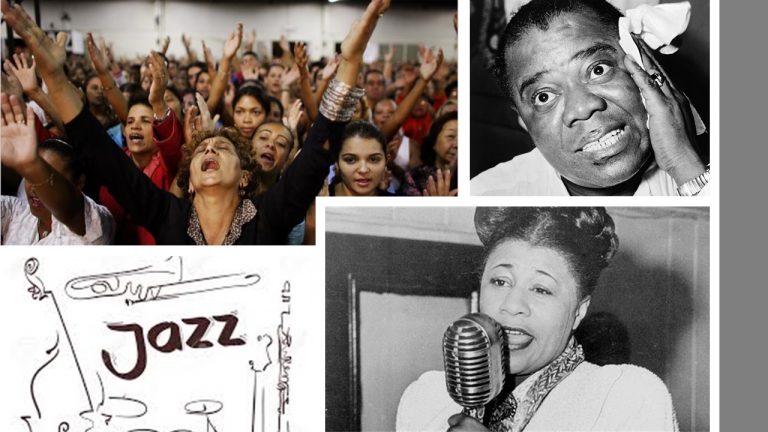
Speaking in tongue can be abused as fraudulent pantomime, but like jazz scatting it has deep cultural roots as a way to elevate the mind beyond the clutter of temporal existence to commune with the gods.

By Chudi Okoye

I must open this piece with a preemptive apologia. What I present here is an honest attempt to explain, in my modest understanding, the phenomenon of ‘glossolalia’, or what is commonly known among Charismatic and Pentecostal Christians as ‘speaking in tongues’.

I am interested in the non-mimetic version of this phenomenon which involves the utterance of sounds that are non-linguistic but probably intelligible in the spiritual realm. I am also interested in the non-esoteric version, known as ‘xenoglossia’, involving a paranormal ability to speak or write a natural language that one could not have learned by natural means.

Both of these phenomena, glossolalia and xenoglossia, are attested in the Bible, I believe.

Is this phenomenon real? Whilst the practice is commonly associated with Christian spirituality, I understand that some form of it can be found in pagan practice as well. I think there are expressions of it in Igbo traditional religion, for instance, and probably in other animistic religions.

I am researching this topic because I was recently invited by a close friend to an online Pentecostal church service in Nigeria where I noticed that every time the pastor said “Come on, begin to pray”, he would immediately start praying in tongue. I was fascinated by this feat, deeply impressed by his ability to launch into this mode with apparent ease.

I have often puzzled about this phenomenon of speaking in tongues ever since my experience long ago at Pastor Kris Okotie’s Household of God Church International Ministries in Lagos. This was in the early 1990s and Okotie’s church was the rage among Lagos yuppies and hoi polloi alike. I had just started my journalism career after youth service, and was trying to get a lay of the land in termagant Lagos.

One Sunday I decided to check out Okotie’s soaring new church. Being a Catholic, I was mesmerized by the informal intensity of worship at his church, to say nothing of the sheer mass of humanity assembled for service. At one point, Okotie asked for new comers to stand up. I stood up with several others. After welcoming and blessing us, he asked that we follow an usher who then escorted us to a prayer room upstairs. There, a few pastoral assistants ministered to us, telling us about the church, what membership involved, etc. They then collected offerings from us, and promptly led us into prayer.

To my great consternation, as soon as the praying started everyone in the room including my fellow new comers began to ‘speak in tongue’, uttering some esoteric words beyond my linguistic comprehension. I was completely befuddled. As a non-Charismatic Catholic, I hadn’t the faintest idea how to pray in tongue. Feeling a little out of my depth, I whizzed around in my head for a way to save myself from embarrassment. Then I remembered that in the Bible there was reference to the apostles speaking in tongues while all the people gathered understood them in their local languages. Emboldened by this recollection I leaned in heavily, praying in the best dialect of my hometown, Awka:

“O Chineke nna nyi, Okacha akacha Eze ivbe anyi, Eze ana ekpeelu onu, Obasi no n’enu, Nna anyi ikuku mili emi, Chukwu abiama, Mgbọlọgwụ ndu anyi, Nna anyi abia gokwem n’ikanunwa taa taa k’am tikuo ghu…”

My voice rose to an unmindful crescendo, my eyes tightly shut, as I got in stride with my prayerful incantation. Then I noticed that there was silence, a sudden hush around the plush prayer room. I opened my eyes to find that others in the room had clammed up as they stared at me as in utter befuddlement.

I was sheepish. I felt freakish. A bashful twentysomething in the midst of cultural extemporization. Then I straightened up and told the prayer leader who had approached me rather reproachfully, his eyes glaring with pious disapproval, that I was merely praying in my local tongue. He told me that that wasn’t what ‘speaking in tongue’ was about, and that I should try to speak in the same spiritual manner as others. I protested that I didn’t know how to do that, nor would I understand what I would be saying if I attempted such. He told me that I wasn’t supposed to understand, but that God would comprehend my utterances. I wasn’t convinced, but for the rest of the session I simply muttered my prayer in strained and subdued English.

I left at the end of the service and never returned to Kris Okotie’s church. Which is a huge regret because I later heard flamboyant tales about Okotie’s cars and wives and would have liked, as a budding journalist, to report these developments from inside the ministry!

Anyway, since that rather unpropitious experience, I have been skeptical of the efficacy or even meaningfulness of speaking in tongues. I often dismissed it as mere performance, a theatrical display by pretentious Christians.

Let me explain where I stood in more detail. I was not exactly persuaded by the argument of those known as cessationists who insist that spiritual gifts such as speaking in tongues, prophecy and healing ended in the Apostolic Age, a period covering the formative first century of the Christian church. But then neither was I particularly persuaded by the continuationist theology, peddled by Pentecostal and Charismatic Christians, which claims that spiritual gifts such as tongues and prophecy have continued untrammelled even to the present age. I was often suspicious of such claims, especially in light of the fraudulences perpetrated in modern-day Pentecostalism which has become little short of an extractive capitalist industry.

But then, as I watched the frenzied effusions of my friend’s pastor the other day as he prayed in tongue, I was struck by an instant epiphany: speaking in tongue is like jazz scatting!

As a lifelong jazz lover, I was astonished that I hadn’t made this connection much earlier. In jazz scatting, the vocalist improvises with emotive, onomatopoeic, nonsense syllables (pseudowords or non-words), wordless (non-lexical) vocables, or even does so without words at all. The scat singer improvises melodies and rhythms using the voice as an instrument rather than a speaking medium. It is often mesmerizing and, observing the most accomplished scat singers in performance, they sometimes seem to have become celestial, transfigured and transcendent, bodily with the audience but yet in a different world altogether.

Listening to Ella Fitzgerald performing the jazz standard, “How High the Moon”, or Louis Armstrong riffing on his “Dinah”, one gets a distinct sense of someone speaking in tongues! Other well-known jazz improvisationalist scat singers include Sarah Vaughn, probably without comparison in her mastery of fricatives as seen in her “Scat Blues”; Betty Carter; Scatman John; Shooby Taylor; Scatman Crothers; and many others including the young and delectable Jazzmeia Horn (check out her “Free Your Mind”).

Scat singing is often associated with swing and bop jazz and especially with Black jazz improvisationalists, and is considered to have a West African origin. But it can be deployed across other genres of vocal jazz as well.

This realization – that jazz scatting is a musical version of speaking in tongue, both sibilant expressions of spiritual ecstasy and probably non-mimetic expressions of deeper mysticism – helped me to finally understand what Pentecostal and Charismatic Christians could be doing when they speak in tongues.

It doesn’t mean that there aren’t charlatans who fake it, probably hamming it to impress co-congregants and perhaps persuade some to part with their purse. But I am convinced that in jazz as in worship, speaking in tongue could be a transcendental tool to reach beyond our cluttered lives and commune directly with the supernatural, sometimes simply absorbed in the joys of their communion or even tapping into their energies to redress the rumpled realities of our temporal life.

Nigeria Records a Sharp New Increase in Covid-19 Cases

0

By Chudi Okoye

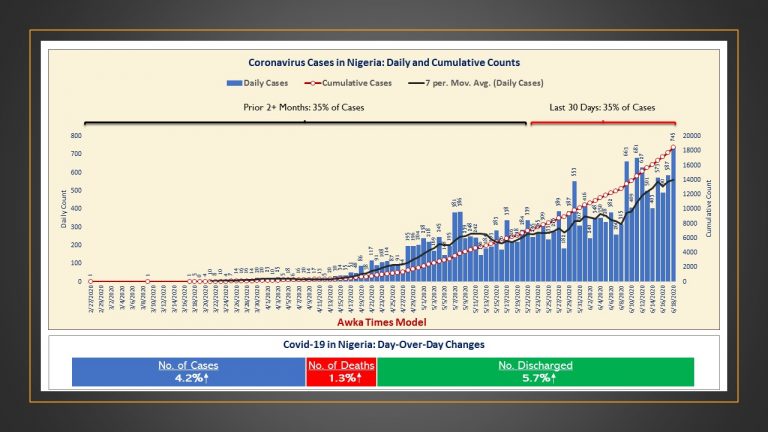
As the global spate of coronavirus cases begins to show a slight decline (for now), Africa is seeing something of a reverse trend with considerable – though still globally insignificant – increases in the number of cases. Amazingly one country alone out of 54, South Africa, represents one in four of the total confirmed coronavirus cases in Africa and one in five of the related deaths.

Nigeria is nowhere near the South African peck, though it remains in the Top 5 deck in Africa. On June 9, Nigeria recorded its largest stack of daily additions so far, a whopping 663 new cases, thus extending its recent trend of triple-digit daily additions.

Lagos State remains the epicenter in Nigeria at 45% of all coronavirus cases in the country. However, a recent downtick in Lagos offered the Southwest zone a slight respite (although Ogun State experienced a quotidian surge), as also witnessed in the Northwest which has long been noted as a zone of particular zing in Covid-19 infections. Kano State, once commanding as much as 14% of total Nigerian cases, now represents about 7.6%.

As the usual hotspots in Nigeria appear lately to be cooling, if ever so slightly, the calmer geopolitical zones of South South and South East seem to be becoming somewhat warmer. For instance, despite the often brusque and militant exertions of Gov. Wike in Rivers, his state continues to surge in coronavirus cases, now ranked 8th in the country and increasing the overall South South share.

The South East too has seen a recent spike in cases. While it isn’t in the league of zonal leaders Ebonyi, Imo and Abia States, Anambra State has gone from a mere 12 cases to 46 in a matter of days, even as the ever-vigilant Gov. Obiano continues to announce new containment measures. The surge in Anambra comes notably in the wake of the recent Egwu Imoka event in the state capital, Awka, although any correlation is tenuous since authorities are tight-lipped about the locality of the new cases.

It is not improbable that the observed surge in Nigeria is simply a function of increased testing, although Nigeria remains outranked in the pecking order of coronavirus testing in Africa. Or more likely it is an ineluctable spike as the country’s teaming rabbles return to their daily scrabble for survival in the joyless era of Maj. Gen. Muhammadu Buhari.

African Americans vs. Africans in America: A Smoldering Tension

0
African American vs. immigrant African in America: An enduring tension

A curious yet highly explainable tension persists between native born African Americans and immigrant Africans in America. At its simplest, the tension manifests as mutual antagonism between the seemingly resentful indigenes and the apparently disdainful immigrants. But the tension is more complex than such simplistic depiction. Our contributor examines this intricate issue, a subject that has become even more poignant with the latest manifestation of police brutality against all Blacks that led to the cold-blooded murder of an African American man, George Floyd, on a concrete pavement in Minneapolis.

By Chidera Michaels

African Americans and Africans in America are two peoples from the same root that were separated by an ugly history, and now live alongside each other in America with sometimes palpable smoldering tension between them. This tension, sometimes barely below the surface, is so real that the two groups often walk on eggshells whenever they are around each other. And each group suspects and distrusts the other for perhaps some cogent reasons, but also for an amalgam of vacuous and nebulous reasons.

I chose to call one group “Africans in America” just so that they could be differentiated from the other group. Otherwise both groups are usually lumped together by the public as simply African Americans. And since most Africans in America are naturalized Americans, they are rightfully referred to as African Americans or black Americans by the public.

When I arrived in the United States, it was not long before I heard an African American referred to as “Akata” by my friend with whom I lived at the time. I was surprised by that word, mostly by the sound of it. When I asked him what the word meant, he said that he didn’t know. So, I decided that someone must have coined the word for its onomatopoeic value, or for its potential to annoy those for whom the epithet was intended. Even then I had the feeling that the word was meant as a negative epithet because of the way my friend whispered the word to me when our African American friend was out of earshot.

Along the way, I found out that the word was being used by virtually every African in America, not just by Nigerians. Then about two years ago I learned for the first time the meaning and etymology of the word. I learned that “Akata” means a wild cat, and that the word is a Yoruba word. Yoruba is a language spoken by people in the southwestern Nigeria. I was nonplussed when I learned this. What on earth prompted someone to start calling African Americans this name? And what could be the purpose?

I was also surprised by the meaning of the word for another reason. All along I had thought that the word meant something very awful. Not that calling someone a wild cat was not awful enough. I just thought that it meant something much more awful. I say that because of the connotation the word held for me before I learned the meaning of it. Prior to learning the meaning of the word, I have never heard an African say of an African American, “Oh, there goes an Akata. Bless her heart.” No! What I have always heard is akin to the following: “Why are you surprised she did that? Don’t you know that she’s an Akata? What did you expect?”

While looking into the reason for this ill-thought-out denigration of an already beleaguered people by their own society, I also needed to know how the Yorubas used the word in Yorubaland? So, I began to ask around amongst my Yoruba friends and acquaintances. What I learned about the word surprised me yet again. They told me that someone started referring to African Americans as Akata because they are of African stock but live outside Africa, their natural habitat. Contrary to what I had learned, these Yorubas told me that Akata does not refer to animals like cheetah, tiger, or lion.

The word refers to those cats that are in every way like the domestic cats but live in the wilds. People from my area of Igboland call them “aghulu,” while the regular cat that live in the homes are called “busu.” The Yorubas I spoke to said that they too were surprised to learn that African Americans were being referred to as Akata, for two reasons. First, they were surprised that someone would decide to refer to African Americans as Akata. Second, they were surprised that the word became a negative epithet. However, they also confessed to have used the word in its current usage, i.e. as a negative epithet for African Americans.

But I think that it is fundamentally wrong for African Americans or any other group of people to be called a demeaning or an unflattering name. It is doubly wrong in this instance because our African American cousins have been of immense help to Africans in America in our quest to obtain documentation here in the USA. How can anyone conceive of calling them wild cats given the way their forebears were brought to this place? And what about what they had been through (and are still being put through) all these years by the white people? And we, of all people, will add to that too?

And, it has been said by some African Americans that Africans in America are taking up the opportunities they fought for with blood and tears. I sincerely salute those noble and courageous African Americans who, through their efforts, made possible the opportunities we enjoy today. But the part about taking native-born African Americans’ opportunities is probably not well thought out. That’s because a lot of the opportunities that became available are not being seized by a chunk of black Americans, especially by black American males. However, it must be acknowledged that the effects of slavery and Jim Crow laws could be responsible for this lag by African American males. But blaming these twin evils is wearing thin by the day.

So, Africans (especially Nigerians) who came to America, hungry for education and progress that aren’t available in their homelands, grabbed these opportunities with both hands and won’t let go. Therefore, in my view it is wrong for African Americans to fault Africans in America for seizing these opportunities. I think that there is no need for begrudging Africans in America for grabbing these opportunities. The reason is because there are enough opportunities to go round. Remember that these Africans in America sometimes needed to be twice as good as white persons to be offered the positions.

It’s for this reason that Africans in America (especially Nigerians) excel in education. That is the only way they know to gain acceptance into this very racist society. But to explain away why Nigerians are the most educated sub-group of people in America today, some African Americans have insinuated that the reason is because these Nigerian Americans are the cream of the crop from their country; that they are the privileged and the smartest from their land. Really? That would make me one of the privileged and smartest from Nigeria. And I know that not to be true.

I could be wrong, but I would have thought that it would be a source of pride for African Americans that their cousins from Africa are conquering education in America. Racist whites have always maintained that black people have lower IQ than whites. The performance by Nigerian immigrants should dispel that if racist whites tell themselves the truth.

However, there is something to be said about being told from the moment you were born that you are inferior. That does things to one’s psyche. But I was of the view that seeing their cousins from Africa performing well would free them from the shackles of inferiority complex. African Americans who are born in America are not inferior to anyone. And I don’t think that they need me to tell them that before they believe that they are not inferior to anyone.

Here’s another fallacy closely related to the above. I have heard some African Americans say that Africans in America look down on them, i.e. feel superior to them. The first time I heard it, I felt sad. Why would Africans in America feel superior to African Americans? Superior in what way? Superior because their homeland is being pillaged by tribal illiterates along with their corrupt enablers?

I am not saying that there are not some Africans in America who may have this inexplicably idiotic feeling of superiority. But I think that the feeling of Africans in America would be one of gratitude rather than feeling of superiority toward their African American cousins. For one, almost every African in America who became naturalized American owe it to an African American. The last sentence doesn’t need to be explained to anyone in the African community in America.

There are, however, a section of Africans in America who do not appear to like African American females. These are African females in America. They allege that African American females flaunt their sexuality on their men’s faces – like literally. Following from this, they further allege that these black American females use their sexuality to poach their men and husbands. I don’t understand what these African females are talking about. In my view, African American females seem to understand why God broke the mold after creating the female species. African females in America probably need to adapt and copy; as long as they keep within probity, and within the values instilled in them while growing up in their homelands.

Another area of difference between African Americans and their African cousins is the seeming lack of marital commitment by African Americans. My first job in America was as a swing shift security guard in a telecommunication company. My partner was a female African American security guard with whom I became friendly over time. She was twenty-eight years old at the time and not married but had four children. That fact would not mean anything to an average American, but as a new immigrant from Africa I was blown away.

And then one day while we were shooting the breeze, she unloaded on me this mother of all doozies. She told me that she had had each of the four children with a different man. Blood drained from my face. When she noticed the shock on my face, she laughed nervously and quipped, “I’m a sinner, right? You ‘effing’ African prick!” Thereupon I apologized and explained to her that I had never been made privy to such knowledge before. That was more than thirty years ago. Now nothing shocks me anymore.

I am not sure what is responsible for this lack of marital commitment among African Americans. Some have opined that it’s because there are not enough African American males to go round. Way too many of them are in prison or recycling through the judicial system. And too many of them are being lost through gang turf wars in their neighborhoods. All the above may be true, but there is a kind of averseness to close relationship that is prevalent among black American men. A black psychologist friend of mine told me that the problem goes all the way back to the slavery time when marriages between slaves were discouraged by their white owners. Since then, he said, it has been difficult for black men to unlearn this behavior.

Being a black man in America, it kills me that whenever the influence of African Americans is being discussed by the larger society, it is African American women that are being referred to. The men have made themselves so irrelevant that they may as well not exist. I think that I know what black American men are going through. I am an African American male for all practical purposes even though I am not a native-born American. So, I go through almost everything they go through. I came to America at the age when African American young men are routinely profiled and suspected of sundry crimes. I get stopped by the police more than I like. When I am in the white section of town, I am more careful what I do or say. But I kept my eyes on the ball.

And someone will say to me: But you didn’t grow up in my neighborhood. You don’t know how tough it is to grow up in the projects. And you don’t know what it means to be forced into a street gang against your will because they threatened to kill your mother if you didn’t. And my answer would be: No, I don’t. That’s where my experience differs from the average homegrown African American male. I know it’s hard. But all I am asking African American men to do is to try a little harder. It doesn’t help them or anyone to just roll over and play dead. African American women are carrying too much family responsibilities all by themselves. Some of them are turning to illicit drugs in order to cope, and some are being driven crazy. African American women need the help of their men.

Having said that, it behooves the African American females to take it easy on their men, especially those of them that are playing by the rules. These kinds of African American males are already being put through hell trying to make it in a white man’s world. They do not need to be dumped on by their women as well. It does not help anyone when African American females carry on as if they are prima donnas when dealing with black men, but they turn around and behave well when they are around white males.

During my early days in the United States, I got myself involved with a few African Americans of the female persuasion. So, I got to know a bit about African American culture through them. But the one African American culture I could not understand, by a long shot, is the culture of see-nothing-say-nothing. The “I ain’t a snitch” syndrome. The effects of racism may still be having debilitating effects in the African American communities, but the one that’s decimating those communities by far is the effects of the ubiquitous street gangs. These gangs have such a death grip on the lives of African Americans in these communities that the only rule of law they know is the unforgiving strangleholds of the gangs.

It’s so bad that they fear the gangs, by a mile, more than they fear the racist police officers. When a white police officer kills an African American, African Americans flood the streets to protest. But when the gangs kill hundreds, often in the presence of family members for purposes of instilling fear, no one tells the police what happened. And African Americans do not flood the streets to protest such gang shootings. It is for this reason that racist whites smirk when they see blacks protesting police killings. They think that such protests have hypocrisy and selective outrage written all over them because black Americans turn blind eyes to thousands of gangland shootings in their own neighborhoods.

I consult at this prison in the State of Maryland infrequently. There, I met this slightly deranged former white police officer who said that he was in prison for killing a black man. His best friend in prison is a black man. He told me that his friend (who was standing by his side smiling) killed more than a hundred black persons in his neighborhood but was not in prison for any of those killings. Rather, he was in prison for stealing a car at a Walmart parking lot. My jaw dropped. “I ain’t a snitch” saw to it that this guy will never serve a day in prison for those alleged killings. Now how does that make any sense?

Chidera Michaels is an attorney and a Christian theologian based in Baltimore, MD, United States (email: chideramichaels@gmail.com)

US Presidential Aspirant, Joe Biden, Speaks On Police Murder of Black Man, George Floyd

1
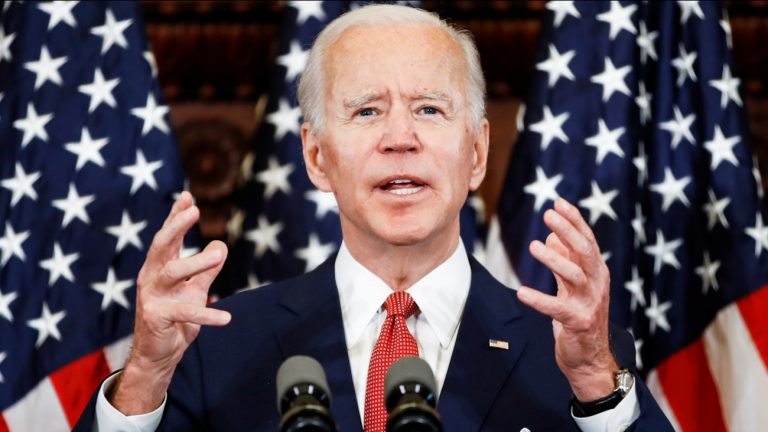
US presidential aspirant, Joe Biden, delivering a speech in Philadelphia after police murder of an unarmed African-American man, George Floyd

By Chudi Okoye

Presumptive Democratic Party nominee for the 2020 US presidential election, Joe Biden, delivered a speech on June 2, 2020, addressing the brutal murder of an African-American man, Mr George Floyd, by the police in the Powderhorn community of Minneapolis, Minnesota, on May 25, 2020. Mr Biden delivered his speech as riots and protests raged across the United States of America following the incident.

Mr Floyd was murdered by the police whilst handcuffed and lying down on a city street. His killer, Derek Chauvin, a white American Minneapolis police officer, kept his knee on the right side of Floyd’s neck for 8 minutes and 46 seconds. Part of that morbid duration – 2 minutes and 53 seconds – occurred after Floyd had become unresponsive. The other officers with Chauvin – Tou Thao, J. Alexander Kueng, and Thomas K. Lane – participated in Floyd’s arrest, with Kueng holding Floyd’s back, Lane holding his legs, and Thao looking on and preventing intervention by onlookers. Some bystander videos even showed three officers at some point all kneeling on the handcuffed Floyd.

Mr Floyd had been arrested over allegation that he used a counterfeit $20 bill at a market, although it is not clear if that was the case, or if he did that knowingly. Police claimed that Floyd physically resisted arrest, but several US media organizations later challenged that claim, pointing out that a security camera from a nearby business did not show Floyd resisting arrest.

Based on police body camera footage, Floyd repeatedly said he couldn’t breathe while pinned down by the police. Several bystanders also recorded the event on their smartphones, with one video showing Floyd repeatedly saying “Please”, “I can’t breathe”, calling for his “Mama”, and pleading with the officers “Don’t kill me”, all to no avail.

A criminal complaint has been filed against the murderer, Derek Chauvin.

So far, only Chauvin has been charged while the other three officers that participated in the incident have not been charged.

Protest continues across America.

Mr Biden’s speech came in the wake of an abysmal response by the current US president, Donald Trump, who preferred to blame those protesting the persistence of racial injustice and police brutality in America which led to the murder of Mr George Floyd.

With Wikipedia reporting

Awka Cultural Festival Successfully Concluded, Despite Coronavirus Concerns

0
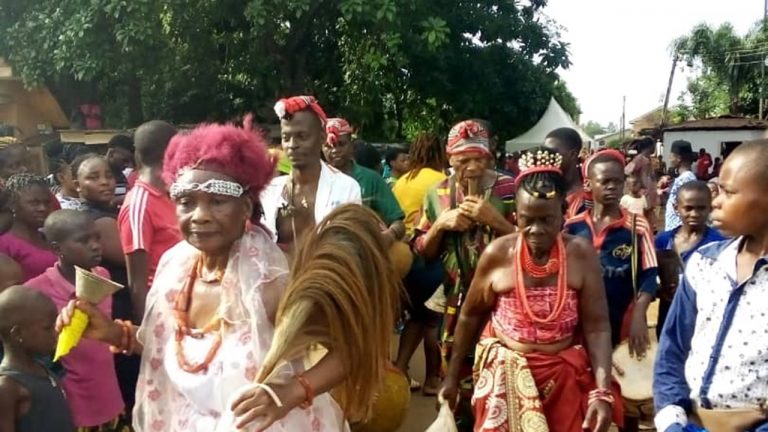
Imoka chief priest, Mr. Ikegbunem (right), welcoming Chief Austin Ndigwe ("Eze Uzu III", centre) to the Imoka shrine on the final day of Egwu Imoka 2020

The grand finale of the Awka cultural festival, Egwu Imoka, took place amid an unfolding coronavirus surge in Nigeria. The finale closed out a three-day cultural splurge that kindled a month of fitful festivities enacted as Awka community mulled how to manage its celebrated annual festival in a pandemic year. Under the watchful eyes of a state government that initially prohibited the event but later recanted, Awka managed to navigate the compulsions of two invisible movers, the virus and the deity, and orchestrated an end-game befitting its name and cultural fame.

By Chudi Okoye with field reporting from Stella Nzekwe

It had started out a most improbable proposition. Through the threatful manifestation of the coronavirus pandemic and the fretful – if well-meaning – proclamations of the state government, it had not seemed possible that Egwu Imoka carnival, the cardinal cultural festival in Awka, the capital of Anambra State, would take place at all in 2020, let alone reach a successful denouement. And yet, through what seemed at times like a fitful enactment of the festival, Awka town managed to pull off a pulsating celebration without any untoward incident, or an indecent compromising of its cultural mores. Fear of the virus did cause some collateral damage; but it seemed this was only epiphenomenal, a little loss of sheen for the usually lustrous event. The essential rituals were faithfully performed, Awka Times gathered, and the event turned out an unmitigated success.

By the reckoning of some Egwu Imoka participants, this year’s event turned out, despite the odds, to be the best ever. A rested chief priest of the Imoka deity, Mr. Mmaduabuchi Ikegbunem, told Awka Times the morning after the final event that “the 2020 Egwu Imoka was successful and peaceful; in short it is the best Egwu Imoka so far.”

The exhilarated chief priest who inherited the role from his father also declared:

“No one has power to stop Egwu Imoka, for it is a thing of the spirit which is beyond humans.”

The chief priest and Imoka adherents generally are probably entitled to that sentiment. They had defied a pesky virus that has held the world spellbound, resisted a state government order that sought to suspend their annual religious festival for fear of spreading the virus, and went ahead to hold an event broadly accounted a success.

As he had done in an earlier interview with Awka Times, Mr. Ikegbunem again decried the Anambra State government’s attempt to suspend the 2020 Egwu Imoka event. He said that although its motivation was understandable, the way the government went about it – imposing a suspension order without consultation – was insensitive and inappropriate. The chief priest noted that Egwu Imoka was the flagship festival in Awka traditional pageantry, and that a suspension of the event after a date had been chosen by the deity was never going to be enforceable.

“Awka people will prefer for government to kill them than to stop the festival,” the chief priest insisted.

With the 2020 Egwu Imoka festival now concluded, it remains to be seen if Awka has got away with its apparent defiance of the government’s commandment, or if it will suffer a surge in coronavirus infection given the untrammelled social mingling that took place during the festival. As Awka Times has reported, Nigeria as a whole has recently seen a spike in coronavirus cases following decisions forced on the federal and state governments to relax some of their social restriction policies.

Policing the Pageant

Egwu Imoka is a weeks-long cultural and religious festival with three specially designated days. There is the Osonogba Umuokpu day when a procession of men and masquerades is sent to the outlying village of Umuokpu to deliver notice of the main Egwu Imoka events. This emissary was sent this year on May 25th. It was followed four days later by the second major event, Opu Eke, when the Imoka deity emerged from its shrine for its annual dance, to be venerated especially by its female worshippers.

The final major event of Egwu Imoka Festival 2020 took place on May 30. It was the Masquerade Day, set aside for a free mingling of masquerades and humans, visits to the Imoka shrine, cultural displays and generalized merry-making.

Musician Osuma Malaika performing a coda to Egwu Imoka 2020

The grand finale of Egwu Imoka is usually the most boisterous and unpredictable. Arrangements are usually made by the community to maintain order, and there is often a legion of law enforcement personnel hovering in the background. This year, in the wake of the coronavirus pandemic and the Anambra State government’s order suspending Egwu Imoka, the security and ancillary agencies were out in force. Awka Times noticed a phalanx of marked vehicles from the Nigerian police, including the Special Anti-Robbery Squad (SARS) and Special Anti-Cultism Squad (SACS); the paramilitary unit, Nigerian Security and Civil Defense Corps (NSCDC); and, rather curiously, a contingent from the Nigerian Navy. There were also some officers from the National Drug Law Enforcement Agency (NDLEA) and the immigration services.

These groups were seen slowly patrolling along the main thoroughfare in Awka, known as Zik Avenue, sirens occasionally blaring, the operatives glaring back at staring revelers and bystanders. At moments along this axis, armed and fierce-looking security operatives would hop out from the vehicles, marching alongside their vehicles, scanning the audience.

Notwithstanding the menacing presence of the security agents, it seemed they were there to maintain order and not necessarily to enforce the government’s suspension order. The security personnel made no noticeable attempt to throttle the unfolding events, except on occasion intervening to regulate the proceedings. For instance Awka Times observed some SARS officers posted at the Eke Awka market roundabout stepping in to break up a particular flogging contest (a feature of Egwu Imoka rituals to test manful endurance) which appeared to be becoming over-excited.

The security agencies did not even make any effort to enforce state government’s physical distancing rules or its new Covid-19 Law, signed just two days earlier on May 28th, which made it an offence to appear in public without a face mask. All of these rules were were disregarded by the thronged masses (except the masquerades already wearing masks!).

This was a surprising disposition considering that the Anambra State Police Command had released a statement after the announcement of the state government’s suspension order saying that it was “determined to enforce the order to the letter and will therefore not hesitate to arrest and prosecute any individual or group of persons found violating this Government order.”

It is not clear if the enforcement approach adopted by the security agencies was always intended (Awka Times sought a comment from the Police), or if the agencies adapted themselves to the vicissitudes of the cultural event. The Imoka worshippers in Awka were determined to carry out a version of the Egwu Imoka event since the deity had insisted on it, although they said they would strive to accommodate to the government’s guidelines. The believers feared potential reprisals from the deity or a defilement of Awka land if the ceremony was not performed. It is possible that sensitivity to such cultural concern prevented the state government and the security agencies, in the end, from disrupting the 2020 Egwu Imoka event.

A Successful Event

The presence of the security forces, especially on the final day of Egwu Imoka, may have helped to ensure the event was peaceful, shorn of the occasional misadventures seen in some previous editions of the festival.  Although the Covid-19 pandemic muted the moment somewhat, robbing the cultural shindig of some sheen, the event was nevertheless upbeat and successful, according to participants who spoke to Awka Times.

Dr. Aneze Chinwuba, a cabinet chief and factional ‘traditional prime minister’ of Awka, told Awka Times that Awka pulled off a remarkable event.

“The 2020 Egwu Imoka festival was peacefully celebrated by indigenes and non-indigenes,” Dr. Chinwuba said. “There was joy in Awka. There was peace in Awka. Everybody was happy.”

Awka Times learned from the organizers that most of the essential Egwu Imoka rituals and practices were observed. On the climactic day of the festival, the Imoka shrine was opened up for the faithful to visit, to present their sacrifices or supplications or simply to honor the deity. There was a mass of people trooping in and out of the shrine. There were clusters of people all around the Nkwo market square which had been shut down for the event and relocated to Ifite Road, as was the practice. The congregants set up sitting stalls and indulged their own entertainment. There weren’t as many stalls as in previous years, a consequence of Covid-19 precautions, but those present did not seem too perturbed by the viral pandemic.

There were masquerades everywhere, different incarnations, emanating from different parts of Awka town onto the main road leading to the central arena of Egwu Imoka. Some of the masquerades were accompanied by a battery of ebullient youths, wielding the totemic whipping canes (anyachu), stopping occasionally to perform for the pockets of crowds gathered all along the thoroughfare to Nkwo market arena. Some other masquerades were accompanied by a handful of youths, austere in their entourage but no less fervent in their performance.

In previous years, the festival always featured a great variety and artistic imagination in the masquerading rituals and displays. It was the same this year, though here again there was slight temperance in masquerading exhibitions.

Again, in previous years the entire length of Zik Avenue would be littered with convivial canopies set up by different groups for public celebration of Egwu Imoka, as they observed the masquerades and troupes on their way to the main arena. There were still such convivial stalls this year; however, following the insistent advisory from the event organizers and community leaders, many celebrants performed the pilgrimage to the Imoka shrine but afterward repaired to their private settings for the follow-on convivialities.

This pattern, plus perhaps the presence of security patrols, resulted in what most adjudged to be a zestful but peaceful celebration of Egwu Imoka in 2020.

Mrs. Nkechi Nwoye, a spectator who said that she had lived in Awka for over 20 years, told Awka Times that she had never seen such a peaceful ceremony. She said there were no gun shots, snatching of ladies’ purses or violent cult fights that had been seen in the past.

Another spectator, Mr. Anayo Ibeabuchi, sounded more triumphal. He too noted how peaceful the 2020 event was. But he gave credit for this to Awka people who, according to him, defied an attempt to shut down an emblematic cultural event but managed to conduct it in a way that showed maturity and self-control.

“Awka people defended their tradition by not allowing its total lockdown,” Mr. Ibeabuchi said, “and in this way performed all the rituals needed to avoid a defilement of the land.”

Mr. Ibeabuchi concluded: “So we win. Government is people, not spirit; we are the government, we know what we want and what we believe in.”

Physical vs. Cultural Distancing

The events surrounding Egwu Imoka 2020 again indicated what might be deep philosophical differences between the contending leadership factions in Awka. The political differences between these factions seem to be related to deeper confessional differences, and it showed in their handling of Egwu Imoka 2020. The official establishment in the town – a coalition formed around the certified traditional ruler of Awka town, Eze Uzu II Gibson Nwosu, and the government-backed president-general of Awka town union, Engr. Tony Okechukwu – had earlier issued a statement supporting the state government’s suspension of Egwu Imoka this year. This coalition, deeply connected to the Catholic episcopate in Awka, had urged Imoka adherents to respect the government’s coronavirus regulations and mark the event in their homes. As would be expected, members of this faction stayed away from the Egwu Imoka arena.

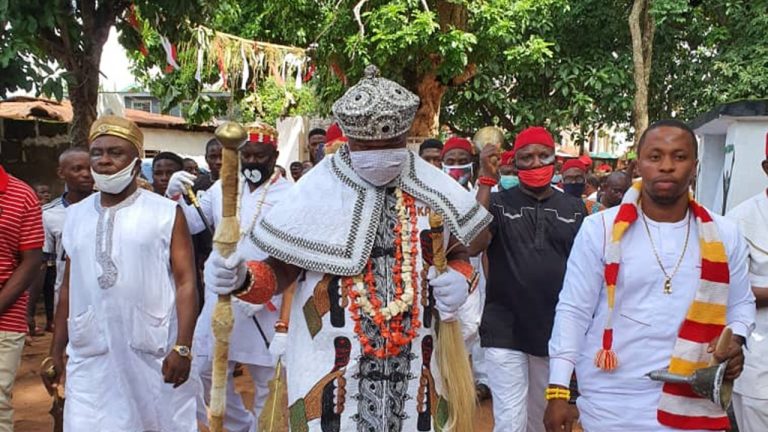
The opposing faction, coalesced around Chief Austin Ndigwe who is acknowledged by segments of Awka society as Eze Uzu III (though he is not certified by the state government), also urged precautions against Covid-19. However, this faction seemed to be more acutely aware of an impression of cultural distancing that might result from a rigid implementation of the state government’s physical distancing order. Chief Ndigwe himself had issued repeated warnings about Covid-19 and even took out a billboard advert to announce the menace of the virus. And yet, on the day of Egwu Imoka grand finale, the chief turned up at the Imoka shrine with members of his alternative cabinet. He was welcomed to the shrine by the youthful Imoka chief priest. He had travelled in a slow motorcade along the crowded Zik Avenue into the arena, in a symbolic show of cultural fraternity with Egwu Imoka celebrants.

Chief Austin Ndigwe, “Eze Uzu III”, on the grounds of Imoka shrine

There were in fact sounds of cannon shots fired at the time of Chief Ndigwe’s arrival at the arena, as if to herald his presence at the occasion. However, the cannon shots were purely coincidental, as Awka Times gathered from the Imoka chief priest, and were not meant to mark Ndigwe’s arrival. The chief priest nevertheless noted that the government-recognized monarch and devout Catholic, Gibson Nwosu, had never entered the Imoka sanctorium.

Awka Times learned that Ndigwe had held celebratory events at his residence on the other days of Egwu Imoka 2020, as he did in previous years. On the day of this year’s grand finale, after visiting the Imoka shrine, he apparently continued the off-arena celebrations.

The divergent actions of the leadership factions reflect the broader tendencies in Awka with regard to the 2020 Imoka festival. There were those who supported the state government’s suspension of the event, concerned with personal health and a potential surge in coronavirus infections. But there were those worried about the health of the community at large, concerned about a potential scourge in the land if the Imoka deity’s apparent wish for the ritual fête was scorned.

In the end, Awka had to navigate these divergent impulses. It carried out the oracular wish of its deity and held the Egwu Imoka event whilst attempting, not always successfully, to follow the state government’s guidelines for Covid-19 containment.

What happens next as a result of the choices made by Egwu Imoka celebrants is up to an invisible virus and a seemingly irrepressible deity.

Adumonye Nwiyi, Ella Okonkwo, Nedu Offodile and Mini Chalas, Awka Times contributor, provided additional photos, videos and reporting for this story

Awka Town Celebrates Day 2 of the 2020 Egwu Imoka Festival in Grand Style But Measured Tone

1

The second-day event of the grand Awka cultural festival, Egwu Imoka, commenced amid ambient uncertainties but it passed off without incident and even ended up, by the accounting of its adherents, an undiluted success. This, despite the prohibitive stance of the Anambra State government against such cultural events due to the risk of coronavirus.

By Chudi Okoye and Ndu Chris Nwannah, ATM Guest Writer, with Stella Nzekwe and Adumonye Nwiyi

Amid a massive overhang of dread and coronavirus-related uncertainties, the adherents of traditional religion in Awka town, the capital of Anambra State, celebrated Day 2 of their three-day annual festival, Egwu Imoka, as scheduled on May 29, 2020. The event took place against the backdrop of a prohibitive stance by the Anambra State government which earlier, on May 10th as the famous Awka festival impended, had issued an order suspending the Awka carnival and all such events, citing the risk of Covid-19 contagion.

Egwu Imoka is a month-long event with three ritual dates calibrated through the Igbo lunar calendar. The first of these important dates is the Umuokpu Day, also known as ‘Okikagba’, when the 32 villages of Awka send a processionary emissary of humans and masquerades (Osonogba) to inform the non-contiguous 33rd village, Umuokpu, that a date has been picked for the annual cultural festival. The remaining major days of the festival are the Opu Eke Day, held on Afor market day and the Masquerade Day, which takes place on Nkwo market day when masquerades engage in transactions. Opu Eke comes four full market days after the Umuokpu Day, while masquerades perform the day after the Opu Eke Day, bringing the ceremony to a concluding climax.

In the wake of the suspension order issued by the Anambra State government, celebrations on the first day of this year’s Egwu Imoka festival, held on May 25th, were inspired but tentative, as adherents tested the rigours and contours of the suspension order.

On the second day of the festival, the Opu Eke Day, security forces were out in significant numbers and the day had started with marked unease, as observed by Awka Times reporters. But the security forces proved unobtrusive; no one was impeded, no one was arrested or challenged. In the end, the second day of Awka town’s Egwu Imoka 2020 sailed off to a resounding success.

The site of the second-day celebrations was the Nkwo Amenyi market square, a hallowed arena located very close to Olulu Imoka, the shrine of the Imoka deity, on to which the deity emerges once in a year to be venerated by the faithful.

The rituals of Opu Eke Day have mythic meaning and are at the core of the Egwu Imoka celebration. Opu Eke is said to epitomize the actual Egwu Imoka celebration, and some believe that without Opu Eke there would be no Egwu Imoka celebration.

Opu Eke is an exclusive preserve of the womenfolk, a day in which the female faithfuls troop out to pay obeisance to the Imoka deity. Awka cultural mythology characterizes Imoka as a female deity and so a day for the women has deep significance.

Opu Eke is a dance for the Imoka deity heralded on the preceding evening of Oye market day to draw attention to the fact that the Opu Eke event is imminent. The drum of Opu Eke continues into the following day, Afor market day, to mark the arrival of Imoka into the scene. The Imoka chief priestess, Eze Nwanyi, usually leads the Opu Eke dance procession.

On this 2020 Opu Eke Day, the female adherents of Egwu Imoka came out in unexpectedly high numbers. They surged forth bedecked in gorgeous costumery, some sporting traditional attires of intricate designs and variegated colours – a blaze of red, white, yellow and other colors. With a throng of onlookers cheering them on, the women worshippers shuffled towards the Imoka shrine performing their mythic dance in a dignified frenzy, the wistful acoustics of the Opu Eke drum carrying them along. Nkwo market square was a beehive of activities, filled with women, men and youths, some watching with bemused curiosity, others regaled by the pageantry, all seemingly unperturbed by the coronavirus menace.

Chief Patrick Nwekemezie Onwudinjo, a native of Amudo village Awka, has been in charge of the delivery of the Opu Eke drums for the past 25 years. He claims that the mastery of the drums was handed down to him by his forebears. He noted that his father was a great friend of Imoka due to his dexterity in the playing of the drums. Speaking further, he stressed that, Opu Eke is the only dance known to Imoka.

“Opu Eke is the only dance performed by Imoka,” Onwudinjo told Awka Times. “The deity is the only one that engages in the dance with women. This is the reason that on the day of Opu Eke, the deity must perform live. Once it performs, the deity withdraws only to come out the next year.”

The acting chief priest of Imoka, Eze Imoka, Mr. Mmaduabuchi Ikegbunem, speaking to Awka Times immediately after the Imoka deity went into recess, also alluded to the fact that Opu Eke is the real day of Imoka celebration. According to him, “without the day, Imoka celebration cannot hold.”

Going down memory lane, the Imoka chief priest said he was unhappy that successive  governments in Anambra State had not made efforts to improve the cultural fortunes of the festival, which he said has huge tourism potential.

As he had told Awka Times previously, Mr. Ikegbunem affirmed that the Anambra State government did not make any effort to reach out to Awka stakeholders before coming out with its statement suspending the annual event. He claimed however that awareness of the risk of Covid-19 meant that measures were put in place to follow government guidelines during the fiesta.

The Eze Imoka reiterated the importance of prayers in the affairs of human beings, asserting that prayers were offered to guard against the spread of coronavirus in the area. He charged celebrants to be law abiding and avoid acts capable of negating the objectives of the ceremony.

The chairman of Egwu Imoka 2020 organizing committee and chairman of Ikolobia Umudioka Village, Mr Anayo Obiakor, told Awka Times that his team was fully cognizant of the global Covid-19 pandemic in planning the ceremony. As he did in an earlier interview with Awka Times, Mr. Obiakor again lamented the failure of the state government to reach out to Awka citizens to fashion a path for the hosting of the programme through observance of standard protocols. He averred that with proper consultations, the community and state government could have taken a decision on how best to go about the event in the most acceptable way, just like markets and churches which the government had allowed to re-open. Mr. Obiakor revealed that his team had made elaborate plans to showcase the rich cultural heritage of Awka to the global community during the 2020 Egwu Imoka festival. But he said due to the Covid-19 pandemic, these planned would be shifted to future years. Nevertheless, he observed that this year’s Egwu Imoka was proving to be successful even with the impediments of the Covid-19 pandemic.

One of the women who participated in the ceremony, Mrs Okechukwu Okoye, an Enugwu-Agidi woman married to Umuzocha village in Awka, also accounted this year’s Opu Eke a huge success and expressed happiness that she had been part of it.

Also, an elderly woman from Ifite Awka, Madam Ifeoma Nwammadu, said the ceremony was of immense benefit to the people of Awka. She prayed for good health upon the people, and urged the youths not to engage in social vices.

Another participant, Ezenwanyi Ukamaka Ibegbunam Nworah from Umbelle village, said she was thrilled with the success of festival, in particular the number of people that graced the occasion. The wife of the late Eze Imoka and mother of the current acting Eze Imoka, Lolo Obioma Ikegbunem, told Awka Times that she was overjoyed for being part of this year’s festival. She said she was full of gratitude to Imoka for the blessings bestowed upon her family. She showered praises on the deity, even as she prayed for more successes. Lolo Ikegbunem underscored the importance of the Opu Eke Day, saying that it was to reverence the deity for the beautiful things it had done for them in past years.

The menfolk were not left out of exhilarations about the festival. Chief Igboemeke Nwammadu, from Agbana Ifite Awka and the treasurer of Otu Omenana Awka, noted in a chat with Awka Times that the festival was an ancient one which had fostered the propagation of Awka cultural heritage.

Another Imoka faithful, Mr. Ifeanyi Nzekwe from Igweogige village Awka, noted that Opu Eke was central to the celebration of Egwu Imoka Awka. According to him, adherents use the occasion to pay homage to the deity. He said the beautiful values of the programme must continue to be preserved to showcase Awka culture to the outside world.

Day 2 of the 2020 edition of Egwu Imoka concluded without any known incident, with government indulging an insistent cultural event whilst seemingly keeping an eye on proceedings. It is to be seen if a similar accommodation will attend the grand finale of the Egwu Imoka pageant which is an altogether more boisterous affair.